
A Node.js library and command-line script that converts Microsoft Edge collections into a bookmarks file. It reads the Edge collectionsSQLite database from a provided path and generates an HTML bookmark file that can be imported by other browsers.
Directory
Search results
Published directory entries matching your search.
Pix2pix implementation in keras. The repository provides code to download the facades dataset, install requirements, and start training, and it references the original Image-to-Image Translation with Conditional Adversarial Networks paper.
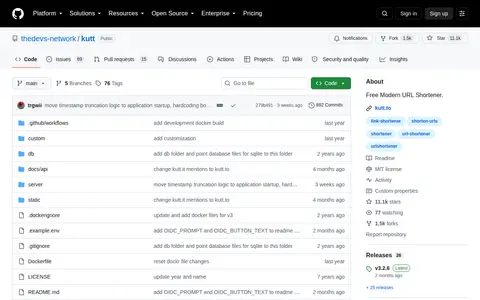
Kutt is a self-hosted URL shortener with custom domain support. It allows creating and editing links, setting custom URLs, passwords and expiration times, viewing statistics, and managing users. It supports SQLite, Postgres and MySQL databases, OpenID Connect login and a RESTful API.
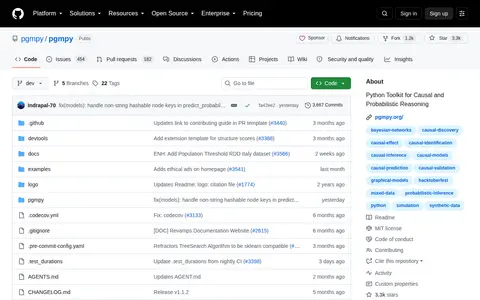
pgmpy is a Python toolkit for causal and probabilistic reasoning using graphical models. It implements data structures for models such as DAGs, PDAGs, MAGs, PAGs, Bayesian Networks, Dynamic Bayesian Networks and Structural Equation Models, with algorithms for tasks including causal discovery, causal identification, inference, model validation, parameter estimation and simulations. Algorithms follow a unified composable API and are scikit-learn compatible when possible. It is available on PyPI and conda.
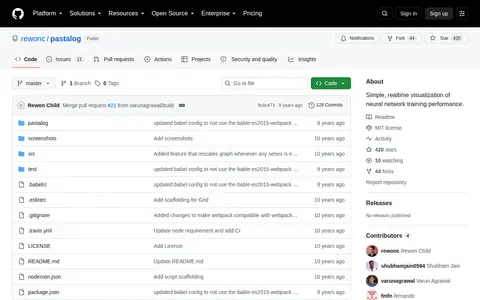
Pastalog is a realtime visualization server for neural network training performance. It works with Lasagne, Keras, Tensorflow, Torch, Theano and other frameworks. Data can be logged through a Python API, a Torch wrapper, or POST requests, and logged metrics update in real time at localhost.
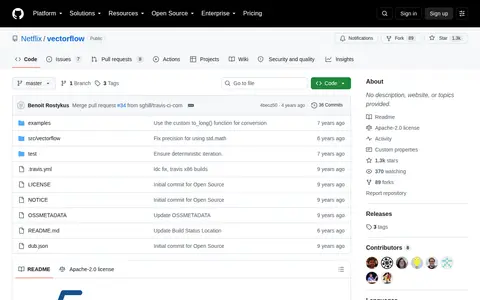
Minimalist neural network library optimized for sparse data and single machine environments.
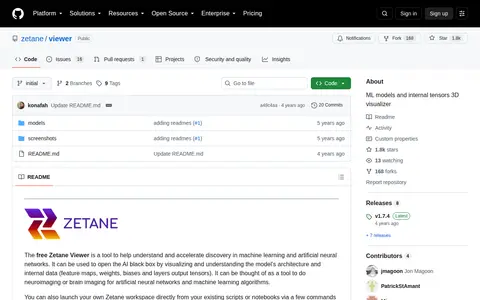
Zetane Viewer is a free tool for visualizing machine learning and artificial neural network models, including architecture and internal data such as feature maps, weights, biases and layer output tensors. The viewer supports .ONNX and .ZTN files and is available for Windows, Linux and Mac. It can also be launched from existing scripts or notebooks via the Zetane Python API.
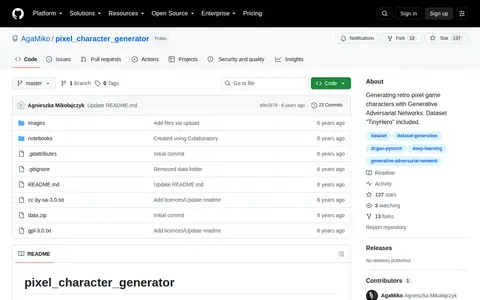
A GitHub repository for generating retro pixel game characters with generative adversarial networks. It includes the TinyHero dataset of 64x64 pixel characters generated from the Universal LPC spritesheet, with 3648 images. Notebooks cover a DCGAN based on the PyTorch tutorial, a conditional DCGAN and a deep convolutional autoencoder. Art is dual licensed under GPL 3.0 and CC-BY-SA 3.0.

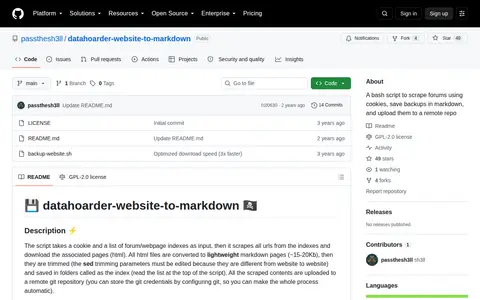
datahoarder-website-to-markdown is an open source project with code, documentation, and setup resources for web archiving and scraping.
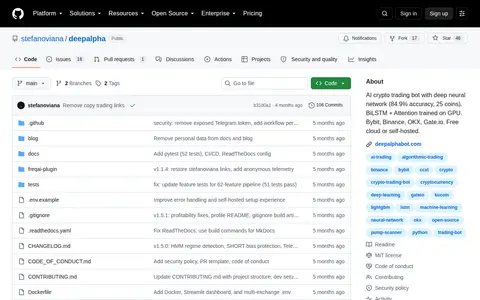
DeepAlpha is an AI-powered cryptocurrency trading bot that uses a deep neural network combining BiLSTM and attention mechanisms, trained on GPU. It supports 25 coins with a reported 84.9% accuracy rate, integrates with Bybit, Binance, OKX, and Gate.io exchanges, and is available as a free cloud or self-hosted service.
TabGAN is a software project hosted on GitHub under the Diyago/Tabular-data-generation repository. It focuses on the application of generative adversarial networks (GANs) to tabular data generation, reviewing and analyzing recent research and practical implementations in this field.
Changd is an open source, self-hosted web monitoring application and a free alternative to SaaS-based solutions. It monitors visual site changes using differential screenshots, XPath expressions or data returned from API endpoints. The frontend uses TypeScript, React and AntD, the backend runs on Node.js, and data is persisted in a Postgres database.
Project that automatically maps relationship networks by parsing public data using LLMs and visualizes it as an interactive graph.
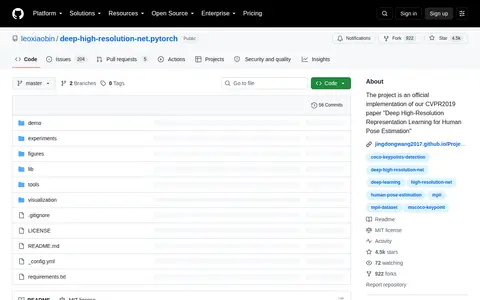
Official PyTorch implementation of the CVPR 2019 paper on deep high-resolution representation learning for human pose estimation. The network maintains high-resolution representations through the whole process and connects multi-resolution subnetworks in parallel with repeated multi-scale fusions. Results are reported on the COCO keypoint detection dataset and the MPII Human Pose dataset.
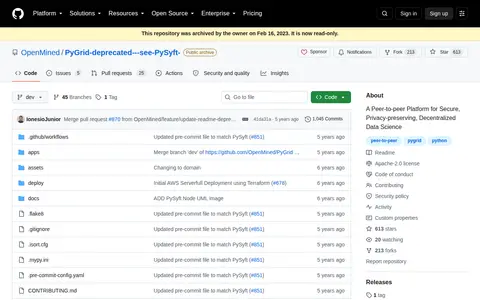
Peer-to-peer network of data owners and data scientists who can collectively train AI models using PySyft.
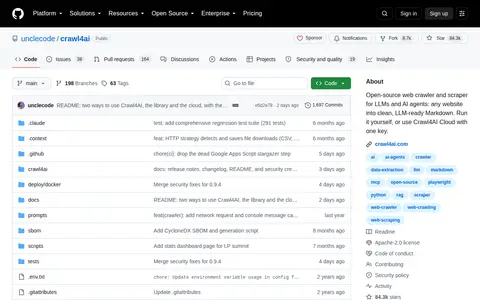
Open source web crawler built for extracting clean website data for AI and LLM workflows.
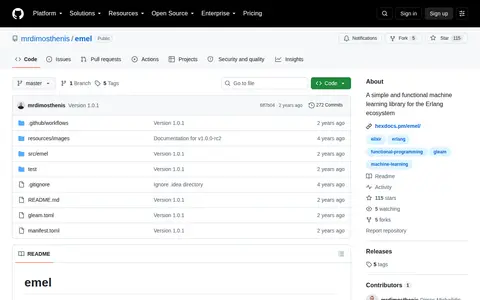
emel is a simple and functional machine learning library built for the Erlang ecosystem and implemented in Gleam. It turns data into functions and supports installing through rebar.config, mix.exs or gleam add. Implemented algorithms include linear regression, k nearest neighbors, decision tree, naive Bayes, k means, perceptron, logistic regression and neural network, along with mathematics, algebra, geometry and statistics.
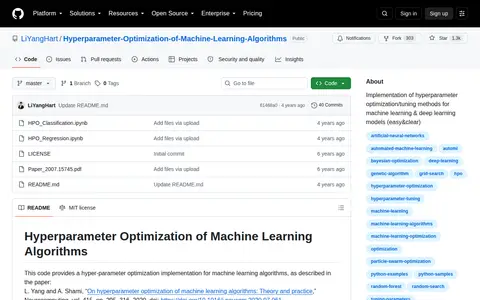
This repository provides a hyperparameter optimization implementation for machine learning algorithms, accompanying a paper on hyperparameter optimization theory and practice. It includes sample code for regression and classification problems using the Boston-Housing and MNIST datasets, covering algorithms such as random forest, SVM, KNN and artificial neural networks.
Libre Hardware Monitor is free software that monitors temperature sensors, fan speeds, voltages, load and clock speeds of a computer. It includes a Windows Forms application presenting data in a graphical interface and a library for use in other applications. It reads information from motherboards, processors, graphics cards, storage drives and network cards. Some sensors require administrator privileges.
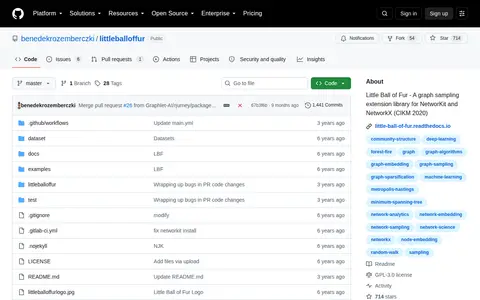
Little Ball of Fur is a graph sampling extension library for Python and a graph sampling extension library for NetworKit and NetworkX. It consists of methods that can sample from graph structured data, covering vertex, edge, and exploration sampling techniques with a unified application public interface.
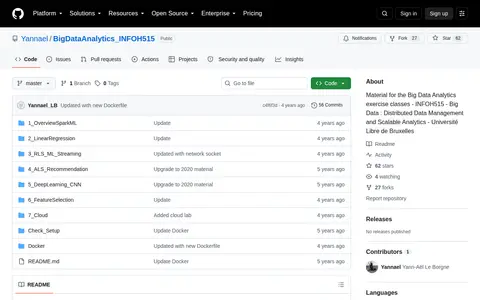
A repository of material for the exercise classes of a Big Data Analytics master course. Hands-on sessions cover Spark and its machine learning library, Map/Reduce implementations of linear regression and alternating least squares, streaming analytics with Recursive Least Squares, and image classification with convolutional neural networks. Material is provided as Jupyter notebooks.
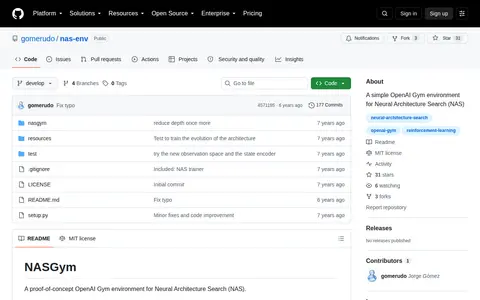
NASGym is a proof-of-concept OpenAI Gym environment for Neural Architecture Search. It implements reinforcement learning steps for NAS and encodes networks using the Neural Structure Code from BlockQNN. A network is modeled as a list of NSCs, an action adds a layer, and the reward is accuracy after early-stop training. CIFAR-10 is the default dataset. The code and documentation may contain minor bugs.
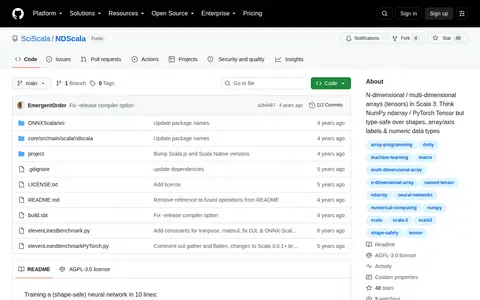
NDScala is a Scala 3 library for N-dimensional and multi-dimensional arrays (tensors), described as comparable to NumPy ndarray or PyTorch Tensor, with type safety over shapes, array and axis labels and numeric data types. The repository includes materials on shape-safe neural network training and an ONNXScala component.
NeuroNER is a program that performs named-entity recognition using neural networks. It relies on Python 3 and TensorFlow 1.0+, optionally uses the BRAT annotation tool, and provides installation instructions, sample datasets and pretrained models.