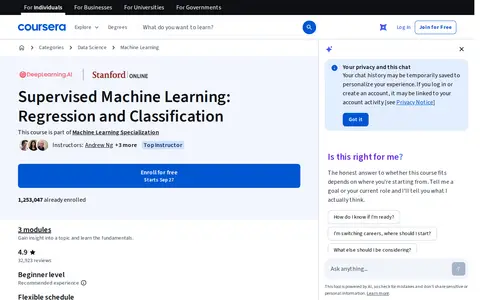

Andrew Ng’s Machine Learning at Stanford University is a Coursera course titled 'Supervised Machine Learning: Regression and Classification'. It is the first course of the Machine Learning Specialization. The course teaches how to build machine learning models in Python using NumPy and scikit-learn, covering regression and classification. It is aimed at beginners, requires flexible scheduling over three weeks at ten hours per week, and offers a shareable certificate.
Directory
Search results
Published directory entries matching your search.
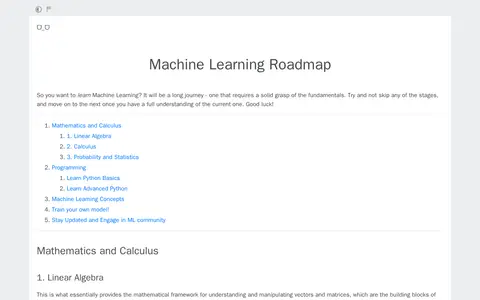
A staged learning roadmap for machine learning that covers mathematics and calculus, programming, and machine learning concepts. It advises moving to the next stage only after fully understanding the current one. The mathematics section covers linear algebra, calculus, and probability and statistics, and the programming section covers Python basics and advanced Python.

Machine Learning Mastery is a website that provides educational content such as tutorials, quick start guides, and eBooks to help developers learn and apply machine learning concepts and algorithms. It covers topics like deep learning, computer vision, natural language processing, and specific libraries including TensorFlow, PyTorch, and scikit-learn.
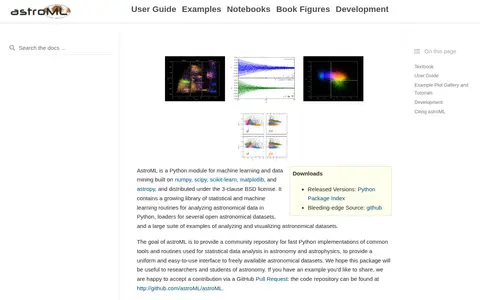
astroML is a Python module for machine learning and data mining built on numpy, scipy, scikit-learn, matplotlib and astropy, distributed under the 3-clause BSD license. It provides statistical and machine learning routines for analyzing astronomical data, loaders for open astronomical datasets, and examples of analyzing and visualizing datasets. The project was started in 2012 to accompany a textbook on statistics, data mining and machine learning in astronomy.
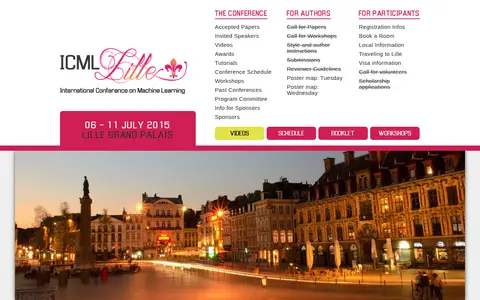
ICML is an international machine learning conference supported by the International Machine Learning Society. The 32nd International Conference on Machine Learning, ICML 2015, was held in Lille, France, on July 6 to July 11, 2015, with tutorials, a main conference and workshops.
Machine Learning – Software Engineering Daily provides machine-learning models, research, training resources, or evaluation tools.
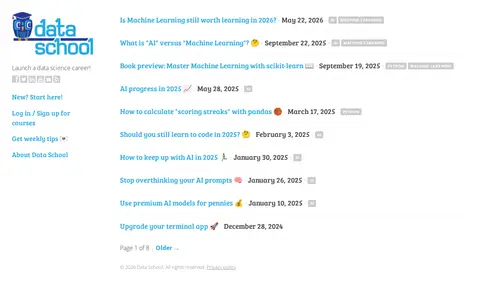
Data School is a blog about data science and machine learning. Its posts cover topics such as the difference between AI and machine learning, learning scikit-learn, AI progress, and using pandas for calculations. Posts are tagged by subject including Python, AI, and machine learning.
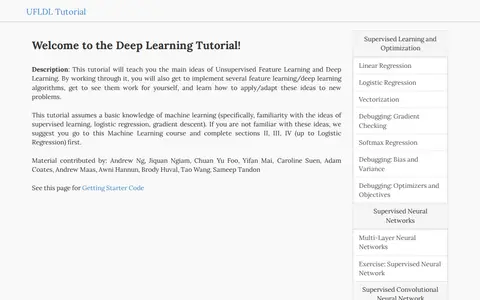
Tutorial teaching the main ideas of unsupervised feature learning and deep learning, with implementation of feature learning and deep learning algorithms. It assumes basic machine learning knowledge, including supervised learning, logistic regression and gradient descent, and suggests completing an earlier machine learning course first.
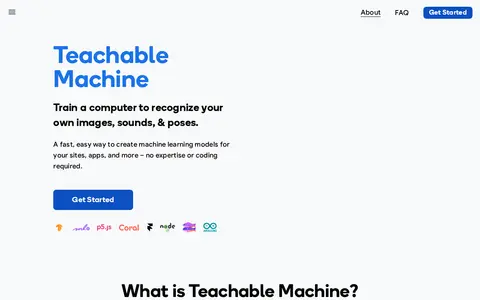
Teachable Machine provides machine-learning models, research, training resources, or evaluation tools.
Machine Learning ka Chilla is a video resource with tutorials, demonstrations, reviews, or related media.
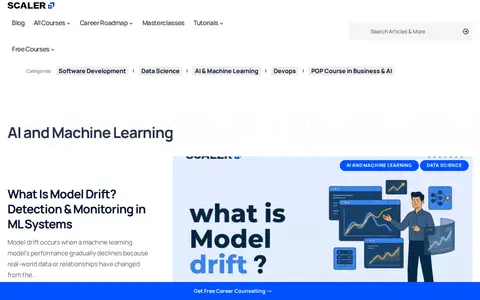
This is a Scaler blog category page collecting articles on artificial intelligence and machine learning. Posts listed include MLOps projects, becoming an AI research scientist, model drift detection and monitoring, and retrieval-augmented generation evaluation metrics. The page also links to categories such as software development and data science, and offers career counselling.
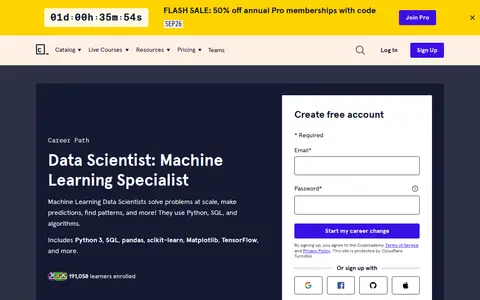
Codecademy's Data Scientist: Machine Learning Specialist Career Path is a beginner-level course covering Python 3, SQL, pandas, scikit-learn, Matplotlib, and TensorFlow. The path is listed as taking 95 hours on average and includes 59 projects with no prerequisites, and is described as teaching analysis of data, drawing predictions with machine learning, and building neural networks.
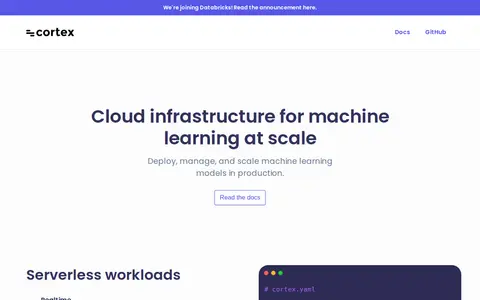
Cortex is cloud infrastructure for machine learning at scale, used to deploy, manage and scale machine learning models in production. It supports realtime, async and batch serverless workloads, along with automated cluster management including cluster autoscaling and spot instances with on-demand backups. Environments, provisioning and CI/CD and observability integrations are also listed. A notice states the project is joining Databricks.
Data Science at Home is a podcast about machine learning, artificial intelligence, and algorithms. The site describes it as among the top AI and machine learning podcasts in the world and notes that industry leaders have sponsored its initiative.
Helps find, analyze or synthesize information for research and knowledge discovery.
Humanity's Last Machine is an educational resource for documentaries, courses, books, reference material, or self-learning.
A blog by Louis Dorard offering practical advice on applying machine learning. Posts cover the Machine Learning Canvas, the Prediction Task Canvas, an investor's approach to ML projects, choosing machine learning APIs, and trusting AI with important decisions.
Apache Mahout builds an environment for quickly creating scalable, performant machine learning applications. Its current work centers on quantum machine learning in Python, with Qumat, a high-level library for writing quantum circuits once and running them on supported backends, and QDP, a GPU-accelerated engine that turns classical data into quantum states. The earlier Mahout Classic codebase is in maintenance mode.
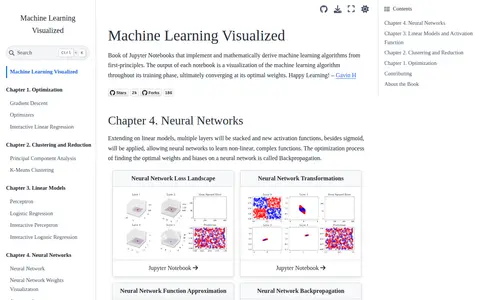
Machine Learning Visualized is a book of Jupyter Notebooks that implement and mathematically derive machine learning algorithms from first principles. Each notebook's output is a visualization of the algorithm during training, converging at its optimal weights. Chapters cover optimization, clustering and reduction, linear models and activation functions, and neural networks.
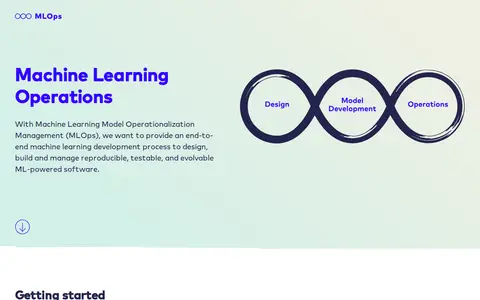
ML-Ops is a site about Machine Learning Operations. It covers motivation for MLOps, designing ML-powered software, the end-to-end ML workflow lifecycle, three levels of ML-based software, MLOps principles, CRISP-ML(Q), the MLOps Stack Canvas and ML model governance. It describes MLOps as aiming to unify the release cycle for machine learning and software.
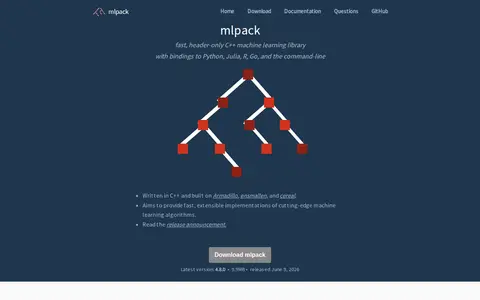
mlpack is a header-only C++ machine learning library with bindings to Python, Julia, R, Go, and the command line. It is built on Armadillo, ensmallen, and cereal and provides implementations of machine learning algorithms. The documentation lists classification, regression, clustering, and preprocessing facilities. It is open source under the 3-clause BSD license.
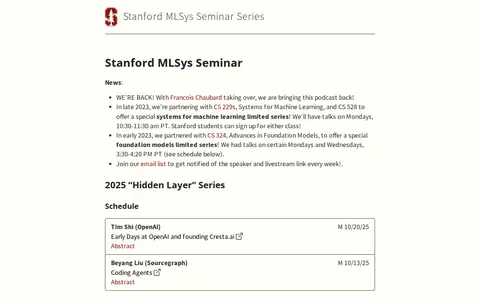
Stanford MLSys Seminar Series is a seminar series on the frontier of machine learning and systems. Its 2025 "Hidden Layer" series schedule lists talks, and earlier limited series covered systems for machine learning and foundation models. Stanford students could sign up for associated classes, and an email list provides speaker and livestream notifications.
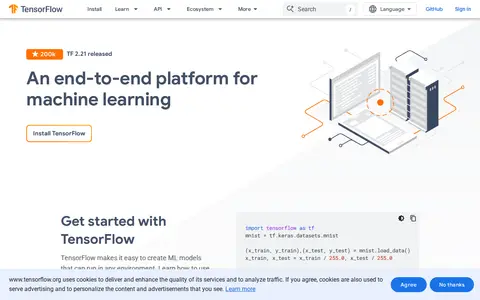
TensorFlow is an end-to-end open source machine learning platform. It provides a flexible ecosystem of tools, libraries, and community resources for machine learning development, including libraries for web, mobile, edge, and production ML pipelines, as well as pre-trained models, datasets, and educational resources for users.
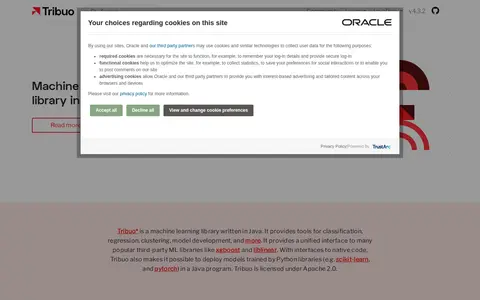
Tribuo is a machine learning library written in Java, developed by Oracle Labs' Machine Learning Research Group and released under the Apache 2.0 license. It supports classification, regression, clustering, anomaly detection and multi-label classification, and provides interfaces to libraries such as XGBoost and TensorFlow along with ONNX model exchange support.