github.com
Open-source project that provides machine-learning models, research, training resources, or evaluation tools.
Directory
Published directory entries matching your search.
Open-source project that provides machine-learning models, research, training resources, or evaluation tools.

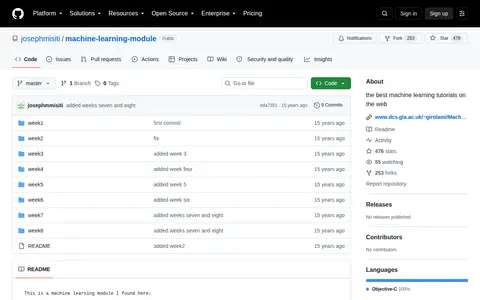
Machine Learning Module is a GitHub repository that claims to host the best machine learning tutorials on the web. It invites contributions from the community and serves as a collection of learning resources for machine learning.

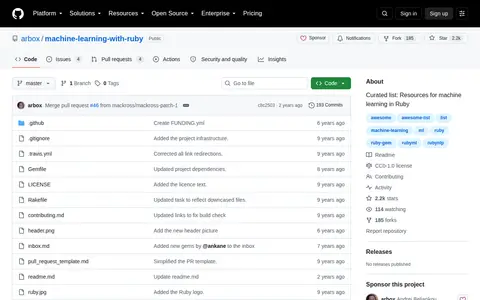
Awesome Machine Learning with Ruby is a GitHub-hosted curated list of resources for machine learning development using the Ruby programming language. It includes tutorials and machine learning libraries for Ruby users.

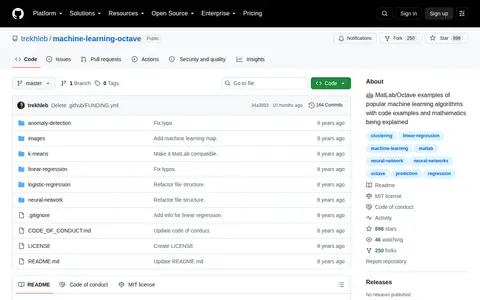
Machine Learning in MatLab/Octave is a collection of MatLab/Octave implementations of popular machine learning algorithms, including code examples and explanations of the associated mathematics. It covers supervised learning tasks such as regression and classification as well as unsupervised learning.

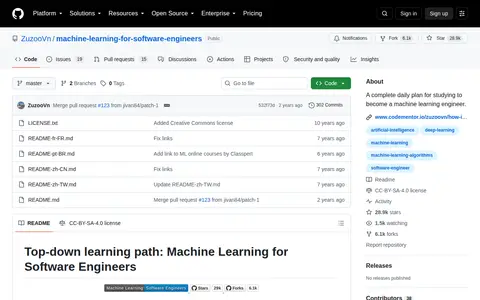
Machine Learning for Software Engineers is a study resource that provides a complete daily study plan for software engineers seeking to become machine learning engineers, structured as a top-down learning path.
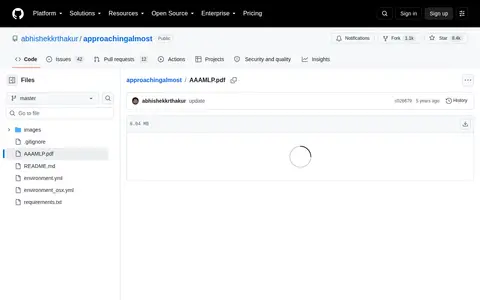
Approaching (Almost) Any Machine Learning Problem is a GitHub repository or organization with source code, releases, documentation, or project.

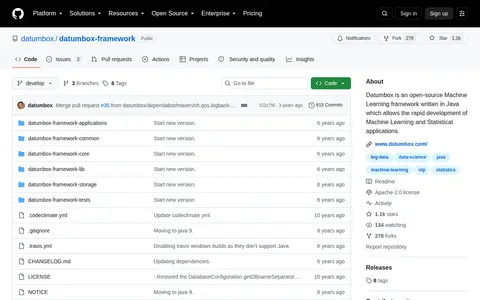
Datumbox is an open-source machine learning framework written in Java for rapid development of machine learning and statistical applications. It focuses on including many machine learning algorithms and statistical methods and on handling large datasets. The code is licensed under the Apache License, Version 2.0, and releases are available on Maven Central, including version 0.8.2.

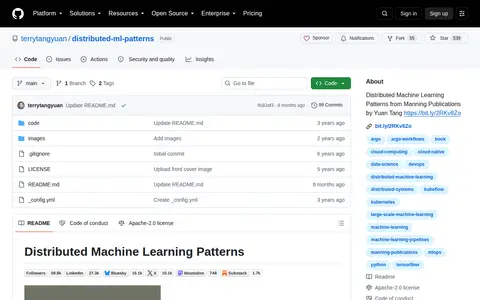
Repository containing references and code for the book Distributed Machine Learning Patterns from Manning Publications by Yuan Tang. The book covers applying patterns to build scalable and reliable machine learning systems, constructing pipelines with data ingestion, distributed training and model serving, and automating tasks with Kubernetes, TensorFlow, Kubeflow and Argo Workflows.

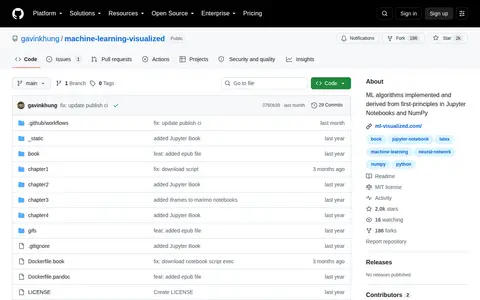
Machine Learning Visualized is a GitHub repository or organization with source code, releases, documentation, or project resources.

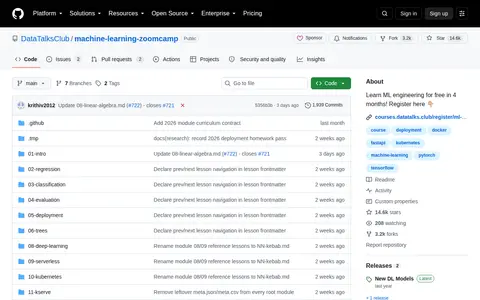
Machine Learning Zoomcamp is a free, hands-on course on building, evaluating, and deploying machine learning systems. It covers the path from framing a problem to preparing data, training and evaluating models, and deploying them, using Python, scikit-learn, TensorFlow, PyTorch, FastAPI, Docker, Kubernetes and AWS Lambda. No prior machine learning experience is required.
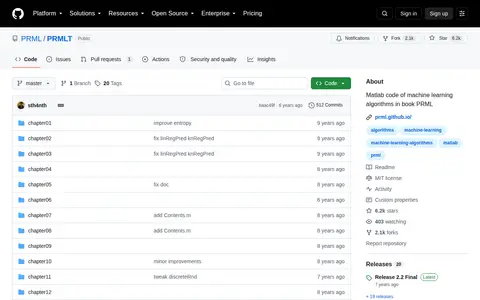
A Matlab package implementing machine learning algorithms described in the textbook Pattern Recognition and Machine Learning by C. Bishop. It is written purely in Matlab and is self-contained with no external dependency.

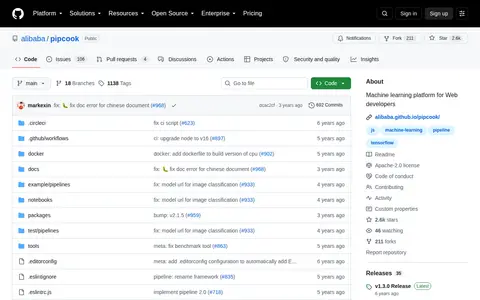
Pipcook is a JavaScript application framework for machine learning and its engineering, aimed at Web developers. It provides subprojects including a machine learning pipeline framework, management tools and a JavaScript runtime for machine learning. A Pipcook Pipeline composes scripts and outputs an NPM package containing the trained model and JavaScript functions. The documentation describes a workflow of install, train, test and deploy using the Pipcook command-line tool.
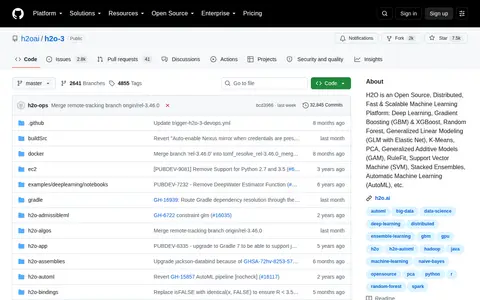
H2O is an open-source, distributed, fast, and scalable machine learning platform hosted on GitHub by the h2oai organization. It supports a wide range of machine learning methods including deep learning, gradient boosting, random forest, generalized linear modeling, clustering, dimensionality reduction, rule fitting, support vector machines, stacked ensembles, and automated machine learning.
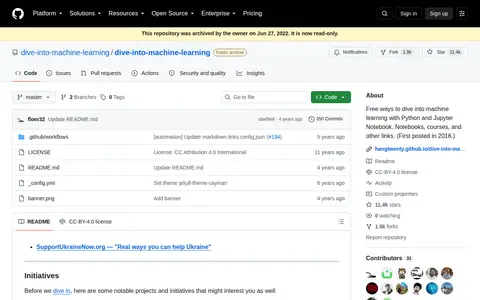
Archived, read-only GitHub repository of free resources for learning machine learning with Python and Jupyter Notebook, including notebooks, courses and other links. It was first posted in 2016 and was archived by the owner on Jun 27, 2022.

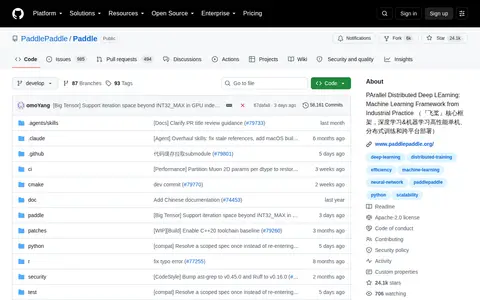
PaddlePaddle is an open-source parallel distributed deep learning framework developed from industrial practice, designed for high-performance single-machine and distributed training, as well as cross-platform deployment of deep learning and machine learning models.

Open-source project that provides machine-learning models, research, training resources, or evaluation tools.

Open-source project that provides machine-learning models, research, training resources, or evaluation tools.

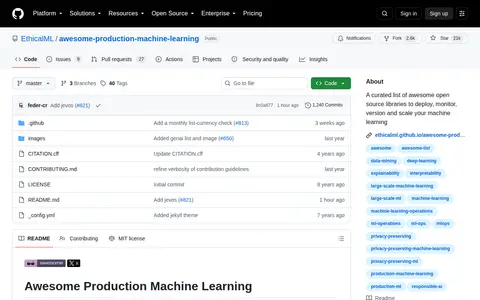
Curated list of awesome open source libraries to deploy, monitor, version and scale your machine learning.

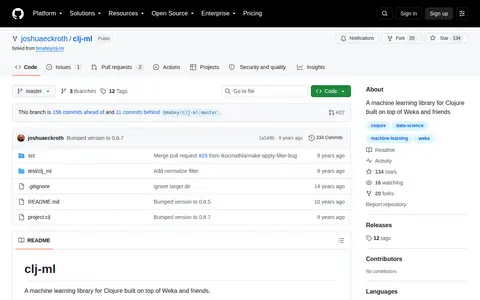
clj-ml is an open-source machine learning library for the Clojure programming language, built on top of the Weka framework and associated tools. It is hosted as a public repository on GitHub, with installation guides for Clojars and Maven, and supports a range of machine learning algorithms.

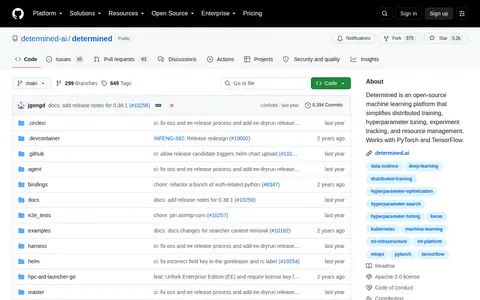
Determined is an open-source machine learning platform that simplifies distributed training, hyperparameter tuning, experiment tracking, and resource management. It works with PyTorch and TensorFlow, offering a Python library, command line interface, and web UI for managing machine learning workflows.

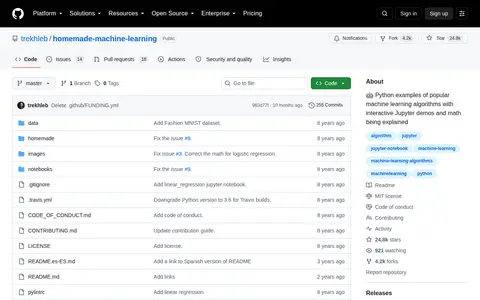
Python examples of popular machine learning algorithms with interactive Jupyter demos and math being explained.
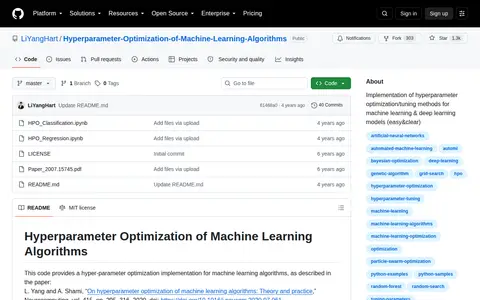
This repository provides a hyperparameter optimization implementation for machine learning algorithms, accompanying a paper on hyperparameter optimization theory and practice. It includes sample code for regression and classification problems using the Boston-Housing and MNIST datasets, covering algorithms such as random forest, SVM, KNN and artificial neural networks.

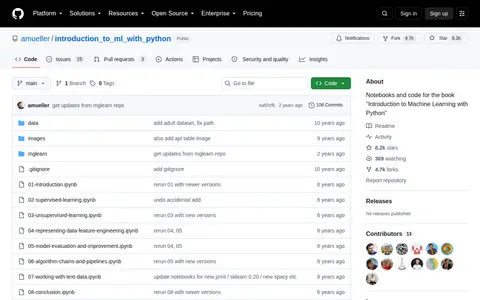
A GitHub repository holding the notebooks and code for the book "Introduction to Machine Learning with Python" by Andreas Mueller and Sarah Guido, together with the mglearn library of helper functions for figures and datasets. The book requires scikit-learn 0.20.0, and the code also needs numpy, scipy, matplotlib, pandas and pillow.

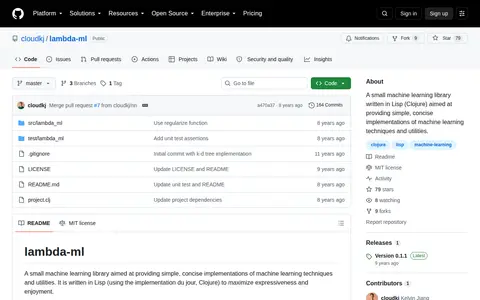
lambda-ml is a small machine learning library written in Lisp, specifically Clojure, aimed at simple, concise implementations of machine learning techniques and utilities. It covers supervised algorithms such as neural networks, decision trees, ensemble methods, k-nearest neighbors, linear and logistic regression, naive Bayes and random forest, plus unsupervised methods including DBSCAN, hierarchical clustering, k-means and non-negative matrix factorization.