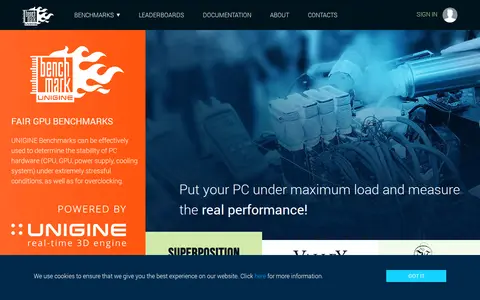

UNIGINE Benchmarks are performance benchmarks by UNIGINE that put a PC under maximum load to measure real performance. The site states they can be used to determine stability of CPU, GPU, power supply and cooling under stressful conditions and for overclocking. Benchmarks support Windows, Linux and macOS with DirectX and OpenGL. A free Basic edition and a Professional edition are offered.
Directory
Search results
Published directory entries matching your search.
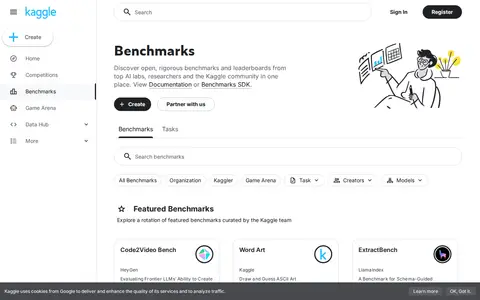
Kaggle Benchmarks is a Kaggle feature that allows the AI research community to build, run, and share benchmarks for evaluating artificial intelligence models and agents. All benchmarks are crowdsourced by the global AI research community.
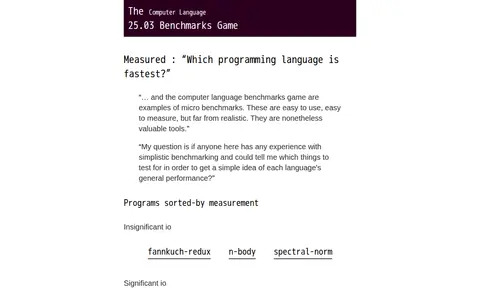
Benchmarks Game is a developer resource for coding, documentation, communities, security research, or software tools.
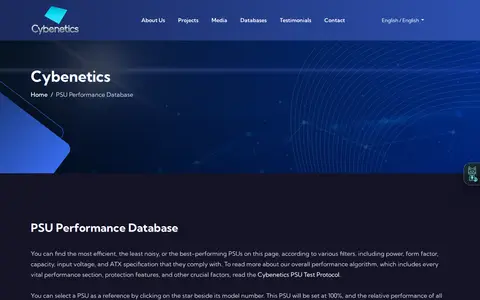
Cybenetics PSU Benchmarks is a curated directory or link collection for discovering useful websites, tools, and resources.
Human Benchmark is a miscellaneous web resource for discovery, directories, archives, web culture, or useful tools.
Open Benchmarking is a miscellaneous web resource for discovery, directories, archives, web culture, or useful tools.
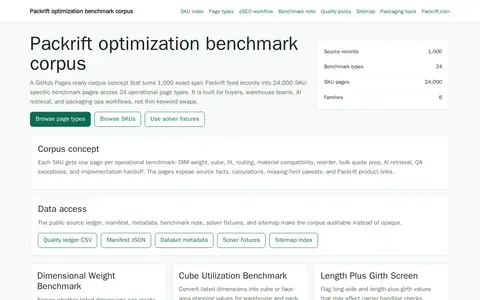
The Packrift Packaging Optimization Benchmark Corpus is a publicly available dataset generated from 1,000 exact-spec Packrift feed records, containing 24,000 SKU-specific benchmark pages across 24 operational page types for packaging optimization workflows, with public source ledgers, manifests, metadata, and solver fixtures to support auditability.
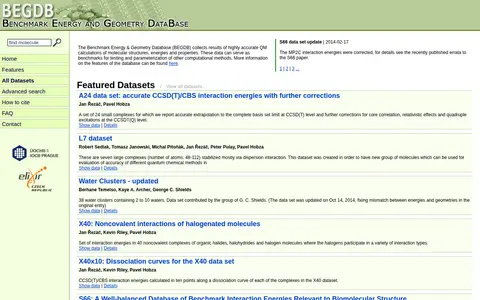
The Benchmark Energy & Geometry Database collects results of highly accurate quantum mechanical calculations of molecular structures, energies and properties. These data serve as benchmarks for testing and parameterizing other computational methods. Featured datasets include interaction energies and dissociation curves for noncovalent complexes.
CodSpeed provides continuous performance testing for CI. It runs benchmarks in the CI pipeline, reports regressions in pull requests, and offers autonomous performance optimization. A documentation quickstart describes connecting a repository and setting up benchmarks, either through an automated wizard or manual configuration, including plugins for languages such as Python and C++.
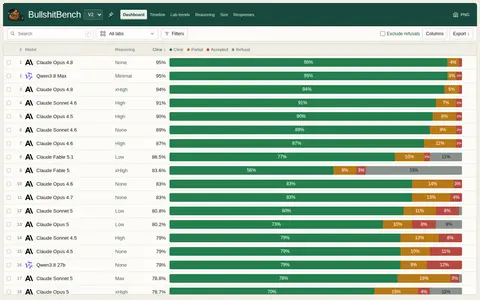
LLMs Bullshit Benchmark provides machine-learning models, research, training resources, or evaluation tools.
MacGamingDB is a compatibility database for games on macOS and Apple Silicon. It reports Apple Silicon benchmarks for M1–M4 and lists FPS results through Rosetta, CrossOver, Parallels and GPTK. The site presents real-world benchmarks and FPS reports for games on modern Macs.
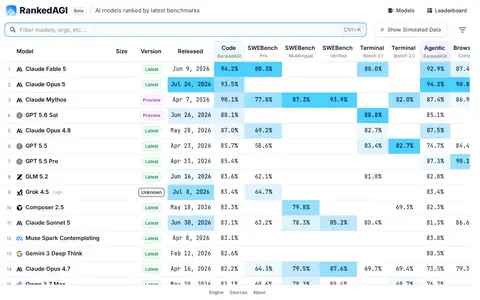
RankedAGI is a website that compares benchmarks across different AI models. It features benchmarks such as SWE Bench Verified, Codeforces, LMSYS and LiveBench, and presents a ranked table of models with size, version, release date, context length, cutoff knowledge, license and organization.
The SEAL LLM Leaderboard is a resource from Scale Labs that provides expert-driven benchmarks and updated rankings for large language models. It evaluates capabilities including agentic coding, frontier reasoning, and safety alignment, with over 20 benchmarks and assessments of more than 100 models from leading AI labs and open-source contributors.
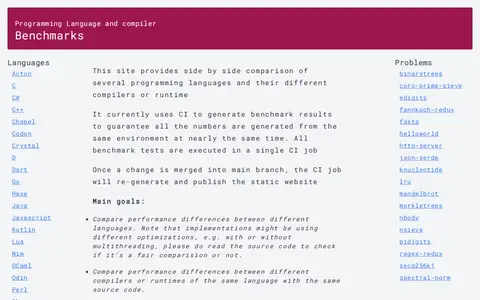
A site offering side-by-side comparisons of programming languages and their compilers or runtimes. Benchmark tests are executed in a single CI job, and the static website is regenerated once a change is merged into the main branch. It aims to compare performance differences between languages and between compilers or runtimes of the same language.
MathNet is a free dataset and benchmark of 30,676 Olympiad-level math problems with solutions, spanning 47 countries, 17 languages and two decades of competitions. It supports problem solving, math-aware retrieval and retrieval-augmented problem solving.
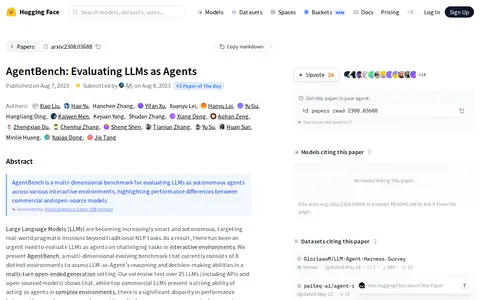
AgentBench is a multi-dimensional benchmark that consists of 8 distinct environments for evaluating LLMs as autonomous agents in interactive tasks. It assesses reasoning and decision-making abilities in multi-turn open-ended generation, and tests over 25 LLMs including APIs and open-source models.
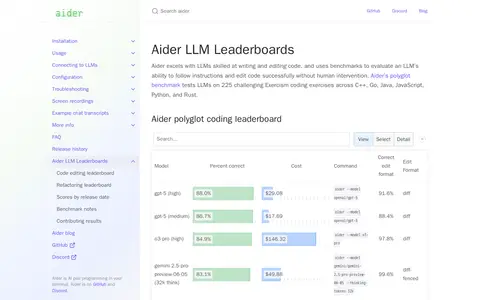
Aider LLM Leaderboards presents quantitative benchmarks of LLM code editing skill. The polyglot benchmark tests LLMs on 225 Exercism coding exercises in C++, Go, Java, JavaScript, Python and Rust, and benchmarks evaluate an LLM's ability to follow instructions and edit code without human intervention.
Arena is a platform that provides leaderboards to compare and benchmark leading frontier AI models across text, image, vision, and other modalities. Its rankings are powered by real user sessions from a global user base, it tracks new model releases, and offers features including live agent sessions, side-by-side model comparison, and user voting for model performance.
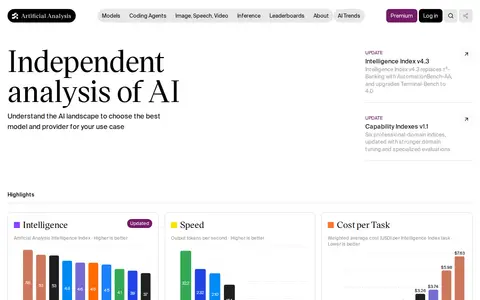
Artificial Analysis provides comparison and analysis of AI models and API hosting providers. It offers independent benchmarks across performance metrics including quality, price, output speed and latency, along with an intelligence index and cost-per-task measures.
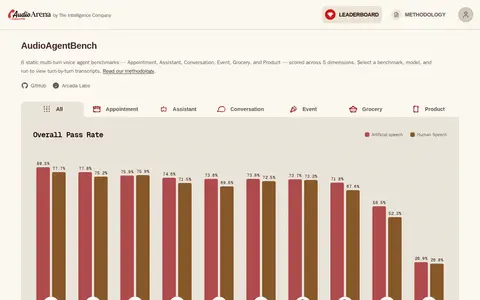
AudioArena is a site for benchmarking and comparing voice models through real conversations. It offers AudioAgentBench, a set of six static multi-turn voice agent benchmarks, scored across five dimensions, and lets users select a benchmark, model, and run to view turn-by-turn transcripts.
A Towards Data Science article by Hui Wen Goh evaluating popular hallucination detectors, including G-eval, Ragas and the Trustworthy Language Model, across four public RAG datasets. Using AUROC and precision/recall, it reports how well the methods automatically flag incorrect LLM responses in retrieval-augmented generation systems.
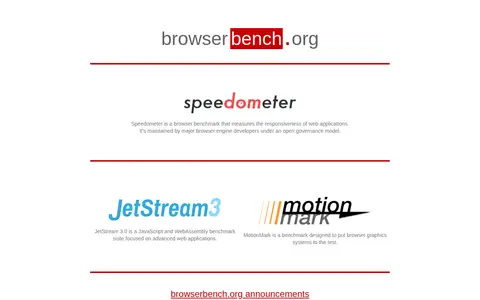
BrowserBench.org hosts browser benchmarks. Speedometer measures the responsiveness of web applications and is maintained by major browser engine developers under an open governance model. JetStream 3.0 is a JavaScript and WebAssembly benchmark suite focused on advanced web applications. MotionMark tests browser graphics systems.
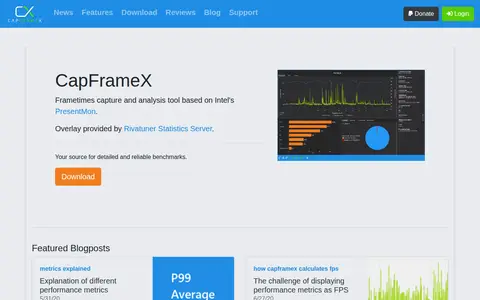
CapFrameX is a benchmarking tool based on Intel's PresentMon that records frames per second, frametimes and sensor measurements while a game runs. It provides overlays via RivaTuner Statistics Server and offers analysis features such as graphs, percentiles and aggregation of runs, plus a cloud service for sharing results.
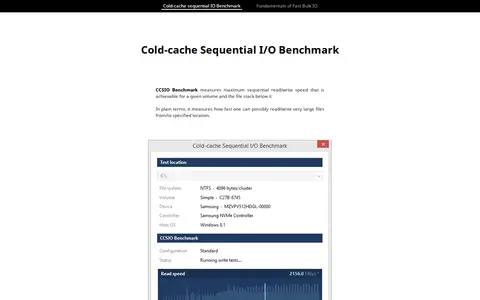
CCSIO Benchmark is a Windows tool that measures the maximum sequential read/write speed achievable for a volume and the file stack beneath it. It cycles through combinations of IO buffer count, buffer size and caching mode to find the combination delivering the highest throughput. It can assess local drives, remote network shares and virtual devices such as RAM disks and encrypted file containers.