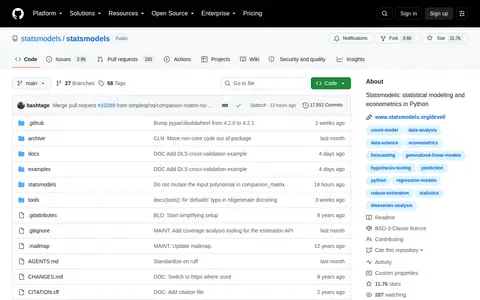
Statsmodels is a Python package that complements scipy for statistical computations, including descriptive statistics and estimation and inference for statistical models. It provides linear regression models, generalized linear models, discrete models, time series analysis, survival analysis, multivariate methods and a range of statistical tests.
Directory
Search results
Published directory entries matching your search.
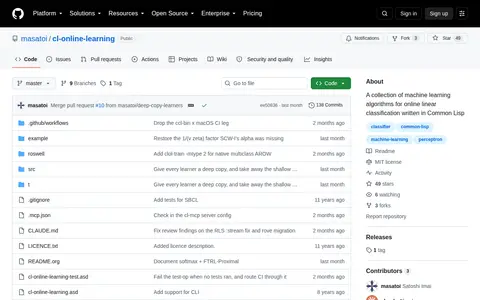
cl-online-learning is a Common Lisp library collecting machine learning algorithms for online linear classification. It implements binary classifiers including Perceptron, AROW, SCW-I, logistic regression with SGD or ADAM, and FTRL-Proximal, plus multiclass approaches such as one-vs-rest, one-vs-one, multiclass AROW and softmax with FTRL-Proximal. Command line tools are provided as a roswell script, and the package is available from Quicklisp.
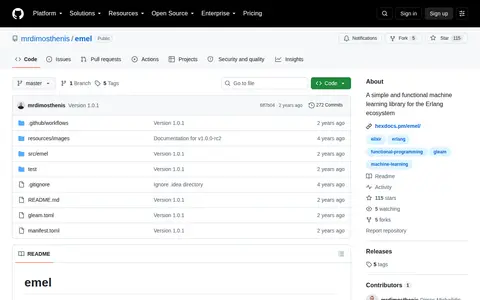
emel is a simple and functional machine learning library built for the Erlang ecosystem and implemented in Gleam. It turns data into functions and supports installing through rebar.config, mix.exs or gleam add. Implemented algorithms include linear regression, k nearest neighbors, decision tree, naive Bayes, k means, perceptron, logistic regression and neural network, along with mathematics, algebra, geometry and statistics.
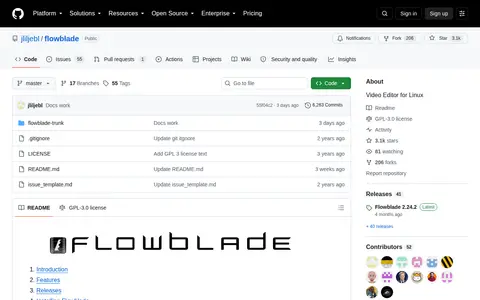
Flowblade is a multitrack non-linear video editor for Linux released under the GPL 3 license. Movies can be composed from video clips, audio clips and graphics files, with clips cut at desired frames, filters added, and multilayer composite images created using compositor objects. It offers editing tools, image and audio filters, and output encoding.
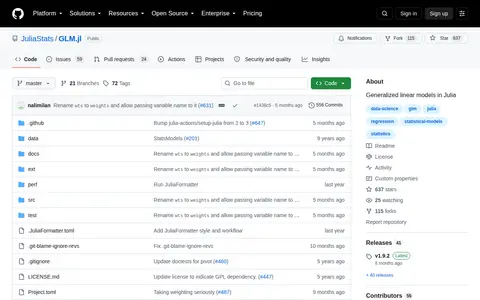
Generalized linear models in Julia.
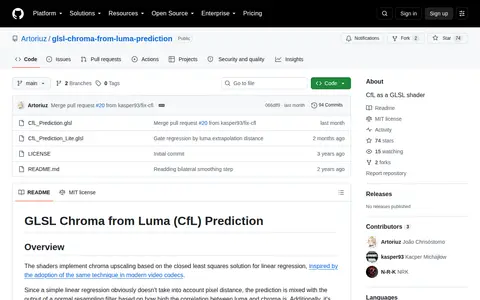
This repository contains GLSL shaders for Chroma from Luma prediction, implementing chroma upscaling based on a closed least squares solution for linear regression. Predictions are mixed with a normal resampling filter and smoothed with a bilateral filter. Settings control which regressions are used and the smoothing step, and a lite variant offers better performance at some quality cost.
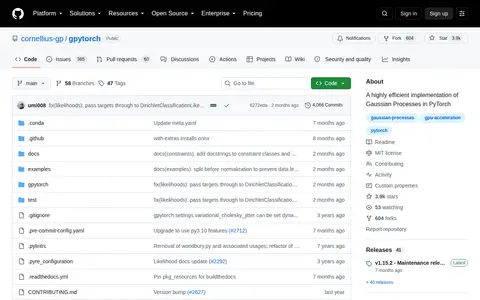
GPyTorch is a Gaussian process library implemented using PyTorch, designed for creating scalable, flexible, and modular Gaussian process models. It performs most inference operations using numerical linear algebra techniques such as preconditioned conjugate gradients, and provides GPU acceleration through matrix-vector-multiplication-based inference. Installation requires Python 3.10 or later, PyTorch 2.4.1 or later, and NumPy 2.0 or later.
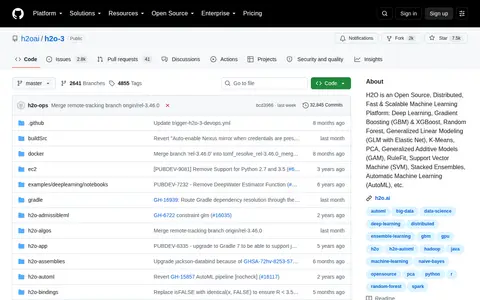
H2O is an open-source, distributed, fast, and scalable machine learning platform hosted on GitHub by the h2oai organization. It supports a wide range of machine learning methods including deep learning, gradient boosting, random forest, generalized linear modeling, clustering, dimensionality reduction, rule fitting, support vector machines, stacked ensembles, and automated machine learning.
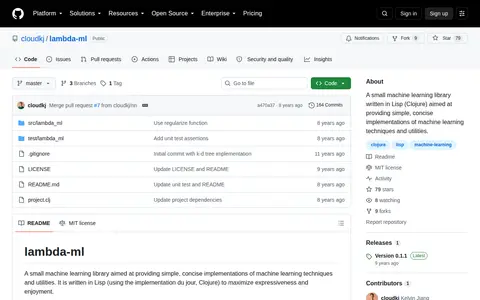
lambda-ml is a small machine learning library written in Lisp, specifically Clojure, aimed at simple, concise implementations of machine learning techniques and utilities. It covers supervised algorithms such as neural networks, decision trees, ensemble methods, k-nearest neighbors, linear and logistic regression, naive Bayes and random forest, plus unsupervised methods including DBSCAN, hierarchical clustering, k-means and non-negative matrix factorization.
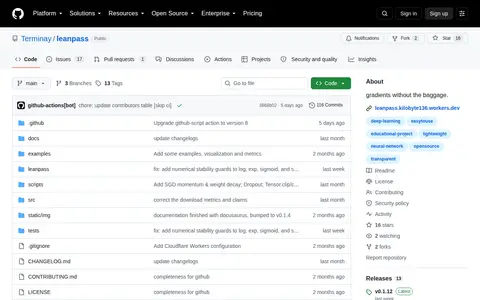
Leanpass is a NumPy-based autodiff library for small neural network experiments, designed to be readable and simple to inspect for learning how automatic differentiation works. It provides tensors with reverse-mode autodiff, activation functions, linear layers, multilayer perceptrons, loss utilities, and SGD and Adam optimizers. Its only dependency is NumPy.
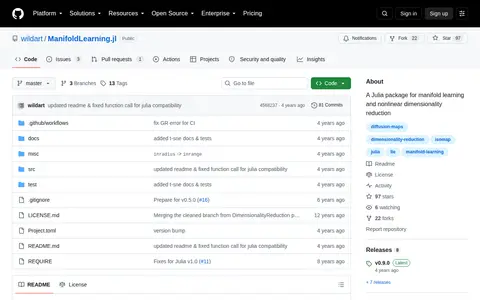
ManifoldLearning.jl is a Julia package for manifold learning and nonlinear dimensionality reduction. It provides methods including Isomap, diffusion maps, locally linear embedding, Hessian eigenmaps, Laplacian eigenmaps, local tangent space alignment and t-SNE. Most methods use k-nearest neighbors to construct local subspace representation, and a custom k-nearest neighbors function is suggested for large datasets.
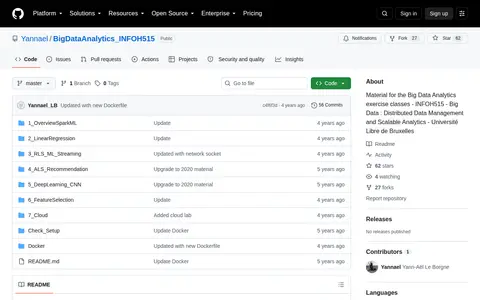
A repository of material for the exercise classes of a Big Data Analytics master course. Hands-on sessions cover Spark and its machine learning library, Map/Reduce implementations of linear regression and alternating least squares, streaming analytics with Recursive Least Squares, and image classification with convolutional neural networks. Material is provided as Jupyter notebooks.
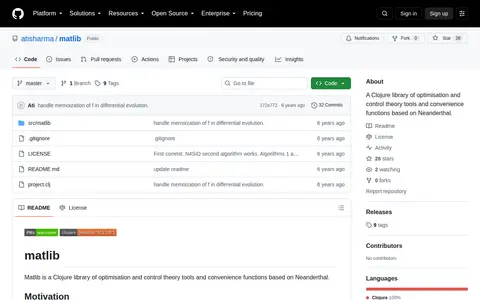
matlib is a Clojure library of optimisation and control theory tools and convenience functions based on the Neanderthal linear algebra library. It is available as a public repository on GitHub.
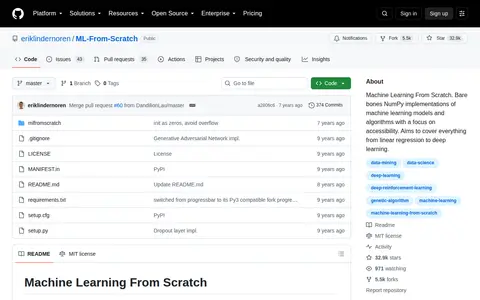
ML-From-Scratch is a GitHub repository that provides bare bones NumPy implementations of machine learning models and algorithms with a focus on accessibility, aiming to cover methods from linear regression to deep learning.
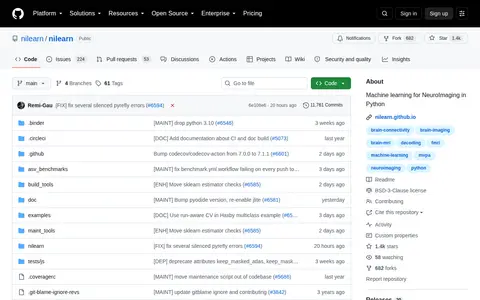
Nilearn provides statistical and machine-learning tools for analyses of brain volumes and surfaces, with documentation and a community. It supports general linear model based analysis and uses the scikit-learn toolbox for multivariate statistics, with applications such as predictive modeling, classification, decoding and connectivity analysis. It is written in Python and installable with pip.
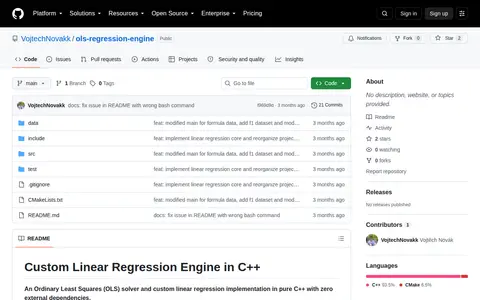
A C++ implementation of an Ordinary Least Squares solver and linear regression engine with zero external dependencies. It uses a custom matrix library, modified Gram-Schmidt orthogonalization and QR decomposition. It includes a CSV test dataset from the Czech film market and computes error metrics such as RSS and MAE.
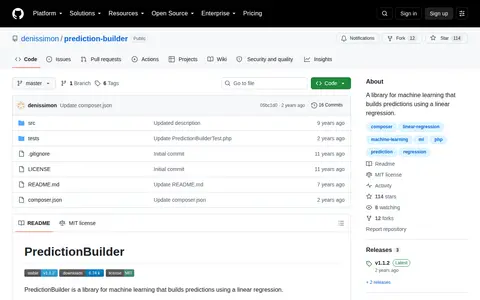
PredictionBuilder is an open-source machine learning library hosted on GitHub, designed to build predictions using linear regression. The repository includes documentation covering library requirements, installation steps, usage examples, and licensing terms.
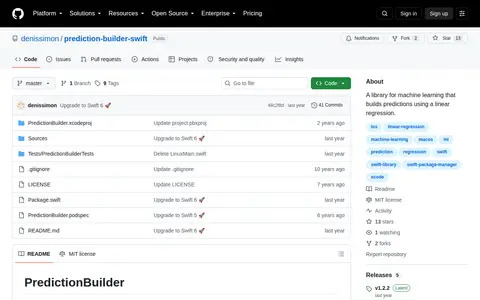
PredictionBuilder (Swift implementation) is an open-source machine learning library hosted on GitHub, designed to build predictions using linear regression. The repository provides documentation for installation, usage examples, and licensing information.
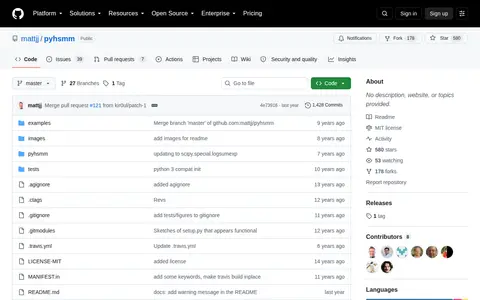
pyhsmm is a Python library for approximate unsupervised inference in Bayesian Hidden Markov Models and explicit-duration Hidden semi-Markov Models, focusing on the HDP-HMM and HDP-HSMM with weak-limit approximations. Extensions include autoregressive models, switching linear dynamical systems and factorial models. The package is stated as no longer maintained and was last tested with Python 3.7.