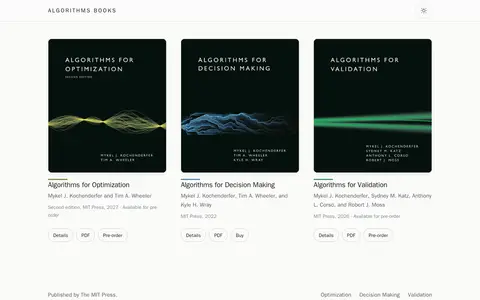
Algorithms Books presents three textbooks by Mykel J. Kochenderfer and coauthors, published by the MIT Press. The books are Algorithms for Optimization, Algorithms for Decision Making, and Algorithms for Validation. Full PDFs are available free.
Directory
Search results
Published directory entries matching your search.
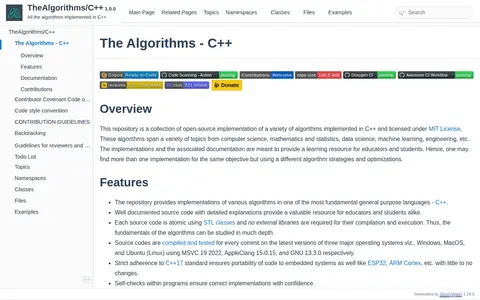
The Algorithms - C++ is a repository of open-source implementations of various algorithms in C++, released under the MIT License. It covers topics including computer science, mathematics, statistics, data science, machine learning and engineering, and is intended as a learning resource for educators and students. The documentation is generated from the source code.
Algo is a self-hosted personal VPN server introduced by Trail of Bits in December 2016. It automatically deploys an on-demand VPN service in the cloud that is not shared with other users, relies on only modern protocols and ciphers, and includes minimal software. The project is described as free.
Algodoo is a free physics simulation program that lets users draw and interact with physical systems on a computer, building and exploring by click and drag, tilt and shake, with colors, graphs and forces for visualization. It is available for Windows, Mac and the iPad, and official videos and webinars cover creating educational scenes and other constructions.
Algorithm Visualizer provides educational videos, lessons, tutorials, or self-learning resources.
algorithms provides educational videos, lessons, tutorials, or self-learning resources.
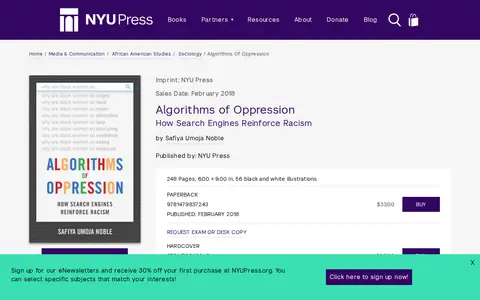
Algorithms of Oppression by Safiya Umoja Noble is a book published by NYU Press in February 2018 under the title How Search Engines Reinforce Racism. It examines how negative biases against women of color are embedded in search engine results and algorithms.
CP-Algorithms is a developer resource for coding, documentation, communities, security research, or software tools.
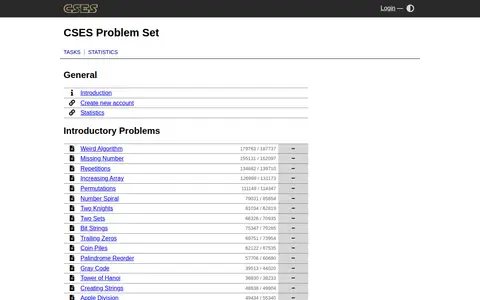
CSES Problem Set is a collection of programming tasks organized into categories including introductory problems, sorting and searching, dynamic programming, graph algorithms, range queries, tree algorithms, mathematics and string algorithms. The page lists tasks with solved and attempt counts and offers account creation and login.
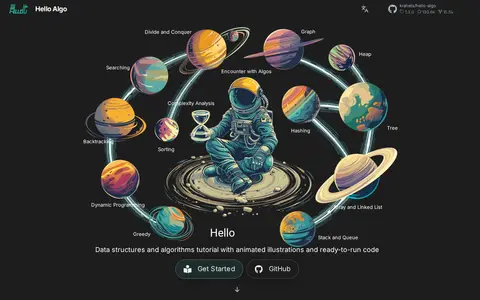
Hello Algo provides educational videos, lessons, tutorials, or self-learning resources.
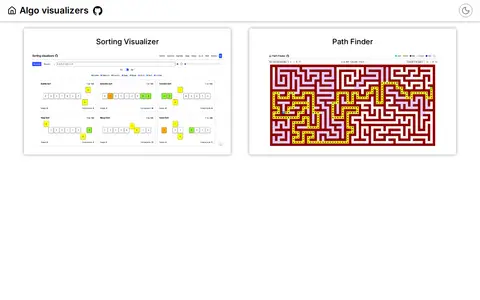
Sorting Algorithms Visualizer provides educational videos, lessons, tutorials, or self-learning resources.
The Algorithms is a GitHub repository or organization with source code, releases, documentation, or project resources.
An open-source resource for learning data structures and algorithms through implementations in various programming languages. The site covers programming languages including Python, Java, JavaScript, Go, Rust, and C++, and organizes algorithms into categories such as sorting, searching, and graph algorithms. It also provides guidance on contributing implementations.
Advances in Evolutionary Algorithms. Edited by: Witold Kosinski. ISBN 978-953-7619-11-4, PDF ISBN 978-953-51-5796-0, Published 2008-11-01.
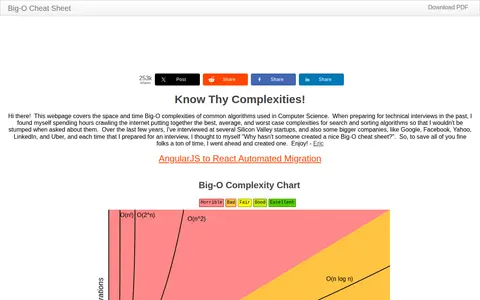
Big-O Cheatsheet is a webpage presenting space and time Big-O complexities of common computer science algorithms. It includes a Big-O complexity chart, common data structure operations with average and worst case time complexity and space complexity, and array sorting algorithms with best, average and worst case time complexity. A downloadable PDF version is offered.
Deconstructing the AI Myth: Fallacies and Harms of Algorithmification provides machine-learning models, research, training resources, or evaluationā¦
Gephi is free, open-source software for network visualization and analysis. It is available as a desktop application and as Gephi Lite in the browser. It includes algorithms for community detection, centrality measures and clustering, multiple layout algorithms, appearance customization and image exports. The source code is released under the GPL license.
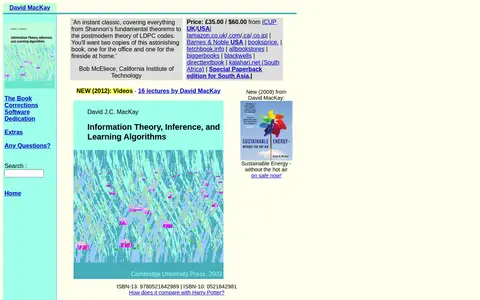
A 2003 book by David J.C. MacKay published by Cambridge University Press, covering information theory, inference, and learning algorithms. The site offers corrections, software, and downloadable figures. It lists a price of £35.00 or $60.00.
LightFM is a Python implementation of recommendation algorithms for implicit and explicit feedback. It allows item and user metadata to be incorporated into matrix factorization algorithms, representing users and items as sums of latent feature representations. Installation is available from PyPI, and a Docker setup is provided for running examples and tests.
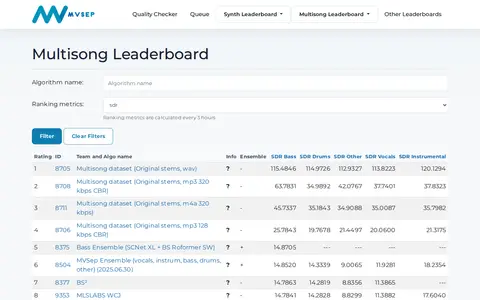
MultiSong Leaderboard is a ranking page on the MVSEP music and voice separation platform. It evaluates multisong audio separation algorithms using metrics including SDR, SI-SDR, L1 frequency, log WMSE, aura STFT, aura MRSTFT, bleedless, and fullness, with rankings updated every three hours. The page lists top-performing algorithms and their scores for separation tasks such as bass, drums, other stems, vocals, and instrumentals.
NSynth Super is an open source experimental instrument that lets musicians play sounds generated by the NSynth algorithm. The NSynth algorithm uses a deep neural network to learn sound characteristics and synthesize new sounds from four source sounds. The interface can be played via any MIDI source, such as a DAW, sequencer or keyboard.
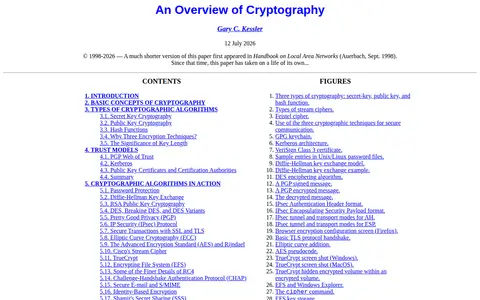
A free, evolving tutorial on cryptography maintained since 1999. It covers basic cryptographic concepts, types of algorithms including secret key, public key and hash functions, trust models, and applied algorithms in action.
RubiksTrainer is a site for learning to solve the Rubik's Cube, with practice solutions, algorithms, a solver, formula, timer and speedcubing material. It covers beginner and advanced sections, 3x3 algorithms, recognition practice, OLL, PLL, COLL, a timer, and a scrambler for Cross and F2L practice. The site notes a forthcoming move to another address.
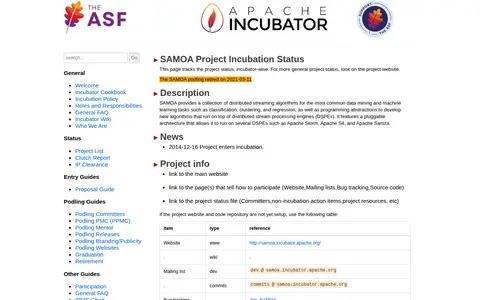
SAMOA was an Apache Incubator podling that provided a collection of distributed streaming algorithms for data mining and machine learning tasks such as classification, clustering and regression, plus programming abstractions for developing new algorithms on distributed stream processing engines. Its pluggable architecture allowed it to run on several engines. The podling retired on 2021-03-11.