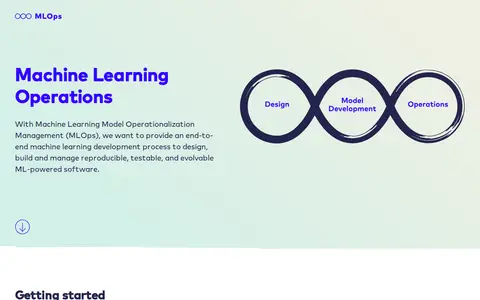
ML-Ops is a site about Machine Learning Operations. It covers motivation for MLOps, designing ML-powered software, the end-to-end ML workflow lifecycle, three levels of ML-based software, MLOps principles, CRISP-ML(Q), the MLOps Stack Canvas and ML model governance. It describes MLOps as aiming to unify the release cycle for machine learning and software.
Directory
Search results
Published directory entries matching your search.
MLOps Community is a global community for machine learning engineers focused on MLOps. It facilitates knowledge sharing, real-world problem solving, networking, and career advancement through in-person meetups and conferences, virtual tech talks, podcasts, workshops, and masterclasses. It reports membership of over 70,000 to 90,000 ML practitioners.
A guide explaining MLOps concepts and how to build an MLOps environment. It covers theory and a tutorial using tools such as DVC, CML, IBM Watson Machine Learning, IBM Watson OpenScale, Terraform and Cookiecutter. The guide is described as modular, allowing tools to be swapped according to project preferences and use cases.
MLOps Now supports deploying, serving, monitoring, or operating AI and machine-learning systems.
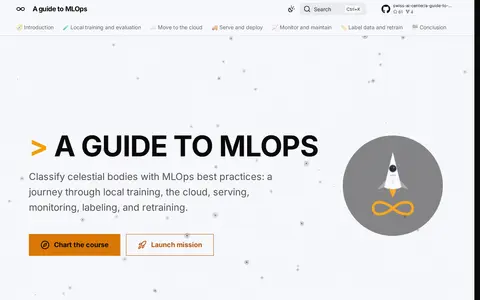
A guide to MLOps is an open-source tutorial from the Swiss AI Center team that walks engineers and small teams from notebook experiments to production. It covers local training and model evaluation, moving the model to the cloud, serving and deploying, monitoring and maintaining, and labeling data and retraining, using tools such as DVC, Git, GitHub Actions, CML, Docker, BentoML, Fluent Bit, Evidently AI, and Label Studio.
A Hugging Face Space that classifies whether given text was written by a human or a language model. Users enter text in an input box and receive a classification result. The Space is shown as sleeping due to inactivity.
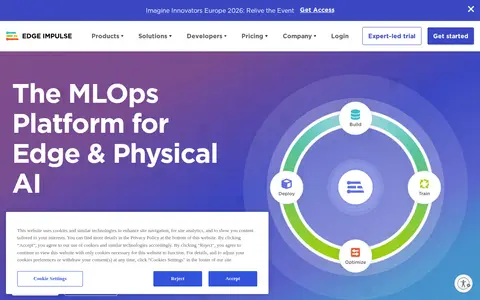
Edge Impulse is an MLOps platform for edge AI and physical AI. It provides native MLOps workflows covering end-to-end pipelines, security, versioning and model monitoring, and is used to develop, deploy and manage AI solutions at scale across the edge hardware ecosystem. A Developer plan is offered at $0 per month.
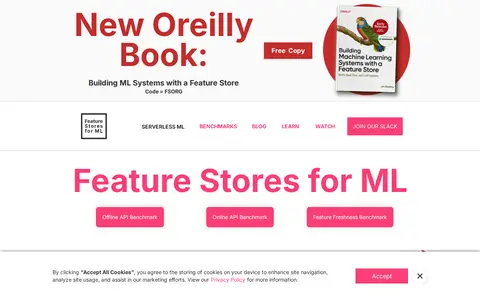
Feature Stores for ML is a global community of data science professionals, researchers, and engineers focused on feature stores for machine learning pipelines. It creates educational content about feature stores and the surrounding data and AI ecosystem, hosts monthly industry meetups, and provides resources including blog posts, videos, benchmarks, and an MLOps dictionary.
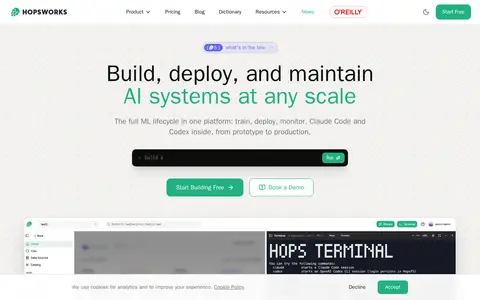
Hopsworks is a platform for building, deploying, and scaling production machine learning systems. It combines a feature store with MLOps tooling, using dual online and offline storage to manage, reuse, and serve features. The platform covers the ML lifecycle: train, deploy, and monitor. An O'Reilly book covers building batch, real-time, and LLM systems with feature stores.
Simplifies and accelerates MLOps by bridging the gap between ML models and edge hardware.

Pipeline Conversations is a podcast from ZenML featuring interviews with platform engineers, ML practitioners and technical leaders building production AI systems. Episodes cover MLOps and LLMOps topics including Kubernetes workflows, model fine-tuning and evaluation, LLM security, cost optimization, prompt engineering and agents in production.
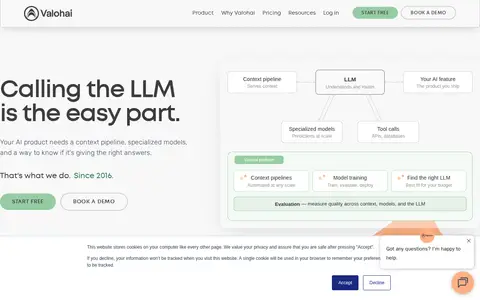
Valohai is an MLOps platform for AI products that combine LLMs and specialized models. It provides experiment tracking, data versioning, hyperparameter optimization, pipeline automation and compute orchestration, and runs on existing AWS, Azure, GCP or on-prem infrastructure. Pricing is per user license across Pro and Enterprise tiers.
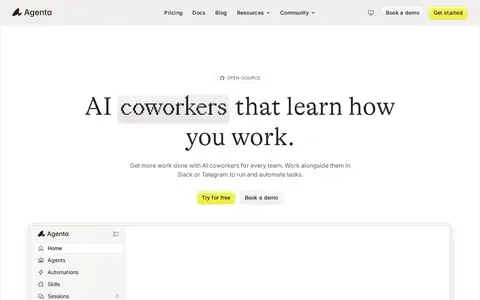
Agenta is an open-source workspace for AI agents. Agents are built through chat, improved with feedback, and shared with a team, either self-hosted or in the cloud. Integrations and messaging in Slack or Telegram are described on the site.
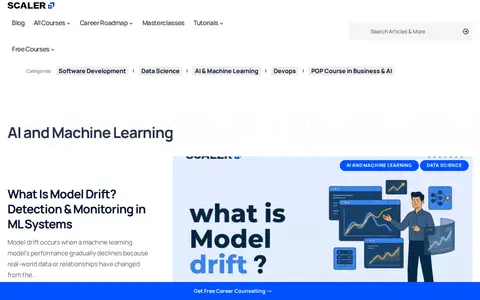
This is a Scaler blog category page collecting articles on artificial intelligence and machine learning. Posts listed include MLOps projects, becoming an AI research scientist, model drift detection and monitoring, and retrieval-augmented generation evaluation metrics. The page also links to categories such as software development and data science, and offers career counselling.
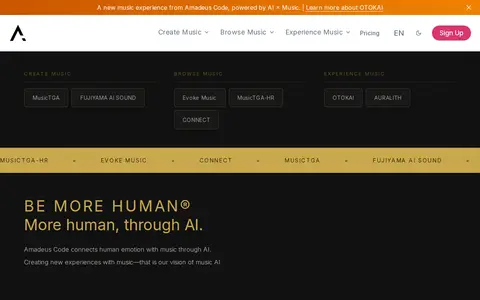
Amadeus Code provides music AI infrastructure spanning rights-cleared training data, audio supply and royalty management. Its products include MusicTGA for MIDI songwriting ideas, FUJIYAMA AI SOUND for music and sound materials, and Evoke Music, a royalty-free library. CONNECT is a royalty management platform for copyrights and master rights in Japan.
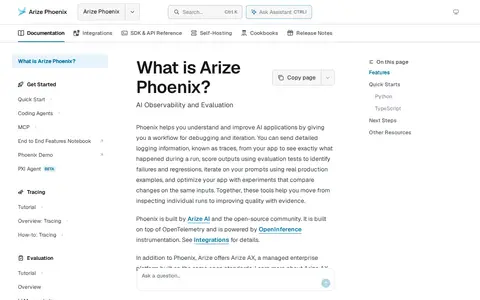
Arize Phoenix is an AI observability and evaluation tool built by Arize AI and the open-source community on OpenTelemetry and OpenInference. It provides tracing for debugging individual runs, evaluations to score output quality, a prompt playground, and datasets and experiments for comparing changes on the same inputs.
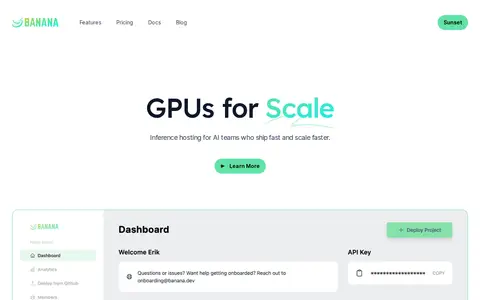
Banana provides GPU inference hosting for AI teams. The platform scales GPUs up and down automatically and includes monitoring, business analytics, a CLI, SDKs, and an open automation API. Backends can be written with Potassium, an open-source HTTP framework. Paid Team and Enterprise tiers are offered.
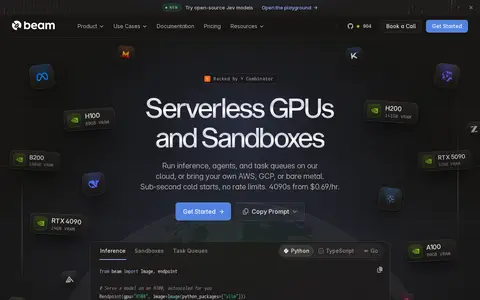
Beam provides a bare-metal cloud for agents, with persistent forkable microVMs that boot in seconds and can be paused, resumed, network-isolated and GPU-accelerated. Virtual machines are billed per second while running, with no compute charges while stopped. The platform also offers serverless GPU tasks, sandboxes and on-demand GPU machines.
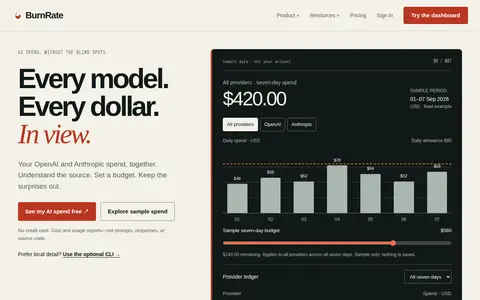
BurnRate is an AI usage analytics tool that tracks costs, tokens and usage patterns across AI coding providers. It connects OpenAI and Anthropic reporting accounts for provider-reported spend and offers a local CLI for session-level detail. Cloud workspaces come in Free, Pro at $12/month and Team at $29/seat/month plans.
Helps teams build, deploy, observe or operate machine-learning systems.
CHICKEN is a compiler for the Scheme programming language that produces portable and efficient C. It supports the R5RS and R7RS standards and many extensions, runs on Linux, OS X, Windows, and many Unix flavours, and is distributed free under the BSD License. Libraries and extensions are available at Eggs Unlimited.
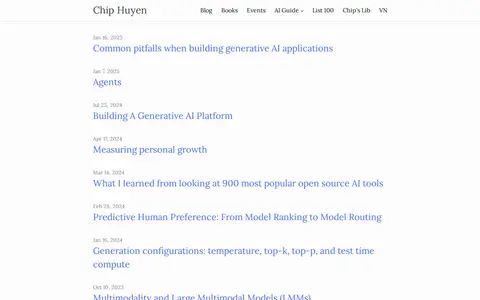
A personal blog about AI system design and bringing AI into production. Posts cover topics including generative AI applications, agents, multimodal models, LLM research challenges, model routing, generation configurations, and machine learning systems.
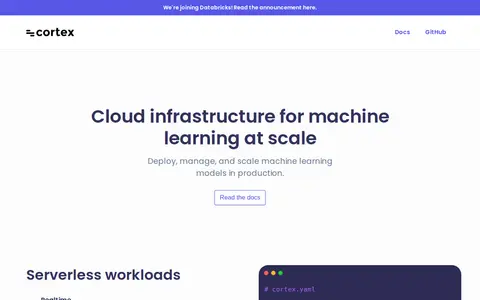
Cortex is cloud infrastructure for machine learning at scale, used to deploy, manage and scale machine learning models in production. It supports realtime, async and batch serverless workloads, along with automated cluster management including cluster autoscaling and spot instances with on-demand backups. Environments, provisioning and CI/CD and observability integrations are also listed. A notice states the project is joining Databricks.
Enjoy unlimited API calls with Serverless AI Workers/LLMs for just $25 per month. No rate or concurrency limits.