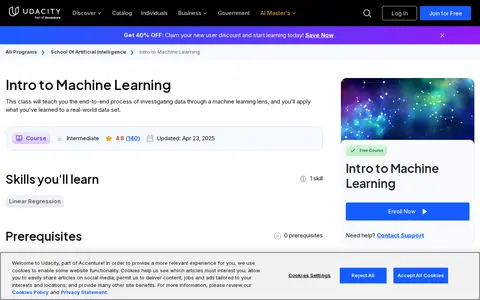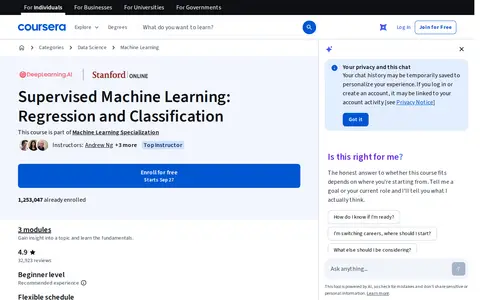

Andrew Ng’s Machine Learning at Stanford University is a Coursera course titled 'Supervised Machine Learning: Regression and Classification'. It is the first course of the Machine Learning Specialization. The course teaches how to build machine learning models in Python using NumPy and scikit-learn, covering regression and classification. It is aimed at beginners, requires flexible scheduling over three weeks at ten hours per week, and offers a shareable certificate.
Directory
Search results
Published directory entries matching your search.
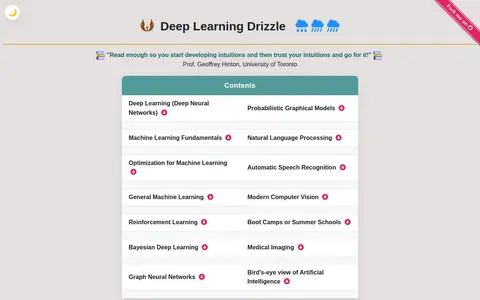
Deep Learning Drizzle is a collection of links to university and instructor lecture materials on deep learning and related machine learning topics. It lists courses by title, instructor or institution, course webpage, lecture videos and year. Topics include neural networks, natural language processing, computer vision, reinforcement learning, Bayesian deep learning, medical imaging and graph neural networks.
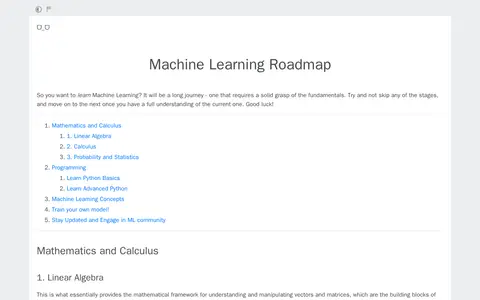
A staged learning roadmap for machine learning that covers mathematics and calculus, programming, and machine learning concepts. It advises moving to the next stage only after fully understanding the current one. The mathematics section covers linear algebra, calculus, and probability and statistics, and the programming section covers Python basics and advanced Python.

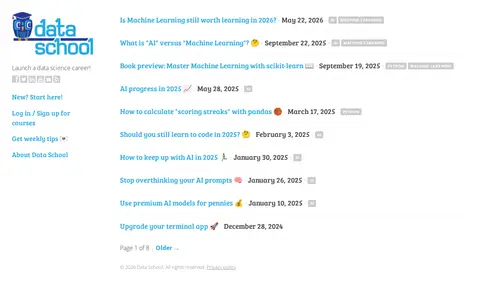
Data School is a blog about data science and machine learning. Its posts cover topics such as the difference between AI and machine learning, learning scikit-learn, AI progress, and using pandas for calculations. Posts are tagged by subject including Python, AI, and machine learning.
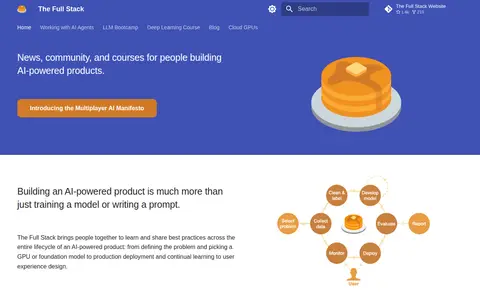
Full Stack Deep Learning offers news, community, and courses for people building AI-powered products. It covers the lifecycle of an AI-powered product, from defining the problem and picking a GPU or foundation model to production deployment and continual learning.
Sebastian Thrun’s Introduction To Machine Learning provides AI-assisted learning, courses, tutorials, or study support.
GeoGebra is an interactive mathematics platform for teaching and learning. It provides free digital tools including calculators, graphing, geometry, 3D exploration, and collaborative whiteboard features. The platform offers ready-made educational resources for grades 4 to 12, tools for users to create custom materials, and classroom functionality for teachers to track student progress and provide feedback. It integrates with various learning management systems and is used by teachers and students at school and university levels.
Supports teaching, studying or skills practice with AI-guided learning tools.
Alison is a free online learning platform that provides free online courses with certificates and diplomas. It has over 6,000 courses across categories including information technology, health, language, business, management, and personal development. The platform has more than 50 million learners and over 15 million graduates from 193 countries. It offers a mobile app for offline learning, business training for organizations, and free tools including English courses, psychometric tests, career guidance, and a resume builder.
Cognitive Class AI by IBM is a free online learning platform. It offers over 100 courses, 300 hands-on projects and 20 learning paths covering AI, cloud computing, full-stack development, cybersecurity, data science and other technology fields. Learners can earn certificates and badges, and the platform serves over 3 million learners.
Data Science 101 is a blog started in 2012 by Ryan Swanstrom about learning to become a data scientist. It covers getting started, data science career tips, free learning resources, videos, and academic papers.
Immersion-Based Japanese Learning is a website explaining an input-driven, immersion-based language learning method with a focus on Japanese. It sets out to argue for the method, provide a learning setup, and list learning resources and Japanese media recommendations.
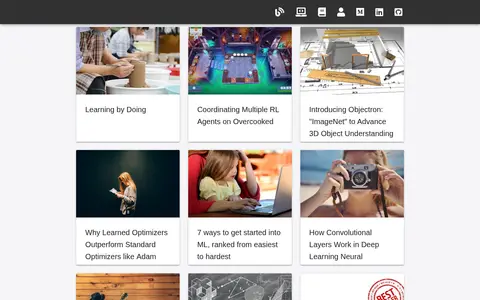
Hong Jing (Jingles) is a data scientist and Alibaba PhD student who writes about machine learning and neuroscience. The site collects blog articles on topics such as reinforcement learning agents, learned optimizers, convolutional layers, transformer models and decoding brain signals.
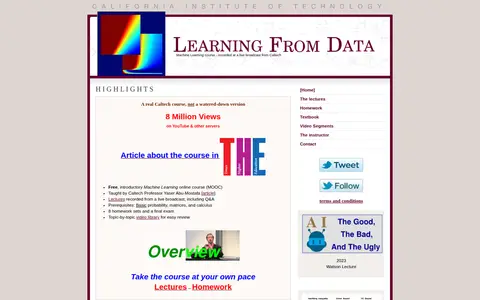
An introductory machine learning course taught by Caltech Professor Yaser Abu-Mostafa, recorded from a live broadcast and available as a free online MOOC. It covers basic theory, algorithms and applications across 18 lectures, with homework sets and a final exam. Prerequisites are basic probability, matrices and calculus.
Machine Learning – Software Engineering Daily provides machine-learning models, research, training resources, or evaluation tools.
MEKA is an open source implementation of methods for multi-label learning and evaluation, based on the WEKA Machine Learning Toolkit. It includes dozens of multi-label methods from the scientific literature and a wrapper to the MULAN framework. The project is distributed via SourceForge, with code hosted on GitHub.
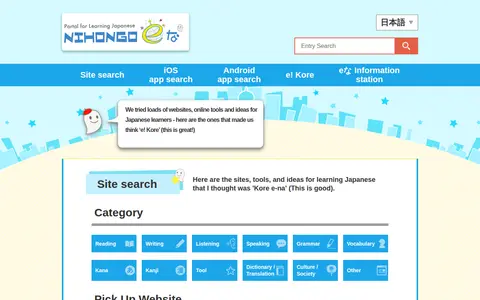
A site that introduces websites and online tools for studying Japanese, with sections for apps and categorized sites. It also includes articles on learning resources and links to a Japan Foundation e-learning platform.
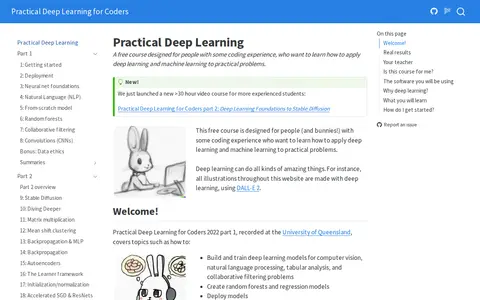
A free course for people with some coding experience who want to learn how to apply deep learning and machine learning to practical problems. It includes 9 lessons of around 90 minutes each, covering computer vision, natural language processing, tabular analysis, and collaborative filtering, plus building and training models, random forests, deployment, and use of PyTorch, fastai and Hugging Face.
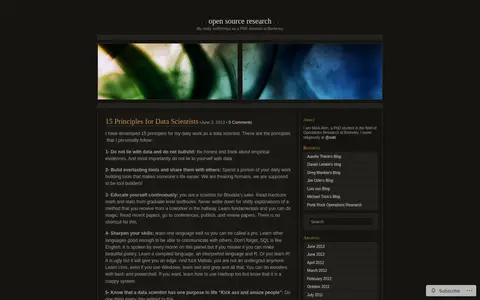
A personal blog by a PhD student at Berkeley that hosts notes and posts on data science, programming and machine learning topics. Entries include 15 principles for data scientists, C++11 learning notes, a Mandelbrot fractal in Python and notes from conference talks.
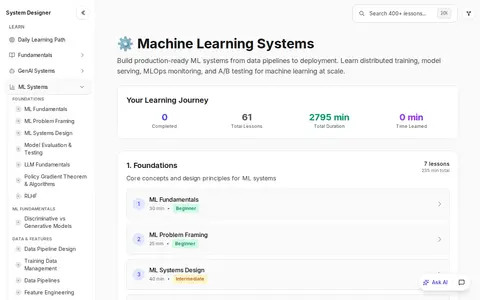
System Designer is a learning site offering interactive lessons and case studies on system design. Its Machine Learning Systems section covers building production ML systems, from data pipelines to deployment, with topics such as distributed training, model serving, MLOps monitoring and A/B testing. Lessons are organized into units with stated difficulties and durations.
Alien Dreams: An Emerging Art Scene - ML@B Blog provides machine-learning models, research, training resources, or evaluation tools.
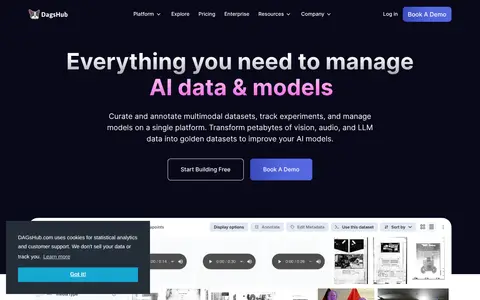
DagsHub is an AI platform for managing the machine learning lifecycle, covering dataset curation and annotation, experiment tracking, and model management. It supports unstructured and multimodal data such as text, images, audio, video, and documents. The platform is built on open source tools and formats. DagsHub states it does not currently provide compute resources and relies on the user's own infrastructure.
Eberban is a logical constructed language intended to be simple, regular, and expressive. Its grammar lets users manipulate predicates with particles, and valid sentences are syntactically unambiguous. The site offers parsers, tools, and learning resources, and it states that users can create their own tools and abstractions.
Supports teaching, studying or skills practice with AI-guided learning tools.