
Groq is a platform for inference, described as one fully integrated platform for infrastructure, inference, and control. It offers tiers including GroqMetal for bare-metal infrastructure, GroqCore for an inference stack, and GroqAssured for governance, auditability, and control.
Directory
Search results
Published directory entries matching your search.
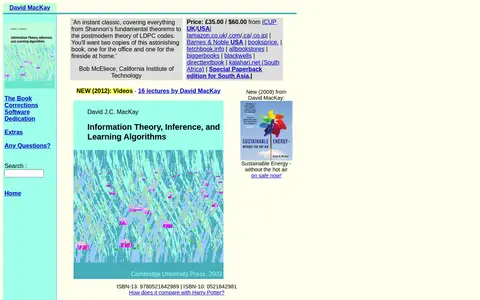
A 2003 book by David J.C. MacKay published by Cambridge University Press, covering information theory, inference, and learning algorithms. The site offers corrections, software, and downloadable figures. It lists a price of £35.00 or $60.00.
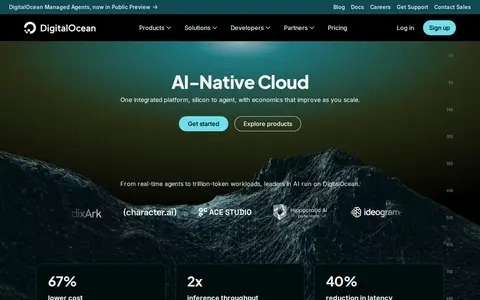
DigitalOcean describes an AI-native cloud platform with a unified stack for agents, inference and cloud infrastructure. Products listed include Managed Agents, Learning Services, Data Services, an Inference Engine with over 75 models, and core cloud services such as Droplets, Kubernetes and App Platform. Harness Runtime is listed starting at $0.0535/hr for durable cloud sandboxes for AI coding agents.
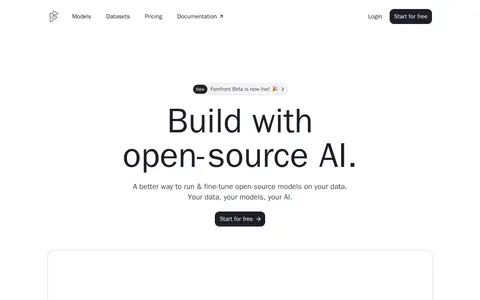
Forefront is described as a platform to fine-tune and inference open-source language models. The site mentions building with open-source AI, fine-tuning models on data, and running inference through serverless API endpoints. It also describes storing training, validation and evaluation data in ready-to-fine-tune datasets. Pricing lists a free tier and a team plan at $99 per month, each including $20 in free credits.
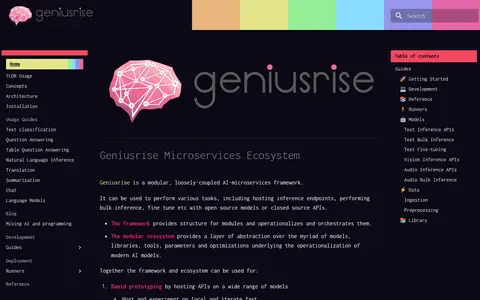
Host inference APIs, bulk inference and fine tune text, vision, audio and multi-modal models.
Seeing Theory is an archived site offering a visual introduction to probability and statistics through interactive visualizations. It covers six chapters: basic probability, compound probability, probability distributions, frequentist inference, Bayesian inference and regression analysis. It was created by Daniel Kunin while an undergraduate at Brown University.
Docker is a platform for building, sharing, and running containerized applications. It provides tools for AI agent sandboxing, agent governance, secure software supply chain management, containerization, local LLM inference, and enterprise-grade application security. The platform is designed to simplify development setup, support local to scaled deployment, and avoid vendor lock-in.
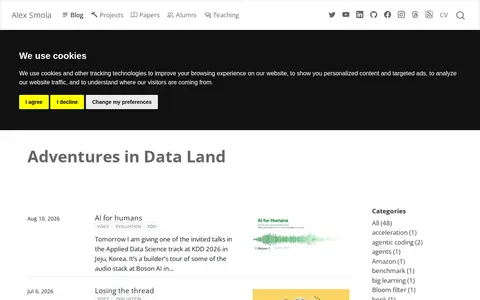
A personal blog by Alex Smola titled Adventures in Data Land, covering machine learning topics. Entries include efficient LLM inference tutorials, random projections, effective sample size, voice agents and evaluation, and porting MXNet to Blackwell and Apple Silicon. Posts reference events such as the Machine Learning Summer School 2026 in NYC.
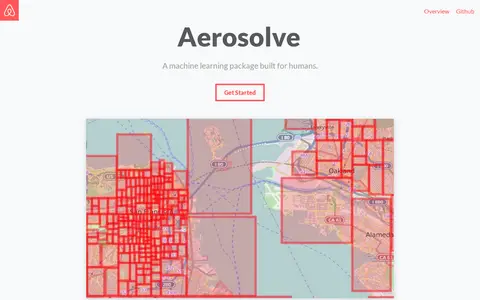
Aerosolve is a machine learning package built on the JVM. It provides features such as geo-based features, controllable quantization and feature interaction, and a feature transform language that gives developers control over features. General additive models are used. Scala handles feature training, with a lightweight Java API for run time inference.
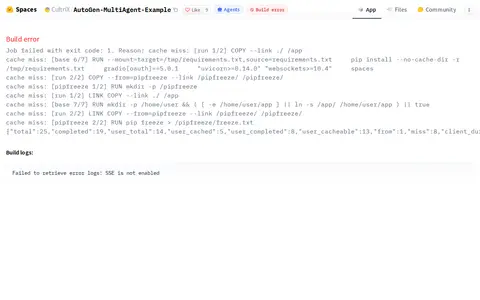
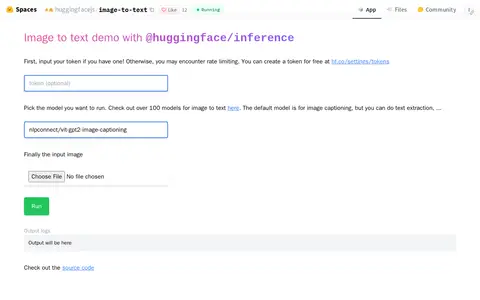
Example chatbot using Gradio, huggingface hub, and the Hugging Face Inference API.
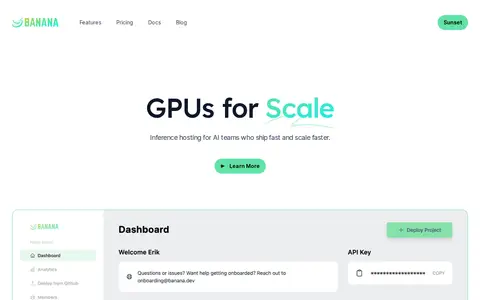
Banana provides GPU inference hosting for AI teams. The platform scales GPUs up and down automatically and includes monitoring, business analytics, a CLI, SDKs, and an open automation API. Backends can be written with Potassium, an open-source HTTP framework. Paid Team and Enterprise tiers are offered.
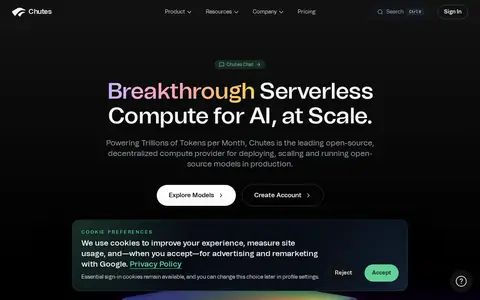
Chutes is a decentralized, serverless inference platform for open-source AI models. It lets developers deploy, run and scale models through an SDK and API, and covers modalities such as image, video, speech and music. Documentation describes building and deploying chutes and OpenAI-compatible API endpoints.
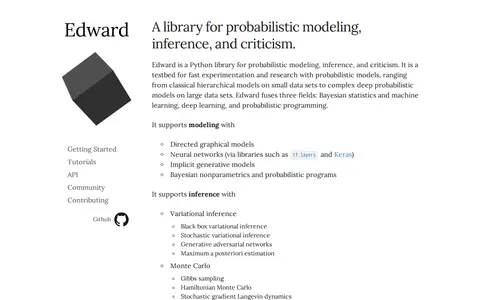
Edward is a Python library for probabilistic modeling, inference, and criticism. It is a testbed for experimentation and research with probabilistic models, from hierarchical models on small data sets to deep probabilistic models on large data sets. It fuses Bayesian statistics and machine learning, deep learning, and probabilistic programming, and is built on TensorFlow.
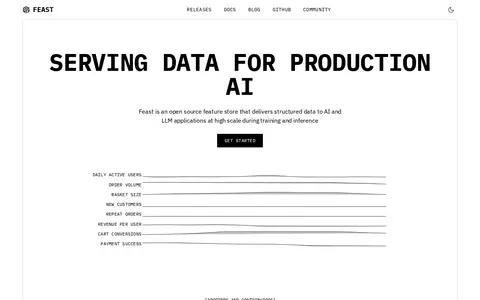
Feast is an end-to-end open source feature store for machine learning. It allows teams to define, manage, discover, and serve features, delivering structured data to AI and LLM applications during training and inference. Documented use cases include real-time recommendations, fraud detection, risk scoring, and customer segmentation.
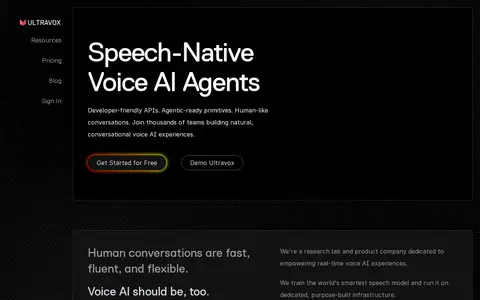
Ultravox is a real-time voice AI infrastructure layer for building voice agents. It trains a speech-native model and manages its own inference and infrastructure stack. The site offers developer-friendly APIs and agentic-ready primitives intended for natural, conversational voice agents. Ultravox has been acquired by Inworld. Pricing lists pay-as-you-go at $0 per month with the first 30 minutes free and $0.05 per minute after that.
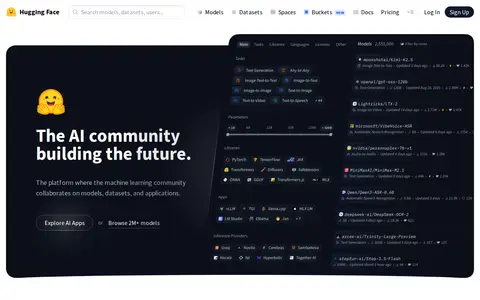
A collaboration platform where the machine learning community shares models, datasets and applications. It hosts public models, datasets and Spaces, and offers an open source stack including libraries such as Transformers, Datasets and Accelerate. It also provides paid Compute and Enterprise solutions, with an Inference Providers API giving access to models from multiple AI providers.
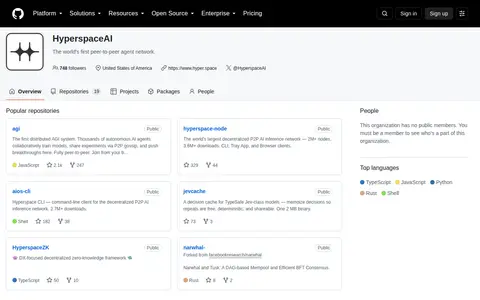
HyperspaceAI describes itself as a peer-to-peer agent network with 19 public repositories on GitHub. Among the repositories is the AGI project, which describes thousands of autonomous AI agents that train models in collaboration and share experiments via P2P gossip. Another repository, hyperspace-node, is described as a decentralized P2P AI inference network with CLI, Tray App and Browser clients.
Showcase streaming text generation using the @huggingface/inference JS lib.
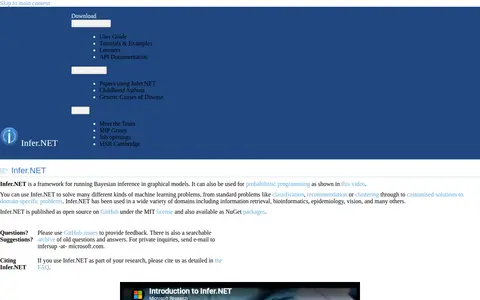
Infer.NET is a framework for running Bayesian inference in graphical models. It can be used for machine learning problems such as classification, recommendation or clustering, and for probabilistic programming. It is published as open source on GitHub under the MIT license and available as NuGet packages.
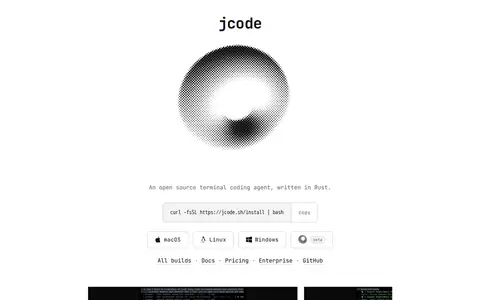
jcode is an open-source terminal coding agent written in Rust. It supports agent swarms, background tasks, and a small RAM footprint, and is installed with one command on macOS, Linux, or Windows. Login flows connect subscription and API model providers, and the agent itself is free while hosted inference plans are available.
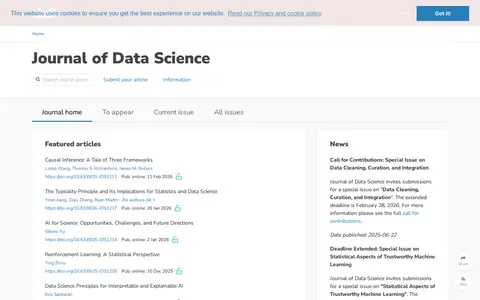
The Journal of Data Science is an academic journal listing featured articles, news, and calls for contributions. Featured articles include items on causal inference, reinforcement learning, and AI for science, each with a DOI and online publication date. The page also lists special issue calls for contributions and most-read articles.
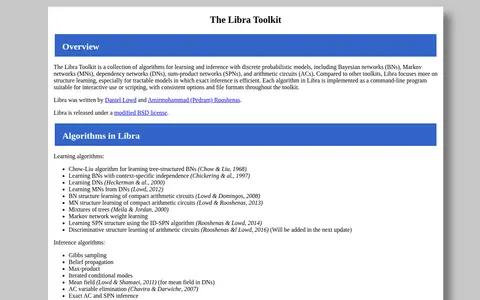
The Libra Toolkit is a collection of algorithms for learning and inference with discrete probabilistic models, including Bayesian networks, Markov networks, dependency networks, sum-product networks and arithmetic circuits. Each algorithm is implemented as a command-line program with consistent options and file formats, and all methods are written in OCaml.
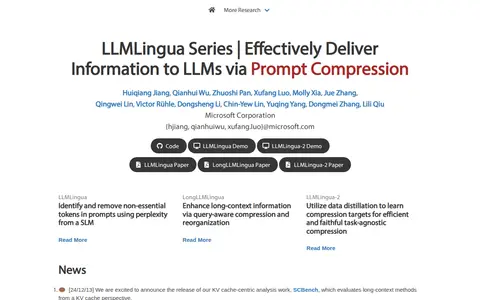
LLMLingua is a Microsoft-developed series of prompt compression tools for large language models, designed to accelerate LLM inference by shortening input prompts. The series includes LLMLingua, LongLLMLingua, LLMLingua-2, and SeCom, each using distinct compression techniques. It supports use cases such as retrieval-augmented generation and online meeting processing, and is integrated with the LangChain and LlamaIndex frameworks.
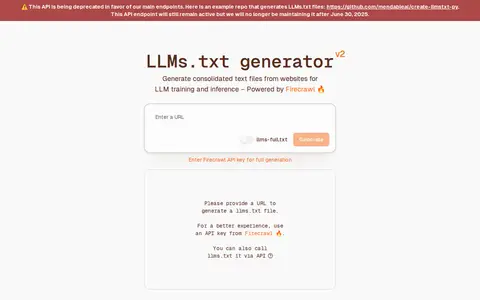
A tool that generates consolidated llms.txt text files from websites for LLM training and inference, powered by Firecrawl. The site states the API is being deprecated in favor of the main endpoints and will no longer be maintained after June 30, 2025, though the endpoint remains active.