
github.com
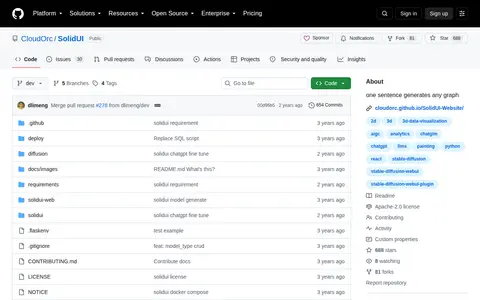
AI-generated visualization prototyping and editing platform, support 2D, 3D models, combined with LLM(Large Language Model) for quick editing.
Directory
Published directory entries matching your search.
AI-generated visualization prototyping and editing platform, support 2D, 3D models, combined with LLM(Large Language Model) for quick editing.

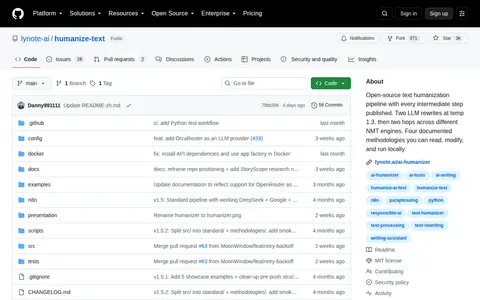
Open-source pipeline for rewriting AI-generated text into natural human prose. The repository documents a structure-first data pipeline that builds SFT and KTO training data for an AI-to-human rewrite model, with training data construction described in its docs.

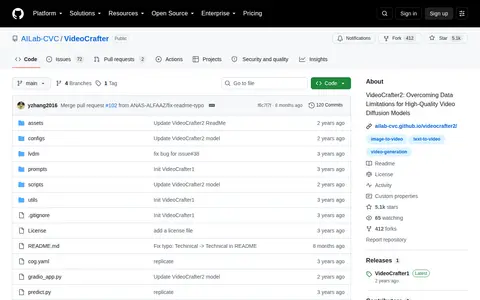
AILab-CVC/VideoCrafter is an open-source video diffusion model project. Its VideoCrafter2 iteration is designed to overcome data limitations for high-quality video generation, with improvements over the previous version including better motion rendering and concept combination, and supports generic text-to-video generation.

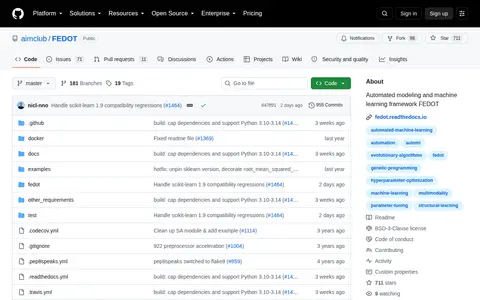
FEDOT is an open-source framework for automated modeling and machine learning. It provides automatic generative design of machine learning pipelines, with an evolutionary approach supporting classification, regression, clustering and time series prediction. Pipelines are represented as graphs defining connections between data preprocessing and model blocks. It is distributed under the 3-Clause BSD license.
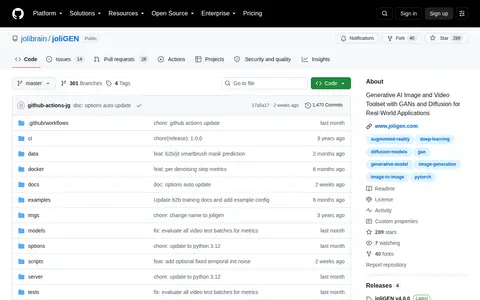
joliGEN is an integrated framework for training custom generative AI image-to-image models. It implements GAN, diffusion and consistency models for paired and unpaired image-to-image translation, including domain and style adaptation that preserves semantics such as image and object classes and masks. A server with REST API is provided for deployment, and documentation includes quickstarts and dataset guidance.

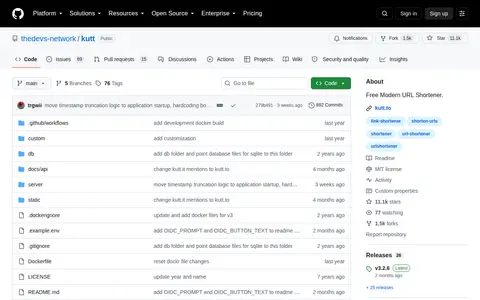
Kutt is a self-hosted URL shortener with custom domain support. It allows creating and editing links, setting custom URLs, passwords and expiration times, viewing statistics, and managing users. It supports SQLite, Postgres and MySQL databases, OpenID Connect login and a RESTful API.

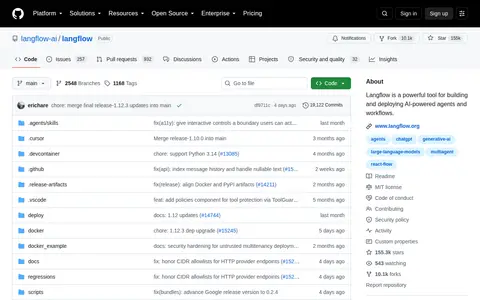
Langflow is a platform for building and deploying AI-powered agents and workflows, with a visual authoring interface and built-in API and MCP servers. It supports major LLMs, vector databases and AI tools, and allows deployment as an API, JSON export or MCP server.

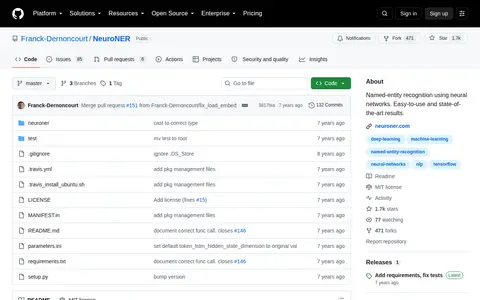
NeuroNER is a program that performs named-entity recognition using neural networks. It relies on Python 3 and TensorFlow 1.0+, optionally uses the BRAT annotation tool, and provides installation instructions, sample datasets and pretrained models.

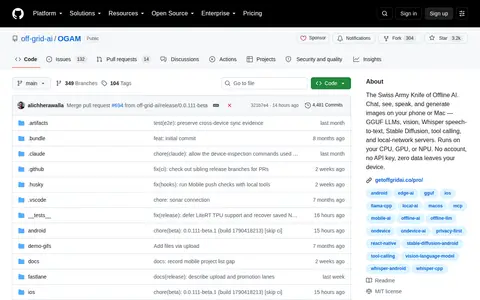
An offline AI application for phones and Macs that supports chat, image generation, vision, Whisper speech-to-text, tool calling and local-network servers. It runs on CPU, GPU or NPU, requires no account or API key, and keeps data on the device. A paid Pro tier adds voice mode, custom personas and draft-and-approve actions.

Steganography extraction tool for finding hidden files or data inside images.

Python steganography tool for hiding or extracting data in supported image and audio files.

A dataframe grammar wrapping tech.ml.dataset, inspired by several R libraries.

A lightweight, self-hosted workspace for databases that runs in the browser and is also available as a desktop app or terminal CLI. It offers spreadsheet-style data editing, a visual schema graph and a query scratchpad, with optional AI features through a chosen provider.

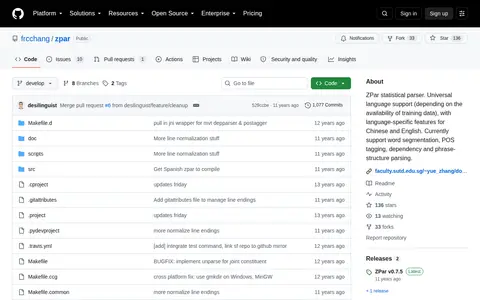
ZPar is an open-source statistical parser hosted on GitHub. It offers universal language support contingent on the availability of training data, with dedicated language-specific features for Chinese and English. The tool supports word segmentation, part-of-speech tagging, dependency parsing, and phrase-structure parsing.