github.com
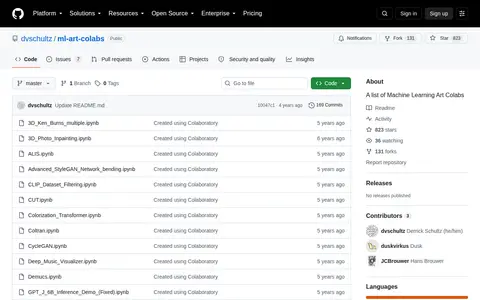
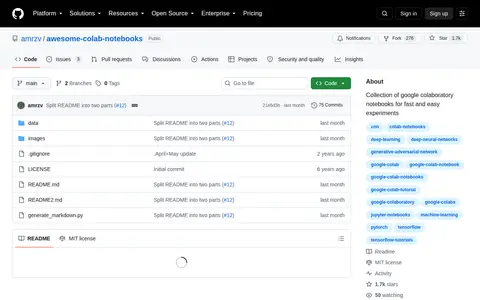
Awesome Colab Notebooks is a code repository or project page with source code, releases, documentation, or setup notes.
Directory
Published directory entries matching your search.
Awesome Colab Notebooks is a code repository or project page with source code, releases, documentation, or setup notes.

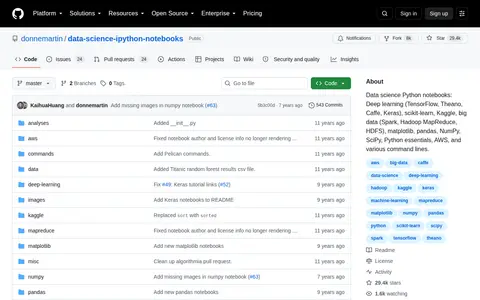
Data Science Ipython Notebooks is a GitHub repository or organization with source code, releases, documentation, or project resources.

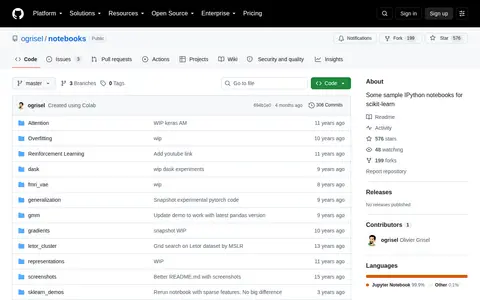
The ipython-notebooks repository, hosted on GitHub under the user ogrisel, contains sample IPython notebooks for use with the scikit-learn machine learning library. It is an open-source project that accepts contributions from GitHub users.

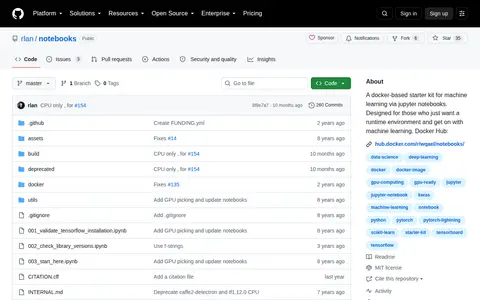
Notebooks is a Docker-based starter kit for machine learning through Jupyter notebooks, intended for users who want a ready runtime environment. Its images cover combinations of Keras, TensorFlow and PyTorch with CUDA v8 through v11, and include JupyterLab, scikit-learn, pandas and visualization, vision and NLP libraries. Python 3 only, as Python 2 is end-of-life.
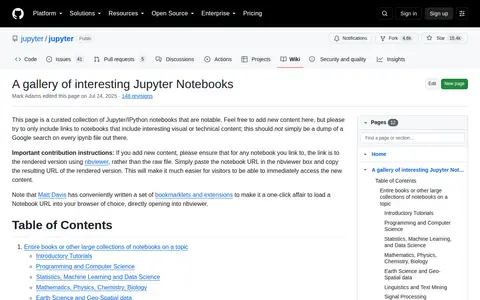
This is a curated gallery of interesting Jupyter Notebooks, organized by topic categories including introductory tutorials, programming and computer science, statistics and machine learning, data science, mathematics, physics, chemistry, biology, earth science, geo-spatial data, linguistics, and text mining.

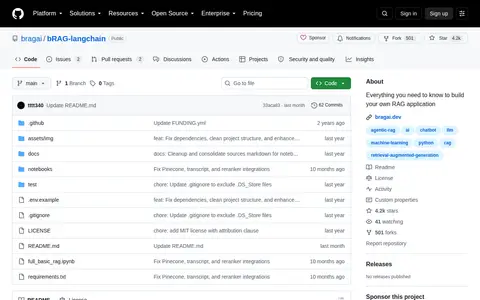
This repository collects notebooks that explore Retrieval-Augmented Generation (RAG) for various applications, from introductory to advanced implementations. It includes a full_basic_rag.ipynb starter and notebooks on multi-querying, routing, query construction, indexing, and advanced retrieval. The materials cover environment setup, data loading, embedding generation, and vector store configuration with ChromaDB or Pinecone.
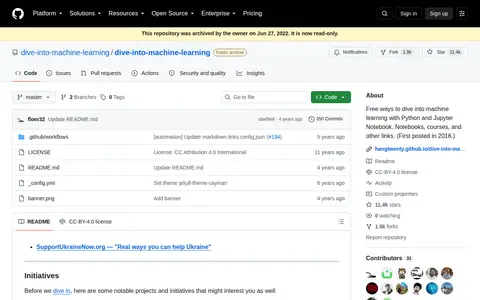
Archived, read-only GitHub repository of free resources for learning machine learning with Python and Jupyter Notebook, including notebooks, courses and other links. It was first posted in 2016 and was archived by the owner on Jun 27, 2022.
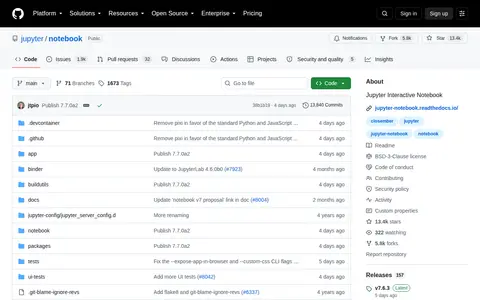
Jupyter notebook is a web-based notebook environment for interactive computing.

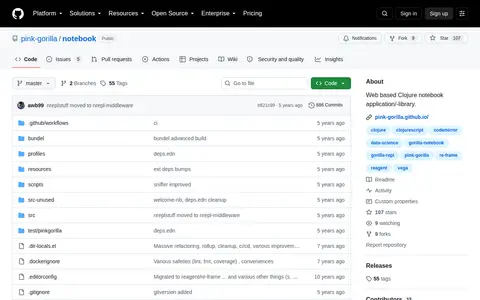
A Clojure/Clojurescript notebook application/-library based on Gorilla-REPL.

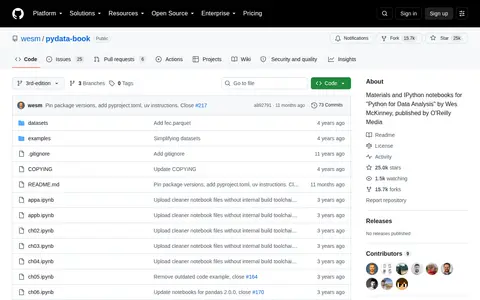
The repository holds materials and IPython notebooks for "Python for Data Analysis, 3rd Edition" by Wes McKinney, published by O'Reilly Media. Notebooks cover chapters on Python basics, NumPy, pandas, data loading, cleaning, visualization, time series and modeling libraries, plus appendices. The code is released under the MIT license.

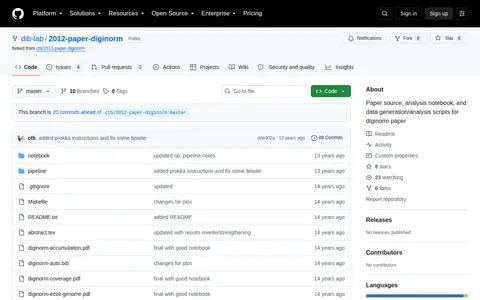
A repository holding the paper source, analysis notebook, and data generation and analysis scripts for the diginorm paper. It is forked from another repository and includes LaTeX sources, bibliography files, figures and a pipeline folder.

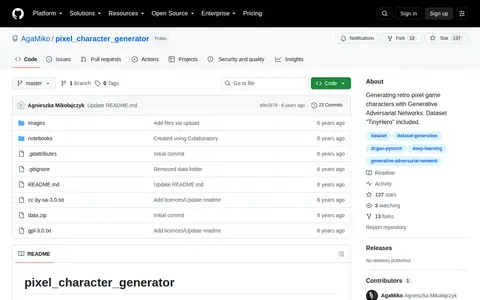
A GitHub repository for generating retro pixel game characters with generative adversarial networks. It includes the TinyHero dataset of 64x64 pixel characters generated from the Universal LPC spritesheet, with 3648 images. Notebooks cover a DCGAN based on the PyTorch tutorial, a conditional DCGAN and a deep convolutional autoencoder. Art is dual licensed under GPL 3.0 and CC-BY-SA 3.0.

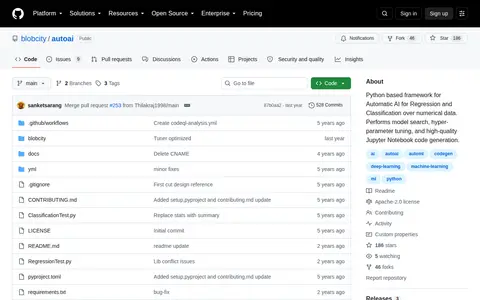
autoai is an open-source Python framework for automatic artificial intelligence focused on regression and classification tasks over numerical data. It automates model search, hyper-parameter tuning, and generates high-quality Jupyter Notebook code for resulting models.

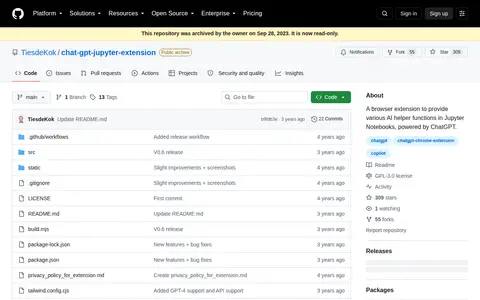
ChatGPT for Jupyter is a browser extension that provides AI-powered helper functions within Jupyter Notebooks, powered by ChatGPT. The extension is compatible with Chrome, Edge, and Firefox browsers, with its code and documentation hosted in a public GitHub repository under the TiesdeKok organization.

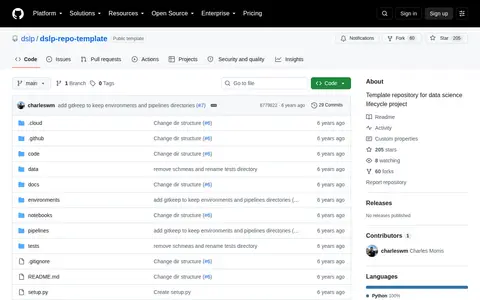
A public GitHub template repository for data science lifecycle projects. It provides a default directory structure including folders for code, data, docs, environments, notebooks, pipelines and tests, plus issue templates and a .github labels file. The source describes it as a launch-off point with minimal opinions. One manual step is creating labels from the labels file.

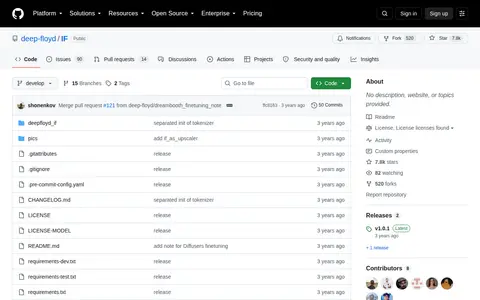
deep-floyd/IF is a GitHub repository for the IF image generation model developed by DeepFloyd Lab at StabilityAI. It provides documentation for minimum model requirements, quick start guides, local notebook support, and integration with the Hugging Face Diffusers library for model use.

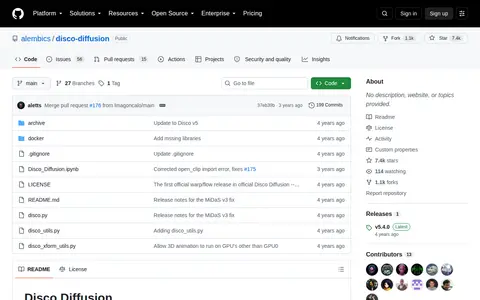
Frankensteinian amalgamation of notebooks, models and techniques for the generation of AI Art and Animations.

Collection of Google Colab Notebooks for ML Arts.

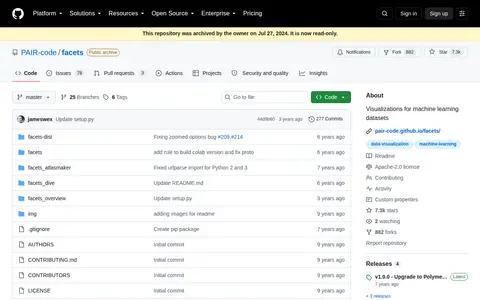
Facets is a project containing two visualizations, Facets Overview and Facets Dive, for understanding and analyzing machine learning datasets. The visualizations are Polymer web components backed by TypeScript that can be embedded in Jupyter notebooks or webpages. Overview produces feature-by-feature statistical analysis and compares statistics across datasets. The repository was archived on Jul 27, 2024 and is now read-only.

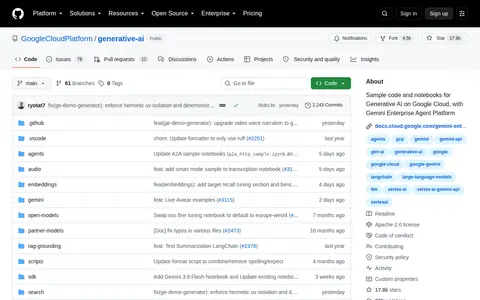
Sample code and notebooks for Generative AI on Google Cloud.

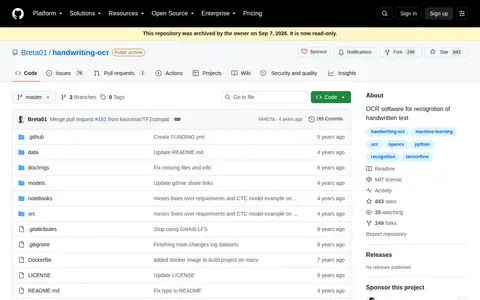
Handwriting-OCR is a project that tries to create software for recognizing handwritten text from photos, including Czech language, using computer vision and machine learning. Recognition is divided into four steps, from page detection through word separation and normalization to character recognition. It is written in Python 3.6 with Jupyter Notebook, and the repository was archived by its owner.

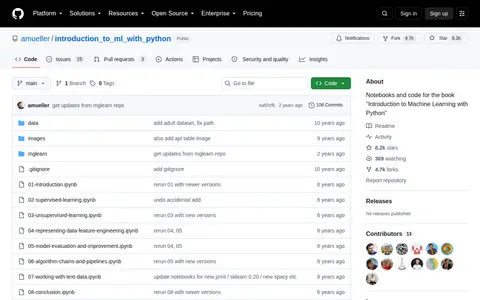
A GitHub repository holding the notebooks and code for the book "Introduction to Machine Learning with Python" by Andreas Mueller and Sarah Guido, together with the mglearn library of helper functions for figures and datasets. The book requires scikit-learn 0.20.0, and the code also needs numpy, scipy, matplotlib, pandas and pillow.
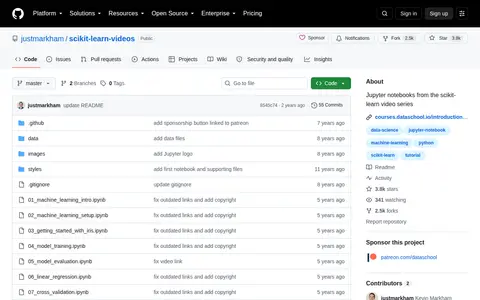
IPython notebooks from Data School's video tutorials on scikit-learn.

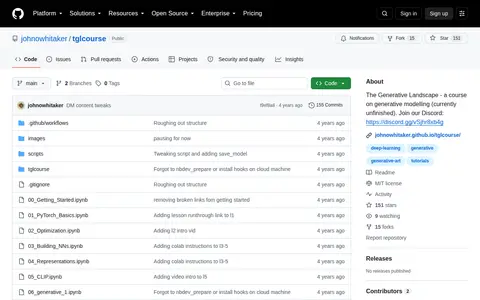
A course on generative modelling, currently unfinished, with the first approximately five lessons mostly done. It covers topics such as PyTorch basics, representations, CLIP, GANs, sequence modelling and transformers. No prior deep learning knowledge is assumed, though comfort with some Python and Jupyter Notebooks is expected.