docs.docker.com
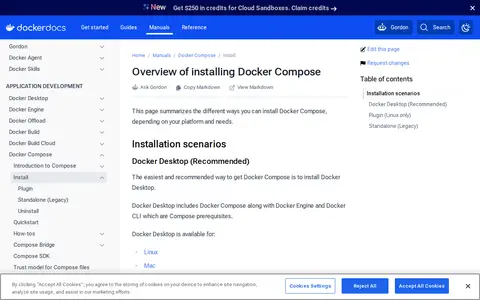
Docker Compose installation guide for running multi-container applications.
Directory
Published directory entries matching your search.
Docker Compose installation guide for running multi-container applications.

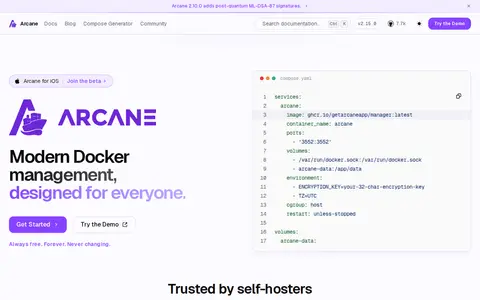
Arcane is a free, open-source Docker management UI covering containers, images, volumes, networks, Compose projects, and remote hosts. It runs as a single container that manages Docker on the same host through the Docker socket and can be installed with Docker Compose or a Linux install script. Documentation also covers agents for managing other Docker hosts.
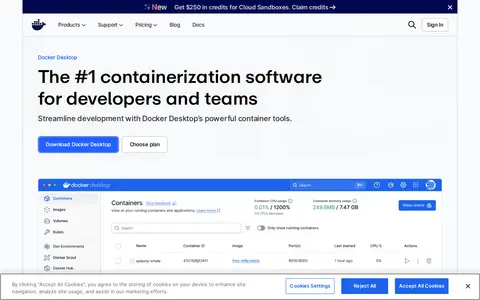
Docker Desktop is containerization software for developers, available for Mac, Windows and Linux. It includes Docker Engine, the Docker CLI, Docker Compose, Docker Build, built-in Kubernetes support, volume management and Docker Debug.

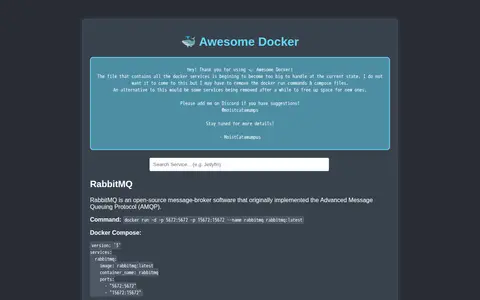
Awesome Docker is a page about a file containing Docker services. It notes the file is becoming too large to handle and that docker run commands and compose files may be removed, with services possibly removed over time to free up space.

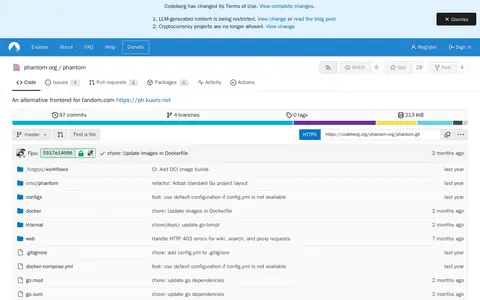
Phantom is an alternative privacy-focused frontend for fandom.com. It supports configuration via a config.yml file or environment variables, with environment variables taking precedence over file settings. The application can be run directly with Go and Make, or deployed using Docker Compose, Podman Compose, or Podman Quadlets. It is open source, with its repository hosted on Codeberg.

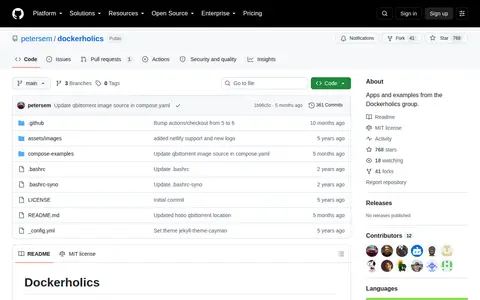
Dockerholics is a GitHub repository with apps and examples from the Dockerholics group. It includes Docker Compose examples and a list of free applications that can be hosted locally in Docker containers, described as images the group experts have tried out and verified. The repository is MIT licensed.

Grimmory is a self-hosted library management system for ebooks, comics, and audiobooks, keeping books and data on the user's own server. It offers smart organization, automatic metadata, a built-in browser reader, Kobo and KOReader sync, OPDS support, rule-based magic shelves, multi-user permissions, and email delivery of books. Installation uses Docker and Docker Compose with MariaDB.

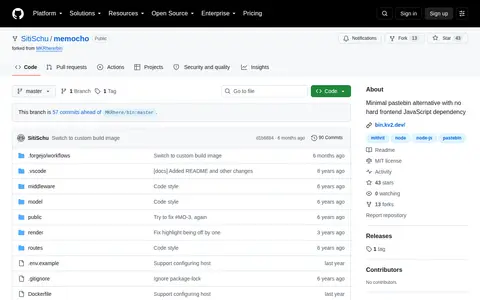
Memochō is a lightweight pastebin and hastebin alternative forked from mkr/bin, with no hard frontend JavaScript dependency. It can run via Node.js with configuration through environment variables, in Docker, or with Docker Compose. Customisation is possible by adding a style.css and addon.js file to a custom directory.

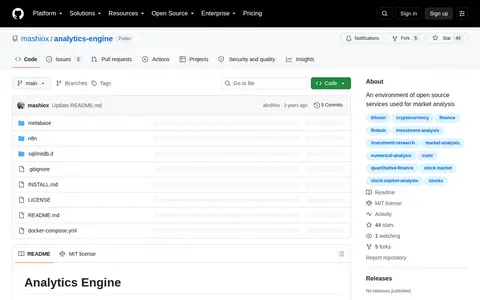
Analytics Engine combines PostgreSQL, n8n and Metabase to collect and analyze market data. The repository includes a Docker Compose environment and setup instructions.

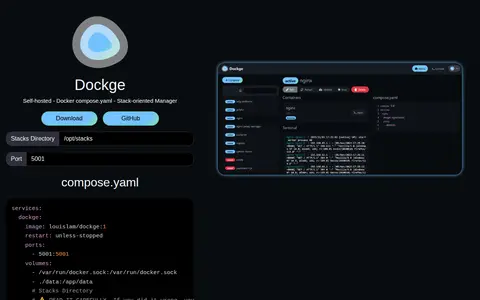
Manage Docker Compose application stacks through a web interface.

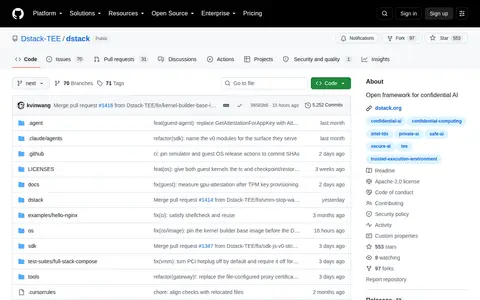
dstack is an open framework for confidential AI that runs containers inside confidential VMs with Intel TDX, using existing Docker Compose files. It supports attested workload identities and native NVIDIA Confidential Computing on H100 and Blackwell GPUs, with options for self-hosted TDX machines or Phala Cloud.

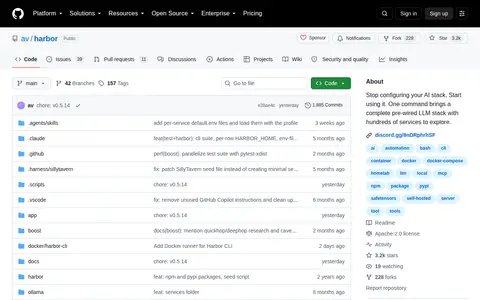
Harbor is a CLI and companion app that starts a pre-wired local LLM stack. Users pick services such as Ollama, llama.cpp, vLLM, Open WebUI, SearXNG, Speaches and ComfyUI, and Harbor handles Docker Compose orchestration, configuration and cross-service connectivity with a single harbor up command.

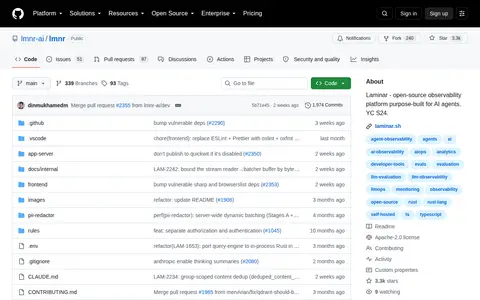
Laminar is an open-source observability platform purpose-built for AI agents. It provides OpenTelemetry-native tracing with a one-line SDK setup, plain-English signals that alert in Slack, and an SDK and CLI for running evals. It is written in Rust with 20x trace compression, and can be used via a managed platform or self-hosted with Docker Compose.

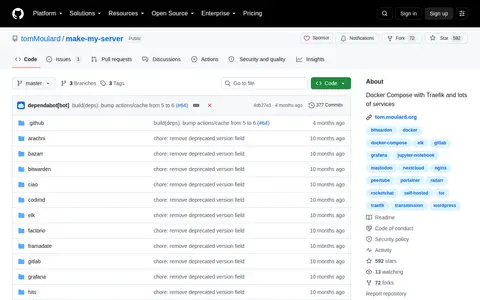
Docker Compose with Traefik and lots of services

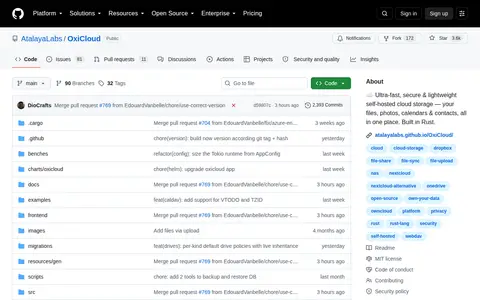
OxiCloud is a self-hosted cloud storage project written in Rust for files, photos, calendars and contacts. It includes built-in WebDAV, CalDAV and CardDAV protocols, plus files, previews, sharing, trash, search, favorites and recent items. Deployment options include Docker Compose, a Helm chart and a Nix module.

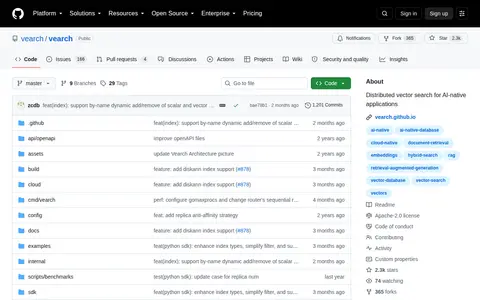
Vearch is a cloud-native distributed vector database for similarity search of embedding vectors in AI applications. It supports hybrid vector search and scalar filtering, replication, elastic scaling, RESTful APIs, and SDKs for Python, Go, Java and Rust. It integrates with frameworks including LangChain and LlamaIndex and can be deployed via Kubernetes or Docker Compose.