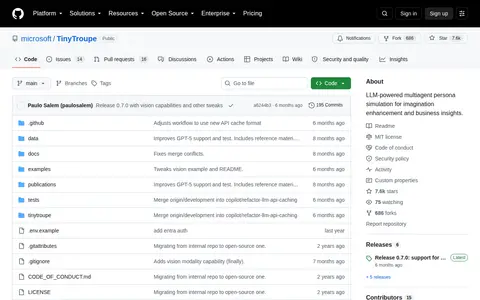

TinyTroupe is an experimental Python library for simulating people with defined personalities, interests and goals. These agents, called TinyPersons, interact in simulated TinyWorld environments using large language models. The project targets imagination enhancement and business insights, with suggested uses such as evaluating digital ads offline, generating synthetic data and simulating focus groups.
Directory
Search results
Published directory entries matching your search.
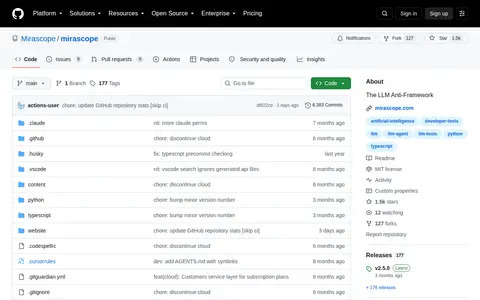
Mirascope is a project labeled the LLM Anti-Framework that provides one unified interface for using frontier LLMs. Its examples show calling LLMs with a decorator, getting structured output via Pydantic models, and building an agent with tools. It is organized as a monorepo with Python and TypeScript implementations plus documentation.
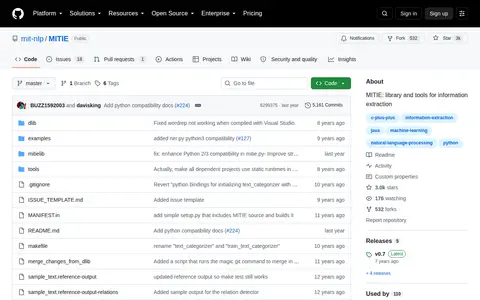
MITIE is a set of tools for information extraction built on dlib. It provides named entity extraction and binary relation detection, along with tools for training custom extractors and relation detectors. Pre-trained models support English, Spanish and German. The core is written in C++, with bindings for Python, R, Java, C and MATLAB.
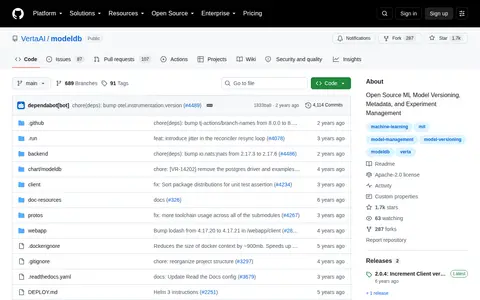
ModelDB is an open-source system for versioning machine learning models, including their code, data, config and environment, and for tracking ML metadata across the model lifecycle. It supports reproducible models, experiment management and lifecycle tracking. It runs on Docker and Kubernetes, offers Python and Scala clients, and is maintained by Verta.ai.
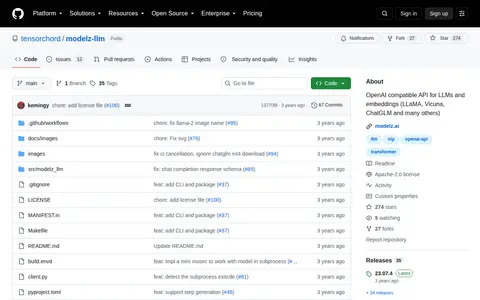
Modelz LLM is an inference server for running open source large language models such as FastChat, LLaMA and ChatGLM on local or cloud environments with an OpenAI compatible API. It supports interaction through the OpenAI python SDK or LangChain and provides docker images for deployment on Kubernetes or Modelz.
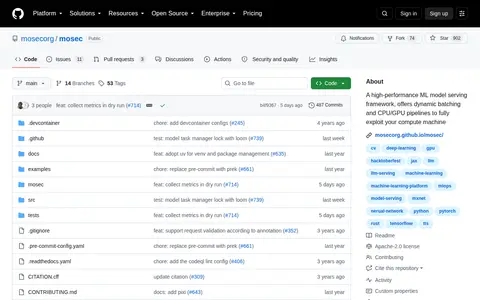
Machine learning model serving framework with dynamic batching and pipelined stages, provides an easy-to-use Python interface.
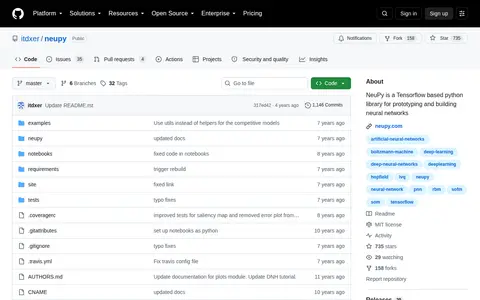
NeuPy is a Python library built on Tensorflow for prototyping and building neural networks. The repository notes that the library is no longer actively maintained. It includes examples and notebooks covering algorithms such as Boltzmann machines and self-organizing maps.
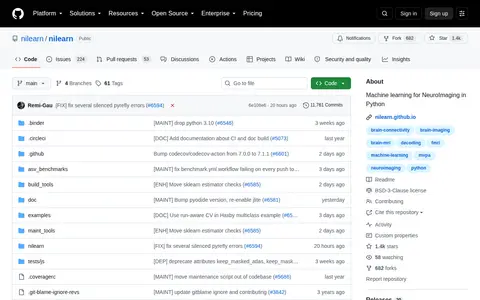
Nilearn provides statistical and machine-learning tools for analyses of brain volumes and surfaces, with documentation and a community. It supports general linear model based analysis and uses the scikit-learn toolbox for multivariate statistics, with applications such as predictive modeling, classification, decoding and connectivity analysis. It is written in Python and installable with pip.


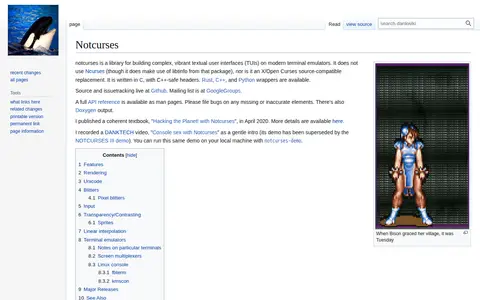
Notcurses is a C library for building complex textual user interfaces on modern terminal emulators. It does not use Ncurses, though it uses libtinfo from that package, and is not a source-compatible X/Open Curses replacement. Rust, C++, and Python wrappers are available. Source and issue tracking are hosted on GitHub, with a man page API reference.
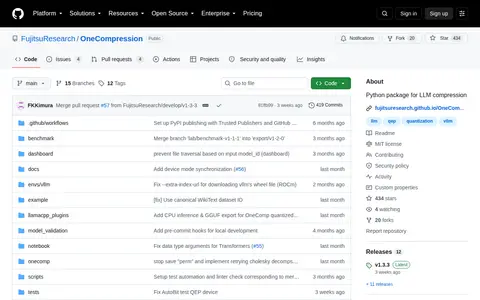
OneComp is a Python package for large language model (LLM) compression, hosted as a public repository under the FujitsuResearch GitHub organization. The project is designed for LLM compression tasks and accepts community contributions to its codebase.
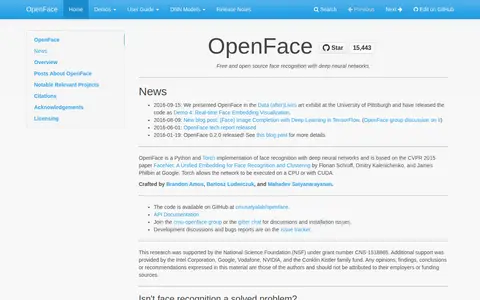
OpenFace is a free and open source face recognition implementation with deep neural networks, written in Python and Torch and based on the CVPR 2015 FaceNet paper. It detects faces, aligns them, and embeds faces on a 128-dimensional unit hypersphere.
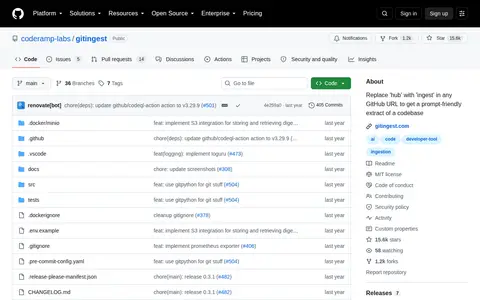
Gitingest converts any Git repository into a prompt-friendly text ingest for LLMs. Users can replace hub with ingest in any GitHub URL to access the corresponding digest. It provides a text digest from a repository URL or directory, with smart formatting for LLM prompts and statistics on file and directory structure, extract size and token count. It is available as a CLI tool and Python package.
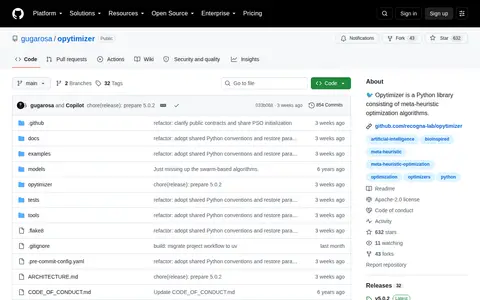
Python-based meta-heuristic optimization techniques.
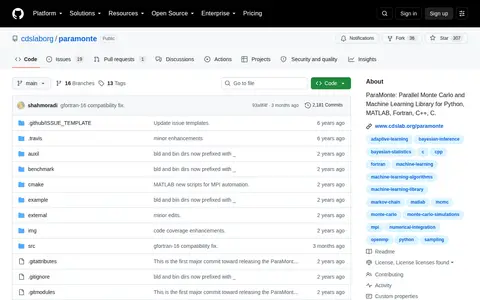
ParaMonte is a serial and parallel library of Monte Carlo routines for sampling mathematical density functions of arbitrary dimensions and machine learning algorithms for scientific inference. It is designed for interoperability with C, C++, Fortran, MATLAB and Python, and supports shared-memory OpenMP threads and MPI distributed communications.
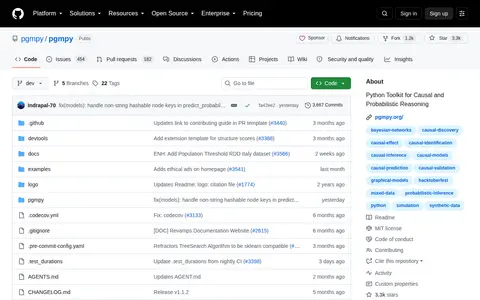
pgmpy is a Python toolkit for causal and probabilistic reasoning using graphical models. It implements data structures for models such as DAGs, PDAGs, MAGs, PAGs, Bayesian Networks, Dynamic Bayesian Networks and Structural Equation Models, with algorithms for tasks including causal discovery, causal identification, inference, model validation, parameter estimation and simulations. Algorithms follow a unified composable API and are scikit-learn compatible when possible. It is available on PyPI and conda.
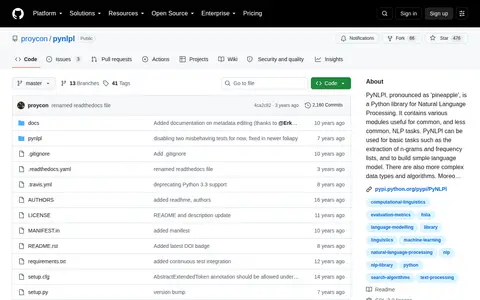
PyNLPl, pronounced "pineapple", is a Python library for natural language processing. It includes modules for common and less common NLP tasks, such as n-gram and frequency list extraction, simple language model building, parsers for common NLP file formats including FoLiA, Giza, Moses, ARPA, Timbl and CQL, clients for NLP-specific servers, and extensive tools for working with FoLiA XML linguistic annotation.
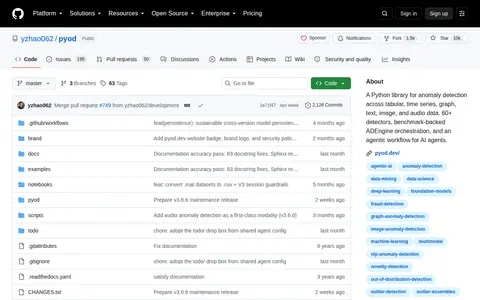
PyOD is an open-source Python library hosted on GitHub for anomaly detection across tabular, time series, graph, text, image and audio data. It includes over 60 anomaly detectors, an ADEngine orchestration tool, and supports agentic workflows for use with AI agents.
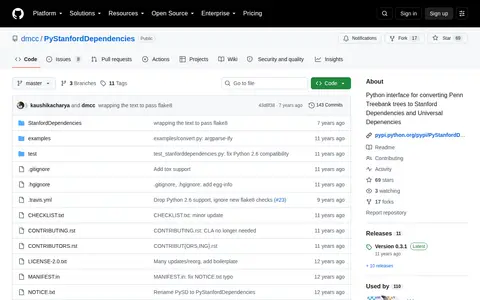
PyStanfordDependencies is a Python interface for converting Penn Treebank trees to Stanford Dependencies and Universal Dependencies. It offers a get_instance() function with subprocess or jpype backends, and convert_tree() or convert_trees() methods returning Token objects. Visualization options include asciitree, Graphviz dotgraphs, and interactive xdot windows. A Stanford CoreNLP or Parser jar file can be supplied, or downloaded automatically.
Discord invite for joining a related community, support server, updates, or project discussion.
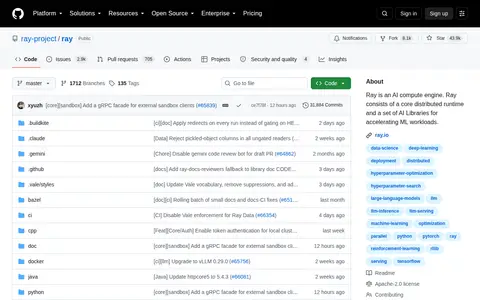
Ray is an AI compute engine consisting of a core distributed runtime and AI libraries for scaling AI and Python applications. It runs on any machine, cluster, cloud provider, and Kubernetes, and is installed with pip install ray.
Ren'Py is a visual novel engine for telling interactive stories with words, images and sounds on computers and mobile devices. It covers visual novels and life simulation games, using an easy to learn script language and Python scripting. It is open source and free for commercial use, with supported platforms including Windows, Mac, Linux, Android and iOS.
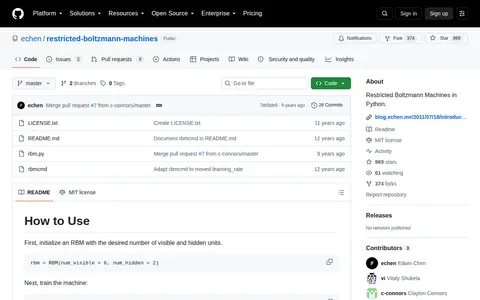
A Python implementation of Restricted Boltzmann Machines. It lets users initialize an RBM with a chosen number of visible and hidden units, train it on a matrix of training examples, run visible or hidden data, and let the network run freely. It is released under an MIT license.
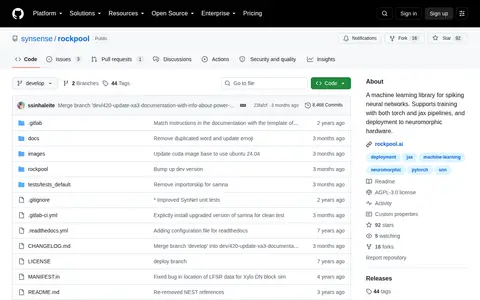
Rockpool is a Python package for developing signal processing applications with spiking neural networks. It allows users to build networks, simulate, train and test them, and deploy them in simulation or on event-driven neuromorphic compute hardware. It provides layers with simulation backends including Brian2, Torch, JAX, Numba and raw numpy.
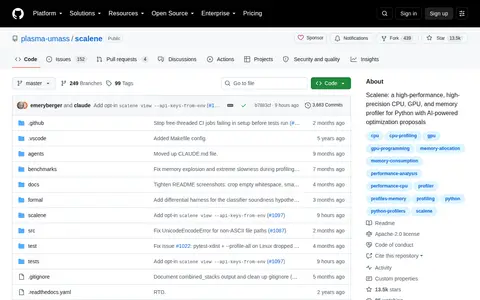
Scalene is a Python profiler that measures CPU, GPU and memory usage. It identifies inefficiencies and can request optimization suggestions from AI providers, including Amazon Bedrock, Microsoft Azure, OpenAI and local models via Ollama. It can be used at the command line or as a Visual Studio Code extension, and installs via pip or conda.