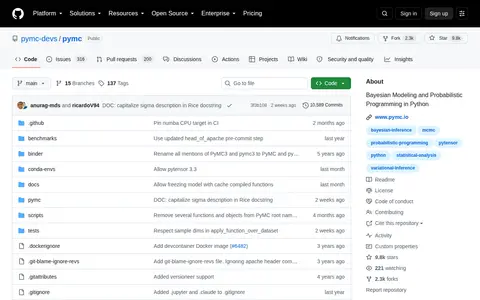

ParaMonte is a serial and parallel library of Monte Carlo routines for sampling mathematical density functions of arbitrary dimensions and machine learning algorithms for scientific inference. It is designed for interoperability with C, C++, Fortran, MATLAB and Python, and supports shared-memory OpenMP threads and MPI distributed communications.
Directory
Search results
Published directory entries matching your search.
Pattern Recognition Toolbox (PRT) is a free, MIT-licensed, object-oriented toolbox for machine learning and pattern recognition in MATLAB. It provides MATLAB commands and data types to help organize, visualize, process, cluster and classify data, and supports predictions based on data.
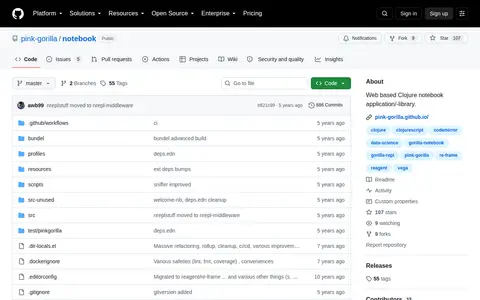
A Clojure/Clojurescript notebook application/-library based on Gorilla-REPL.
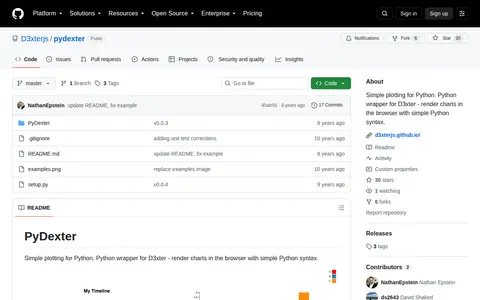
PyDexter is a Python wrapper for D3xter that renders charts in the browser using simple Python syntax. It supports histogram, scatter, plot, pie, timeline and bar chart examples. Installation is done with pip install PyDexter, and charts can be configured with settings such as height, width and title.
Markov Chain Monte Carlo sampling toolkit.
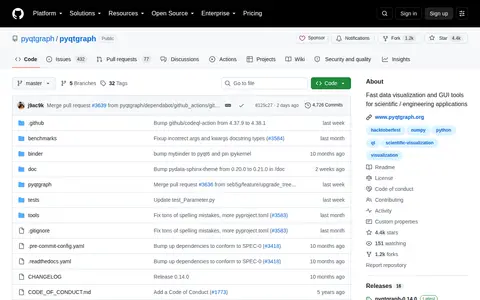
PyQtGraph is a pure-Python graphics library that uses the Qt framework. It is intended for mathematics, scientific and engineering applications, and relies on numpy for number crunching, Qt's GraphicsView for 2D display and OpenGL for 3D display. It supports Python 3.12+, Qt 5.15 or 6.8+, and numpy 2.2+.
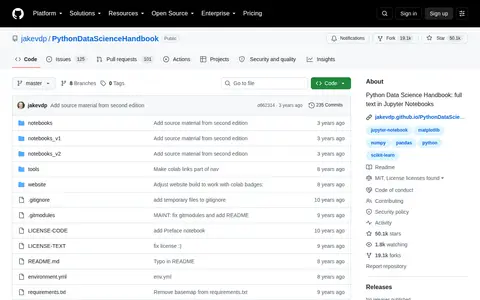
Python Data Science Handbook is a code project with source, releases, documentation, or setup notes.
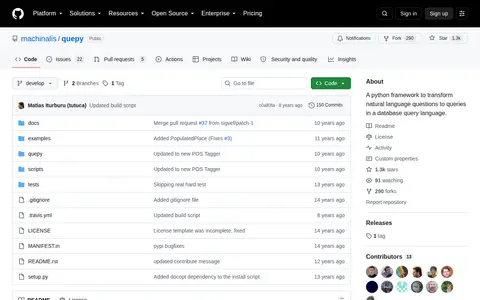
A python framework to transform natural language questions to queries in a database query language.
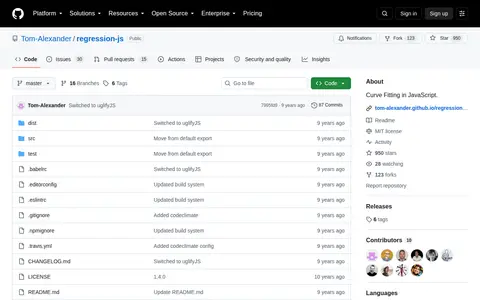
regression-js is a JavaScript library for curve fitting. It is hosted on GitHub and can be contributed to by the community. It is open source and available for installation via npm.
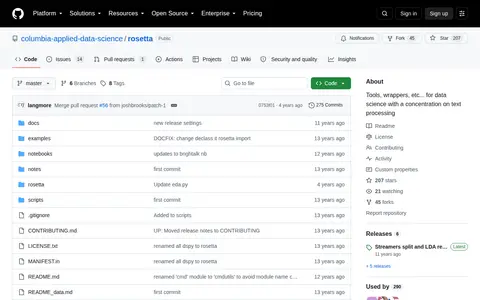
Rosetta is an open-source data science toolset hosted in the columbia-applied-data-science GitHub repository. It provides tools, wrappers and other utilities for data science workflows, with a specific focus on text processing.
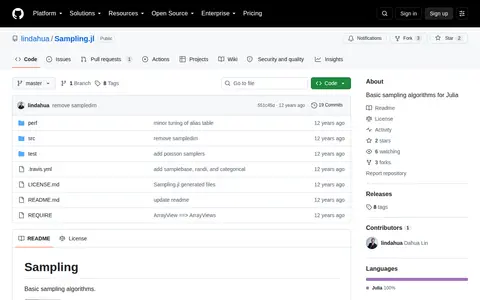
Basic sampling algorithms for Julia.
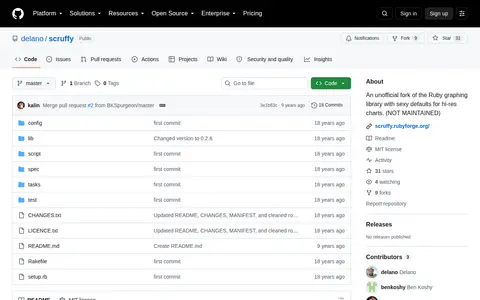
Scruffy is an unofficial fork of the Ruby graphing library, based on the official 0.2.5 release, intended for hi-resolution graphs and charts. It renders to SVG or bitmap formats such as PNG and JPG. The fork is marked as not maintained.
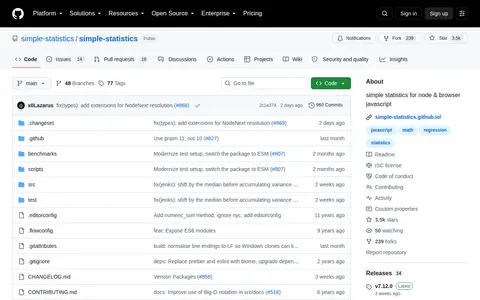
Simple Statistics is a JavaScript implementation of descriptive, regression, and inference statistics. It is written in literate JavaScript with no dependencies and is designed to work in all modern browsers and in Node.js. The repository is published under an ISC license.
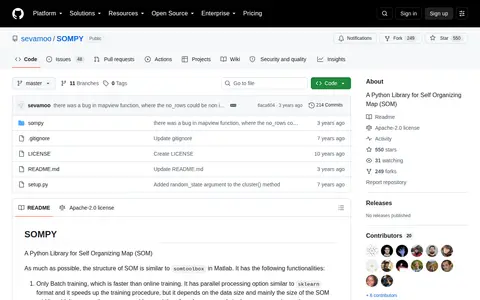
SOMPY is a Python library for self-organizing maps structured similarly to somtoolbox in Matlab. It offers only batch training, PCA or RandomPCA initialization, component plane visualization, hitmap and U-Matrix visualization, and 1-d or 2-d SOM with rectangular, planar grid. It supports function approximation and predictions, mostly using Sklearn.
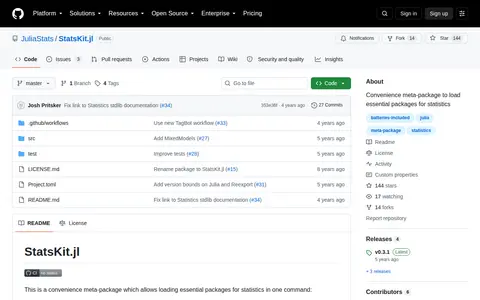
StatsKit.jl is a convenience meta-package for the Julia programming language. Developed by the JuliaStats organization, it aggregates essential packages for statistical computing into a single installation. The project is hosted on GitHub and aims to simplify the setup of a comprehensive statistics environment in Julia.
Statsmodels is a Python package that complements scipy for statistical computations, including descriptive statistics and estimation and inference for statistical models. It provides linear regression models, generalized linear models, discrete models, time series analysis, survival analysis, multivariate methods and a range of statistical tests.
Summingbird is a library for writing MapReduce programs that resemble native Scala or Java collection transformations and running them on distributed MapReduce platforms including Storm and Scalding. Programs can execute in batch mode, realtime mode, or a hybrid mode combining Scalding and Storm. The repository was archived by its owner on Jan 20, 2022 and is read-only.
SVGo is a Go language library for SVG generation. It supports common SVG elements including shapes, lines, text, paths, images, and gradients, and is hosted as an open-source project on GitHub.
A Python library for symbolic mathematics.
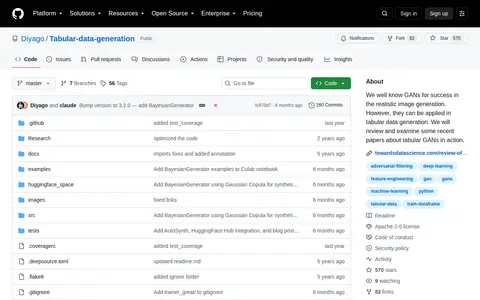
TabGAN is a software project hosted on GitHub under the Diyago/Tabular-data-generation repository. It focuses on the application of generative adversarial networks (GANs) to tabular data generation, reviewing and analyzing recent research and practical implementations in this field.
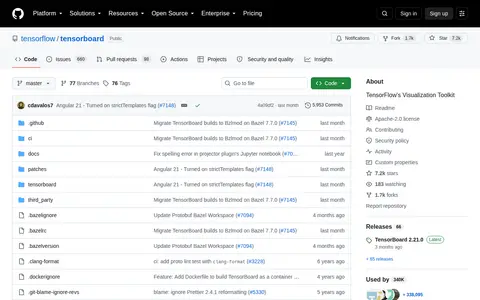
TensorFlow's Visualization Toolkit.
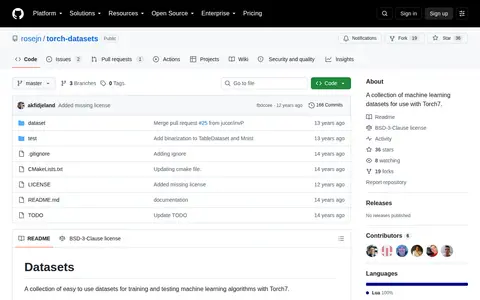
Scripts to load several popular datasets including:.
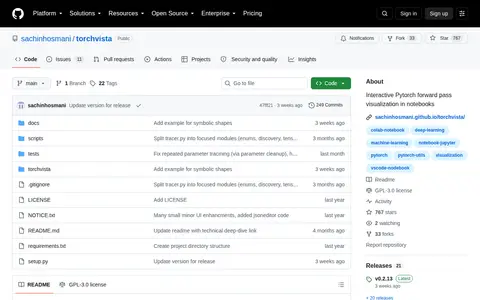
torchvista is an open-source tool that enables interactive visualization of PyTorch forward passes in Jupyter notebooks, maintained as a public GitHub repository under the sachinhosmani organization. It supports interactive drag-and-zoom graphs, collapsible nodes for hierarchical modules, and error-tolerant partial visualization when errors arise.
The visualizer is a tool developed by the cheminformatics department of the Swiss Federal Institute of Technology for rendering complex datasets. Its modules, placed on a browser page, display information as tables, charts, matrices or lists and interact through a central API of variables and actions. Visualization starts by passing three JSON file URLs in the browser address bar. It is released under the MIT license.