
docs.geniusrise.ai
Host inference APIs, bulk inference and fine tune text, vision, audio and multi-modal models.
Directory
Published directory entries matching your search.
Host inference APIs, bulk inference and fine tune text, vision, audio and multi-modal models.

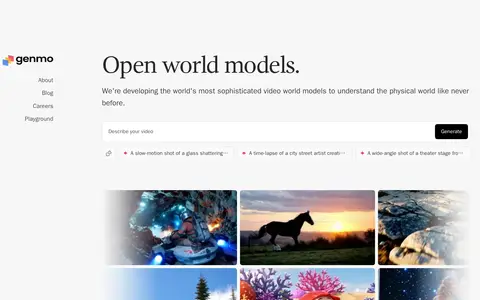
Genmo is a research lab that develops open models for video generation. Its Mochi 1 model is an open-source text-to-video model, available through an open-source repository or ComfyUI and an interactive playground. The playground creates AI-generated videos, and FAQ materials describe MP4 output, text-to-video generation, and Free, Lite, Standard, and Pro plans.

Open-source project that provides machine-learning models, research, training resources, or evaluation tools.
Godmode provides machine-learning models, research, training resources, or evaluation tools.

Google tool for building, testing, and experimenting with Gemini prompts, models, and API workflows.

Google tool for building, testing, and experimenting with Gemini prompts, models, and API workflows.

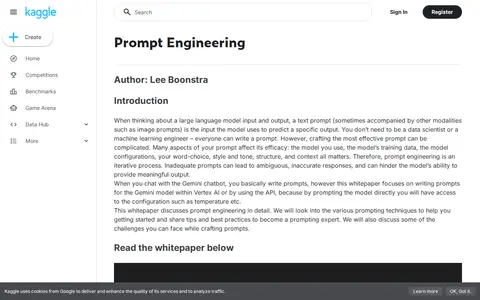
This is a Kaggle page for a Google prompt engineering whitepaper. It invites users to join a community of builders, researchers and labs evaluating AI agents, models and frontier technology through crowdsourced benchmarks, competitions and hackathons.

GPT Engineer provides machine-learning models, research, training resources, or evaluation tools.

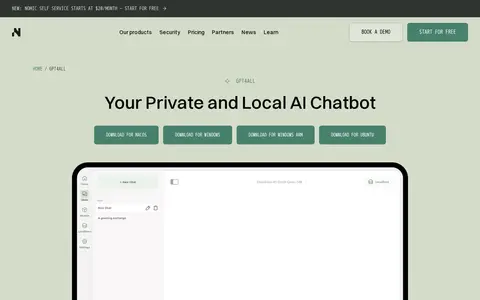
GPT4All is a private, local AI chatbot tool developed by Nomic. It enables users to run open-source AI models directly on their personal devices without cloud connectivity, with all user data remaining on the local machine.

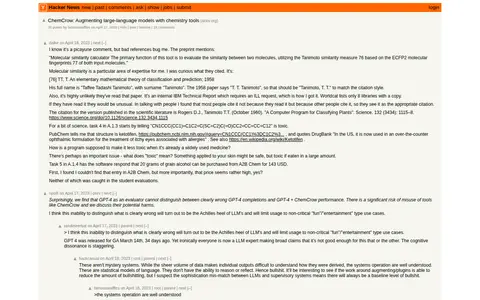
A Hacker News discussion thread about the ChemCrow preprint on augmenting large-language models with chemistry tools. Commenters raise citation problems and question how a program can make an already widely used medicine less toxic.

Heroes Wear Masks provides machine-learning models, research, training resources, or evaluation tools.

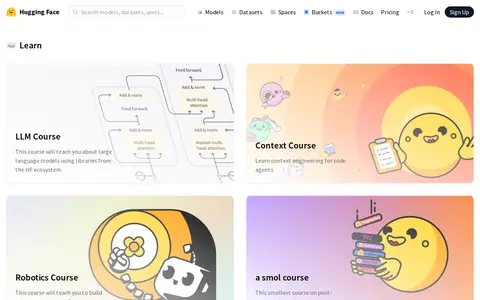
HF Learn supports machine learning models, deployment, inspection, datasets, or AI development workflows.

Creates, rewrites or summarizes written content with language models.
How AI Fails Us Edmond & Lily Safra Center for Ethics provides machine-learning models, research, training resources, or evaluation tools.

Hugging Face provides machine-learning models, research, training resources, or evaluation tools.

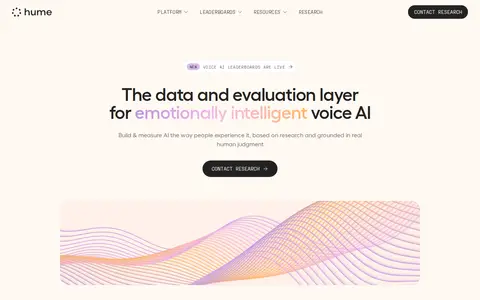
Hume provides voice AI evaluation infrastructure through its VoiceEQ platform. It turns real-world use cases into targeted evaluation suites and combines automated measurement with human judgment to diagnose failures in voice models and agents. The platform covers TTS, speech-to-speech, ASR, and cascaded systems, and the company reports support for over 50 languages.

Hunyuan provides machine-learning models, research, training resources, or evaluation tools.
A first-person essay by former writing and literature teacher Victoria Livingstone describing why she left teaching, citing students' reliance on large language models such as ChatGPT for drafting and revising written work. The piece discusses pedagogical attempts to address AI use and the difficulty of evaluating AI-revised text.

IBM Watson is enterprise AI technology from IBM. IBM Research began work in 2007 on a computer system to compete at Jeopardy!, and in 2011 the Watson system defeated two top-ranked players. Watson technology became available as a cloud development platform in 2013. In 2023 IBM announced the watsonx AI portfolio for training, tuning and distributing models.

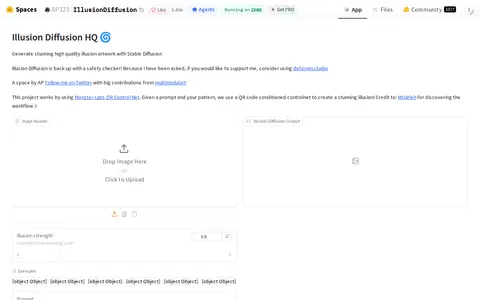
Illusion Diffusion is a Hugging Face Space developed by AP123 for AI image generation. Users can upload an image to use as an illusion pattern, input a text prompt describing their desired output, and the app generates high-quality artwork that blends the uploaded pattern with the prompt content.

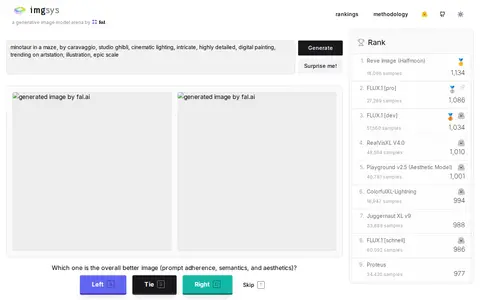
imgsys is a generative AI image model arena developed by fal.ai. It allows users to test prompts across different image models, view public model rankings and compare generated outputs to select preferred results.

The Indico LLM Leaderboard provides benchmarking for large language models on extractive, classification, and predictive tasks. It includes accuracy comparisons, cost of ownership assessments, and datasets such as CORD and Kleister NDA, with the latest update in August 2024.
Infer.NET is a framework for running Bayesian inference in graphical models. It can be used for machine learning problems such as classification, recommendation or clustering, and for probabilistic programming. It is published as open source on GitHub under the MIT license and available as NuGet packages.

InferKit provides machine-learning models, research, training resources, or evaluation tools.