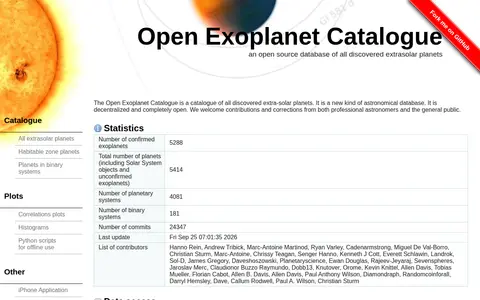
The Open Exoplanet Catalogue is a decentralized, open-source database of discovered extrasolar planets. The website displays the catalogue in a browser, while the data is stored as human-readable XML files in a git version control system. Contributions and corrections are accepted from professional astronomers and the public, and data can be downloaded from the GitHub repository.

Directory
Search results
Published directory entries matching your search.
Open Government Portal provides a searchable catalogue of Government of Canada open data. It lists datasets by publisher, format, subjects and update frequency, and includes guidance on working with datasets. The source describes open data as machine-readable, freely shared and reusable without restrictions.
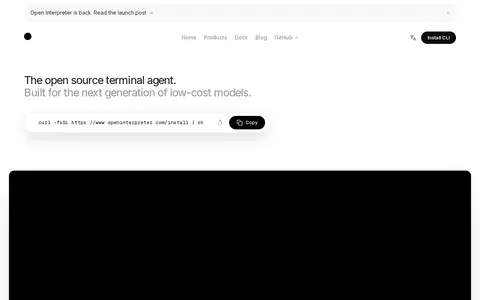
An open-source coding agent built for low-cost and open-weight models.
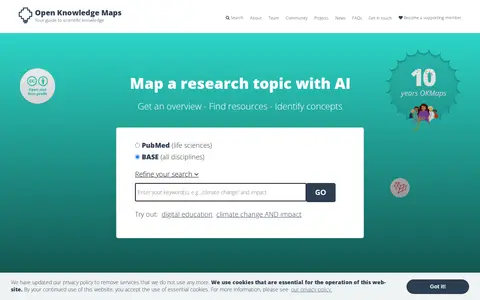
Open Knowledge Maps is a nonprofit, open science AI-based search engine for scientific knowledge. It provides visual overviews of research topics, helps users find relevant research outputs and identify key concepts. The platform searches over 400 million outputs from more than 11,000 sources, with results based solely on underlying metadata to avoid hallucinations.
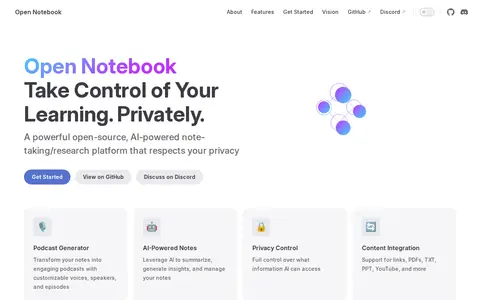
Open Notebook is an open-source, AI-powered note-taking and research platform focused on user privacy. It includes a podcast generator that transforms notes into customizable audio content, AI tools for summarizing notes and generating insights, granular privacy controls for AI data access, and support for integrating links, PDFs, text files, presentations, YouTube videos and other content types. The platform is designed for researchers, students, and learning enthusiasts.
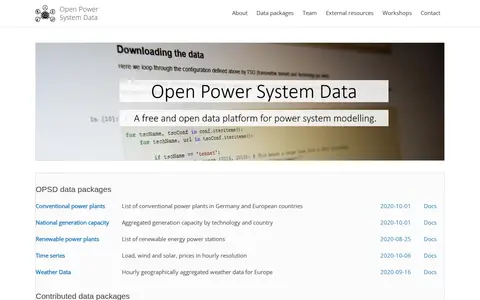
Open Power System Data is a free-of-charge data platform for electricity system researchers and power system modelling. It collects, checks, processes, documents and publishes publicly available power system data that is inconvenient to use, covering installed generation capacity, individual power plants and time series such as consumption, spot prices and wind and solar generation. Processing scripts are open source on GitHub and data is published primarily as CSV files with JSON metadata.
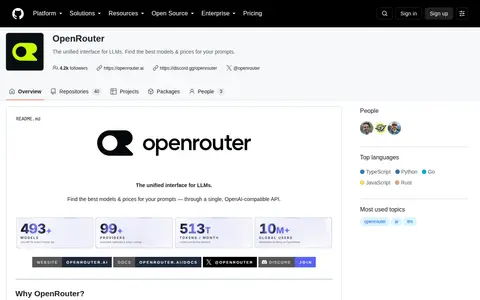
OpenRouterTeam is the GitHub organization behind OpenRouter, described as a unified interface for LLMs. The organization publishes open source SDKs for TypeScript, Python and Go, plus agent tooling, and maintains the Mintlify-hosted documentation repository for openrouter.ai/docs.
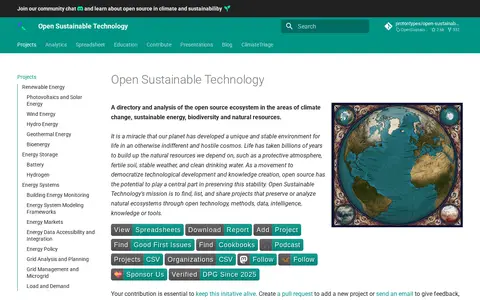
Open Sustainable Technology is a directory and analysis of the open source ecosystem in climate change, sustainable energy, biodiversity and natural resources. Its stated mission is to find, list, and share projects that preserve or analyze natural ecosystems through open technology, methods, data, intelligence, knowledge or tools. Contributions are invited via pull request or email.
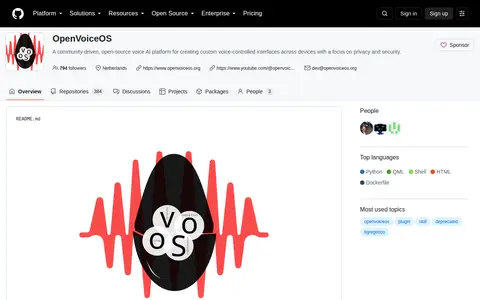
Open Voice Os is a miscellaneous web resource for discovery, directories, archives, web culture, or useful tools.
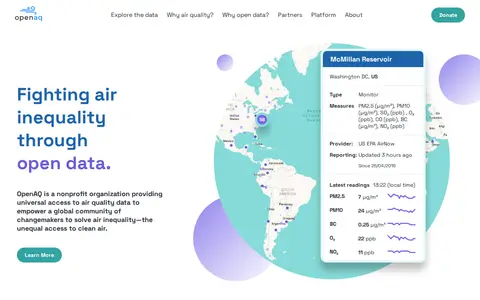
OpenAQ is a nonprofit environmental technology organization that provides open access to ground-level air quality data. It aggregates data from hundreds of sources worldwide and harmonizes them on an open-source platform. Users can access data through a REST API, an interactive map, and the OpenAQ Explorer web application. The platform provides physical measurements rather than aggregated values such as air quality indexes.
OpenArt is an AI creation platform for generating images, videos, audio and 3D worlds. Its features include a cinematic video generator, a URL to Video tool that turns a web link into a video, and generators for Pixar-style characters, logos, 3D cartoons, technical drawings and interior designs. OpenArt Worlds creates navigable 3D worlds from an image, powered by World Labs spatial AI.
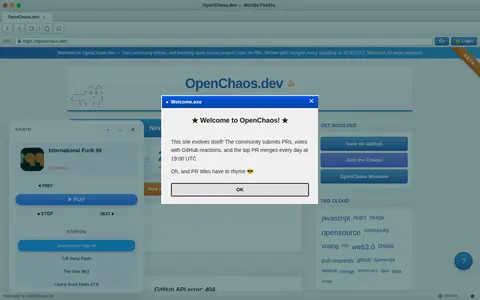
OpenChaos.dev is a self-evolving open source project in which the community votes weekly on pull requests and the winning PR is merged. The site frames this as Control versus Chaos and lists past winners in a Hall of Chaos. It also references voting countdowns and a project tag cloud.
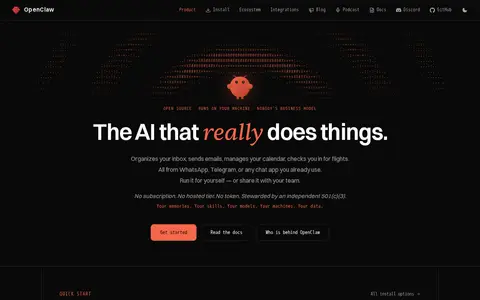
OpenClaw is an open-source AI assistant that runs on the user's machine and works from WhatsApp, Telegram or other chat apps. According to the site, it organizes inboxes, sends emails, manages calendars and checks users in for flights. Desktop apps are listed for macOS, Windows and Linux, and an enterprise platform is in development ahead of a 1.0 release.
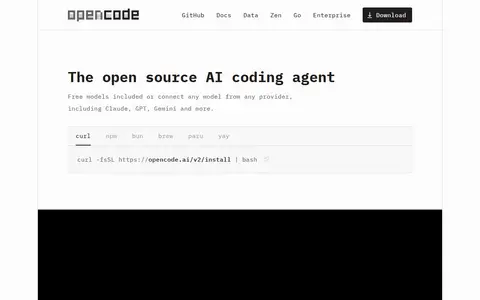
OpenCode is an open source AI coding agent available as a terminal-based interface, desktop app, or IDE extension. It supports multiple LLM providers and local models, and does not store code or context data. Enterprise options include centralized configuration, SSO integration, and an internal AI gateway.
OpenColorIO is an open-source color management solution geared towards motion picture production, with an emphasis on visual effects and computer animation. OCIO is integrated and ready to use in many major software packages.
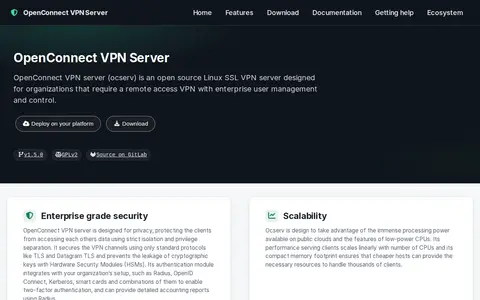
The OpenConnect VPN server (ocserv) is an open source Linux SSL VPN server designed for organizations requiring a remote access VPN with enterprise user management and control. It secures VPN channels using standard protocols like TLS and Datagram TLS, and its performance scales linearly with the number of CPUs.
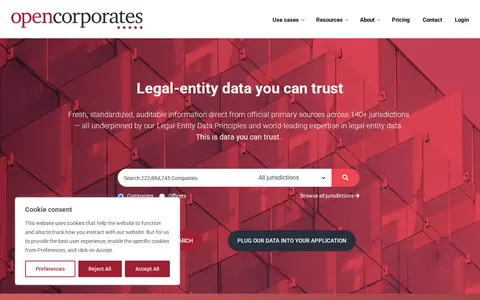
OpenCorporates provides legal-entity data drawn from official primary sources across more than 140 jurisdictions. It offers search of its legal-entity database and access to data through a self-serve API or secure bulk delivery. The site lists use cases including entity verification, third-party risk management, investigations and data management. API plans carry stated monthly and annual prices.

OpenCV is an open source computer vision library that contains over 2500 algorithms and supports model execution for machine learning and artificial intelligence. It was designed to be cross-platform, written in C with C++ and wrappers for Python and Java, and runs on desktop and mobile systems. A GPU module implemented with CUDA provides acceleration for part of the library.
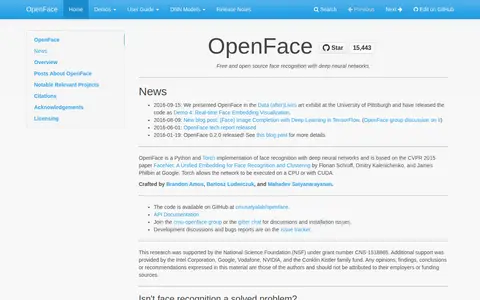
OpenFace is a free and open source face recognition implementation with deep neural networks, written in Python and Torch and based on the CVPR 2015 FaceNet paper. It detects faces, aligns them, and embeds faces on a 128-dimensional unit hypersphere.
OpenFOAM is a free, open source computational fluid dynamics (CFD) software developed primarily by OpenCFD Ltd since 2004. It offers an extensive range of features for solving complex fluid flows involving chemical reactions, turbulence and heat transfer, as well as acoustics, solid mechanics and electromagnetics. Releases are scheduled every six months, and the software is distributed under the GPL v3 licence.
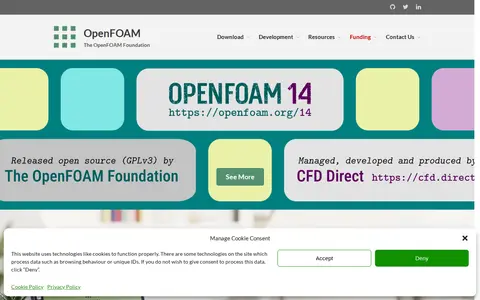
OpenFOAM is free, open source computational fluid dynamics software written in C++, owned by the OpenFOAM Foundation and distributed under the General Public Licence. It calculates fluid motion and forces, heat transfer, thermodynamics and chemistry in fluids and solids. It is produced by the core maintenance team at CFD Direct and is used in industry, government research and academia.
OpenFront Wiki is the official community wiki for OpenFront, described as an open-source, browser-based real-time strategy game. The wiki covers guides, game mechanics and updates, including wiki pages on settings, combat, gold, bots, nations and buildings, and featured beginner and team game guides.
Opengist is an open-source, self-hosted pastebin powered by Git. Snippets are stored in Git repositories and can be managed with standard Git commands or a web interface. It supports public, unlisted, and private snippets, multiple files per snippet, revisions and diffs, syntax highlighting, and login through OAuth2 providers, LDAP, and passkeys. It is written in Go and can run as a single binary, Docker image, or Kubernetes deployment, backed by SQLite, PostgreSQL, or MySQL.
openHAB is a vendor- and technology-agnostic open source automation software for the home, developed in Java on Apache Karaf. Its pluggable architecture supports over 400 technologies and thousands of devices, with rules driven by time, events, scripts, actions, notifications and voice control. It runs on Linux, macOS, Windows, Raspberry Pi, Docker and Synology, and is accessed through web, iOS and Android apps. It runs on local hardware without requiring cloud services.