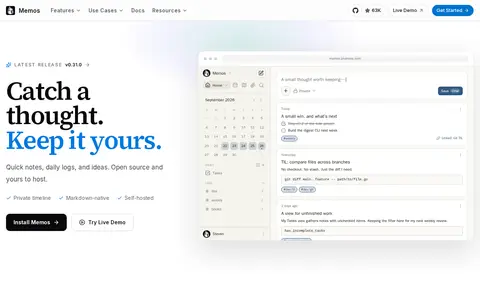

Memos is an open-source, self-hosted note-taking app that provides a timeline for quick notes written in Markdown. New memos are private by default, and visibility can be limited to the author, invited people, or anyone with the link. The software is MIT licensed, sends no telemetry, and can be deployed with Docker.
Directory
Search results
Published directory entries matching your search.
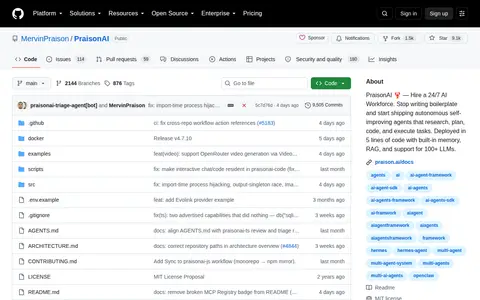
PraisonAI is an open-source project hosted on GitHub under the MervinPraison/PraisonAI repository. It enables the deployment of autonomous, self-improving AI agents capable of researching, planning, coding, and executing tasks. The tool includes built-in memory and retrieval-augmented generation (RAG) capabilities, supports over 100 large language models, and can be deployed with 5 lines of code.
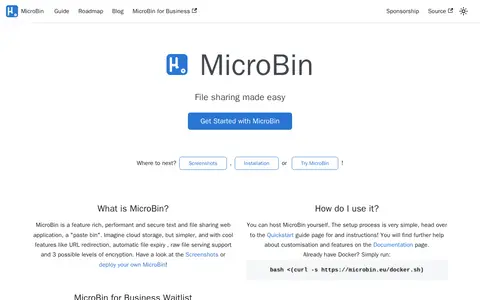
MicroBin is a self-hosted text and file sharing web application described as a paste bin. It offers features such as URL redirection, automatic file expiry, raw file serving and three levels of encryption. The project provides documentation for creating, accessing and modifying uploads, privacy levels and installation via Docker or Cargo.
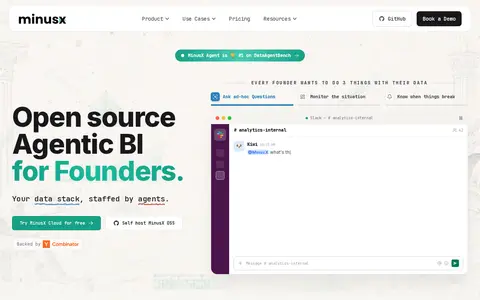
MinusX is an open source agentic business intelligence platform that combines a data agent with a BI tool. It answers questions, builds dashboards and sets alerts, with slides and data stories, visualizations and a SQL GUI. It can be self-hosted or used via MinusX Cloud, and the source is available and inspectable.
MiroTalk P2P is an open-source self-hosted WebRTC video calling and meeting platform. It supports peer-to-peer video calls with screen sharing, chat, whiteboard and collaboration in the browser. The project is released under AGPLv3 and states unlimited conference rooms without call time limitation.
MiroTalk P2P is an open-source self-hosted WebRTC video calling and meeting platform. It provides peer-to-peer calls with screen sharing, chat, whiteboard and collaboration in the browser. Calls require no download, plug-in, or login.


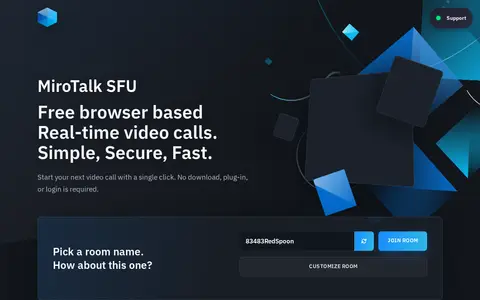
MiroTalk SFU is an open-source, self-hosted WebRTC video conferencing platform powered by Mediasoup. It offers browser-based real-time video calls with screen sharing, chat, recording, a collaborative whiteboard, file sharing and RTMP streaming. It is released under the AGPLv3 license and states no download, plug-in or login is required.
Moonlight is an open source game streaming client and implementation of NVIDIA's GameStream protocol that allows users to play PC games remotely on supported devices. It offers streaming at up to 4K with HDR support and up to 120 FPS, and can run on a self-hosted gaming server.
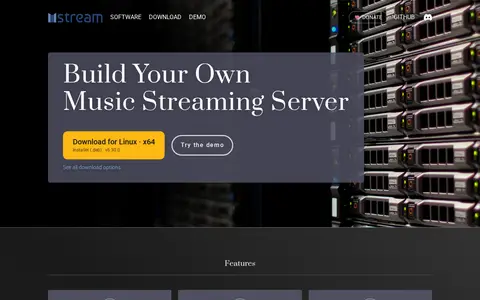
mStream is open source software for syncing and streaming music between devices. It is a self-hosted music server that runs on a computer the user owns, including old hardware and boards like the Raspberry Pi. Streams can include FLAC and lossless files, and the server is available for Windows, macOS, Linux, Raspberry Pi and NAS boxes, with Docker and source install options.
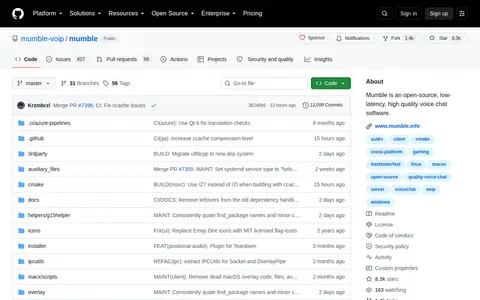
Open source voice chat software for low-latency group communication and self-hosted servers.
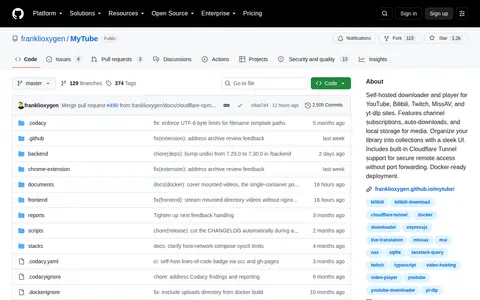
Self-hosted downloader and player for YouTube, Bilibili, Twitch, MissAV, and yt-dlp sites. Features channel subscriptions, auto-downloads, and local storage for media. Organize your library into collections with a sleek UI. Includes built-in Cloudflare Tunnel support for secure remote access without port forwarding. Docker-ready deployment.
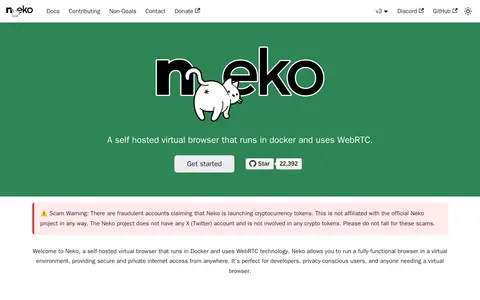
neko (stylized as n.eko) is a self-hosted virtual browser that runs in Docker using WebRTC technology. It supports use cases including watch parties, interactive presentations, collaborative work, teaching, content embedding, automated browsing, ultra-low-latency streaming, multi-participant control, and live broadcasting.
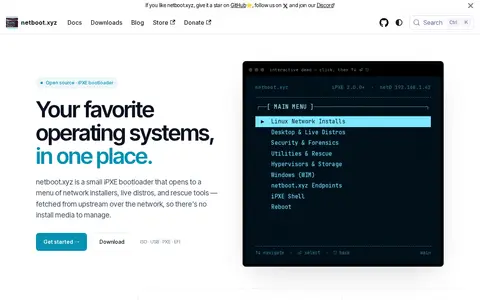
netboot.xyz is an iPXE-based bootloader that presents a menu for PXE booting operating system installers, live distros and rescue utilities over the network, so no install media is required. It can be placed on a USB stick, ISO or DHCP server, and can be self-hosted.
NoteDiscovery is a lightweight, self-hosted note-taking application for writing, organizing and discovering notes. Notes are stored as plain markdown files in folders, and the project is released under an MIT license.
NoteDiscovery is a self-hosted Markdown knowledge base described as free and open source. It includes wikilinks, graph view, a drawing editor, LaTeX math, and Mermaid diagrams, along with AI assistant integration via MCP. Notes are stored as plain Markdown files in folders, and the project offers a Docker-based setup.
Odysseus is a self-hosted AI workspace for running language models on one's own hardware. It offers chat, autonomous agents, tools and MCP connections, model serving, an email assistant, deep research, model comparison and persistent memory. The project is described as local-first and privacy-first, with no telemetry.
OmniRoute by Cheaper Inference is an open-source AI router that routes requests across providers through one OpenAI-compatible endpoint, with automatic fallback. It accepts OpenAI, Claude, Gemini and Responses API requests at /v1 and ships as a self-hosted gateway with a local dashboard. The catalog covers chat, media, search, local runtimes and cloud agents.
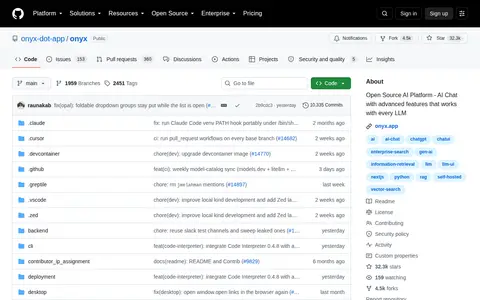
Onyx is an open-source AI platform that connects to applications to index and surface knowledge, with self-hosted deployment options. It provides agentic RAG search, deep research reports, custom agents, web search, a secure sandbox for code execution, artifacts, and voice mode. It works with major LLMs.
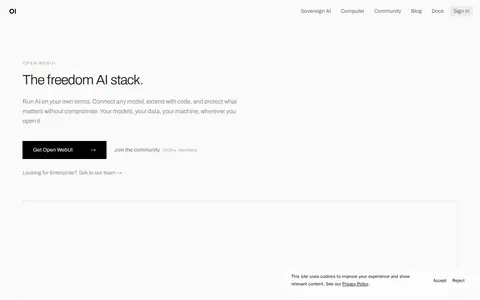
Open WebUI is a self-hosted AI interface for running AI on the user's own hardware. It connects to local or cloud models including Ollama, OpenAI, Anthropic, or compatible services, and can be extended with Python. The project offers community-shared prompts, models, tools, and functions, and lists deployment options including on-premises or air-gapped setups. Installation can be done with a pip command.
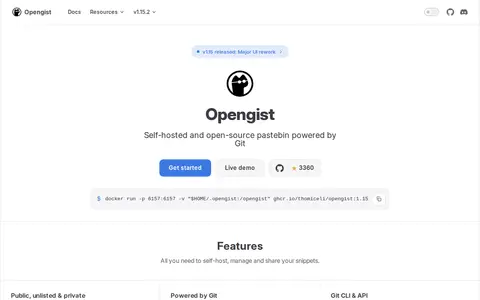
Opengist is an open-source, self-hosted pastebin powered by Git. Snippets are stored in Git repositories and can be managed with standard Git commands or a web interface. It supports public, unlisted, and private snippets, multiple files per snippet, revisions and diffs, syntax highlighting, and login through OAuth2 providers, LDAP, and passkeys. It is written in Go and can run as a single binary, Docker image, or Kubernetes deployment, backed by SQLite, PostgreSQL, or MySQL.
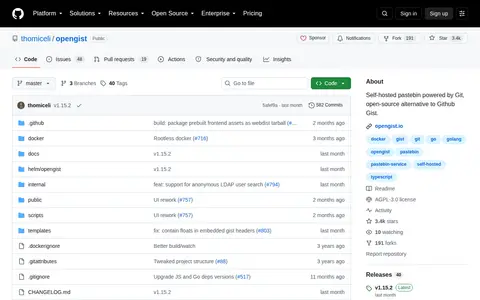
Opengist is a self-hosted pastebin powered by Git, described as an open-source alternative to GitHub Gist. Snippets are stored in a Git repository and can be read or modified with standard Git commands or through a web interface. It supports public, unlisted and private snippets, Git operations over HTTP or SSH, and Docker deployment.
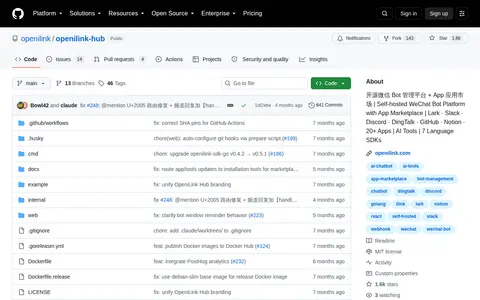
开源微信 Bot 管理平台 + App 应用市场 | Self-hosted WeChat Bot Platform with App Marketplace | Lark · Slack · Discord · DingTalk · GitHub · Notion · 20+ Apps | AI Tools | 7 Language SDKs
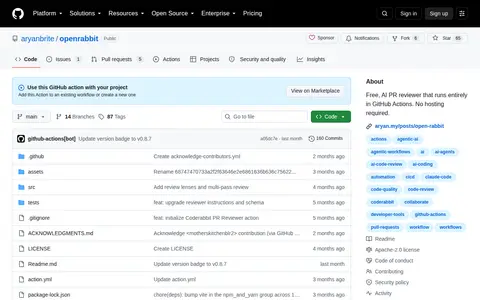
OpenRabbit is a free, open-source, self-hosted GitHub pull request reviewer. It analyzes PR diffs, consults a pluggable LLM provider such as Groq or OpenRouter, and posts a summary with inline comments. It runs entirely in GitHub Actions, so no server or hosting subscription is required, and code stays in the user's runner.
OpenSpeedTest is a browser-based HTML5 internet speed test that measures download, upload, ping, and jitter without Flash or Java. It works on phones, TVs, consoles, and computers. A free and open-source self-hosted server can be deployed, and a speed test widget can be embedded on websites or apps.