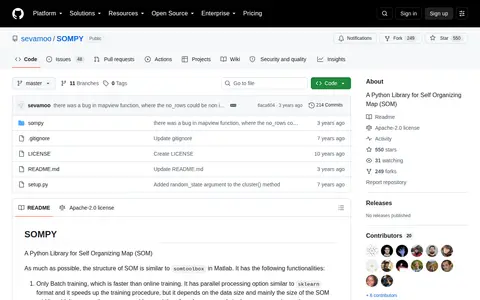

SOMPY is a Python library for self-organizing maps structured similarly to somtoolbox in Matlab. It offers only batch training, PCA or RandomPCA initialization, component plane visualization, hitmap and U-Matrix visualization, and 1-d or 2-d SOM with rectangular, planar grid. It supports function approximation and predictions, mostly using Sklearn.
Directory
Search results
Published directory entries matching your search.
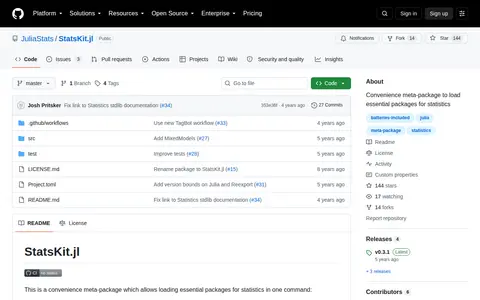
StatsKit.jl is a convenience meta-package for the Julia programming language. Developed by the JuliaStats organization, it aggregates essential packages for statistical computing into a single installation. The project is hosted on GitHub and aims to simplify the setup of a comprehensive statistics environment in Julia.
Statsmodels is a Python package that complements scipy for statistical computations, including descriptive statistics and estimation and inference for statistical models. It provides linear regression models, generalized linear models, discrete models, time series analysis, survival analysis, multivariate methods and a range of statistical tests.
Summingbird is a library for writing MapReduce programs that resemble native Scala or Java collection transformations and running them on distributed MapReduce platforms including Storm and Scalding. Programs can execute in batch mode, realtime mode, or a hybrid mode combining Scalding and Storm. The repository was archived by its owner on Jan 20, 2022 and is read-only.
SVGo is a Go language library for SVG generation. It supports common SVG elements including shapes, lines, text, paths, images, and gradients, and is hosted as an open-source project on GitHub.
A Python library for symbolic mathematics.
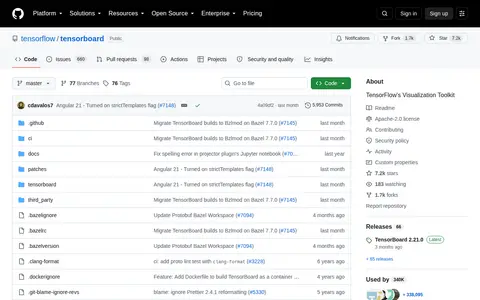
TensorFlow's Visualization Toolkit.
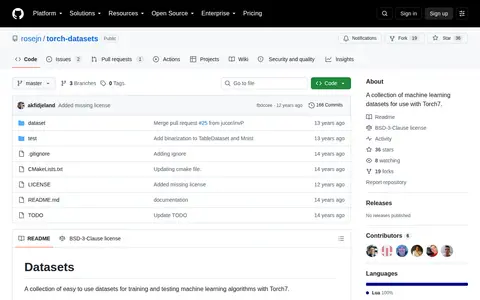
Scripts to load several popular datasets including:.
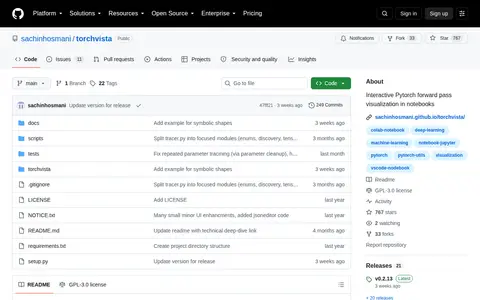
torchvista is an open-source tool that enables interactive visualization of PyTorch forward passes in Jupyter notebooks, maintained as a public GitHub repository under the sachinhosmani organization. It supports interactive drag-and-zoom graphs, collapsible nodes for hierarchical modules, and error-tolerant partial visualization when errors arise.
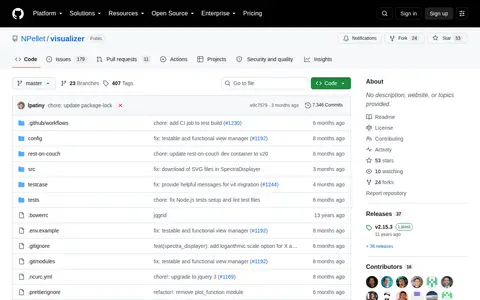
The visualizer is a tool developed by the cheminformatics department of the Swiss Federal Institute of Technology for rendering complex datasets. Its modules, placed on a browser page, display information as tables, charts, matrices or lists and interact through a central API of variables and actions. Visualization starts by passing three JSON file URLs in the browser address bar. It is released under the MIT license.
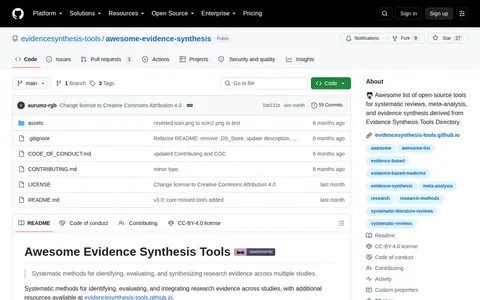
An awesome list of open-source tools for systematic reviews, meta-analysis, and evidence synthesis derived from Evidence Synthesis Tools Directory. It organizes tools under categories such as literature search, text mining and NLP, screening, data extraction, risk of bias, meta-analysis statistics, and visualization and reporting.
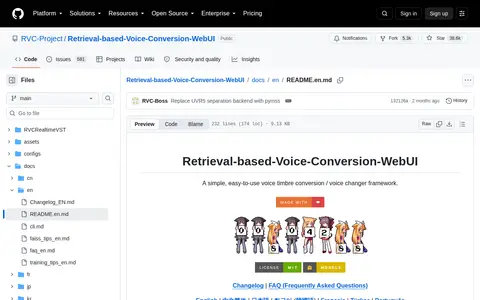
Retrieval-based-Voice-Conversion-WebUI is a project for training voice conversion models from voice data, with an easy-to-use WebUI. It includes a pymss/MSST model to separate vocals and instruments and a high-pitch voice extraction algorithm to prevent a muted sound problem. Dependencies differ by hardware, including CPU, AMD, Intel and NVIDIA GPU setups.
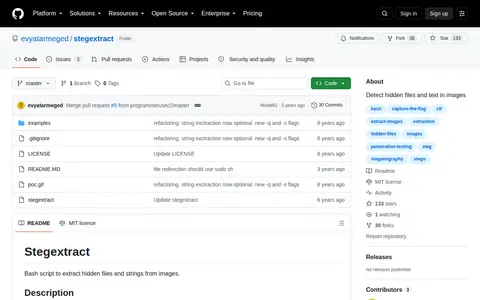
Steganography extraction tool for finding hidden files or data inside images.
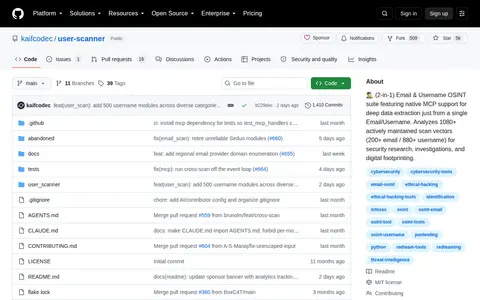
User Scanner is a two-in-one email and username OSINT suite with native MCP support. It performs deep data extraction from a single email or username, analyzing over 1080 maintained scan vectors, including more than 200 email and 880 username sources. It is intended for security research, investigations, and digital footprinting.