ArcGIS Hub page for discovering, analyzing and downloading data. Files can be downloaded in CSV, KML, Zip, GeoJSON, GeoTIFF or PNG formats, and API links are provided for GeoServices, WMS and WFS. Analysis is available through charts and thematic maps, and users can create StoryMaps and Web Maps.
Directory
Search results
Published directory entries matching your search.
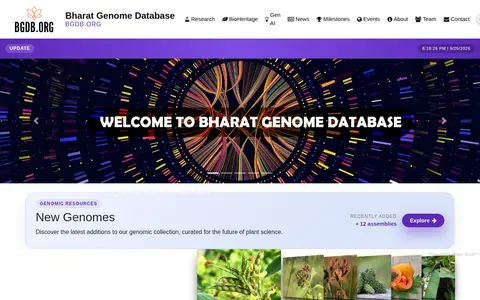
Bharat Genome Database is the flagship digital data resource of the BioHeritage Program, powered by the Sivasakthi Science Foundation. It functions as a centralized, open-access FAIR data repository focused on plant genomes of the Indian subcontinent. The platform hosts curated plant genome assemblies and provides genomic analysis tools including BLAST, JBrowse, JBrowse 2, IGV, and Gen AI Labs.
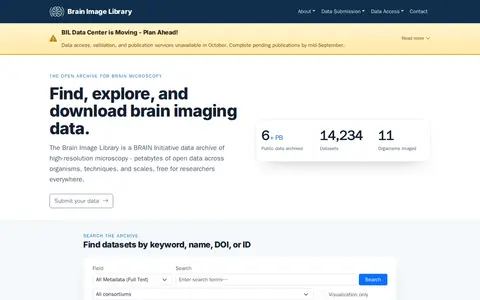
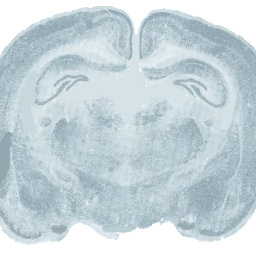
The Brain Image Library is a public archive of high-resolution brain microscopy data from the BRAIN Initiative. It holds petabytes of open data across organisms, techniques and scales, and lets researchers find and download imaging datasets by keyword, name, DOI or ID. Datasets are browsable by organism and by imaging and analysis modality.
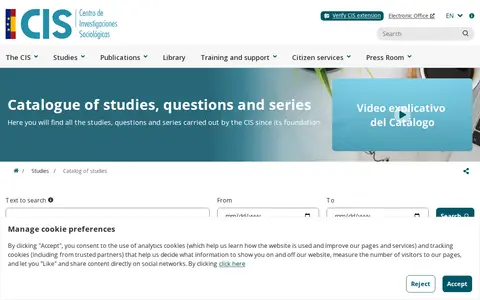
Operated by the Centre for Sociological Research (CIS), this platform hosts a catalogue of sociological studies, survey questions and data series dating back to 1963. It provides access to surveys, time series and microdata for use in social research and sociological analysis.
An ArcGIS Hub catalogue for Brantford open data. It lets users discover, analyze and download datasets as CSV, KML, Zip, GeoJSON, GeoTIFF or PNG, and find API links for GeoServices, WMS and WFS. Charts and thematic maps support analysis, and StoryMaps and Web Maps can be created.
Find and access basic in biology and medicine research data, with indexed datasets.
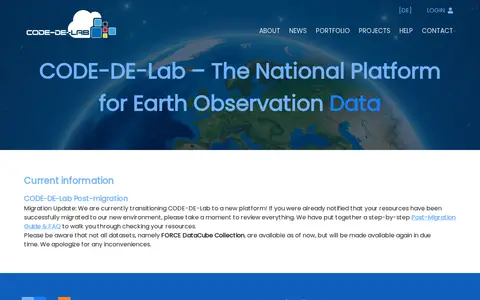
CODE-DE-Lab is the national platform for the provision and processing of Earth observation data in Germany. It offers searching, access, analysis and processing of a repository of Earth observation data on a cloud infrastructure, with services described as free of charge. Infrastructure resources are reserved for German public authorities and the academic community.
Research data portal for exploring atmospheric, oceanography and climate records, including datasets.
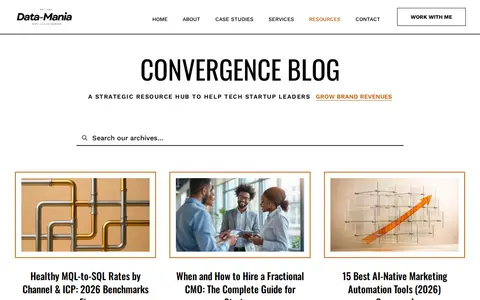
Data Mania Blog, also known as the Convergence Blog, is a resource hub published by Data-Mania, LLC for technology startup leaders. It features content covering topics such as AI search visibility, AI marketing tools, and startup growth strategies.
Data Science Degree @ Berkeley refers to the UC Berkeley School of Information's online Master of Information and Data Science (MIDS) program. The program is designed for working professionals, features a rigorous holistic curriculum, flexible program paths, and a capstone component, and is nationally recognized by Fortune.
The Data Science Lab is a blog of experiments with data. Posts cover topics including k-means clustering, k-means++ seeding, the gap statistic, and an alternative approach to selecting the optimal number of clusters based on a 2004 publication by Pham, Dimov and Nguyen. A 2014 annual report notes the blog was viewed about 74,000 times that year.
Data Science Trello Board is a Trello project board intended for organizing data science work. The associated page displays a notice that Trello resources may fail to load due to browser, firewall or proxy configuration issues, and provides troubleshooting guidance for users.
Data Studio is a web-based reporting tool for building interactive dashboards and reports. It offers built-in and partner connectors to access many kinds of data, and allows reports and dashboards to be shared with individuals, teams or the public, embedded on web pages, and viewed in a gallery. The page states it is easy and free to use.
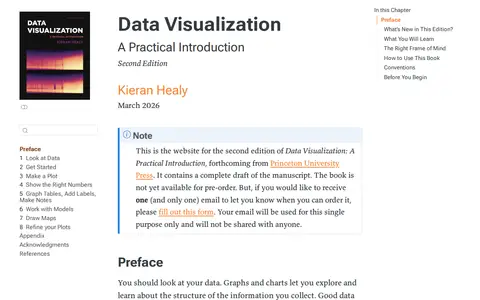
This is the website for the second edition of Data Visualization: A Practical Introduction by Kieran Healy, forthcoming from Princeton University Press. It contains a complete draft of the manuscript, and the book is not yet available for pre-order. According to the preface, the book teaches the ideas and methods of data visualization in a reproducible way.
Datacast is the personal blog and podcast series of James Le. It features written posts and podcast episodes covering topics such as data infrastructure, data observability, responsible AI, product management, and data engineering.
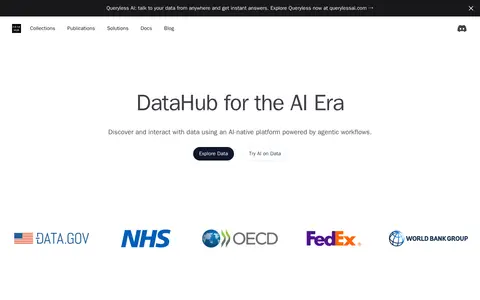
DataHub Cloud is a platform for discovering, accessing, and working with high-quality data. It offers curated datasets, including country codes, S&P 500 company data, airport codes, and geographic boundaries, as well as enterprise data solutions. It features an AI-native interface with agentic workflows.
DataRich is the data and information website for Richmond upon Thames, open to everyone. It provides statistics and analysis for the borough under themes including population, economy and employment, health and social care, transport and travel, crime, community wellbeing, housing and environment. It contains 2011 Census data and a profile of key facts, drawing on sources such as the Office for National Statistics, NOMIS, DCLG and Neighbourhood Statistics.
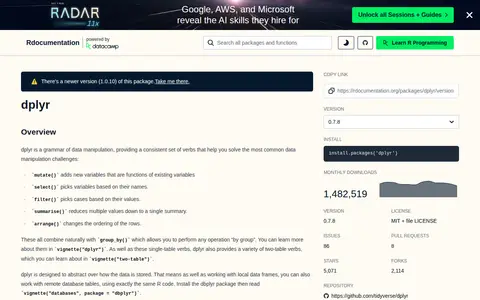
dplyr is an R package providing a grammar of data manipulation with a consistent set of verbs, including mutate(), select(), filter(), summarise() and arrange(), which combine with group_by(). It is designed to abstract over how data is stored, so the same R code works with local data frames and remote database tables via the dbplyr package.
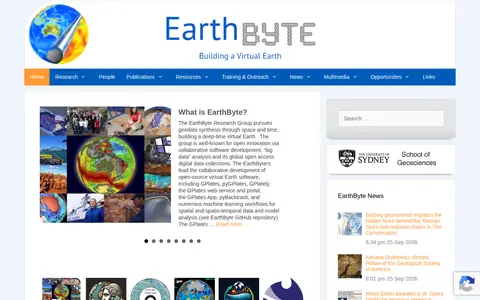
EarthByte is a research group at the University of Sydney's School of Geosciences. It pursues geodata synthesis through space and time, building a deep-time virtual Earth, and is known for collaborative software development, big data analysis and open access digital data collections. It leads development of open-source virtual Earth software including GPlates and pyGPlates.
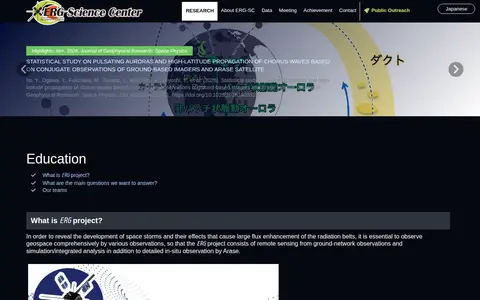
The ERG Science Center is run by ISAS/JAXA and ISEE, Nagoya University, as a joint research center for space science. It archives data related to the ERG project and releases the data. The project combines Arase satellite in-situ observation with ground-network remote sensing and simulation or integrated analysis to study space storms and radiation belt flux enhancement.
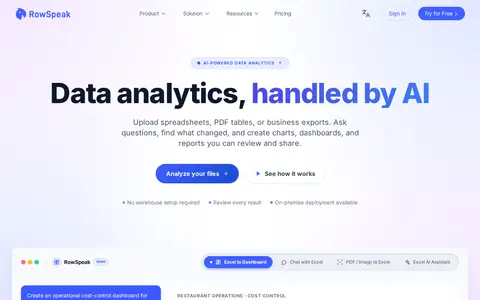
Excelmatic, offered by RowSpeak, is an AI-powered data analytics tool that processes messy Excel, CSV, PDF, and image tables. It uses AI to identify trends, explain data changes, generate charts, dashboards, and reports, cleanse data, and convert files between formats including images and PDFs to editable Excel spreadsheets.
The Forschungsdatenzentrum des SOEP is the DIW Berlin Research Data Center for the Socio-Economic Panel study. It provides access to SOEP core, cross-country, regional, and integrated study datasets, alongside documentation, data access services, re-analysis support, and related resources for scientific research use.
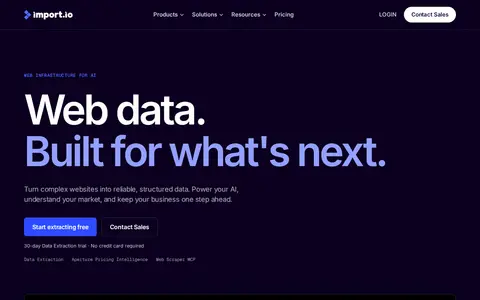
Import.io is a web data extraction and AI infrastructure platform. It converts website content into structured data, and provides web scraping tools, managed data services, pricing intelligence, and MCP tools for AI agents. It supports use cases across multiple industries including retail, ecommerce and AI development.
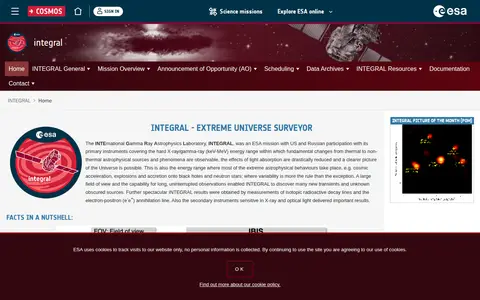
INTEGRAL was an ESA mission with US and Russian participation whose instruments covered the hard X-ray and gamma-ray energy range. It provided wide-angle, time-resolved imaging in gamma-ray, X-ray, and visual light, broadband spectroscopy, and all-sky detection of transients. Its data are available through the INTEGRAL Science Legacy Archive and the Off-line Scientific Analysis software in ESA Datalabs.