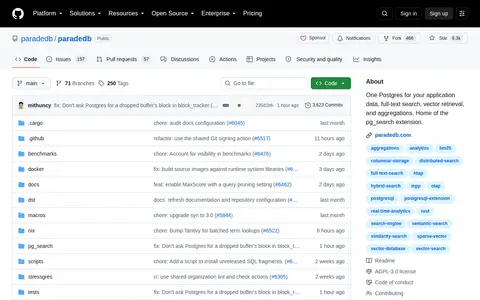

ParadeDB is an open-source PostgreSQL extension hosted on GitHub. It adds functionality for application data management, full-text search, vector retrieval and data aggregations to PostgreSQL databases, and is the home of the pg_search extension. The repository includes links to associated documentation, community resources, a blog and a changelog.
Directory
Search results
Published directory entries matching your search.
Build AI Assistants with memory, knowledge and tools.
Lightweight Bash scripts that enhance your terminal coding workflow with web-based AI assistants like Claude or Grok.
Ask questions to your documents without an internet connection, using the power of LLMs.
The lightweight PyTorch wrapper for high-performance AI research.
Toolbox of models, callbacks, and datasets for AI/ML researchers.
Dump all your files and chat with it using your generative AI second brain using LLMs & embeddings.
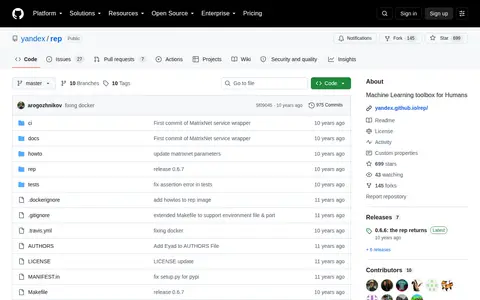
REP is a GitHub-hosted machine learning toolbox developed by Yandex, branded as a Reproducible Experiment Platform. It includes documentation for its main features, usage examples, and installation guidance for both Docker and manual setup.
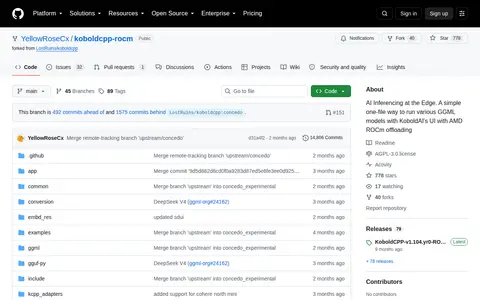
KoboldCpp fork for AMD ROCm that runs GGML models with the KoboldAI interface. It is a single-file executable without installation or external dependencies and runs on CPU or GPU with full or partial offloading. It supports text generation and includes a bundled KoboldAI Lite UI with chat, adventure, instruct and storywriter modes.

Chrome extension that uses local LLMs to assist with writing and drafting responses based on the context of your open tabs.
A neuro-symbolic framework for building applications with LLMs at the core.
TalkToPapers, referenced as the namuan/dr-doc-search GitHub repository, is an open-source tool that enables users to converse with book content, built using GPT-3. The repository includes documentation covering prerequisites, installation steps, and example usage.
TavernAI is an AI roleplay chat platform with an advanced prompting system. It supports running machine learning models locally or connecting to external AI providers, and can be adapted to function as an AI game engine.
Creates, rewrites or summarizes written content with language models.
A Ruby implementation of the UEA-Lite stemmer for conservative stemming in search and indexing workloads. It normalizes suffixes with a rule set while avoiding aggressive stemming, removes possessive apostrophes, expands contractions by default and preserves tokens beginning with uppercase letters. The gem has no runtime dependencies.
Any URL to clean markdown for LLMs. Free API, no signup required. Strips JS/CSS and outputs LLM-ready content.
Open-source project that provides conversational AI for questions, tasks, and general assistance.
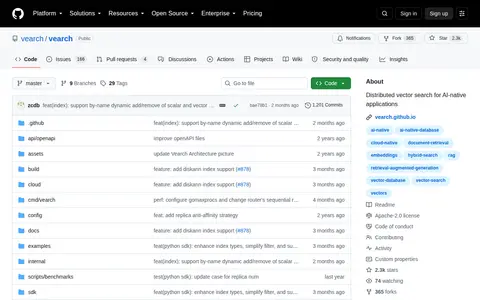
Vearch is a cloud-native distributed vector database for similarity search of embedding vectors in AI applications. It supports hybrid vector search and scalar filtering, replication, elastic scaling, RESTful APIs, and SDKs for Python, Go, Java and Rust. It integrates with frameworks including LangChain and LlamaIndex and can be deployed via Kubernetes or Docker Compose.
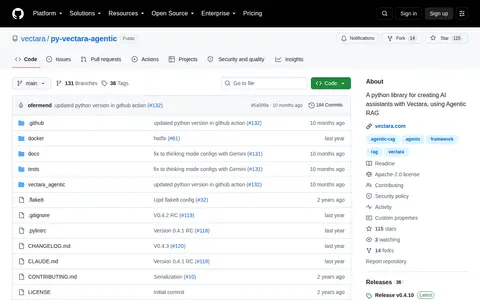
Vectara-agentic is a Python library hosted on GitHub for creating AI assistants with Vectara using Agentic RAG. The repository provides an overview, key features, and example AI assistants to help developers integrate the technology.
Open-source project that supports AI-assisted research, knowledge retrieval, summarization, or source analysis.
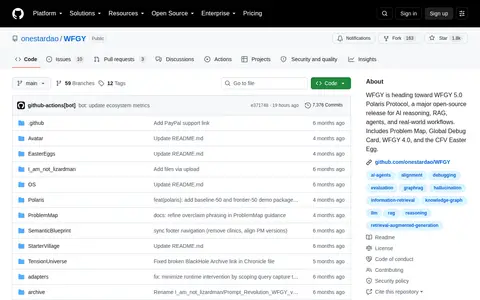
WFGY is an open-source project focused on AI reasoning, retrieval-augmented generation, AI agents, and real-world workflows. It is developing the WFGY 5.0 Polaris Protocol, and currently includes components such as the Problem Map, Global Debug Card, 4.0 version, and CFV Easter Egg.
Helps find, analyze or synthesize information for research and knowledge discovery.
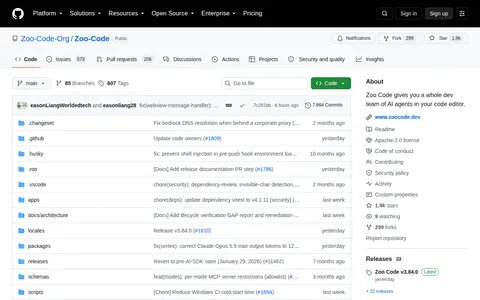
Zoo Code is a GitHub repository for a tool that provides a team of AI coding agents integrated directly into a code editor. The repository includes information about migration from Roo Code to Zoo Code, new features added since that migration, and version notes for v3.84.0.