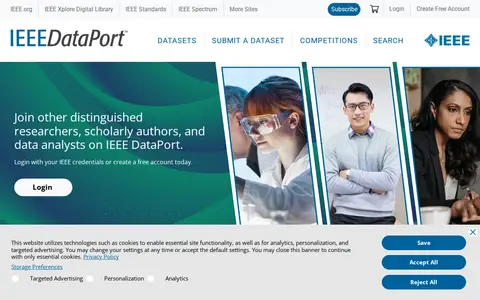
IEEE DataPort is a research data platform that provides open access to scientific data. It enables researchers and institutions to share research, manage data, and collaborate. The platform hosts over 13,000 datasets, offers more than 2 TB of storage via AWS S3, and provides data management tools such as DOI assignment and usage tracking.
Directory
Search results
Published directory entries matching your search.
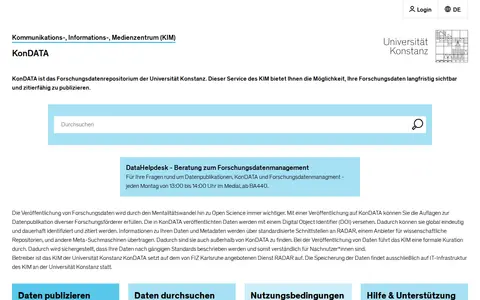
KonDATA is the research data repository of the University of Konstanz, operated by its Communication, Information and Media Center (KIM). It lets researchers publish research data with lasting visibility and citability. Published data receive a Digital Object Identifier, and metadata are transferred via standardized interfaces to RADAR and other meta search engines. The KIM performs formal curation of published data.
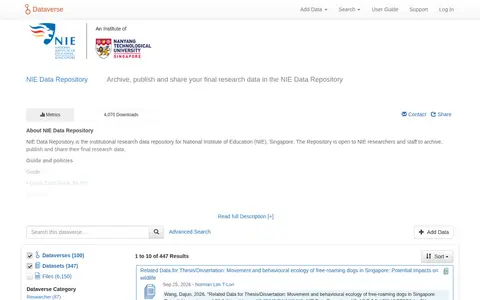
The NIE Data Repository is the institutional research data repository for the National Institute of Education, Singapore. It is open to NIE researchers and staff to archive, publish and share their final research data.
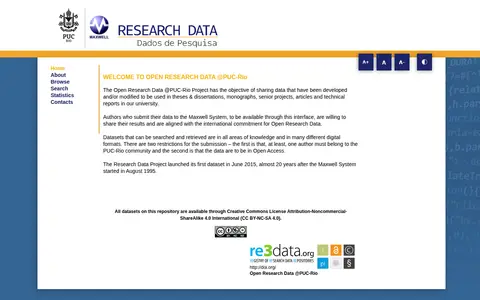
Open Research Data @PUC-Rio is a project of the Maxwell System that shares data developed or modified for theses, dissertations, monographs, senior projects, articles and technical reports at the university. Datasets span all areas of knowledge and many digital formats and can be searched and retrieved. Submission requires at least one author from the PUC-Rio community and open access data.
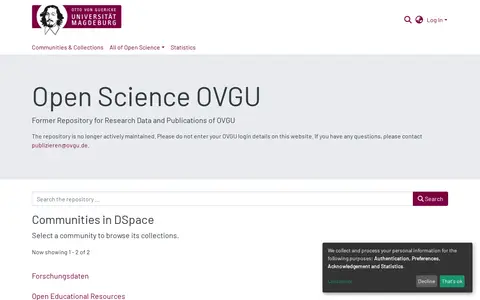
Open Science OVGU is the former open access repository for research data and publications of Otto-von-Guericke University Magdeburg (OVGU). It is no longer actively maintained, and users are advised not to enter OVGU login details on the site. The repository hosts communities for research data and open educational resources, and includes recent submissions such as the 2024 TapCorder Data Set, which explores classification of oily or cream-like substances using smartphone-captured diffraction data.
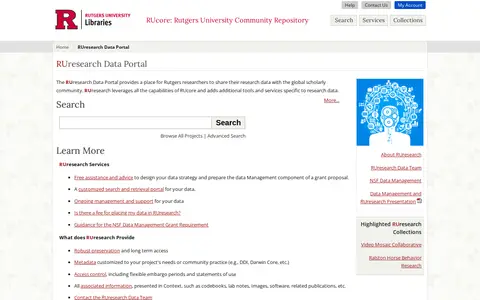
The RUresearch Data Portal is a place for Rutgers researchers to share research data with the global scholarly community. It builds on RUcore and adds tools and services specific to research data, including preservation and long-term access, metadata customized to a project, and access control with embargo periods and statements of use.
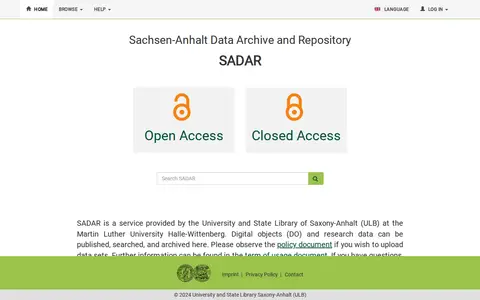
SADAR is the Sachsen-Anhalt Data Archive and Repository, a service of the University and State Library of Saxony-Anhalt at Martin Luther University Halle-Wittenberg. It allows digital objects and research data to be published, searched and archived, and runs on DSpace, which captures, distributes and preserves digital research products such as articles, preprints, reports, conference papers and data sets.
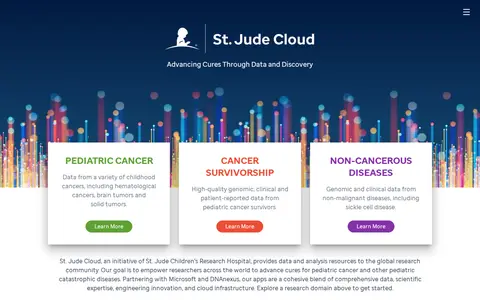
St. Jude Cloud is a pediatric catastrophic disease data sharing ecosystem created by St. Jude Children's Research Hospital. It provides data and analysis resources to the global research community, including genomic data on pediatric cancers, cancer survivorship and non-cancerous diseases. Its applications cover a genomics platform, a pediatric cancer knowledge base, visualizations, and patient-derived xenograft data.
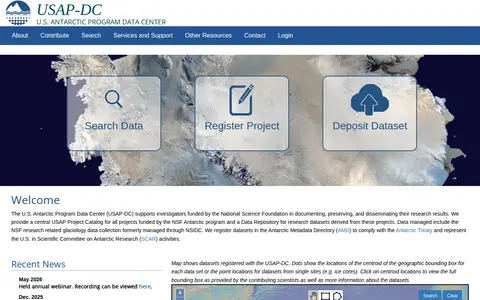
USAP-DC is the U.S. Antarctic Program Data Center, a repository that accepts research data from NSF-funded Antarctic projects and offers data publication in the DOI system and long-term archiving. It also hosts a project catalog for NSF US Antarctic Program awards, linking projects to citations and research datasets.
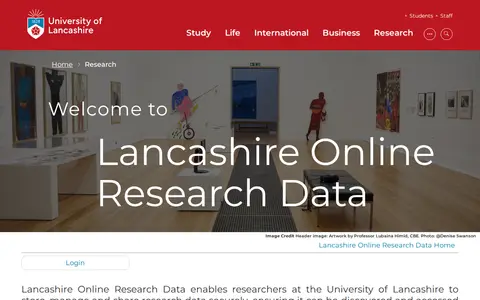
Lancashire Online Research Data is the University of Lancashire's institutional data repository. It provides browsing and text search across deposited research data, including search fields, lists of values and year filters, and offers guidance for selecting and depositing data.
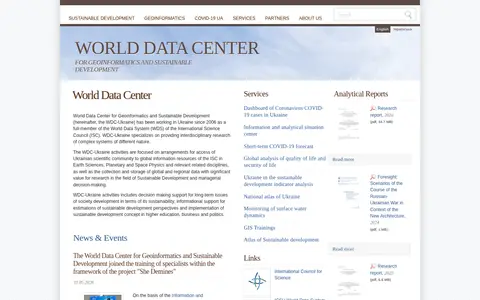
The World Data Center for Geoinformatics and Sustainable Development has operated in Ukraine since 2006 as a full member of the World Data System (WDS) of the International Science Council (ISC). It specializes in interdisciplinary research of complex systems, provides the Ukrainian scientific community with access to ISC global information resources in Earth Sciences, Planetary and Space Physics and related disciplines, and collects and stores global and regional data for sustainable development research and managerial decision-making. It supports long-term societal sustainability decision-making and sustainable development perspective estimation.

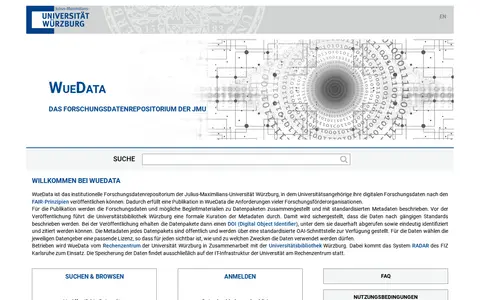
WueData is the institutional research data repository of Julius-Maximilians-Universität Würzburg, where university members can publish digital research data according to the FAIR principles. Data and accompanying materials are compiled into data packages with standardized metadata, curated by the university library, and published with a DOI. Metadata is public and available via a standardized OAI interface. It runs on the RADAR system of FIZ Karlsruhe, operated by the university computing center and library.
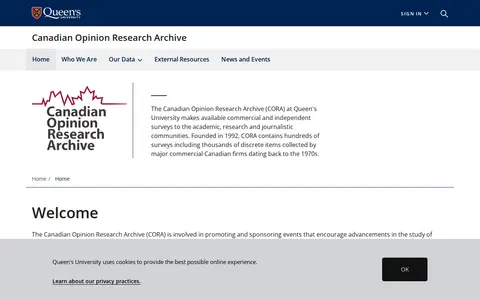
The Canadian Opinion Research Archive (CORA) at Queen's University makes commercial and independent public opinion surveys available to academic, research and journalistic communities. Founded in 1992, it contains hundreds of surveys with items collected by major Canadian commercial firms dating back to the 1970s. Survey data is accessed through the Odesi repository.
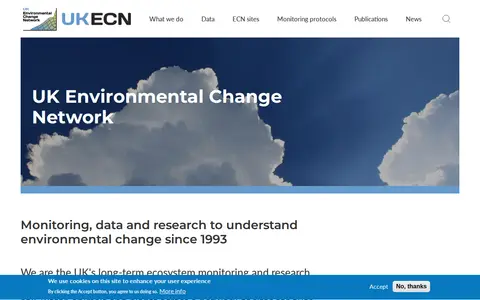
The UK Environmental Change Network is the UK's long-term ecosystem monitoring and research programme, making regular measurements of air, soil, water, animals and plants across a network of sites since 1993. It provides free access to over two decades of detailed environmental data and instrumented research sites supporting environmental research and education.
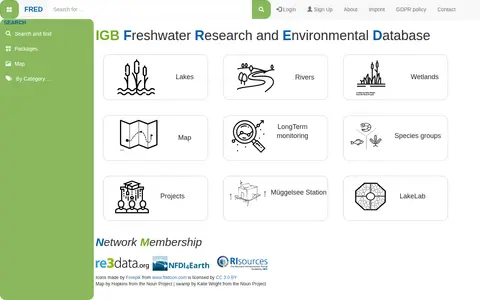
FRED (Freshwater Research and Environmental Database) is a data repository focused on freshwater research. It provides access to datasets related to lakes, rivers, wetlands, long-term monitoring, and species groups. Users can search by categories, view maps of study sites, sampling locations, parameters, and access project information and DOIs.
The Luxembourg Institute of Socio-Economic Research (LISER) is a public research institute established in 2014 that conducts fundamental and applied research in social sciences. Its work covers living conditions, the labour market, and urban development and mobility, and it hosts a data centre and experimental economics infrastructure.
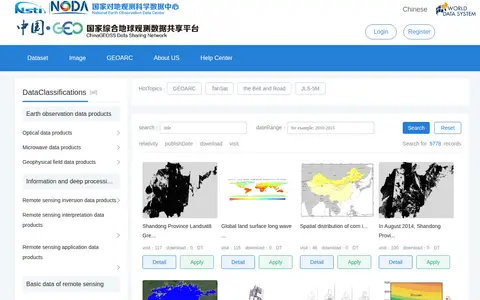
ChinaGEOSS Data Sharing Network is a data discovery platform showing earth observation data products, deeper-processed information data, remote sensing data and other data. Datasets can be filtered by spatial location, data format and data type, or searched by keyword and time range. Online resources can be downloaded directly; offline resources require administrator approval.
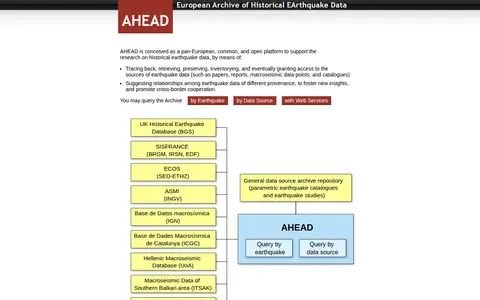
AHEAD is a pan-European, open platform for research on historical earthquake data. It traces, retrieves, preserves, inventories and grants access to earthquake data sources such as papers, reports, macroseismic data points and catalogues, and suggests relationships among data of different provenance. The archive can be queried by earthquake or by data source, and its services are integrated in the EPOS Data Portal.
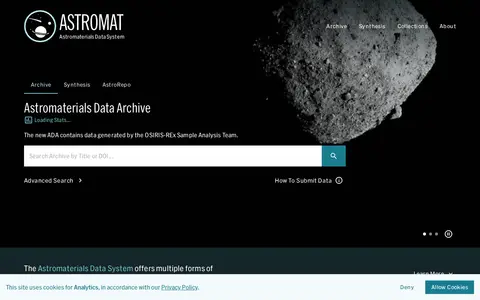
The Astromaterials Data System (Astromat) is a data infrastructure that curates, archives, and provides access to analytical data generated from astromaterials samples. It is NASA’s designated archive for laboratory analytical data acquired on samples from past, present, and future NASA missions curated by NASA’s Astromaterials Acquisition and Curation Office. The system supports end-to-end data curation and synthesis for advanced analysis and AI/ML use, and features machine- and human-actionable interfaces for the astromaterials research community.
The EDI Data Portal provides access to environmental and ecological data packages contributed by participating organizations. Each dataset includes metadata and a digital object identifier for citation. Users are asked to contact data providers before using data in published research and to cite data appropriately.
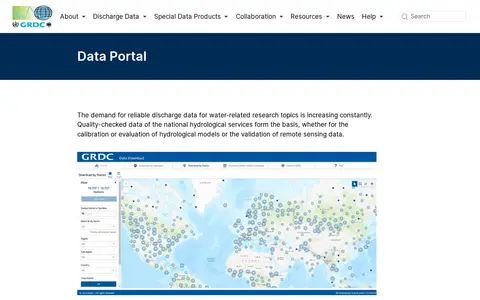
The GRDC Data Portal is a web-based tool for searching and visualising runoff stations and time series data in map and table view. Users select stations, regions, subregions or countries and download data in six formats, with optional subregion or watershed boundaries. Hydrological data are released only for research purposes; commercial use and redistribution are not allowed.
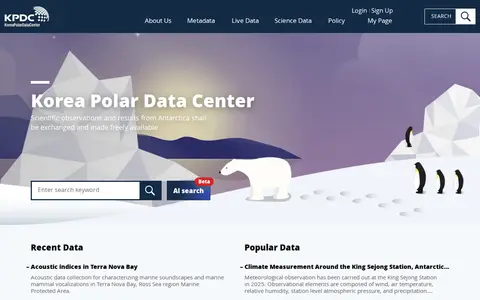
The Korea Polar Data Center (KPDC) manages diverse data obtained from Korean polar scientific research in the Arctic and Antarctic. Its site provides metadata keyword search, data collection browsing by type, and advanced search. It also lists science data resources and live data such as the IBRV ARAON route and weather.
MatDB is a database hosted within the European Commission Joint Research Centre's ODIN Portal, which operates as the EU's science and knowledge service to support European policies with independent evidence across the full policy cycle. The platform offers open access data catalogs, data summaries, citable datasets and catalogs, and DOI listings for frequently viewed, recently published, and recently uploaded data. The open access module only provides access to a limited subset of ODIN's hosted data, with full feature and data access requiring user registration and login. Downloading data from MatDB requires agreement to the licenses accompanying individual datasets and the ODIN terms and conditions.
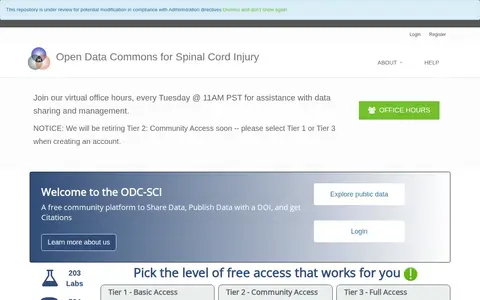
The Open Data Commons for Spinal Cord Injury is a free community platform for sharing and publishing spinal cord injury research data. It offers tiered access levels, allowing users to download public data, access community data, share their own datasets, and obtain citable DOIs. The platform includes tutorials, documentation, an apps toolbox, and a sample data management and sharing plan.