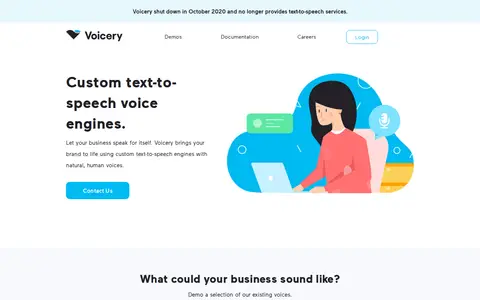

Voicery is a company that creates natural-sounding text-to-speech engines and custom brand voices for enterprise clients. Its solutions leverage deep-learning research optimized for specific business use cases and technical infrastructure.
Directory
Search results
Published directory entries matching your search.
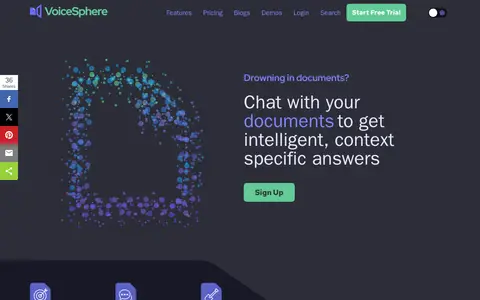
Voicesphere is an AI document interaction tool that allows users to upload documents including PDFs, DOCs, PPTs, videos, texts, and CSVs to ask natural language questions and receive context-specific answers. It includes a secure document management system, and is designed for use by manufacturing companies, medical professionals, law firms, researchers, recruitment agencies, and customer service teams.
Vosk is an offline speech recognition API hosted in the alphacep/vosk-api GitHub repository. It is compatible with Android, iOS, Raspberry Pi, and server environments, and provides SDKs for Python, Java, C#, and Node.
A simple and efficient end-to-end Automatic Speech Recognition (ASR) system from Facebook AI Research.
USE BAZEL VERSION=5.0.0./bazelisk-linux-amd64 build wavegru mod -c opt --copt=-march=native.
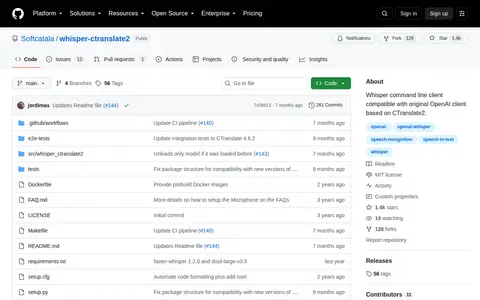
Whisper command line client compatible with the original OpenAI client and based on CTranslate2. It uses CTranslate2 and the Faster-whisper implementation. The project lists Docker images with pre-loaded models, speaker diarization, voice activity detection and live transcription from a microphone. It is installed as a Python package or run from a Docker image.
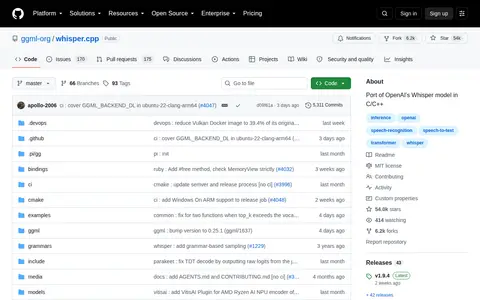
A C/C++ port of OpenAI's Whisper automatic speech recognition model, providing high-performance inference without dependencies. It supports CPU-only inference and GPU backends, and runs on platforms including macOS, iOS, Android, Linux, Windows, WebAssembly and Raspberry Pi. The whisper-cli example currently runs only with 16-bit WAV files.
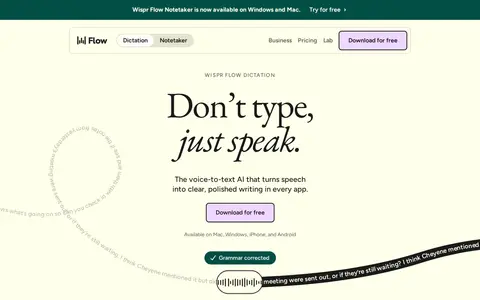
Wispr Flow is a voice-to-text dictation tool that converts speech into text in any app and on every device. It includes a Notetaker feature. It is available on Mac, Windows, iPhone, and Android. A free plan includes speech-to-text in any app and 100+ languages; paid plans add team management and admin controls.
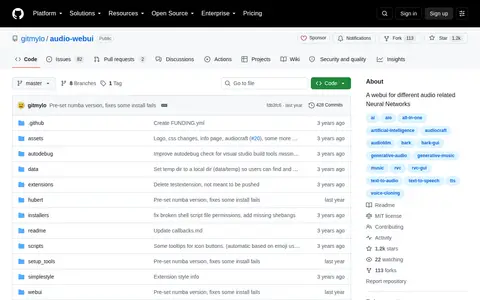
Open-source project that uses AI for speech, voice, transcription, music, or other audio workflows.
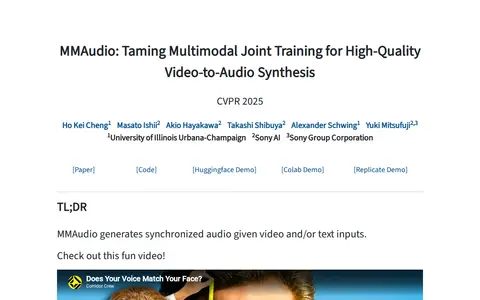
MMAudio is a Hugging Face Space that generates synchronized audio from video or text. Users can upload a short video and write a prompt, including a negative prompt, to add realistic sound, or create a standalone audio clip from a text description.
A Hugging Face Space that turns an ebook file or pasted text into a complete audiobook. The user selects a language, voice and audio format, then generates audio to listen to or download; sections can also be previewed and edited. The page states support for 1107+ languages.
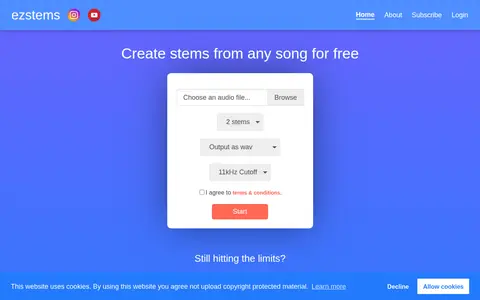
Ezstems is a website that uses Spleeter, a tool that creates stems from any audio file. Users upload an audio file and the resulting stems download in seconds. Free use is subject to limits, with a stated cap of 20 uploads per day and a 20MB file size limit.

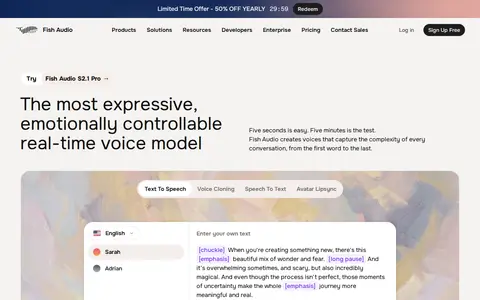
Fish Audio provides AI text-to-speech and voice cloning with emotion control and multilingual support. It offers TTS, speech-to-text, voice agents, and developer APIs with Python and TypeScript SDKs. The site lists a free tier with 8,000 monthly credits and paid Plus, Pro, and Max plans.
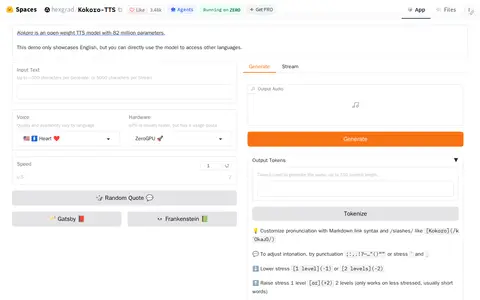
Kokoro TTS is a Hugging Face Space developed by hexgrad that converts input English text to spoken audio. Users can select a voice and speaking speed, and choose to download the generated audio or listen to a live streaming version.
MMAudio is a research project on multimodal joint training for video-to-audio synthesis. It generates synchronized audio given video and/or text inputs. The work is presented at CVPR 2025 by authors from the University of Illinois Urbana-Champaign and Sony.
Moe TTS is a Hugging Face Space created by skytnt that enables users to generate speech from input text and convert existing audio to a different speaker's voice. Users can input text to create speech output, select from available speakers, and adjust the playback speed of generated audio.
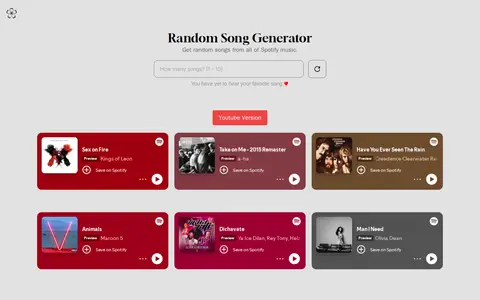
Random Song Generator is a website that generates random songs from Spotify music to help music enthusiasts discover new songs and artists. Users enter a number from 1 to 10 and generate tracks per run, with unlimited generations; an invalid or blank number defaults to 6 results. A YouTube version is also referenced.
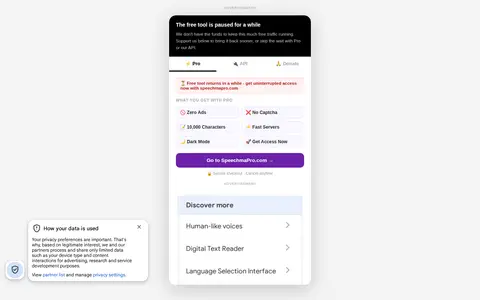
Speechma is an online text-to-speech converter that turns text into audio using a library of AI voices. The site states that no registration is required and that generated audio can be used commercially. A REST API for developers is also offered under a monthly subscription.
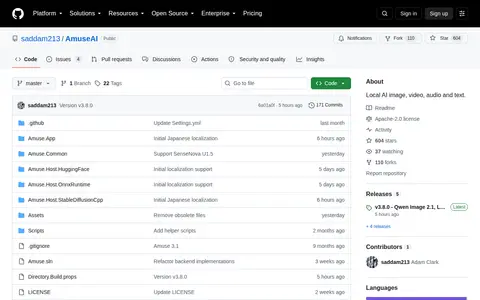
Amuse is an open-source local AI tool hosted on GitHub. It supports generation of images, videos, audio, and text, with dedicated pipelines for each media type, and welcomes community contributions to its development.
AnyVoiceLab is a free, no-login-required AI voice cloning tool. Users provide a short voice sample to create lifelike voice replicas, generate studio-quality speech, and download the resulting audio for free. Additional features include long-form text-to-speech, voice changing, sound effect generation, premium voice options, AI voice generation, payment plans, and support for emotion tags in speech.
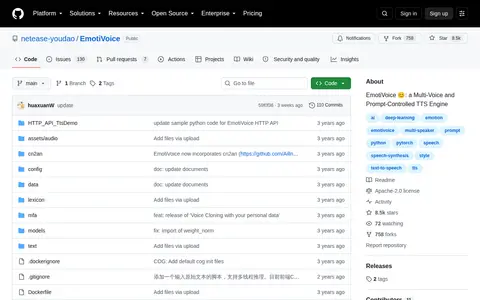
EmotiVoice is an open-source text-to-speech engine that speaks English and Chinese with over 2000 voices. Its main feature is emotional synthesis across emotions such as happy, excited, sad and angry. It provides a web interface and a scripting interface for batch generation.
This is a Hugging Face Space created by user Woleek that generates soundtracks matching uploaded images. Users can adjust denoising steps and eta parameters to refine the output audio quality.
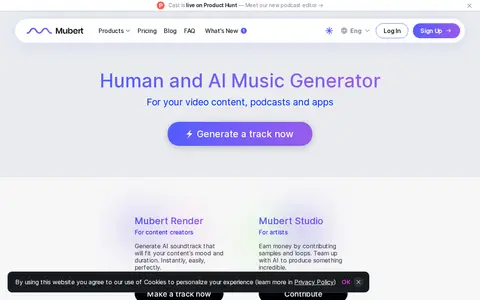
Mubert is an AI music generator offering royalty-free music from text prompts. It provides Render for content creators, Studio for contributing samples and loops, API for developers, and Play for listeners. The API supports track generation and music streaming integration.
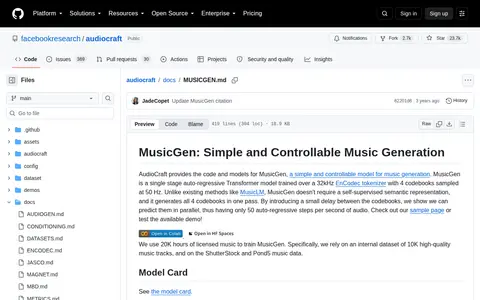
MusicGen is a single-stage auto-regressive Transformer model for music generation trained over a 32kHz EnCodec tokenizer with four codebooks, part of the AudioCraft library. It supports text-to-music and text-plus-melody-to-music models ranging from 300M to 3.3B parameters. Running it locally requires a GPU, with at least 16 GB of memory recommended for medium-sized models.