
opendata.cesa.edu.co
Dataset repository covering computer, with searchable source code.
Directory
Published directory entries matching your search.
Dataset repository covering computer, with searchable source code.

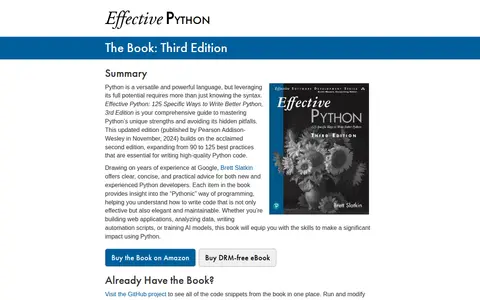
Effective Python: 125 Specific Ways to Write Better Python, 3rd Edition is a book by Brett Slatkin, published by Pearson Addison-Wesley in November 2024. It expands on the second edition from 90 to 125 best practices for writing Python code, adds new chapters on robustness and performance, and covers the language through Python version 3.13.

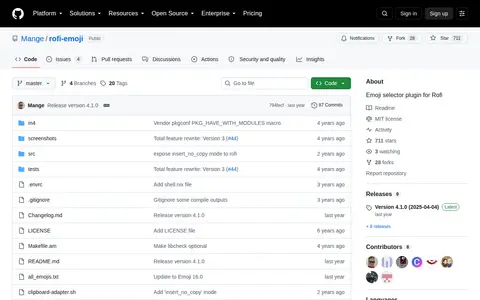
A plugin for Rofi that provides an emoji selector and copies the selected emoji to the clipboard. Search can be limited by group or subgroup prefixes. A menu offers alternative actions such as copying the emoji name or codepoint. It supports insert, copy, insert_no_copy and menu modes.

Explanations is a series of articles aiming to let people play with fun parts of computers, such as graphics, compression and audio. Its tagline is "Play, don't show". The series was previously known as Xplain and focused on the X11 window system and protocol. The source code for all demos is available on GitHub under the MIT/X11 license.

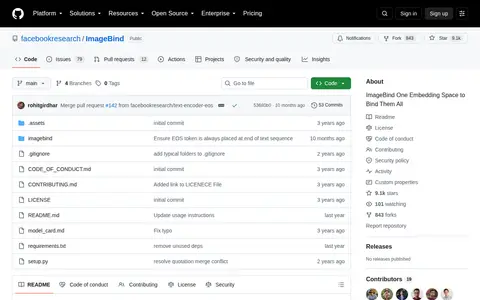
ImageBind is a PyTorch implementation with pretrained models from FAIR, Meta AI. It learns a joint embedding across six modalities: images, text, audio, depth, thermal, and IMU data. The release includes code and model weights under the CC-BY-NC 4.0 license.

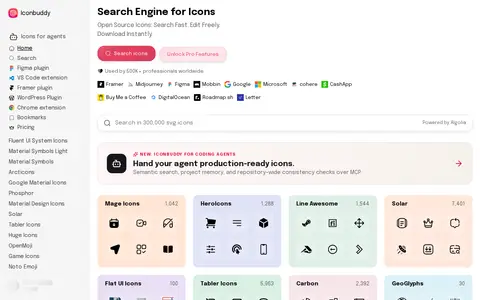
Iconbuddy is an icon search and download service offering over 300,000 free SVG icons from open source libraries. Users can customize colors and sizes and export in SVG, PNG, JSX, or Base64 formats. The site also documents an MCP server for coding agents and lists extensions for Figma, VS Code, Framer, WordPress and Chrome.

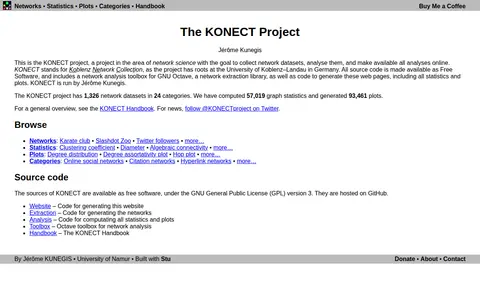
KONECT is the Koblenz Network Collection, a network science project that collects network datasets, analyses them, and publishes the analyses online. It holds 1,326 network datasets in 24 categories, with computed graph statistics and generated plots. Its source code, including an Octave network analysis toolbox and an extraction library, is available as free software under GPL version 3.

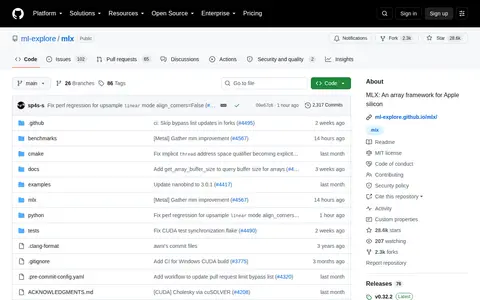
MLX is an array framework developed for use on Apple silicon hardware. The project includes example code, quickstart guides, installation instructions, and contribution guidelines. It is hosted as an open source repository on GitHub.

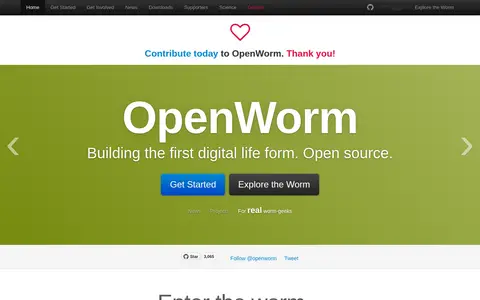
OpenWorm is an open source project that aims to create a virtual C. elegans nematode in a computer. Its sub-projects include a worm body simulator with physics of muscles, soft tissues and fluids, WormSim for interacting with the worm in a browser, DevoWorm for developmental processes, a 3D Browser, the NeuroML Connectome, and Geppetto. Code and models are released under the MIT licence.

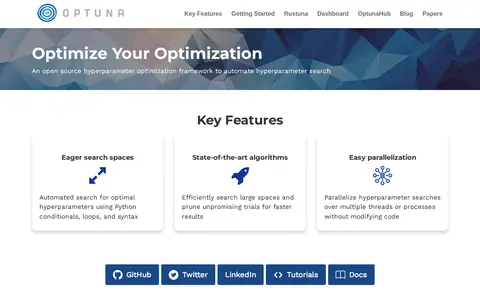
Optuna is an open source automatic hyperparameter optimization software framework designed for machine learning. It provides an imperative, define-by-run style user API with eager search spaces, algorithms that prune unpromising trials, and parallelization of searches over multiple threads or processes without modifying code. It is framework agnostic and can be installed with pip on Python 3.10 or newer.

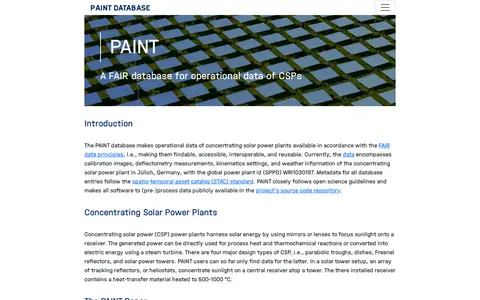
PAINT is a database making operational data of concentrating solar power plants available under FAIR data principles: findable, accessible, interoperable, and reusable. Its current data covers calibration images, deflectometry measurements, kinematics settings, and weather information from the solar tower plant in Jülich, Germany. Metadata follows the STAC standard, and software for data processing is publicly available in the project's source code repository.

RePEc (Research Papers in Economics) is a crowd-sourced initiative that indexes economics research, including working papers, journal articles, and software code. It aggregates machine-readable metadata contributed by thousands of publishers and archives, and provides free public services for readers, authors, and institutions to access, browse, and disseminate research.

A fan-run, noncommercial archive for fandom works such as fanfiction, fanart, fandom meta, fan videos and podfic. It is a project of Squidge.org based on open-source code from the OTW. Users with an account can share fanworks, receive update notifications, take part in challenges and track visited and saved works.

An illustrated explainer article on VQGAN, describing how the model generates images from text at a conceptual level and how VQGAN and CLIP work in tandem. It covers a theory of perception, using transformers to model interactions, expressing images through a codebook, and training the GAN and transformer.
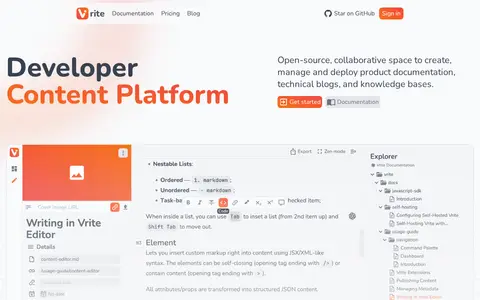
Vrite is an open-source, collaborative developer content platform for documentation, technical blogs, and knowledge bases. It includes a technical content editor with code editing, Markdown, and keyboard shortcuts, and can be self-hosted or used through a cloud service. It offers a headless API, JavaScript SDK, content variants, metadata, Git sync, and AI-powered semantic search. Paid plans begin with a 14-day free trial.

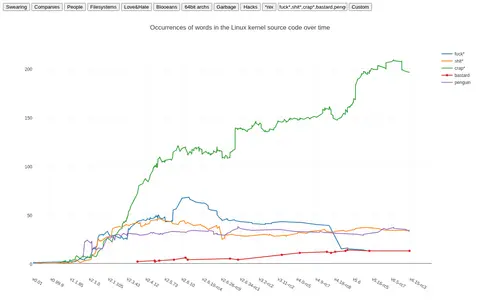
WordCount is a web tool that displays the frequency of words, names, and functions in Linux kernel source code. Users can browse example counts or submit comma-separated custom word lists to retrieve frequency results. The tool supports wildcard (*) searches and combined term sums using the foo|bar syntax, with words defined by backslash while ignoring case and accents. Interactive graphs are available for users with JavaScript enabled, while non-JavaScript users see an outdated static PNG version. The page creator also hosts other recreational content.