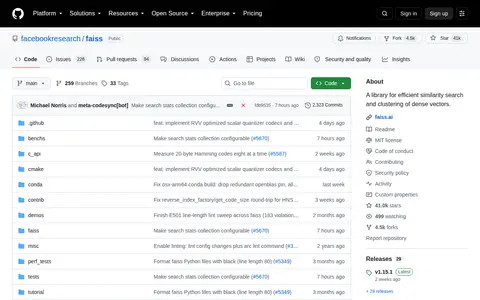

Faiss is a library for efficient similarity search and clustering of dense vectors, containing algorithms that search sets of vectors of any size. It is written in C++ with complete wrappers for Python/numpy, with some algorithms implemented on the GPU, and is developed primarily at Meta's Fundamental AI Research group.
Directory
Search results
Published directory entries matching your search.
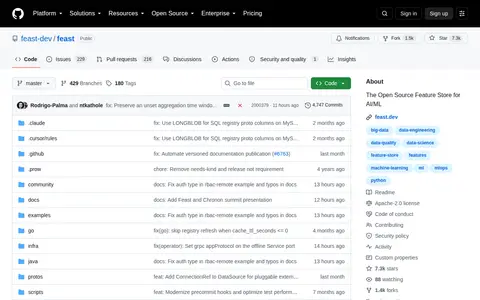
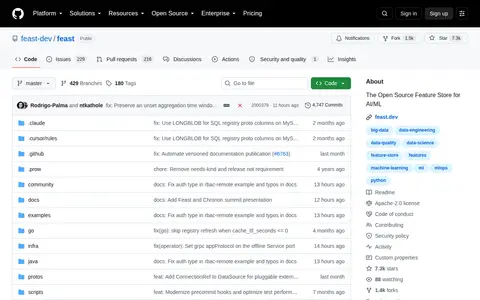
Feast is an end-to-end open source feature store for machine learning. It allows teams to define, manage, discover, and serve features, delivering structured data to AI and LLM applications during training and inference. Documented use cases include real-time recommendations, fraud detection, risk scoring, and customer segmentation.
Feast is an open source feature store for machine learning. It manages an offline store for historical data, a low-latency online store, and a feature server. It generates point-in-time correct feature sets to avoid data leakage and provides a single data access layer abstracting feature storage from retrieval. Installable with pip and initialized through a CLI.
Open-source project that provides machine-learning models, research, training resources, or evaluation tools.
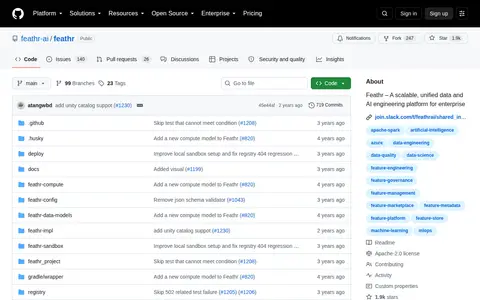
An enterprise-grade, high performance feature store.
Feature Stores for ML is a global community of data science professionals, researchers, and engineers focused on feature stores for machine learning pipelines. It creates educational content about feature stores and the surrounding data and AI ecosystem, hosts monthly industry meetups, and provides resources including blog posts, videos, benchmarks, and an MLOps dictionary.
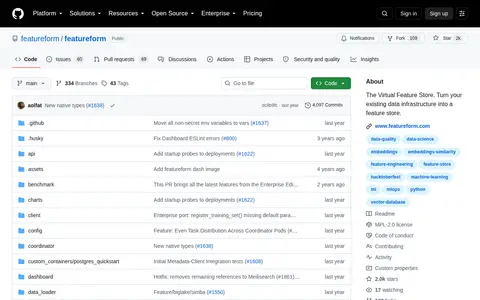
Featureform is an open-source virtual feature store hosted on GitHub under the featureform organization. It is designed to turn users' existing data infrastructure into a feature store, with supporting resources including a public website, documentation, community forum, and explanatory material on its core abstraction and unique value proposition.
Open-source project that provides machine-learning models, research, training resources, or evaluation tools.
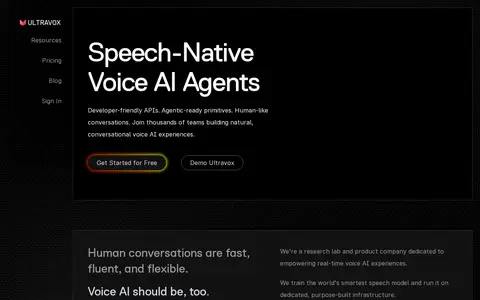
Ultravox is a real-time voice AI infrastructure layer that powers fast, natural, and scalable voice agents.
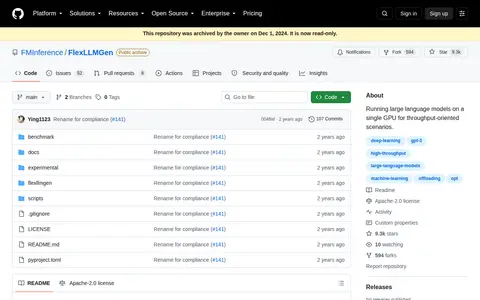
FlexGen is a software project that enables running large language models on a single GPU. It focuses on throughput-oriented scenarios, offering an approach to efficient inference. The project is available on GitHub as FMInference/FlexLLMGen.
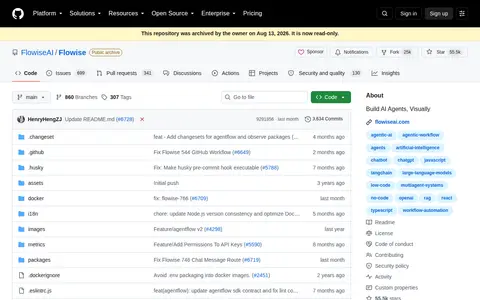
Drag & drop UI to build your customized LLM flow using LangchainJS.
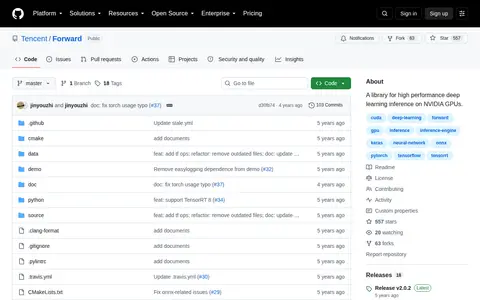
Library for high performance deep learning inference on NVIDIA GPUs.
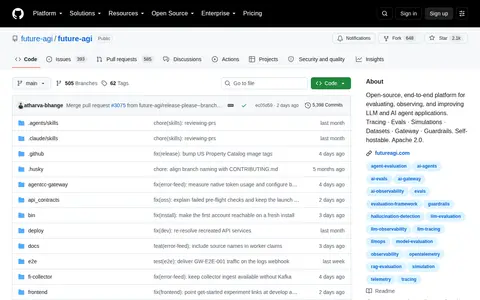
Future AGI is an open-source, self-hostable platform for evaluating, observing, and improving LLM and AI agent applications. It combines tracing, evals, simulations, datasets, a gateway and guardrails on one platform with a feedback loop. The Apache 2.0 core can be self-hosted, and a managed Cloud option is offered.

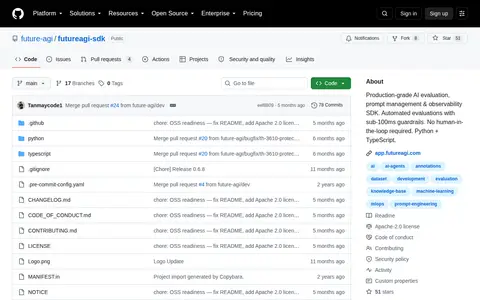
Future AGI SDK is a production-grade software development kit for AI evaluation, prompt management, and observability. It offers automated evaluations with sub-100ms guardrails and does not require human-in-the-loop. The SDK supports Python and TypeScript.
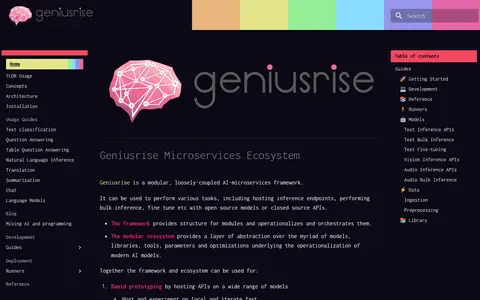
Host inference APIs, bulk inference and fine tune text, vision, audio and multi-modal models.
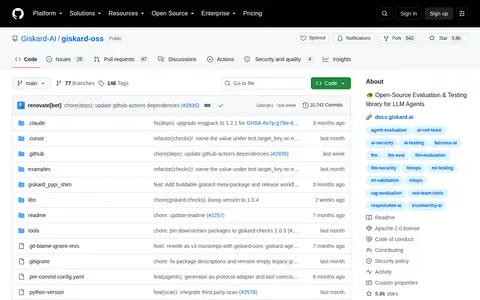
Testing framework dedicated to ML models, from tabular to LLMs. Detect risks of biases, performance issues and errors in 4 lines of code.
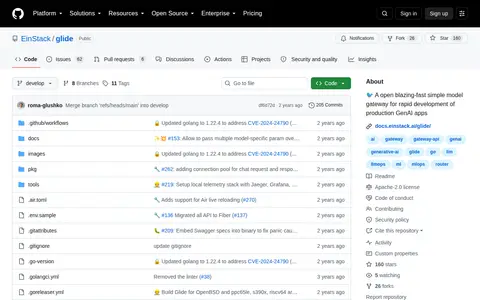
Cloud-Native LLM Routing Engine. Improve LLM app resilience and speed.
gotoHuman is a platform for supervising AI agents, letting workflows request human review of critical steps. Reviewers approve and edit AI-generated content in an Agent Inbox, with email and Slack notifications, and completed reviews return to the workflow via webhook. Review types are configured in a no-code editor and can capture text, images, markdown and JSON.
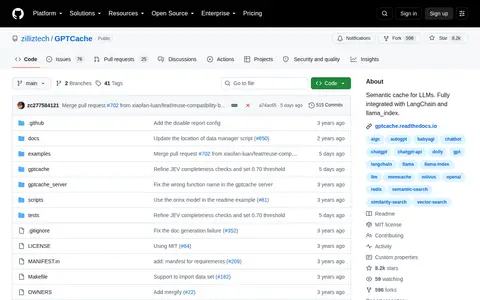
Creating semantic cache to store responses from LLM queries.
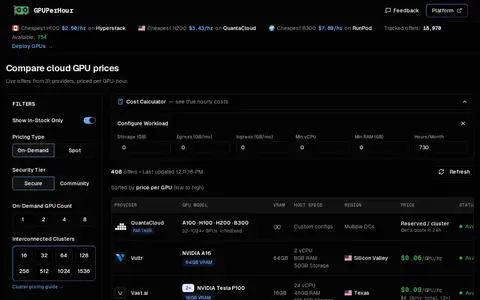
GPU Per Hour is a website that compares live cloud GPU pricing from 31 providers. It lists prices per GPU-hour for various GPU models, including H100, H200, B200, A100, and RTX 4090, and provides market snapshots and historical averages.
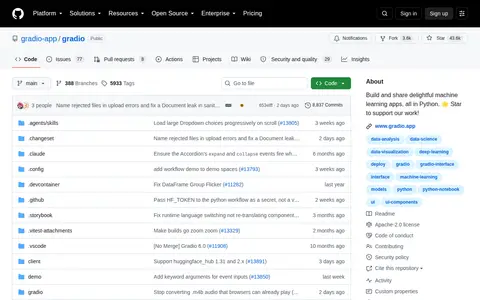
Gradio is an open-source Python library that enables developers to build and share machine learning web applications easily. It provides simple interfaces for creating demos and sharing models, supporting a wide range of ML frameworks.
Groq is a platform for inference, described as one fully integrated platform for infrastructure, inference, and control. It offers tiers including GroqMetal for bare-metal infrastructure, GroqCore for an inference stack, and GroqAssured for governance, auditability, and control.
Helicone AI supports deploying, serving, monitoring, or operating AI and machine-learning systems.
HF Learn supports machine learning models, deployment, inspection, datasets, or AI development workflows.