agentic-engineering-jobs.com
Agentic Engineering Jobs supports AI agents, automated workflows, orchestration, or delegated tasks.
Directory
Published directory entries matching your search.
Agentic Engineering Jobs supports AI agents, automated workflows, orchestration, or delegated tasks.

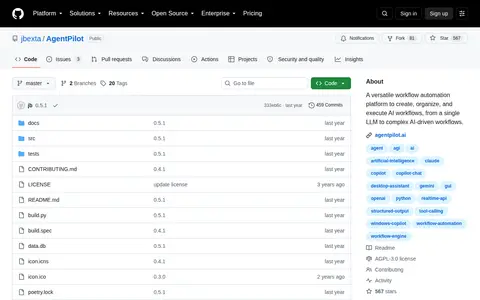
AgentPilot is a workflow automation platform for creating, organizing and executing AI workflows, ranging from a single LLM to complex AI-driven workflows. It offers an interface for designing workflows and chatting with them in real time, with branching chats and graph workflows supporting parallel execution. Workflows can be scheduled using natural language expressions of time.
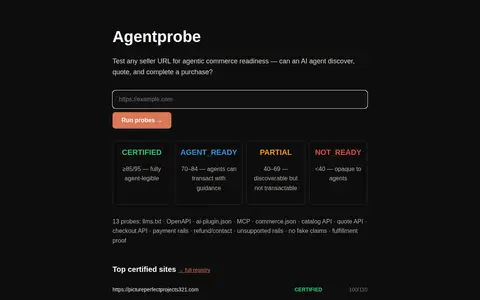
Agentprobe is a tool that tests seller URLs for agentic commerce readiness. It evaluates whether an AI agent can discover, quote, and complete a purchase using 13 probes, such as llms.txt, OpenAPI, and checkout APIs. Results are scored from NOT_READY (

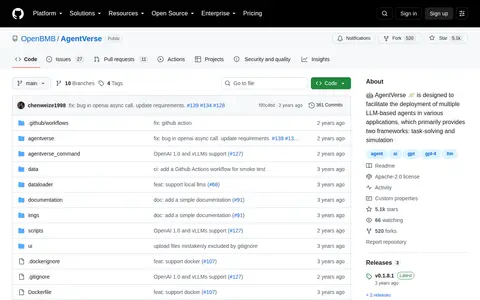
AgentVerse is designed to facilitate deployment of multiple LLM-based agents in various applications. It provides two frameworks: task-solving, which assembles multiple agents as an automatic multi-agent system to collaboratively accomplish tasks, and simulation, which lets users set up custom environments to observe or interact with multiple agents.
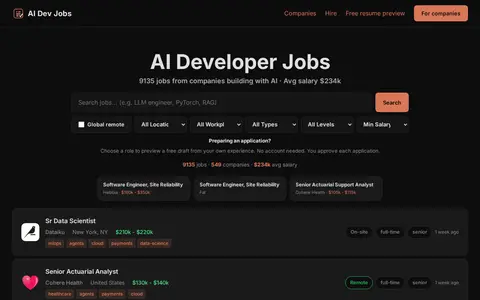
AI Dev Jobs lists open positions for AI developers, covering technologies such as PyTorch, TensorFlow, LLMs, RAG, and computer vision, with salary data and requirements. It also provides a free public REST API and MCP server for AI job search, matching, and candidate-reviewed application preparation.

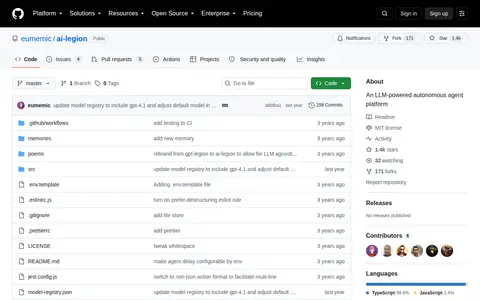
AI Legion is an open-source, LLM-powered autonomous agent platform hosted on GitHub. The repository provides code and documentation for building and running autonomous agents. It includes setup instructions, action error handling, and agent state management. The project is developed by eumemic and encourages community contributions.

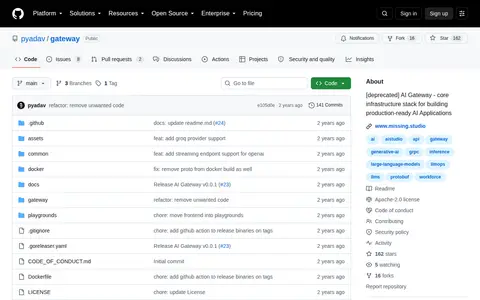
A deprecated GitHub repository described as an AI Gateway, a core infrastructure stack for building production-ready AI applications. It provides a universal API for inferencing over 100 LLMs and lists supported providers and endpoints such as OpenAI and Groq.

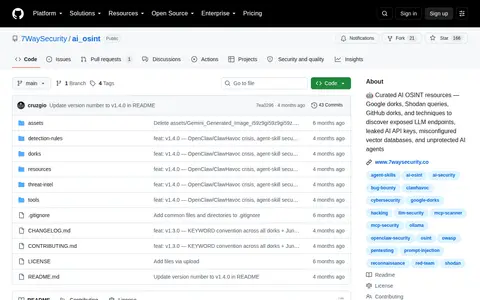
🤖 Curated AI OSINT resources — Google dorks, Shodan queries, GitHub dorks, and techniques to discover exposed LLM endpoints, leaked AI API keys, misconfigured vector databases, and unprotected AI agents

Open-source project that provides machine-learning models, research, training resources, or evaluation tools.

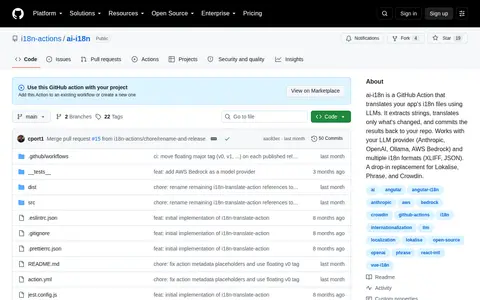
ai-i18n is a GitHub Action that translates internationalization files using large language models. It extracts strings, translates only changed content, and commits results back to the repository. Supported providers include Anthropic, OpenAI, Ollama, and AWS Bedrock, with compatibility for XLIFF and JSON formats. It serves as a drop-in replacement for services like Lokalise, Phrase, and Crowdin.

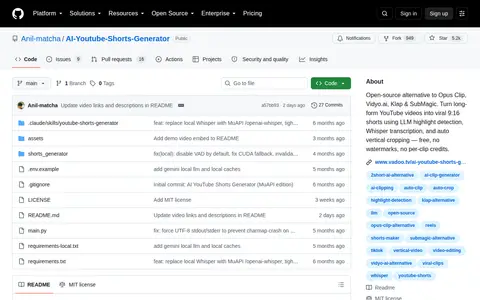
Open-source alternative to Opus Clip, Vidyo.ai, Klap & SubMagic. Turn long-form YouTube videos into viral 9:16 shorts using LLM highlight detection, Whisper transcription, and auto vertical cropping — free, no watermarks, no per-clip credits.
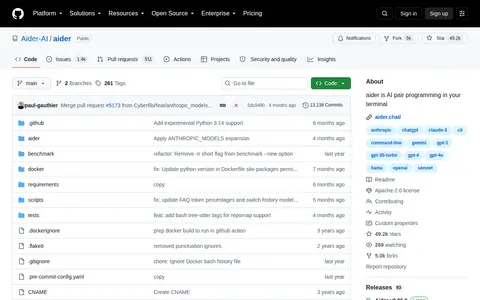
Aider is an AI pair programming tool that runs in the terminal and works with cloud and local LLMs. It maps the codebase, supports more than 100 code languages, and integrates with Git to automatically commit changes. It can also run in an IDE and accept voice-to-code instructions.

Aider is an AI pair programming tool that runs in the terminal. It connects to cloud or local LLMs to start new projects or build on existing codebases, maps the codebase, and works with many programming languages. Changes are committed automatically with git, and aider can lint and test code after edits.

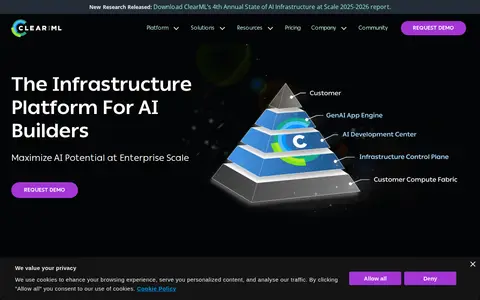
ClearML is an AI infrastructure platform organized in three layers. The Infrastructure Control Plane connects and manages GPU clusters across on-premises, cloud, and hybrid environments, with multi-tenancy, role-based access control, and billing. The AI Development Center provides a workbench for developing, training, and testing models. The GenAI App Engine deploys LLMs onto clusters, with ClearML handling networking, authentication, and security.

Open-source project that provides conversational AI for questions, tasks, and general assistance.

Ambrosia is a cross-platform command line tool written in Go for improving text datasets used in machine learning. It offers fast deduplication, filtering, length checking and whitespace trimming, plus an LLM-based filtering option called psort. It ships as a single binary with no dependencies and is pre-1.0 software.

AI Agent Assistant & development framework that integrates lots of IM platforms, LLMs, plugins and AI feature, and can be your openclaw alternative. ✨
An overview of the current attack techniques on LLMs by Marcello Carboni.

Drop-in AsyncOpenAI replacement that transparently batches requests via the Batch API for cheaper LLM inference.
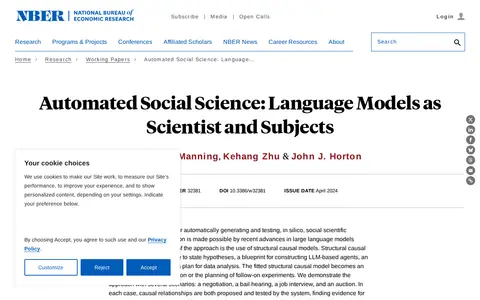
An NBER working paper presenting an approach for automatically generating and testing social scientific hypotheses in silico, using large language models with structural causal models. The approach is demonstrated in a negotiation, a bail hearing, a job interview, and an auction.

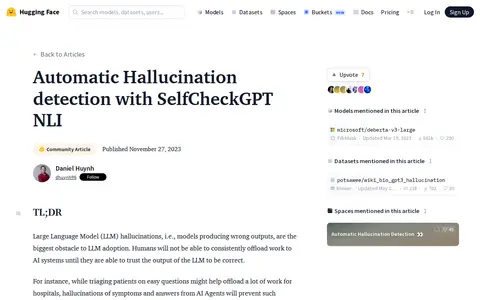
A Hugging Face blog post by Daniel Huynh describing an experiment assessing SelfCheckGPT NLI as a measure of LLM inconsistencies for predicting hallucinated outputs. It reports that scores were highly precise after a threshold and that a score of 0.8 corresponded to close to 80% of hallucinations being identified.

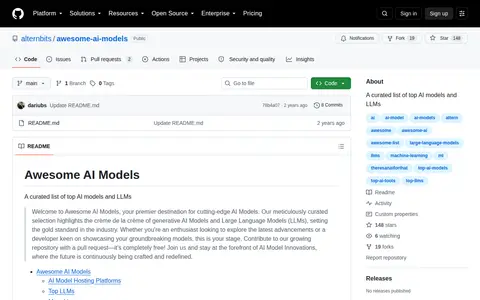
A curated GitHub list of top AI models and large language models, organized into AI model hosting platforms and top LLMs sections. It includes hosting platforms such as Hugging Face and GitHub Models, and lists models from providers including Meta, Google, Mistral AI and DeepSeek. Contributions are made through pull requests.

Open-source project that provides machine-learning models, research, training resources, or evaluation tools.

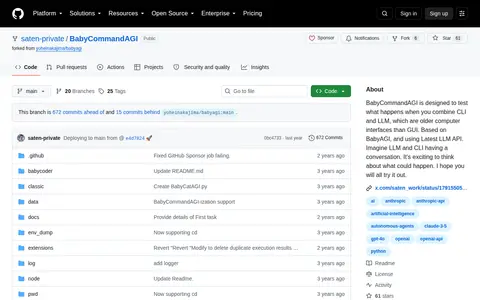
BabyCommandAGI is a Python script system based on BabyAGI that is designed to test combining CLI and LLM interfaces, with the thinking part of BabyAGI greatly simplified to execute commands efficiently. The README warns that it may unintentionally destroy the environment, recommends running it in a virtual environment such as Docker, and recommends Claude 3.7 Sonnet or higher.