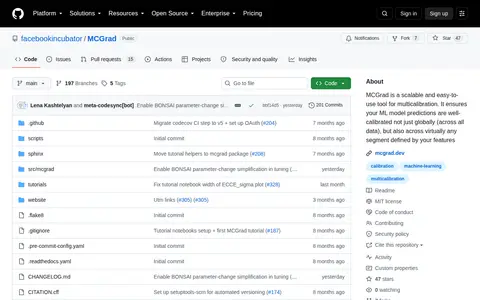

MCGrad is a tool for multicalibration that aims to keep machine learning model predictions calibrated globally and across segments defined by features. It requires Python 3.10+ and is installed with pip or conda; the project's own description says it has been deployed at Meta on hundreds of production models.
Directory
Search results
Published directory entries matching your search.
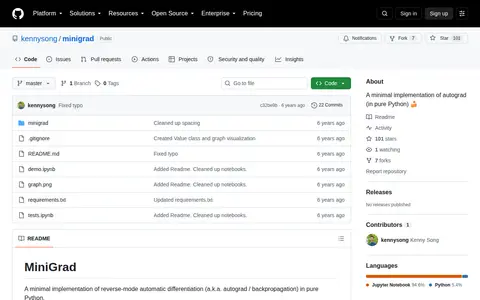
A minimal, educational, Pythonic implementation of autograd (~100 loc).
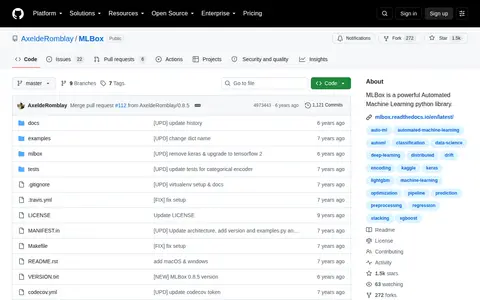
MLBox is an open-source automated machine learning library implemented in Python, hosted in the AxeldeRomblay/MLBox GitHub repository. It provides contribution guidelines, project topic information, and resources documenting the library's functionality.
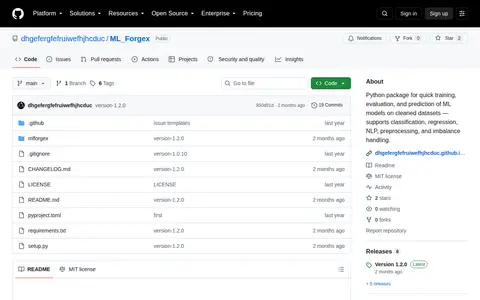
Lightweight ML utility for automated training, evaluation, and prediction with CLI and Python API support.
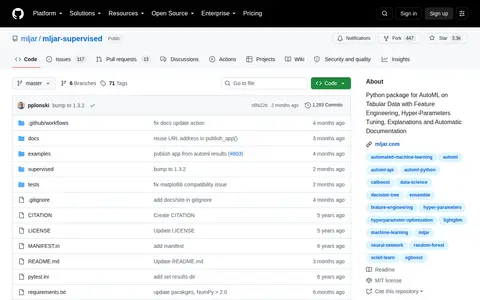
mljar-supervised is an Automated Machine Learning Python package for tabular data. It automates data preprocessing, model construction and hyperparameter tuning, and produces a Markdown report for each model. It offers Explain, Perform and Compete modes, along with model explanations and generated web apps for predictions.
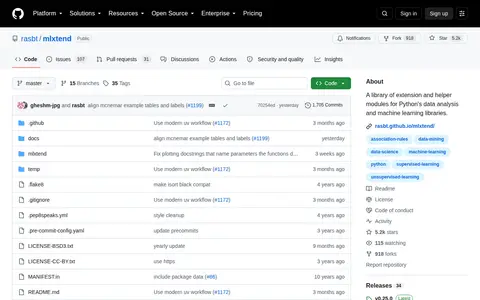
mlxtend is a library that provides extension and helper modules for Python's data analysis and machine learning libraries. The project includes installation guides, example code, license information, and contact details. It is hosted as an open source repository on GitHub.
A tutorial website offering MySQL lessons covering basics, stored procedures, triggers, views and indexes, plus programming interfaces for PHP, Java, Python, Node.js and Perl. It includes a getting-started section intended to leave a local MySQL database with a sample database for practice.
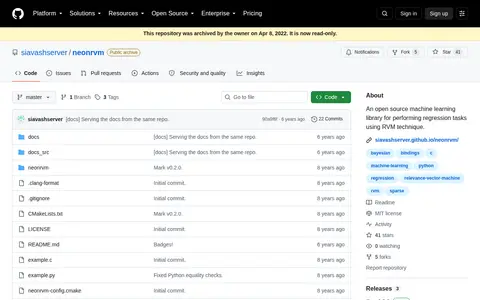
neonrvm is an open-source machine learning library for performing regression tasks using the Relevance Vector Machine (RVM) technique. It is written in Python and available on GitHub. The library aims to provide efficient implementations for RVM-based regression.
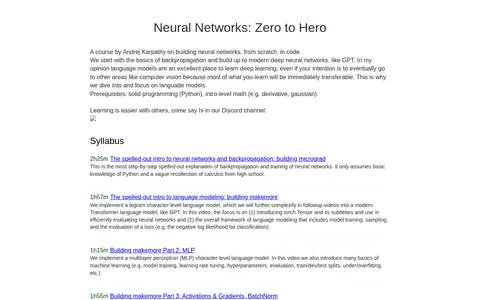
A course by Andrej Karpathy on building neural networks from scratch in code, starting with backpropagation basics and building up to modern deep neural networks like GPT. Prerequisites are solid Python programming and intro-level math such as derivatives and gaussians.
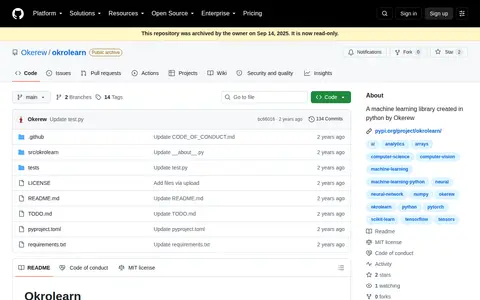
Okrolearn is a machine learning library created in Python by Okerew. It provides a Tensor type and can be installed from PyPI for CPU or GPU use. The repository was archived by its owner on Sep 14, 2025, and is now read-only.

OpenCV is an open source computer vision library that contains over 2500 algorithms and supports model execution for machine learning and artificial intelligence. It was designed to be cross-platform, written in C with C++ and wrappers for Python and Java, and runs on desktop and mobile systems. A GPU module implemented with CUDA provides acceleration for part of the library.
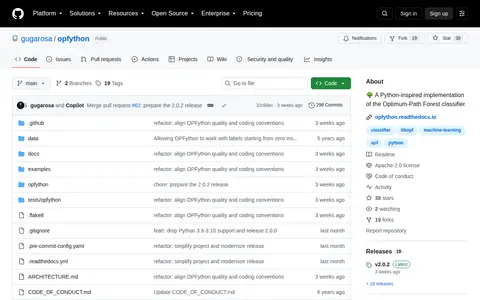
OPFython is a GitHub repository offering a Python-inspired implementation of the Optimum-Path Forest classifier. The library enables classification tasks using the optimum-path forest algorithm. It includes installation instructions, quick start guides, and classifier documentation. The project is open source and welcomes contributions from the community.
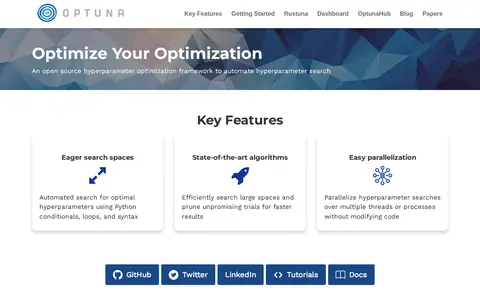
Optuna is an open source automatic hyperparameter optimization software framework designed for machine learning. It provides an imperative, define-by-run style user API with eager search spaces, algorithms that prune unpromising trials, and parallelization of searches over multiple threads or processes without modifying code. It is framework agnostic and can be installed with pip on Python 3.10 or newer.
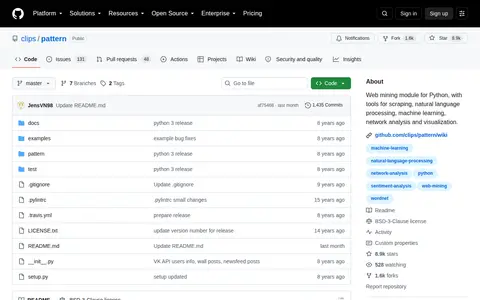
Pattern is a web mining module for Python with tools for data mining, natural language processing, machine learning, and network analysis and visualization. The repository is archived and no longer maintained, receiving no further updates, bug fixes or security patches.
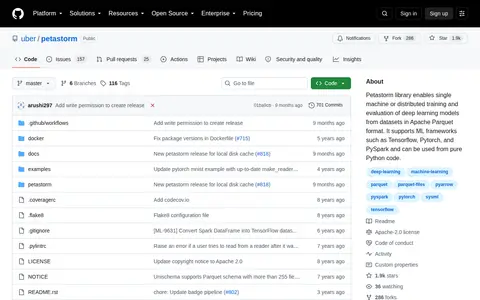
Petastorm is a library developed by Uber for deep learning model training and evaluation. It supports single-machine and distributed workflows with datasets in Apache Parquet format, is compatible with TensorFlow, PyTorch, and PySpark, and can be used via pure Python code.
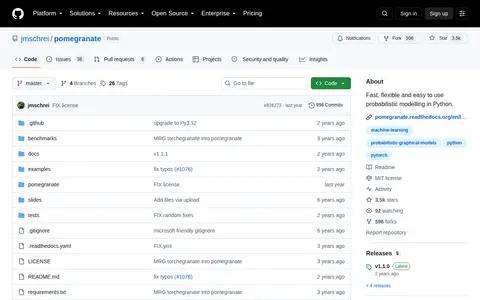
Hidden Markov Models for Python, implemented in Cython for speed and efficiency.
Programiz provides free online compilers and code editors that run in a browser for languages including Python, JavaScript, SQL, C, C++, Java, HTML and CSS. It also offers interactive lessons with practical code that can be run directly in the browser. The site states no installation or sign up is needed.
Prophet is a forecasting procedure implemented in R and Python. It provides automated forecasts that can be tuned by hand, and is based on an additive model with non-linear trends and yearly, weekly and daily seasonality plus holiday effects. Facebook released it as open source, available on CRAN and PyPI.
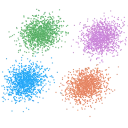
Multidimensional cluster generation in Python.
Python Library for Probabalistic Programming (Bayesian Inference and Machine Learning).
A Python library for secure and private Deep Learning built on PyTorch and TensorFlow.
Helps find, analyze or synthesize information for research and knowledge discovery.
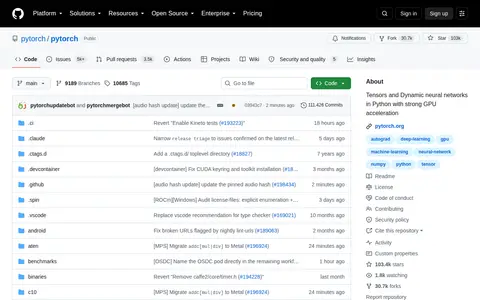
PyTorch is a Python package providing tensor computation with strong GPU acceleration and deep neural networks built on a tape-based autograd system. It includes components such as torch, torch.autograd, torch.nn, and torch.utils, and can be used as a NumPy replacement or a deep learning research platform.
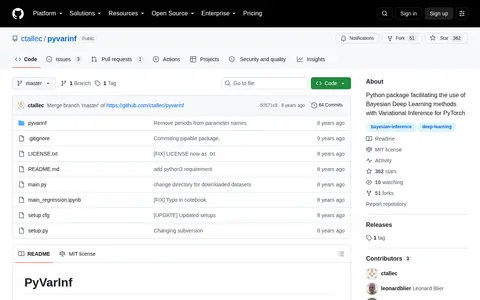
PyVarInf is a Python package that facilitates the use of Bayesian deep learning methods with variational inference for PyTorch, providing facilities to train PyTorch neural network models using variational inference. It approximates the posterior distribution over network weights with a parametric distribution.