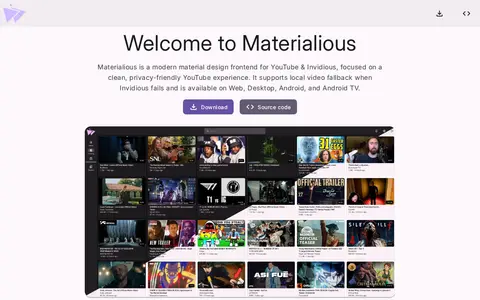
Materialious is a material design frontend for YouTube and Invidious aimed at a clean, privacy-friendly experience. It runs on Web, Windows, Android, Android TV, Docker, macOS and Linux, and supports local video fallback when Invidious fails.
Directory
Search results
Published directory entries matching your search.
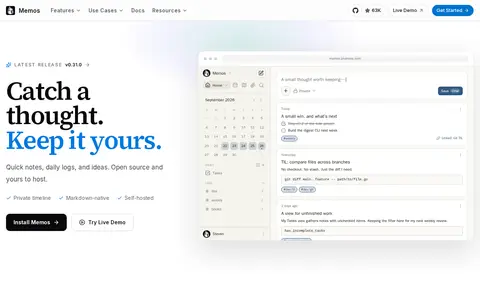
Memos is an open-source, self-hosted note-taking app that provides a timeline for quick notes written in Markdown. New memos are private by default, and visibility can be limited to the author, invited people, or anyone with the link. The software is MIT licensed, sends no telemetry, and can be deployed with Docker.
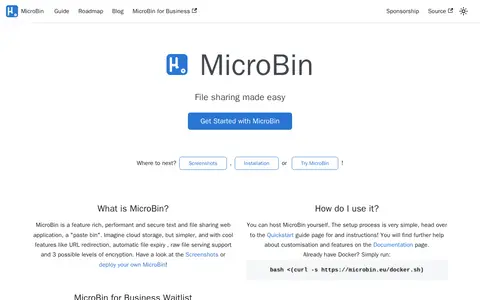
MicroBin is a self-hosted text and file sharing web application described as a paste bin. It offers features such as URL redirection, automatic file expiry, raw file serving and three levels of encryption. The project provides documentation for creating, accessing and modifying uploads, privacy levels and installation via Docker or Cargo.
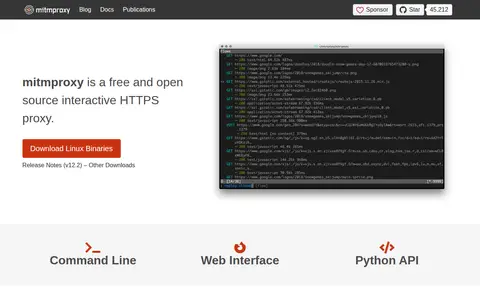
mitmproxy is a free and open source interactive HTTPS proxy. It can be used to intercept, inspect, modify and replay web traffic, including HTTP/1, HTTP/2, HTTP/3, WebSockets and other SSL/TLS-protected protocols. It offers a command line interface, a graphical web interface, and a Python API for writing addons and scripts. Downloads are available for Windows, Linux, macOS and Docker.


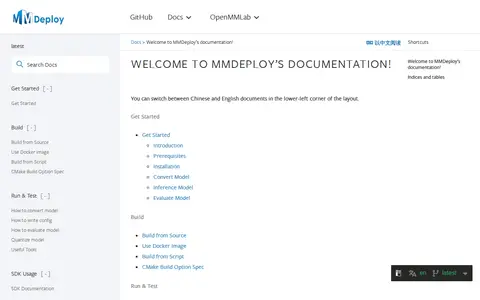
MMDeploy is documented at version 1.3.1 and covers getting started, converting, running, evaluating and quantizing models, building from source or Docker image, and SDK usage. Its backend support pages describe ncnn, ONNX Runtime, OpenVINO, PPLNN, SNPE, TensorRT, TorchScript, RKNN, TVM and Core ML, and its codebase support covers several OpenMMLab projects.
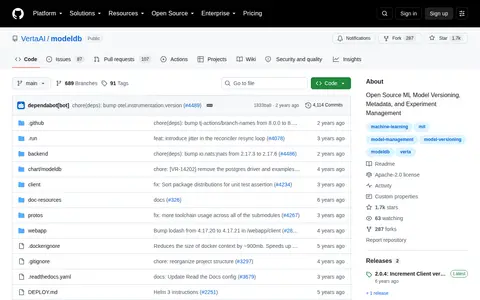
ModelDB is an open-source system for versioning machine learning models, including their code, data, config and environment, and for tracking ML metadata across the model lifecycle. It supports reproducible models, experiment management and lifecycle tracking. It runs on Docker and Kubernetes, offers Python and Scala clients, and is maintained by Verta.ai.
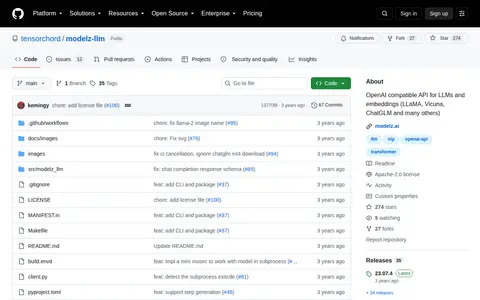
Modelz LLM is an inference server for running open source large language models such as FastChat, LLaMA and ChatGLM on local or cloud environments with an OpenAI compatible API. It supports interaction through the OpenAI python SDK or LangChain and provides docker images for deployment on Kubernetes or Modelz.
Motrix is an open-source download manager supporting HTTP, FTP, BitTorrent, Magnet and Metalink. It provides task controls for pausing, resuming, retrying and prioritizing downloads, plus torrent connection management and plugins. It runs on macOS, Windows and Linux, and Docker, with links sent from supported browser extensions. No account is required, and the software has been open-source since 2018.
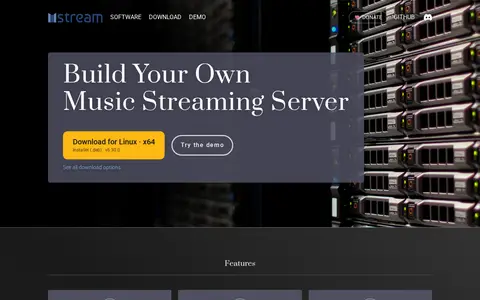
mStream is open source software for syncing and streaming music between devices. It is a self-hosted music server that runs on a computer the user owns, including old hardware and boards like the Raspberry Pi. Streams can include FLAC and lossless files, and the server is available for Windows, macOS, Linux, Raspberry Pi and NAS boxes, with Docker and source install options.
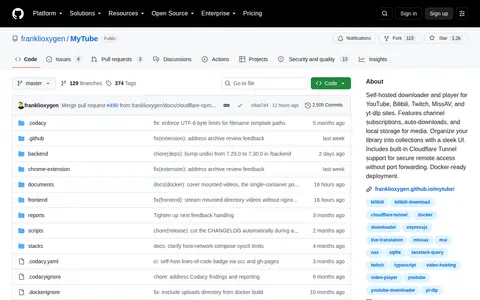
Self-hosted downloader and player for YouTube, Bilibili, Twitch, MissAV, and yt-dlp sites. Features channel subscriptions, auto-downloads, and local storage for media. Organize your library into collections with a sleek UI. Includes built-in Cloudflare Tunnel support for secure remote access without port forwarding. Docker-ready deployment.
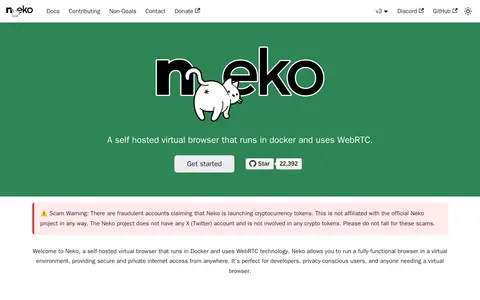
neko (stylized as n.eko) is a self-hosted virtual browser that runs in Docker using WebRTC technology. It supports use cases including watch parties, interactive presentations, collaborative work, teaching, content embedding, automated browsing, ultra-low-latency streaming, multi-participant control, and live broadcasting.
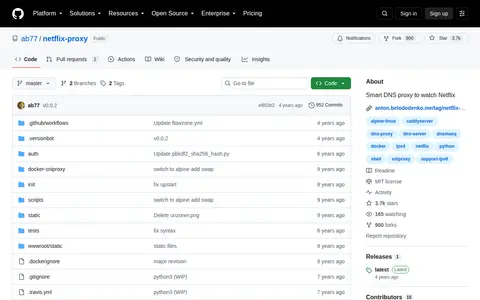
Netflix Proxy is a smart DNS proxy for streaming Netflix, Hulu, HBO Now and other services from other regions. It is deployed with Docker containers and uses dnsmasq and sniproxy to provide SmartDNS services. Additional services are added by updating the dnsmasq.conf file.
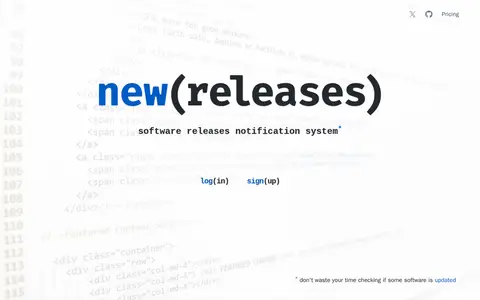
A release tracker for software developers and DevOps that sends notifications when software is updated. It supports many providers including GitHub, GitLab, Codeberg, Gitea, Bitbucket, package registries and Docker image tags, and delivers messages through email, webhooks and instant messengers. The service is free and accepts donations.
NextPVR is a free whole-home digital video recorder for Windows, Linux, Mac and Docker. It records, watches and streams live TV across devices, with live TV, a TV guide, recordings, search and a web scheduler. Supported tuners include DVB, ATSC, QAM, DMB-T, analog, SAT>IP and HDPVR.
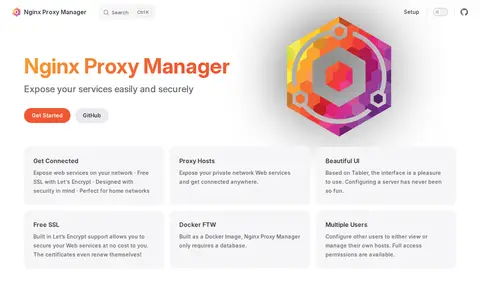
Nginx Proxy Manager is a Docker container with a built-in web application for managing Nginx proxy hosts through an interface. It provides free SSL support via Let's Encrypt and exposes web services on a network. The project describes itself as designed with security in mind and suited to home networks.
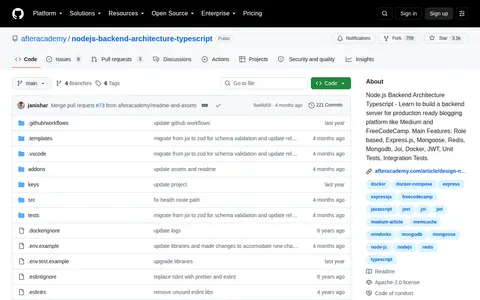
Node.js Backend Architecture Typescript - Learn to build a backend server for production ready blogging platform like Medium and FreeCodeCamp. Main Features: Role based, Express.js, Mongoose, Redis, Mongodb, Joi, Docker, JWT, Unit Tests, Integration Tests.
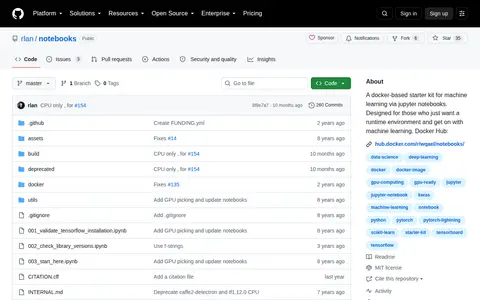
Notebooks is a Docker-based starter kit for machine learning through Jupyter notebooks, intended for users who want a ready runtime environment. Its images cover combinations of Keras, TensorFlow and PyTorch with CUDA v8 through v11, and include JupyterLab, scikit-learn, pandas and visualization, vision and NLP libraries. Python 3 only, as Python 2 is end-of-life.
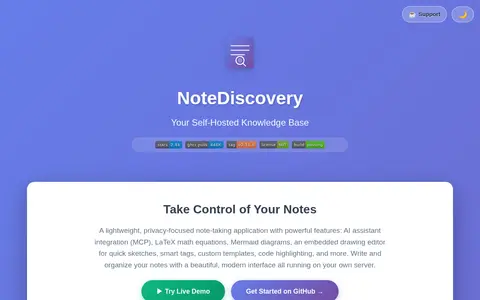
NoteDiscovery is a self-hosted Markdown knowledge base described as free and open source. It includes wikilinks, graph view, a drawing editor, LaTeX math, and Mermaid diagrams, along with AI assistant integration via MCP. Notes are stored as plain Markdown files in folders, and the project offers a Docker-based setup.
NZBGet is an NZB downloader that retrieves articles from Usenet newsgroups, written in C++ for high performance and low resource consumption. It runs on Windows, macOS, Linux, NAS devices, and Docker, and works with Sonarr, Radarr, and other automation tools. It offers queue management, post-processing scripts, automatic par-check and repair, and a remote web interface.
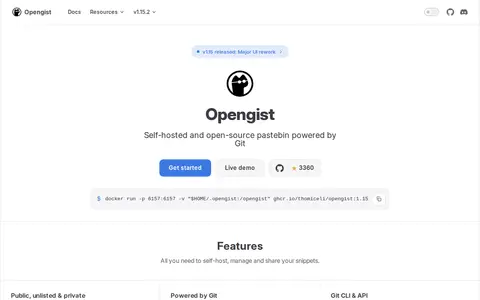
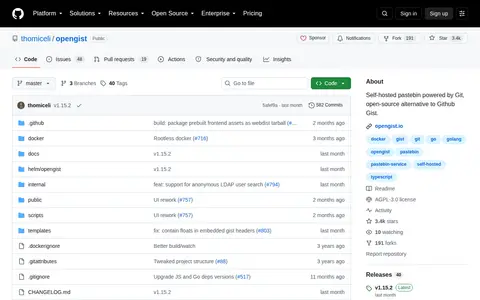
Opengist is an open-source, self-hosted pastebin powered by Git. Snippets are stored in Git repositories and can be managed with standard Git commands or a web interface. It supports public, unlisted, and private snippets, multiple files per snippet, revisions and diffs, syntax highlighting, and login through OAuth2 providers, LDAP, and passkeys. It is written in Go and can run as a single binary, Docker image, or Kubernetes deployment, backed by SQLite, PostgreSQL, or MySQL.
Opengist is a self-hosted pastebin powered by Git, described as an open-source alternative to GitHub Gist. Snippets are stored in a Git repository and can be read or modified with standard Git commands or through a web interface. It supports public, unlisted and private snippets, Git operations over HTTP or SSH, and Docker deployment.
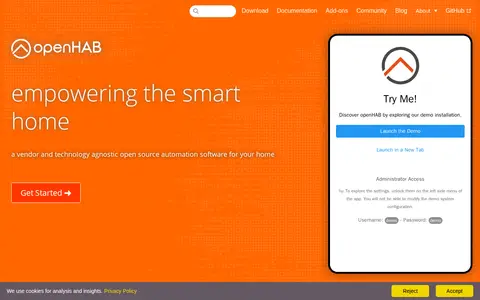
openHAB is a vendor- and technology-agnostic open source automation software for the home, developed in Java on Apache Karaf. Its pluggable architecture supports over 400 technologies and thousands of devices, with rules driven by time, events, scripts, actions, notifications and voice control. It runs on Linux, macOS, Windows, Raspberry Pi, Docker and Synology, and is accessed through web, iOS and Android apps. It runs on local hardware without requiring cloud services.
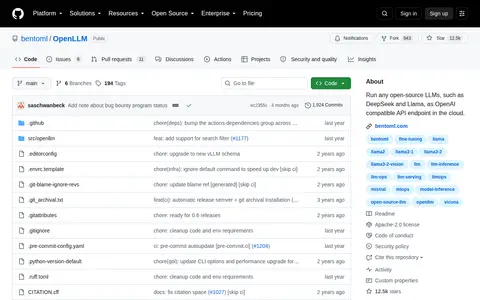
OpenLLM is a project from BentoML for running open-source LLMs or custom models as OpenAI-compatible APIs with a single command. It includes a built-in chat UI, inference backends, and a workflow for cloud deployment with Docker, Kubernetes, and BentoCloud, and it does not store model weights. A Hugging Face token is required for gated models.
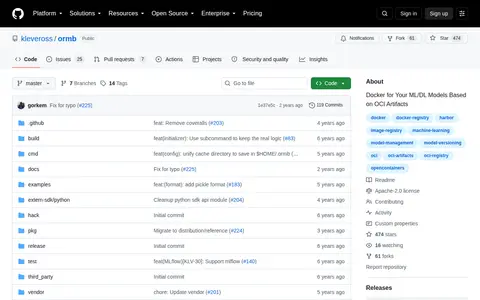
An open-source model registry that uses an image registry to distribute machine learning models. Users upload and download models with ormb pull and ormb push, and describe model information in ormbfile.yaml, similar to a Dockerfile.