
KushoAI is AI-native infrastructure for software maintenance, with autonomous agents integrated into customer CI/CD pipelines to handle continuous testing, healing, and monitoring. It automatically generates test suites from OpenAPI specifications or Postman collections to catch breaking API changes before production.
Directory
Search results
Published directory entries matching your search.
Laminar is an open-source observability platform purpose-built for AI agents. It provides OpenTelemetry-native tracing with a one-line SDK setup, plain-English signals that alert in Slack, and an SDK and CLI for running evals. It is written in Rust with 20x trace compression, and can be used via a managed platform or self-hosted with Docker Compose.
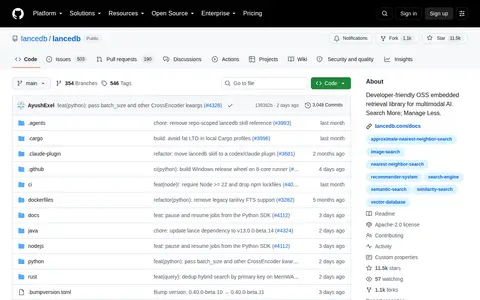
LanceDB is a developer-friendly open-source embedded retrieval library for multimodal AI. It emphasizes searching more and managing less. The project tagline is 'Search More; Manage Less.' It is available on GitHub.
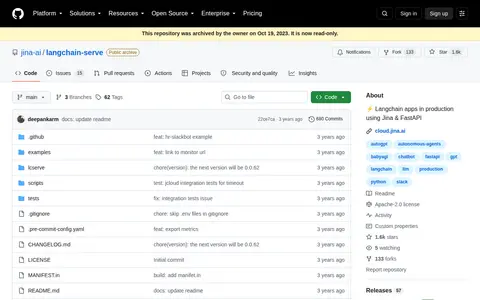
An archived, read-only repository that provided a way to deploy LangChain apps using Jina and FastAPI, wrapping apps as services on Jina AI Cloud. The README notes the project is no longer maintained and that it could deploy apps on a user's own infrastructure.
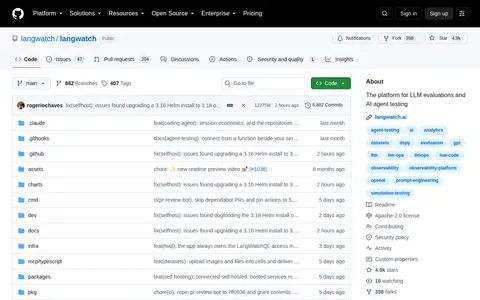
LangWatch is a platform for evaluating large language models and testing AI agents. The open-source project is hosted on the GitHub platform under the langwatch organization as the langwatch/langwatch repository.
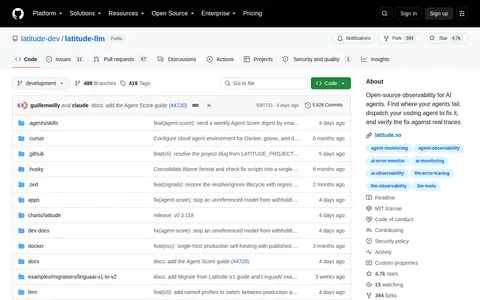
Latitude is an open-source observability tool for AI agents. It helps identify failures, dispatch coding agents to fix issues, and verify fixes using real traces. The platform is available on GitHub.
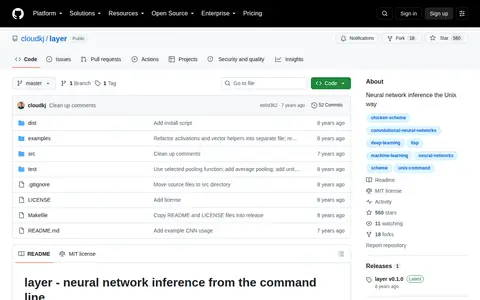
layer is a command-line tool for neural network inference, following the Unix philosophy. It enables users to perform inference from the command line. The project is open-source and hosted on GitHub.
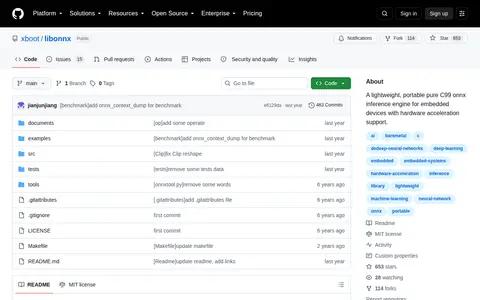
libonnx is a lightweight, portable pure C99 ONNX inference engine for embedded devices with hardware acceleration support. Its .c and .h files can be dropped into a project and compiled with it. Models are loaded from a file into a context, and inference runs on input tensors via onnx_run. It is based on ONNX version v1.17.0 with opset 24 support, and some operators are not implemented.
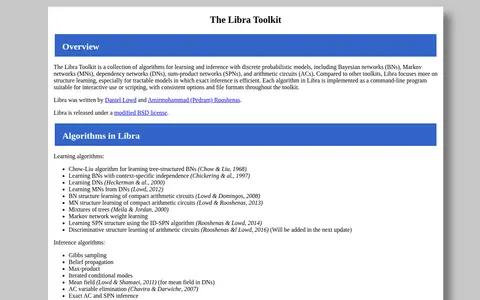
The Libra Toolkit is a collection of algorithms for learning and inference with discrete probabilistic models, including Bayesian networks, Markov networks, dependency networks, sum-product networks and arithmetic circuits. Each algorithm is implemented as a command-line program with consistent options and file formats, and all methods are written in OCaml.
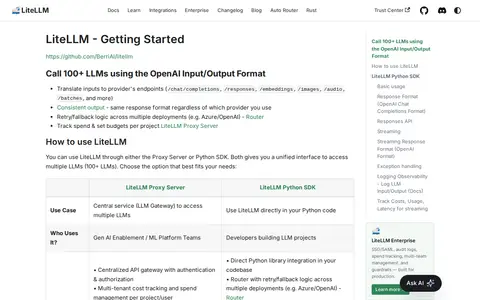
LiteLLM is an open-source library that provides a single, unified interface to call over 100 LLMs using the OpenAI format. It includes a Python SDK whose completion() function uses the same arguments across providers and returns responses in the OpenAI Chat Completions format, plus a self-hosted gateway with virtual keys, cost tracking and an admin UI.
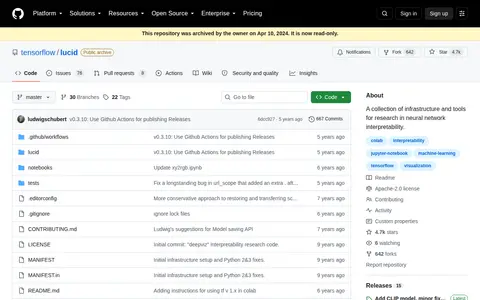
Collection of infrastructure and tools for research in neural network interpretability.
Lunary is an observability and prompt management platform for LLM-based applications. It provides chatbot analytics, agent tracing, prompt templates, topic classification, PII masking and feedback tracking. A self-hostable option is offered. The Team cloud plan costs $20 per user per month, billed monthly, and payment is required to activate a workspace.
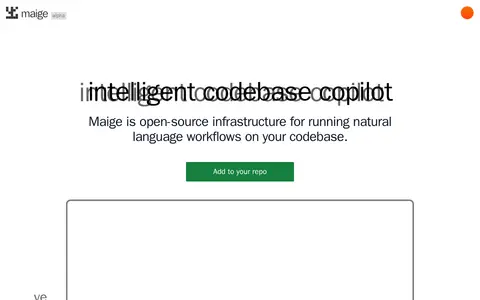
Maige is open-source infrastructure for running natural language workflows on a codebase. After connecting a repository, users write rules describing what should happen when issues and pull requests are opened, and the tool can label, assign, comment, review code, and run simple code snippets. It works with the GitHub API. A standard plan is offered after free use, with usage-based payment.
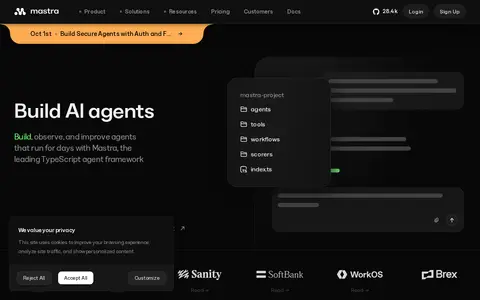
Mastra is a TypeScript AI framework for building agents and AI applications. It includes built-in memory, tool support, MCP compatibility, and observability features to support development from prototype to production. The framework also offers workflow tools, agent factory functionality, cloud deployment servers, and an agent builder for evaluation and iteration.

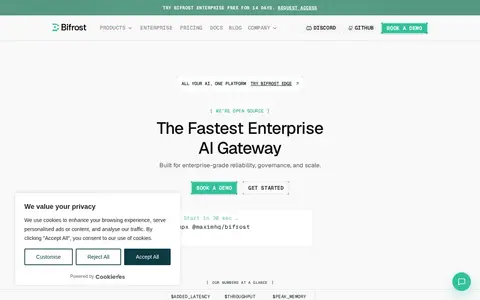
Bifrost is an open-source AI gateway for LLMs, MCP and agents, offered by Maxim AI. It provides routing, governance, guardrails and observability, and is described as a drop-in replacement for AI SDKs. Enterprise adds features such as SSO, RBAC, adaptive load balancing, cluster mode and in-VPC deployment, free for 14 days.

Mem0 is a drop-in memory infrastructure tool for AI agents and applications. It provides persistent context for AI systems, is built for production use, and is available as a public repository on GitHub.
Milvus is open source vector database for production AI, written in Go and C++, scalable and blazing fast for billions of embedding vectors.
Full-stack AI platform focused on multimodal agents and consumer-scale deployment.
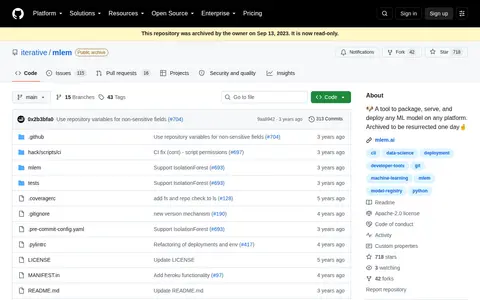
MLEM is an open source tool designed to package, serve, and deploy machine learning models on any platform. The project's primary repository is currently archived, with maintainers noting plans to resurrect it in the future.
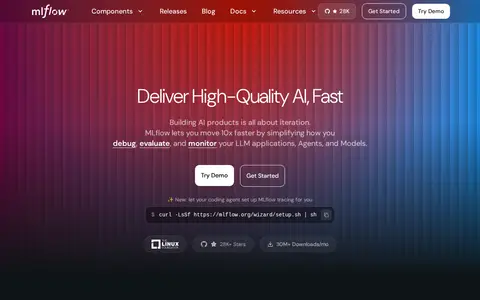
MLflow is an open source AI engineering platform for agents, LLMs, and ML models. It provides tools for debugging, evaluating, monitoring, and optimizing AI applications, including tracing, evaluation metrics, prompt management, an AI gateway, and an agent server. The project is released under the Apache 2.0 license.
MLOps Community is a global community for machine learning engineers focused on MLOps. It facilitates knowledge sharing, real-world problem solving, networking, and career advancement through in-person meetups and conferences, virtual tech talks, podcasts, workshops, and masterclasses. It reports membership of over 70,000 to 90,000 ML practitioners.
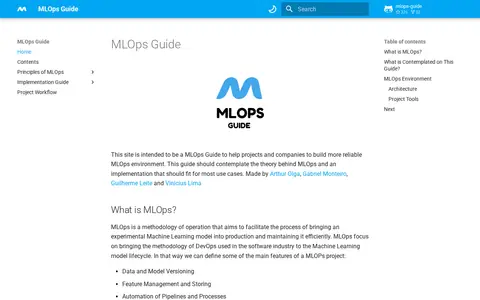
A guide explaining MLOps concepts and how to build an MLOps environment. It covers theory and a tutorial using tools such as DVC, CML, IBM Watson Machine Learning, IBM Watson OpenScale, Terraform and Cookiecutter. The guide is described as modular, allowing tools to be swapped according to project preferences and use cases.
MLOps Now supports deploying, serving, monitoring, or operating AI and machine-learning systems.
MLReef is an open source ML-Ops platform for collaborating, reproducing and sharing machine learning work. The repository notes it is no longer supported or updated there, with work continuing on GitLab. Described sections include data management with versioned data hosting, containerized code repositories, experiment tracking and ML pipelines on Kubernetes, cloud or bare metal.