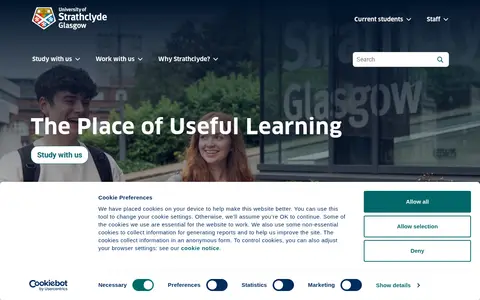

The University of Strathclyde is a Glasgow-based higher education institution home to 30,000 students from 140 countries. It offers undergraduate, postgraduate taught and postgraduate research courses, including a January 2027 intake option. It has received multiple UK and Scottish University of the Year awards for 2026 and 2027, and 90% of its research is rated world leading or internationally excellent per Times Higher Education’s analysis of REF2021.
Directory
Search results
Published directory entries matching your search.
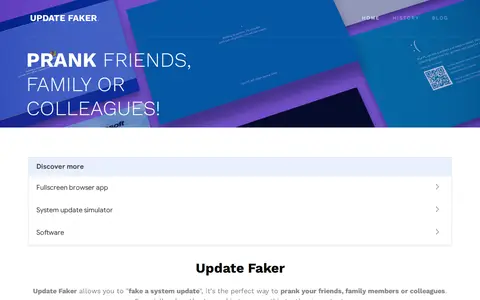
Update Faker is a harmless prank website that displays fake system update screens for multiple operating systems including Windows 10, Windows 11, Windows XP, Windows 98 and Apple Mac OS X. It is designed to prank friends, family or colleagues who leave their computers unattended, with optional fullscreen mode and bluescreen of death effects for added immersion. The site states pranks should not be harmful or last long.
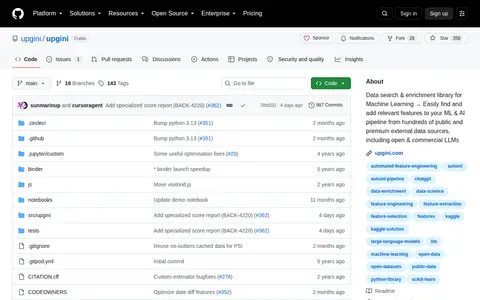
Upgini is an open-source data search and enrichment library for Machine Learning and AI pipelines. It enables users to find and add relevant features from hundreds of public and premium external data sources, including open and commercial large language models.
Usage Tracker supports software development with code generation, analysis, debugging, or documentation.
Handbook and recipes for data-driven solutions of real-world problems.
Vaex is an open-source Python DataFrame library for working with large tabular datasets without loading them fully into memory. It supports lazy opening of CSV files and processing of hundreds of millions or billions of rows per second. The project also offers consultancy and training services.
VaporLens summarizes Steam game reviews into pros, cons, performance notes and player sentiment to help players judge whether a game is worth buying. It offers a public API endpoint that returns summarized review analysis for a Steam app, and documents license conditions for that API.
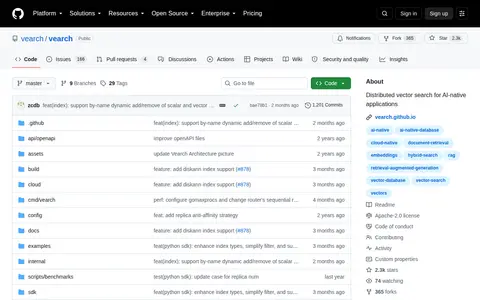
Vearch is a cloud-native distributed vector database for similarity search of embedding vectors in AI applications. It supports hybrid vector search and scalar filtering, replication, elastic scaling, RESTful APIs, and SDKs for Python, Go, Java and Rust. It integrates with frameworks including LangChain and LlamaIndex and can be deployed via Kubernetes or Docker Compose.
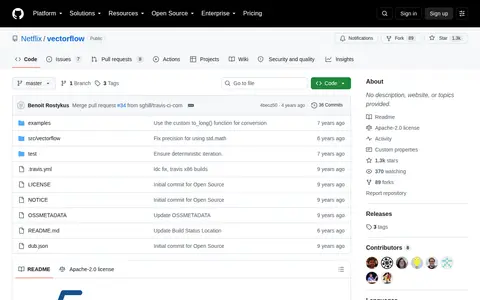
Minimalist neural network library optimized for sparse data and single machine environments.
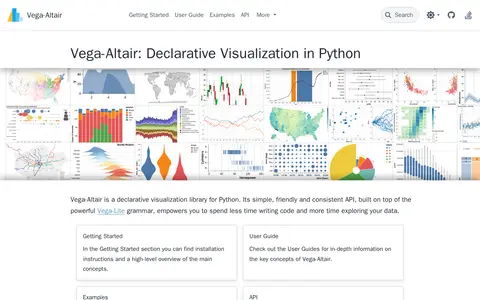
Vega-Altair is a declarative visualization library for Python with a simple, friendly and consistent API built on the Vega-Lite grammar. The project states it is not affiliated with Altair Engineering, Inc.
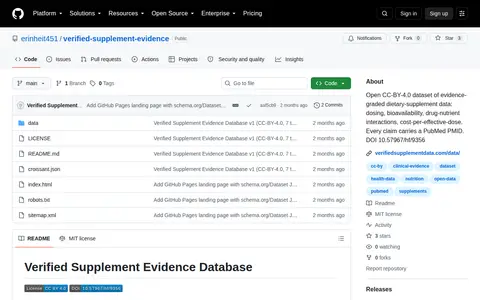
Open CC-BY-4.0 dataset of evidence-graded dietary-supplement data covering dosing, bioavailability, drug-nutrient interactions and cost-per-effective-dose, with every clinical claim tied to a PubMed PMID. Compiled by Verified Supplement Data, it is mirrored on Hugging Face and Kaggle and offered as a free live JSON API.
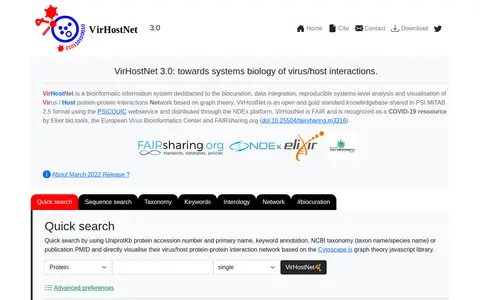
VirHostNet is a bioinformatic information system for biocuration, data integration, analysis and visualisation of virus/host protein-protein interactions. It offers quick search by protein accession, keyword, taxonomy or PMID, BLAST protein sequence search, browsing by viral taxonomy and keyword annotations, and an Interology web service. The knowledgebase is shared in PSI MITAB 2.5 format via the PSICQUIC web service and distributed through NDEx.
Security scanning service for checking files, URLs, domains, and hashes across many detection engines.
Research report examining seven years of truck-involved fatalities, 2018 through 2024, across 19 major US cities, based on FARS data. It compares each city's 2018-2019 baseline average with its 2023-2024 average and notes that of 17 Vision Zero adopters, 10 improved and 7 did not.
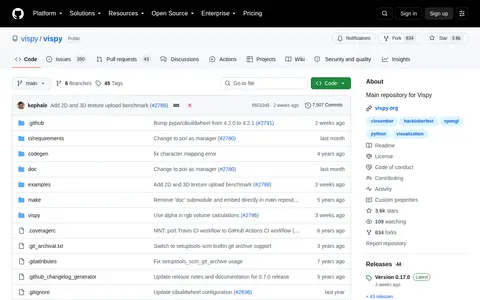
VisPy is a high-performance interactive 2D/3D data visualization library that uses GPUs through OpenGL to display large datasets. It offers a Pythonic, NumPy-aware interface for OpenGL ES 2.0 called gloo and an experimental OpenGL backend for matplotlib. The project is described as young and under heavy development, with high-level plotting interfaces still experimental.
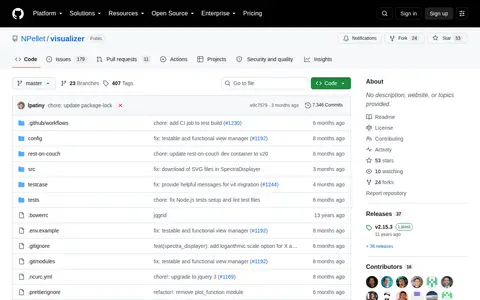
The visualizer is a tool developed by the cheminformatics department of the Swiss Federal Institute of Technology for rendering complex datasets. Its modules, placed on a browser page, display information as tables, charts, matrices or lists and interact through a central API of variables and actions. Visualization starts by passing three JSON file URLs in the browser address bar. It is released under the MIT license.
Offers a unique blend of business model canvassing and AI-driven market analysis.
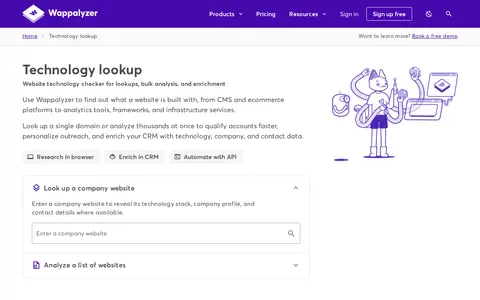
Wappalyzer is a website technology checker that identifies the technologies a site is built with, including CMS and ecommerce platforms, analytics tools, frameworks and infrastructure services. It supports single-domain lookups or bulk analysis of thousands of sites, and can also be used in the browser, in a CRM, or through an API.
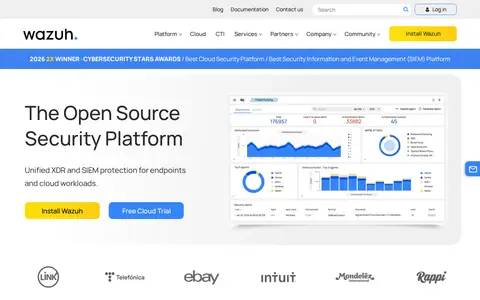
Wazuh is a free and open source security platform that unifies XDR and SIEM protection for endpoints and cloud workloads. It collects, aggregates, indexes and analyzes security data to detect intrusions, threats and behavioral anomalies. Capabilities include file integrity monitoring, vulnerability detection, configuration assessment and log data analysis. A managed Wazuh Cloud service is also offered.
Web3 Antivirus is a security suite for Web3 users. It includes a browser extension, a MetaMask Snap, a free security API, wallet risk analysis, and an address poisoning monitor, aimed at protecting against phishing, wallet drainers, and other blockchain threats.
WebAIM works to expand the potential of the web for people with disabilities by helping individuals and organizations create accessible content. Its offerings include accessibility training, technical assistance, procurement guidance, and evaluation and reporting, alongside surveys and the WebAIM Million analysis of home pages.
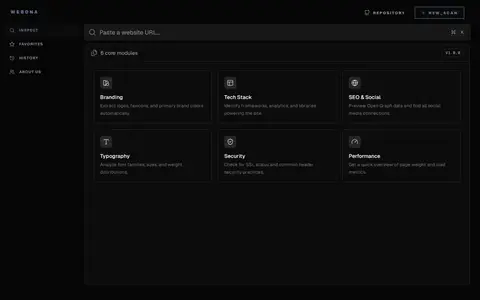
WebDNA is a website analysis tool that examines six core modules of a site. It extracts logos, favicons and brand colors, identifies frameworks, analytics and libraries, previews Open Graph data and social connections, analyzes font families, sizes and weights, checks SSL status and header security practices, and gives an overview of page weight and load metrics.
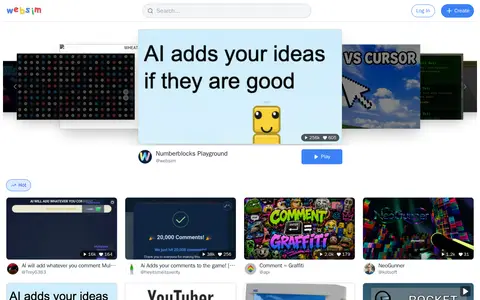
Websim supports software development with code generation, analysis, debugging, or documentation.
Websim AI supports software development with code generation, analysis, debugging, or documentation.