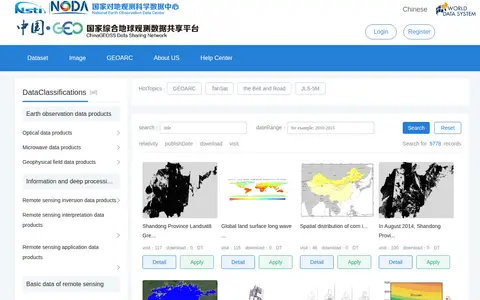
ChinaGEOSS Data Sharing Network is a data discovery platform showing earth observation data products, deeper-processed information data, remote sensing data and other data. Datasets can be filtered by spatial location, data format and data type, or searched by keyword and time range. Online resources can be downloaded directly; offline resources require administrator approval.
Directory
Search results
Published directory entries matching your search.
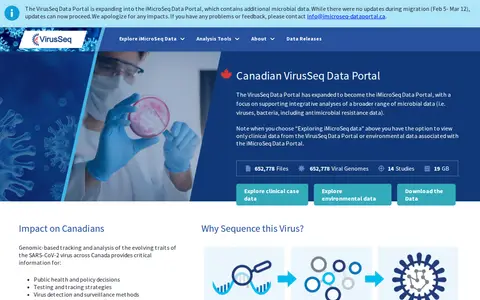
The Canadian VirusSeq Data Portal is a data portal for clinical case data that has expanded into the iMicroSeq Data Portal, which supports integrative analyses of broader microbial data such as viruses and bacteria, including antimicrobial resistance data. Genome Canada partnered with DNAstack to share VirusSeq data on Viral AI, a federated network for genomic variant surveillance and infectious disease research.
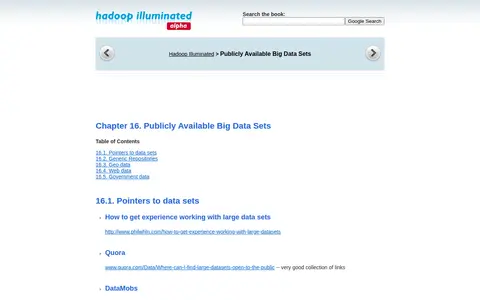
Hadoop Illuminated's Chapter 16 page lists pointers to publicly available big data sets, covering generic repositories, geo data, web data and government data. It links to sources such as Amazon AWS data sets, InfoChimps, the Comprehensive Knowledge Archive Network, OpenStreetMap, Wikipedia data, Google N-gram data, Freebase, data.gov and World Bank data.
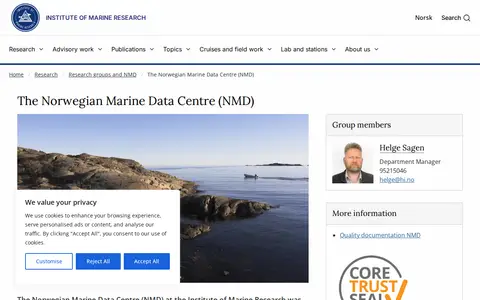
The Norwegian Marine Data Centre at the Institute of Marine Research is a national data centre for processing and long-term storage of marine environmental and fisheries data. It maintains Norway's largest collection of such data and produces data products. Its activities include operational data management, data storage, standards and guidelines, and participation in international networks and research projects.
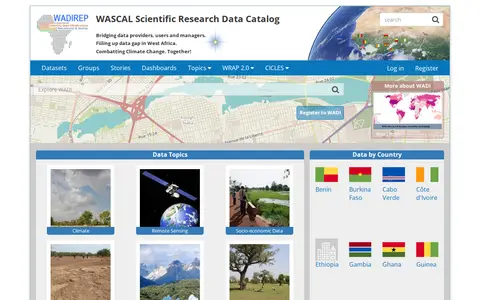
WASCAL Scientific Research Data Catalog is a portal on the WASCAL Data Infrastructure (WADI), the hardware, software, network resources and IT services set up by WASCAL to enable collection, storage, management, discovery, access, sharing and dissemination of primary and secondary research data related to environment and climate change in the West African region. It lists data topics and data groups.
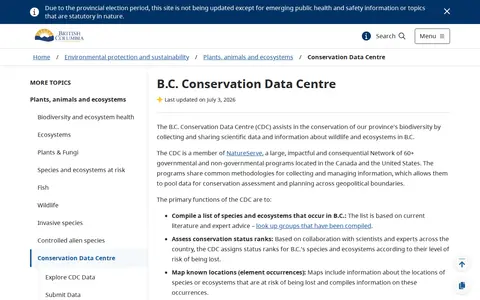
The B.C. Conservation Data Centre collects and shares scientific data about wildlife and ecosystems in British Columbia that are at risk. It compiles species and ecosystem lists, assigns conservation status ranks, maps known locations, and disseminates data. The centre is a member of the NatureServe network and offers online tools for exploring data.
The Coastal Data Information Program (CDIP) measures, analyzes, archives and disseminates coastal environment data. It specializes in wave measurement, swell modeling and forecasting, and analysis of coastal environment data. CDIP is an extensive network for monitoring waves and beaches along United States coastlines, operated by the Ocean Engineering Research Group at Scripps Institution of Oceanography. It has produced a publicly-accessible environmental data database since 1975.
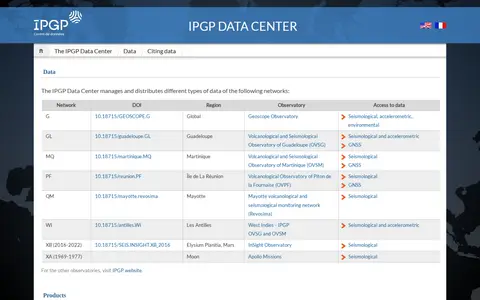
The IPGP Data Center manages and distributes several types of data from networks including the Geoscope Observatory and the volcanological and seismological observatories of Guadeloupe, Martinique, Réunion and Mayotte. It also provides access to validated earthquake data and volcano activity reports, and hosts the IPGP Research Collection for sharing and preserving research data and documents.
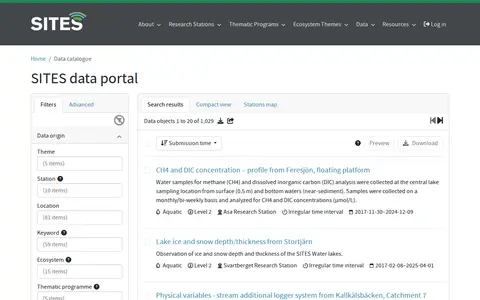
SITES Data Portal is a data portal for the SITES research infrastructure, which operates a network of Swedish research stations and runs thematic research programs. The portal hosts datasets related to aquatic, terrestrial, atmospheric and biological research themes, provides information on data licensing, usage acknowledgement, and data management planning, and offers access to related research resources, publications and outreach materials.
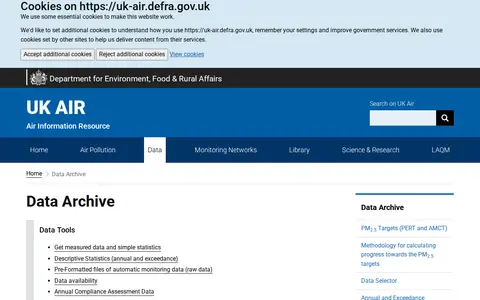
A data archive from DEFRA UK Air offering measured air quality data and simple statistics. It covers monitoring data from over 1500 UK sites organised into automatic and non-automatic networks, descriptive statistics such as annual mean, maximum and minimum values, and exceedance statistics for concentrations above specific threshold values. Data can be downloaded using a Data Selector Tool or pre-formatted files.
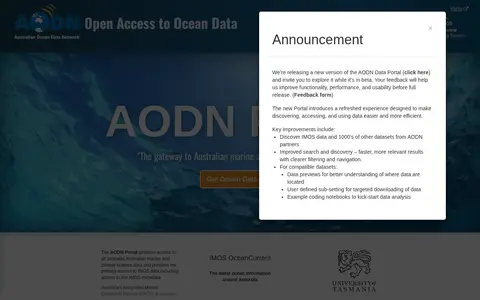
The AODN Portal is a gateway to Australian marine and climate science data. It provides access to all available Australian marine and climate science data and is the primary access point for IMOS data, including IMOS metadata.
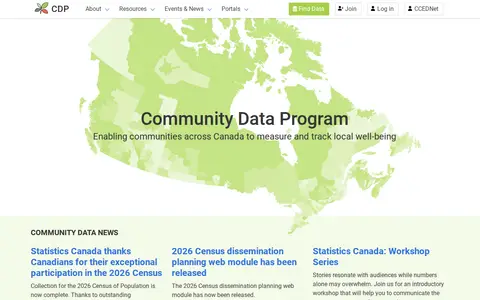
The Community Data Program is a membership-based community development initiative for Canadian public, non-profit or community sector organizations with a local service delivery or public policy mandate. It makes data accessible and useful to members through training and capacity building resources, and supports dialogue and sharing of best practices in community data use through its network.
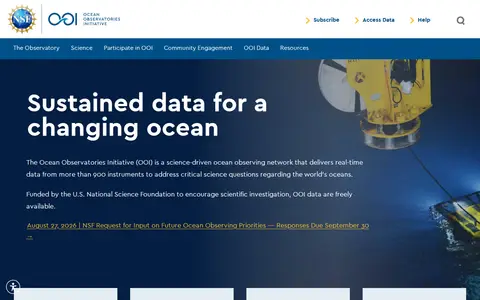
The NSF Ocean Observatories Initiative Data portal supports the Ocean Observatories Initiative, a science-driven ocean observing network. The OOI delivers real-time data from more than 900 instruments to address critical ocean science questions. The portal provides access to OOI data, publications, science highlights, educational resources, and information about the initiative's observing arrays, infrastructure, and community engagement programs.
NSF Unidata's Internet Data Distribution (IDD) is a system for disseminating near real-time Earth observations and prediction model output over the Internet. It delivers datasets to computers at a site as soon as they are available from the observing system. The IDD is a peer-to-peer network of cooperating Local Data Manager (LDM) installations. It is not considered operational data, since 24 hour support is not possible.
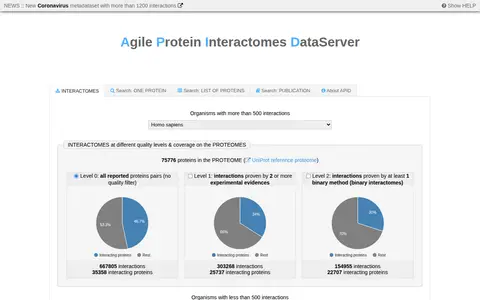
APID (Agile Protein Interactomes DataServer) is a database that aggregates comprehensive protein interactome data for more than 1000 organisms. It integrates experimentally validated protein-protein physical interaction data, and offers search functionality for individual proteins, lists of proteins, and associated publications. The platform includes a network viewer for visualizing interaction data.
BioCASe is a transnational network of primary biodiversity repositories. It links specimen data from natural history collections, botanical and zoological gardens and research institutions worldwide with observation databases. The aim is to make biodiversity data freely accessible on the Internet through data portals and web services.
The Bureau Central de Magnétisme Terrestre provides ground-based geomagnetic observations and data products. It operates the French National Magnetic Observatory at Chambon-la-Forêt, a network of 18 overseas observatories and 11 repeat stations in metropolitan France. The site offers collected raw magnetic measurements and derived data products, with Digital Object Identifiers for variation and definitive data.
Cambium is a data and code access layer operated by the MRC Brain Network Dynamics Unit, supporting the MRC CoRE in Restorative Neural Dynamics. It hosts research outputs including datasets and code resources affiliated with the unit's research groups, covering data types such as recorded data, analysis code, modelling materials, and methodological documentation. The platform provides search functionality for these resources.
CDS-Coriolis is a data service for ocean in situ observations, collecting, validating, archiving and disseminating real-time and delayed-mode data for operational oceanography and research. It manages physical and biogeochemical parameters from long-term observation networks and provides data for validating satellite missions.
Find data collections, study records and related research documentation.
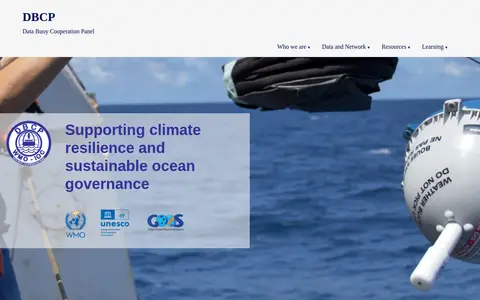
The Data Buoy Cooperation Panel (DBCP) is a global program coordinated by the WMO and IOC-UNESCO. It manages networks of autonomous ocean buoys, including drifting buoys, moored buoys, and tsunameters. DBCP supports climate resilience and sustainable ocean governance by collecting and providing ocean observation data. The network comprises over 1,500 active buoys covering 361 million km² and has operated for more than 50 years.
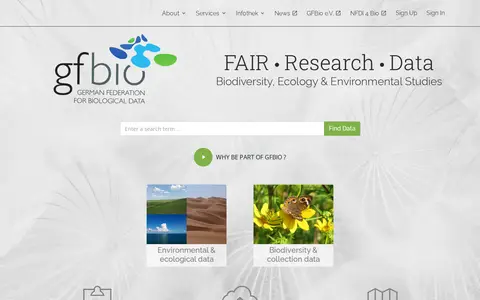
A DFG-funded network of experts for research data management in biodiversity, ecology and environmental studies. It presents information about the project and its services, including links and training material for planning, submitting and visualizing research data.
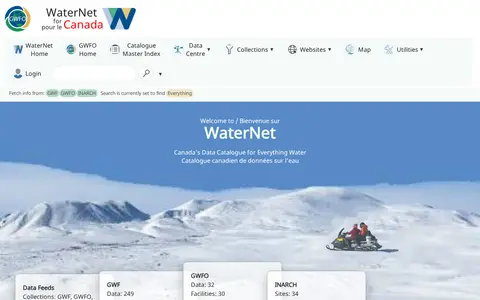
GWFNet, operating as WaterNet, is Canada's national information resource for water data. It hosts a catalogue of water data, publications and observatories, with features to search for data by variable or site, view near-realtime telemetry, and access collections from initiatives including the Global Water Futures Observatories, Changing Cold Regions Network and other related water research programs.
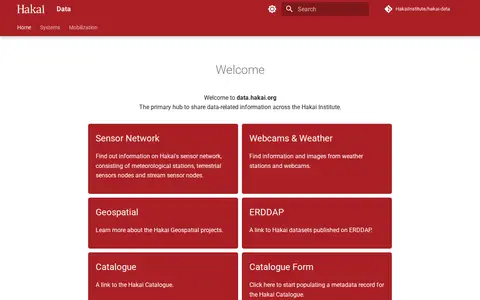
Hakai Data is the Hakai Institute's hub for sharing data-related information. It links to the institute's sensor network of meteorological stations, terrestrial sensor nodes and stream sensor nodes, plus webcams and weather stations, geospatial projects, oceanography projects and datasets published on ERDDAP. It also links to the Hakai Catalogue and a form for populating metadata records.