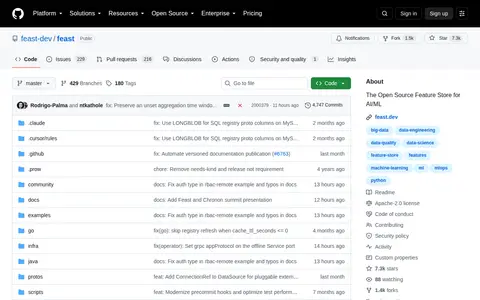

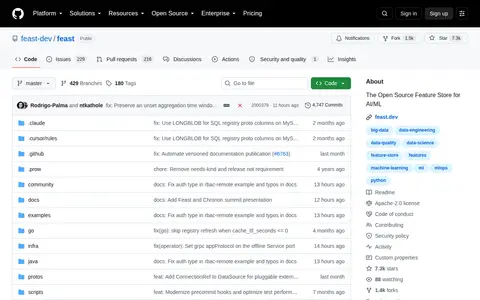
Feast is an open source feature store for machine learning. It manages an offline store for historical data, a low-latency online store, and a feature server. It generates point-in-time correct feature sets to avoid data leakage and provides a single data access layer abstracting feature storage from retrieval. Installable with pip and initialized through a CLI.
Directory
Search results
Published directory entries matching your search.
Open-source project that provides machine-learning models, research, training resources, or evaluation tools.
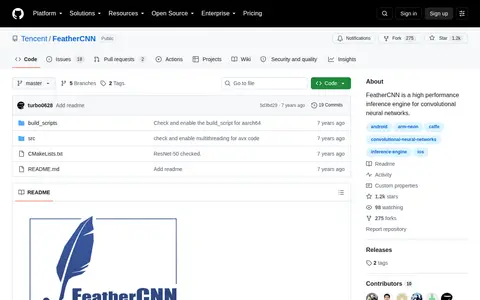
FeatherCNN is a lightweight CNN inference library developed by Tencent AI Platform Department, originating from a game AI project for King of Glory. It targets ARM CPUs and is developed for mobile phones, embedded devices and ARM-based servers. It accepts Caffe models, which are converted into a single binary model.
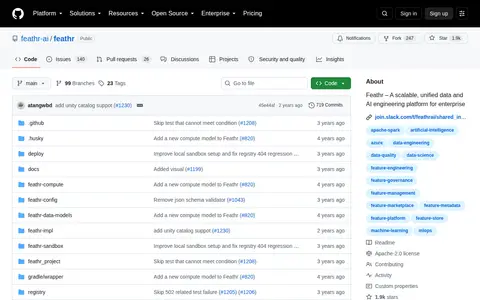
An enterprise-grade, high performance feature store.
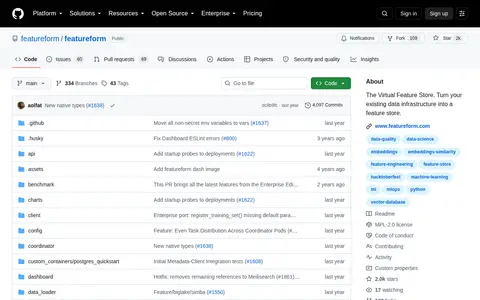
Featureform is an open-source virtual feature store hosted on GitHub under the featureform organization. It is designed to turn users' existing data infrastructure into a feature store, with supporting resources including a public website, documentation, community forum, and explanatory material on its core abstraction and unique value proposition.
Open-source project that provides machine-learning models, research, training resources, or evaluation tools.
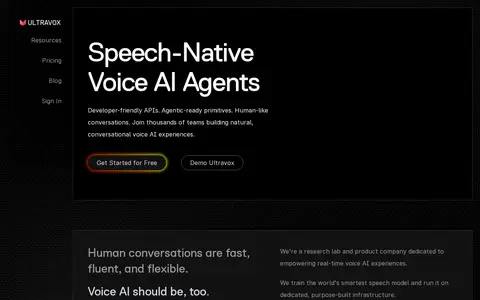
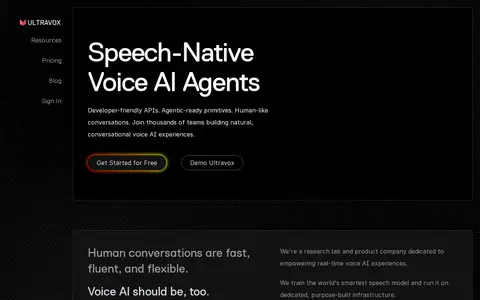
Ultravox is a real-time voice AI infrastructure layer that powers fast, natural, and scalable voice agents.
Ultravox is a real-time voice AI infrastructure layer for building voice agents. It trains a speech-native model and manages its own inference and infrastructure stack. The site offers developer-friendly APIs and agentic-ready primitives intended for natural, conversational voice agents. Ultravox has been acquired by Inworld. Pricing lists pay-as-you-go at $0 per month with the first 30 minutes free and $0.05 per minute after that.
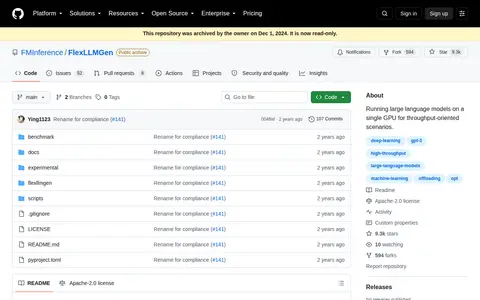
FlexGen is a software project that enables running large language models on a single GPU. It focuses on throughput-oriented scenarios, offering an approach to efficient inference. The project is available on GitHub as FMInference/FlexLLMGen.
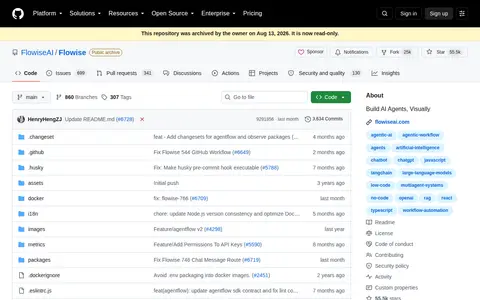
Drag & drop UI to build your customized LLM flow using LangchainJS.
Library for high performance deep learning inference on NVIDIA GPUs.
Future AGI is an open-source, self-hostable platform for evaluating, observing, and improving LLM and AI agent applications. It combines tracing, evals, simulations, datasets, a gateway and guardrails on one platform with a feedback loop. The Apache 2.0 core can be self-hosted, and a managed Cloud option is offered.
Future AGI SDK is a production-grade software development kit for AI evaluation, prompt management, and observability. It offers automated evaluations with sub-100ms guardrails and does not require human-in-the-loop. The SDK supports Python and TypeScript.
Host inference APIs, bulk inference and fine tune text, vision, audio and multi-modal models.
Testing framework dedicated to ML models, from tabular to LLMs. Detect risks of biases, performance issues and errors in 4 lines of code.
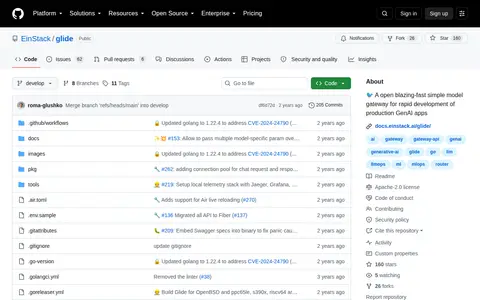
Cloud-Native LLM Routing Engine. Improve LLM app resilience and speed.
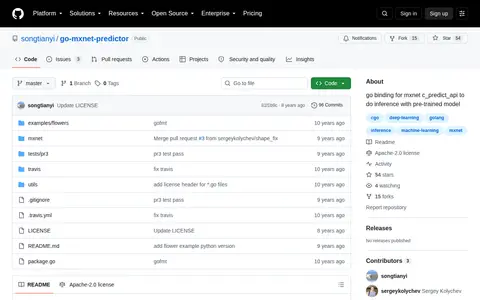
Go binding for MXNet c predict api to do inference with a pre-trained model.
gotoHuman is a platform for supervising AI agents, letting workflows request human review of critical steps. Reviewers approve and edit AI-generated content in an Agent Inbox, with email and Slack notifications, and completed reviews return to the workflow via webhook. Review types are configured in a no-code editor and can capture text, images, markdown and JSON.
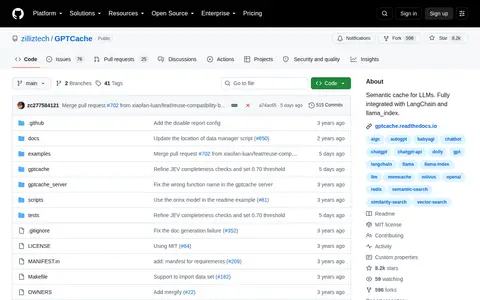
Creating semantic cache to store responses from LLM queries.
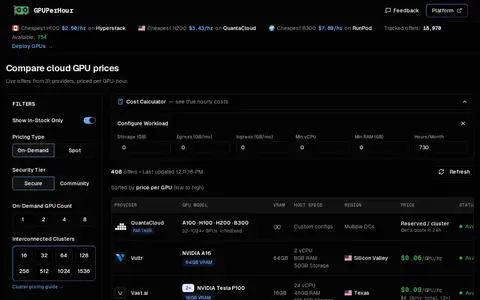
GPU Per Hour is a website that compares live cloud GPU pricing from 31 providers. It lists prices per GPU-hour for various GPU models, including H100, H200, B200, A100, and RTX 4090, and provides market snapshots and historical averages.
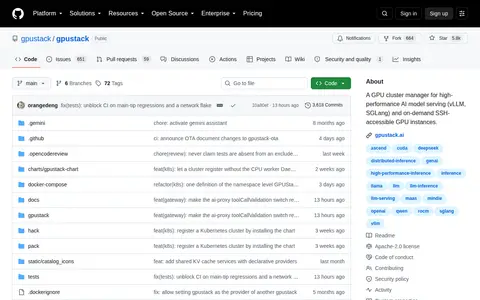
GPUStack is a GPU cluster manager built for high-performance AI model serving, with support for vLLM and SGLang, and offers on-demand SSH-accessible GPU instances, hosted in the gpustack/gpustack GitHub repository.
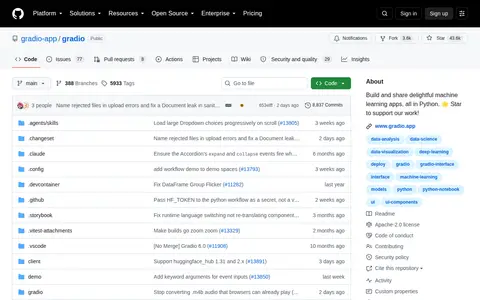
Gradio is an open-source Python library that enables developers to build and share machine learning web applications easily. It provides simple interfaces for creating demos and sharing models, supporting a wide range of ML frameworks.
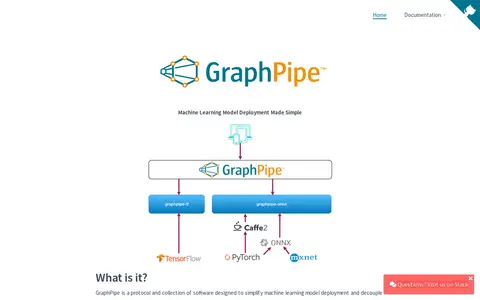
GraphPipe is a protocol and collection of software designed to simplify machine learning model deployment. It decouples deployment from framework-specific model implementations, allowing models to be served in a consistent manner across different environments.
Groq is a platform for inference, described as one fully integrated platform for infrastructure, inference, and control. It offers tiers including GroqMetal for bare-metal infrastructure, GroqCore for an inference stack, and GroqAssured for governance, auditability, and control.