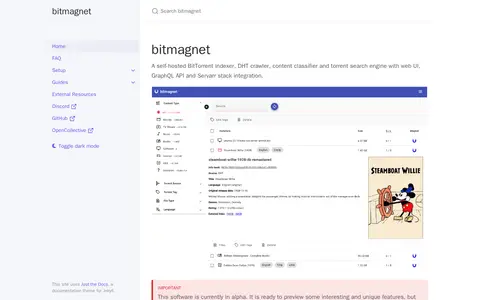

BitMagnet is a self-hosted BitTorrent indexer, DHT crawler, content classifier and torrent search engine with a web UI, GraphQL API and Servarr stack integration. The software is currently in alpha, and the documentation notes likely bugs plus API and database schema changes before a theoretical 1.0 release.
Directory
Search results
Published directory entries matching your search.
GDEX is NSF NCAR's platform for discovering, sharing, preserving, and analyzing Earth system science data. It provides a dataset search interface, a data deposit request process, and specialized AI-ready and Zarr format datasets. Web services include an API, a Python client, OAI-PMH metadata harvesting, and CSW metadata exposure. Registered users can run a client utility to submit subset requests on select gridded datasets and download completed outputs.

Fatcat is a catalog of research publications including journal articles, conference proceedings, and datasets. It provides archival file-level metadata, a preservation coverage visualizer, work/edition grouping, and public metadata dumps. The project aims to track gaps in preservation coverage to support long-term access to research content on the scholarly web. It is hosted at the Internet Archive.
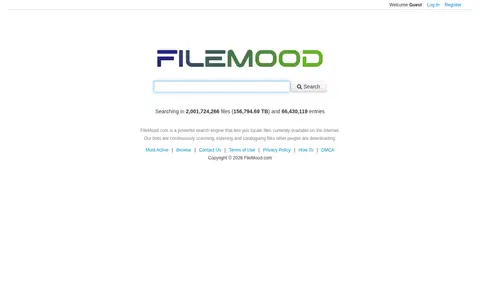
FileMood is a search engine for locating files that are currently available on the internet. Its bots continuously scan, index and catalogue files that other people are downloading. The site reports searching across 1,989,951,443 files and 66,122,456 entries.
Index Copernicus describes itself as working on the parametrisation of science, describing scientific achievements in a unified metadata structure so they can be assessed. Its scientific databases include and parametrise data on scientific journals, research units, scientists and their achievements. Its IT systems support processing of metadata on evaluation events, using achievements of bibliometrics and scientometrics. It lists ICI Journals Master List and ICI Science Evaluation.
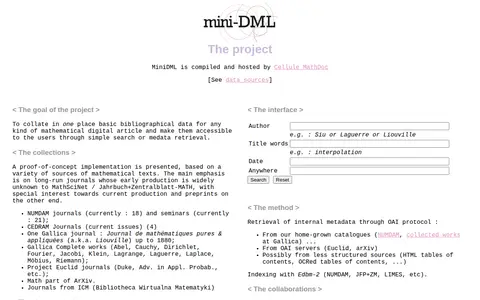
MiniDML is a proof-of-concept project compiled and hosted by Cellule MathDoc that collates basic bibliographical data for mathematical digital articles in one place. It makes the data accessible through search or metadata retrieval, drawing on sources such as NUMDAM journals and seminars, CEDRAM journals, Gallica, Project Euclid and the math part of arXiv. Internal metadata is retrieved through the OAI protocol.
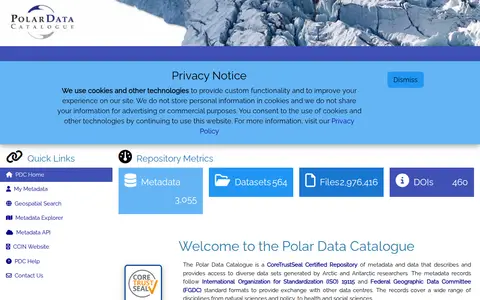
The Polar Data Catalogue is a repository of metadata and data describing datasets from Arctic and Antarctic researchers. Its records follow ISO 19115 and FGDC formats for exchange with other data centres and span natural sciences, policy, health and social sciences. It offers public search tools and lets registered partner researchers upload metadata and data.
Public Geodata Repository refers to GeoNetwork, an open source data catalog designed for spatial data infrastructures. It offers metadata editing and search functionalities, and is listed as a community project under the Metadata Catalogs category by the Open Source Geospatial Foundation (OSGeo).
qBittorrent is an open-source software project intended as an alternative to µTorrent, based on the Qt toolkit and libtorrent-rasterbar library. It runs on FreeBSD, Linux, macOS, OS/2 and Windows, and is developed by volunteers. Its features include a µTorrent-like interface, no ads, a search engine, RSS support, BitTorrent extensions, remote control through a web interface and bandwidth scheduling.
Torrents.csv is a collaborative git repository of torrents, consisting of a single, searchable torrents.csv file. It is initially populated with a January 2017 backup of the pirate bay, and new torrents are periodically added from various torrents sites. It comes with a self-hostable webserver, a command line search, and a folder scanner to add torrents.
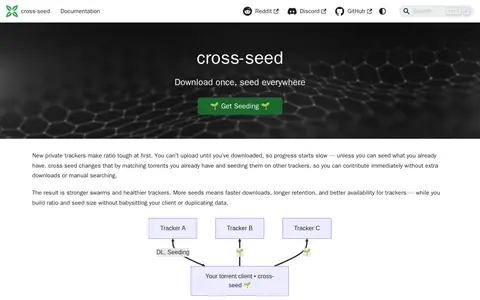
cross-seed is an application that finds cross-seeds automatically, matching torrents already downloaded and seeding them on other trackers. It runs in daemon mode to monitor new downloads and cross-seed them. It works with qBittorrent, rTorrent, Deluge and Transmission, plus Torznab providers, and is designed primarily for private trackers.
ØMagnet is a torrent and magnet link sharing site. The page states that 2,769,402 magnet links are shared on ØMagnet and offers an upload area for torrent files. It lists alias domains 13mag.net and 0magnet.com.
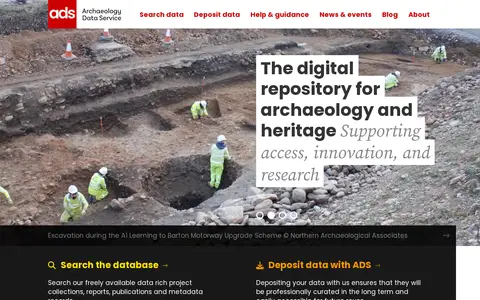
The Archaeology Data Service is a digital repository for archaeology and heritage, supporting access, innovation and research. It offers freely available project collections, reports, publications and metadata records, and accepts deposited data for long-term curation. Instructions for depositors cover dataset structure, file naming and metadata.
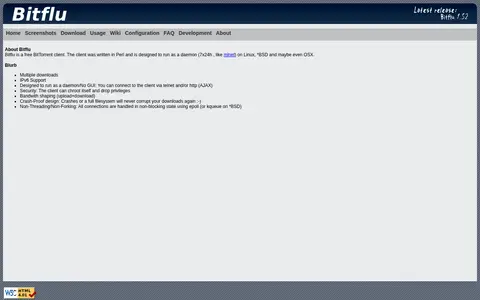
BitFlu is a free BitTorrent client written in Perl and designed to run as a daemon on Linux, *BSD and possibly OSX. It has no GUI; users connect via telnet or http (AJAX). It can chroot itself and drop privileges, offers bandwidth shaping and uses a non-blocking design for connections.
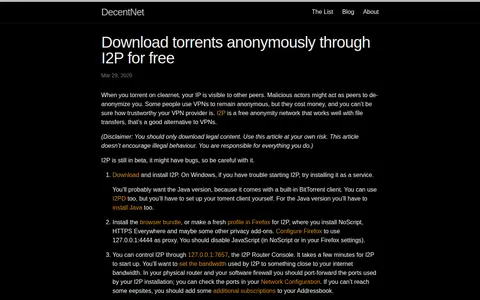
A blog post describing how to download torrents anonymously through I2P, a free anonymity network. It covers installing I2P, configuring Firefox to use its proxy, and using I2PSnark, noting that clearnet tracker torrents usually do not work inside I2P and only peers running I2P can connect.
Dracula for qBittorrent is a theme that changes the client's interface. The page provides a .qbtheme file for download, activation instructions through the qBittorrent preferences, and a separate Web UI theme installed from a repository. It also lists troubleshooting steps for Windows title bar and white flash behavior.
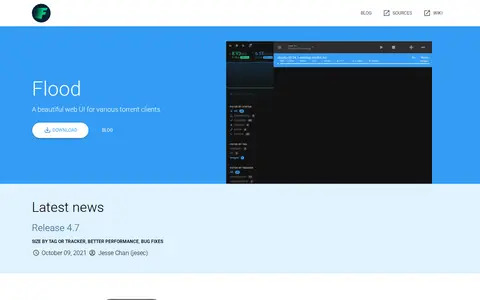
Flood is a web interface for rTorrent, Transmission and qBittorrent torrent clients. It supports touch screen devices with a responsive, collapsible sidebar, and offers light and dark color schemes that follow the system theme by default. Over 20 languages are supported, with language detected from browser preferences and automatic switching.
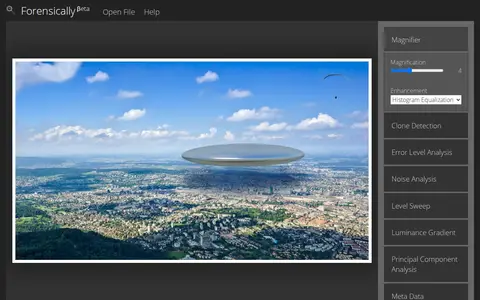
Forensically is a set of free online tools for digital image forensics, made by Jonas Wagner. It includes a magnifier, clone detection, error level analysis, metadata extraction and noise analysis. The tools help reveal hidden details in images. An offline mode is available.
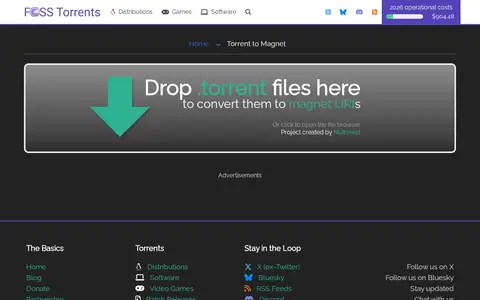
FossTorrents T2M is a Javascript tool that converts .torrent files to magnet URIs. Users drop .torrent files onto the page or open them through a file browser, and Javascript is required for the inline converter.
Image forensics tool for checking metadata, compression artifacts, and possible photo manipulation clues.
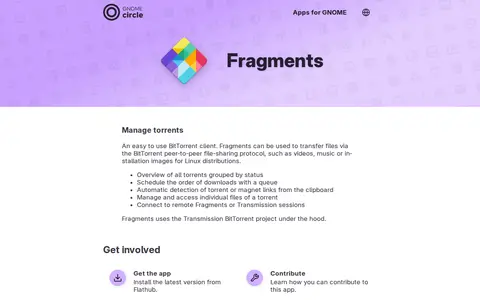
Fragments is an easy-to-use BitTorrent client for GNOME used to transfer files over the BitTorrent peer-to-peer protocol. It groups torrents by status, supports download queues, detects torrent and magnet links from the clipboard, manages individual torrent files, and can connect to remote Fragments or Transmission sessions. It uses the Transmission BitTorrent project under the hood.
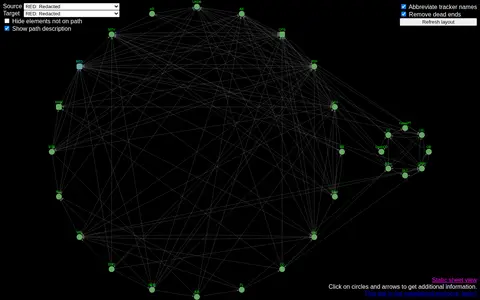
The Graph is a static sheet view of tracker connections that lets users abbreviate tracker names, remove dead ends, and set source and target filters. Users can hide elements not on a path, display a path description, and click circles and arrows for additional information. The site is no longer maintained.
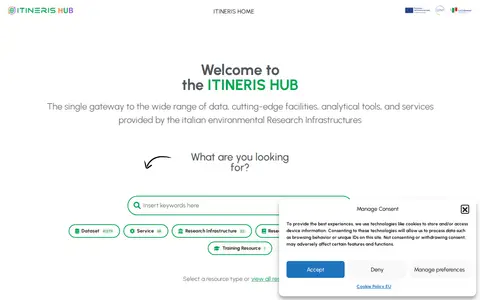
ITINERIS HUB is a single access point to data, facilities, analytical tools and services from Italian environmental Research Infrastructures. It includes a metadata catalogue, geospatial metadata hub, access platform, virtual research environments, training resources, datasets and a terminology service. Resources are described as freely accessible under FAIR and open science principles.
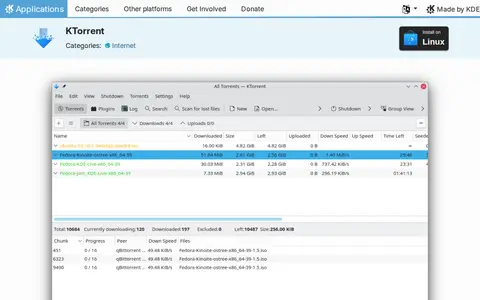
kTorrent is a BitTorrent application by KDE for downloading files using the BitTorrent protocol. It can run multiple torrents simultaneously and includes features such as torrent queuing, global and per-torrent speed limits, selective downloading and file prioritization for multi-file torrents, protocol encryption, DHT, UPnP port forwarding, and tracker authentication. Plugins add further functionality.