Magic.dev is an artificial intelligence company focused on developing safe artificial general intelligence (AGI) to accelerate progress on high-priority global problems. The company builds frontier code models intended to automate software engineering and AI research workflows. Its technical approach combines large-scale pre-training, domain-specific reinforcement learning, extended context windows, and increased inference-time compute. Magic.dev employs a small team of engineers and researchers working on fundamental AGI-related research problems.
Directory
Search results
Published directory entries matching your search.
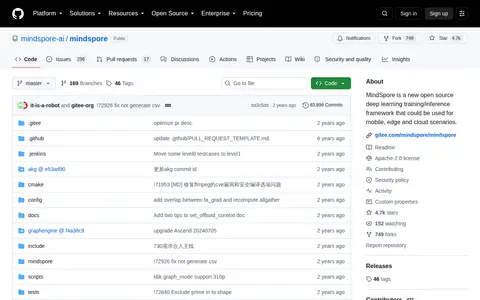
MindSpore is an open source deep learning training and inference framework that could be used for mobile, edge, and cloud computing scenarios. Its source code is hosted in the mindspore-ai/mindspore repository on GitHub.
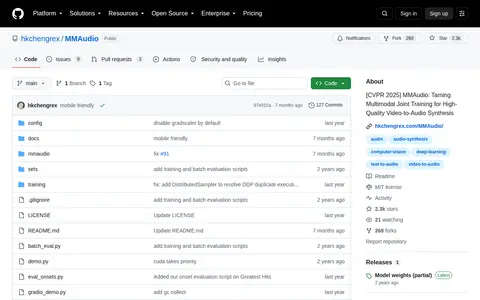
MMAudio is a CVPR 2025 project for video-to-audio synthesis that generates synchronized audio from video and/or text inputs. It uses multimodal joint training and a synchronization module to align generated audio with video frames. A pretrained large_44k_v2 model is used by default, with inference around 6GB of GPU memory in 16-bit mode.
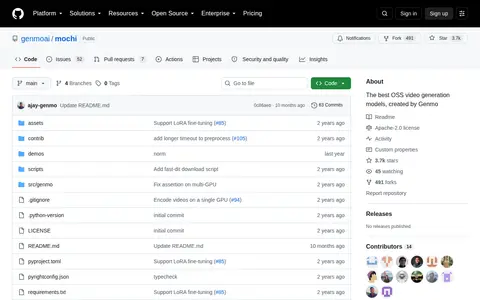
Mochi is an open-source video generation model by Genmo, released under an Apache 2.0 license. The repository provides installation, weight downloads, a Gradio UI, CLI, and API, plus LoRA fine-tuning support and an inference harness.
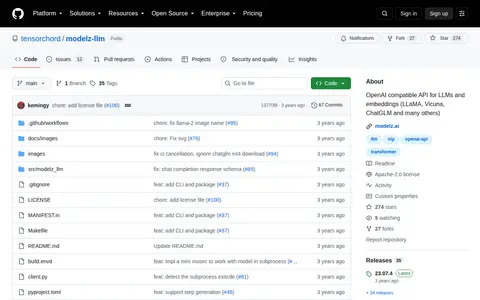
Modelz LLM is an inference server for running open source large language models such as FastChat, LLaMA and ChatGLM on local or cloud environments with an OpenAI compatible API. It supports interaction through the OpenAI python SDK or LangChain and provides docker images for deployment on Kubernetes or Modelz.
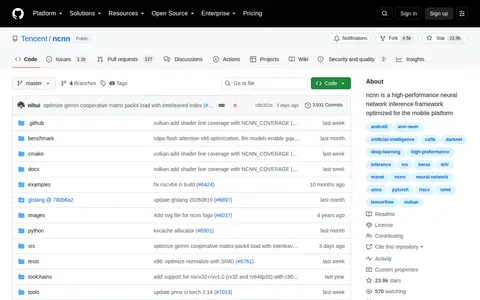
NCNN is a neural network inference framework optimized for mobile, embedded, and desktop deployment. It has no third-party runtime dependencies and runs across CPU and Vulkan GPU backends. Tools such as pnnx convert PyTorch and ONNX models to ncnn, allowing deployment to phones, PCs, browsers, and edge devices. The project is used in several Tencent applications.
Easy-to-use library to boost AI inference.
Neurolink is described as the pipe layer of an AI nervous system, providing one interface connecting provider neurons to an application across three inference types: generate, stream, and a calibrated decide via TypeSafe Jev. It lists MCP-native, voice, RAG, memory and file processor features and powers several Juspay projects.
Nexusflow/NexusRaven-V2-13B is a 13-billion parameter language model available on Hugging Face. It is designed for zero-shot function calling and text generation, aiming to advance open-source artificial intelligence. The model can be used with libraries such as Transformers and provides instructions for deployment via inference providers, notebooks, and local applications.
NobodyWho is an inference engine that runs LLMs locally and offline on any device, powered by llama.cpp. Bindings are available for Kotlin, Swift, React Native, Flutter, Python and Godot. It supports GGUF models, tool calling, multimodal input, text-to-speech and speech-to-text.
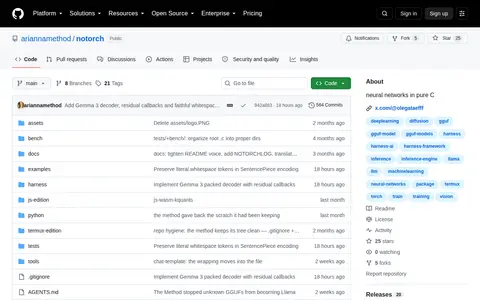
Neural networks framework in pure C: training and inference, no dependencies.
NVIDIA AI is a suite of enterprise artificial intelligence solutions offered by NVIDIA. The portfolio includes accelerated infrastructure, enterprise-grade software, and AI models. Solution areas span agentic AI, inference, conversational AI, data science, and cybersecurity. The program aims to help organizations transform into AI-enabled enterprises.
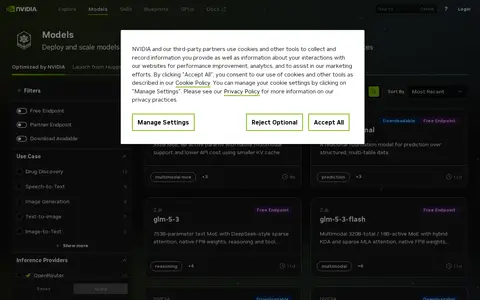
NVIDIA NIM is a catalog of models offered as inference microservices for deployment on the user's GPU infrastructure. The listings include downloadable models and free or partner endpoints, organized by use cases such as image generation, speech-to-text and drug discovery.
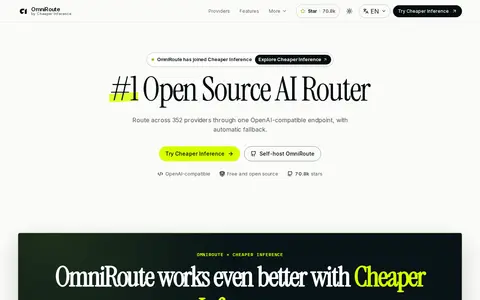
OmniRoute by Cheaper Inference is an open-source AI router that routes requests across providers through one OpenAI-compatible endpoint, with automatic fallback. It accepts OpenAI, Claude, Gemini and Responses API requests at /v1 and ships as a self-hosted gateway with a local dashboard. The catalog covers chat, media, search, local runtimes and cloud agents.
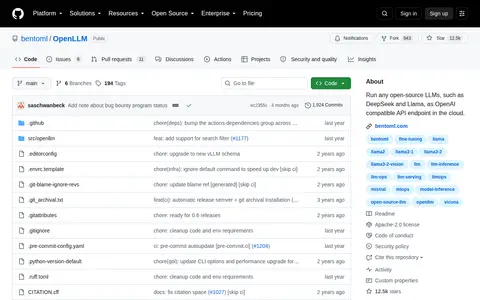
OpenLLM is a project from BentoML for running open-source LLMs or custom models as OpenAI-compatible APIs with a single command. It includes a built-in chat UI, inference backends, and a workflow for cloud deployment with Docker, Kubernetes, and BentoCloud, and it does not store model weights. A Hugging Face token is required for gated models.
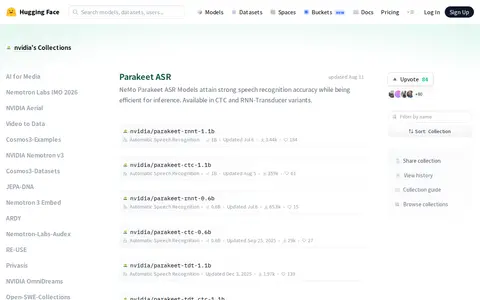
NeMo Parakeet ASR Models attain strong speech recognition accuracy while being efficient for inference. Available in CTC and RNN-Transducer variants.
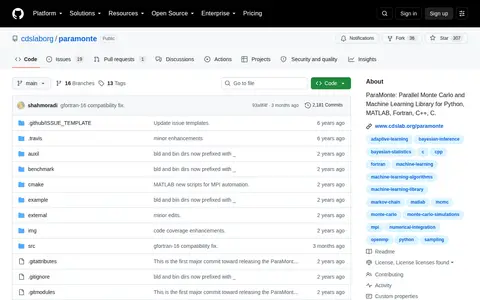
ParaMonte is a serial and parallel library of Monte Carlo routines for sampling mathematical density functions of arbitrary dimensions and machine learning algorithms for scientific inference. It is designed for interoperability with C, C++, Fortran, MATLAB and Python, and supports shared-memory OpenMP threads and MPI distributed communications.
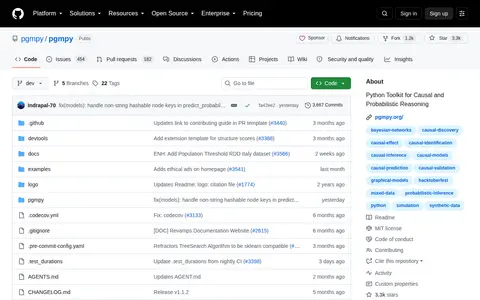
pgmpy is a Python toolkit for causal and probabilistic reasoning using graphical models. It implements data structures for models such as DAGs, PDAGs, MAGs, PAGs, Bayesian Networks, Dynamic Bayesian Networks and Structural Equation Models, with algorithms for tasks including causal discovery, causal identification, inference, model validation, parameter estimation and simulations. Algorithms follow a unified composable API and are scikit-learn compatible when possible. It is available on PyPI and conda.
PocketPal AI is an open-source app for running language models directly on a device, available on iOS and Android. It supports GGUF models from Hugging Face, on-device processing, device benchmarking, conversation history and adjustable inference settings.
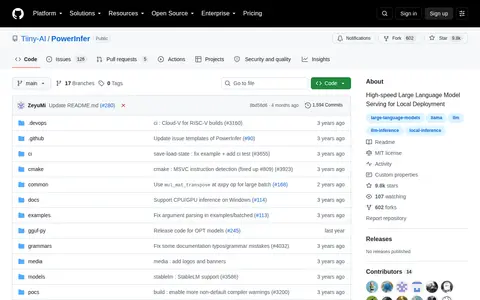
A high-speed inference engine for deploying LLMs locally.
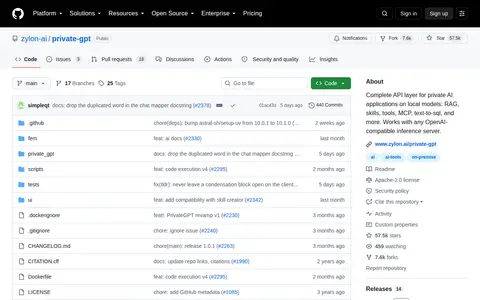
PrivateGPT is an open-source API layer for building private AI applications on local models, following the Claude API model. It provides a messages API, file and artifact ingestion, retrieval with citations and agentic RAG, built-in and custom tools, MCP connectors, structured database and CSV access, and embeddings. It connects to any OpenAI-compatible inference server and does not run models itself.
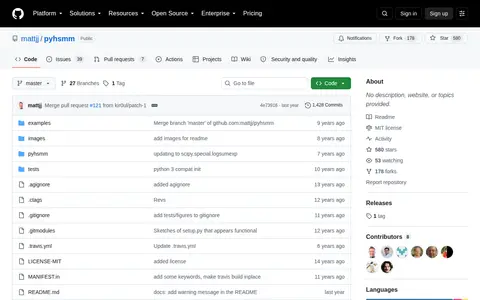
pyhsmm is a Python library for approximate unsupervised inference in Bayesian Hidden Markov Models and explicit-duration Hidden semi-Markov Models, focusing on the HDP-HMM and HDP-HSMM with weak-limit approximations. Extensions include autoregressive models, switching linear dynamical systems and factorial models. The package is stated as no longer maintained and was last tested with Python 3.7.
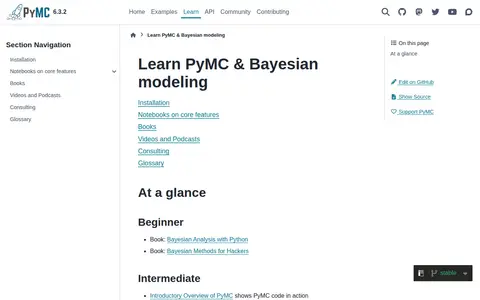
Python Library for Probabalistic Programming (Bayesian Inference and Machine Learning).
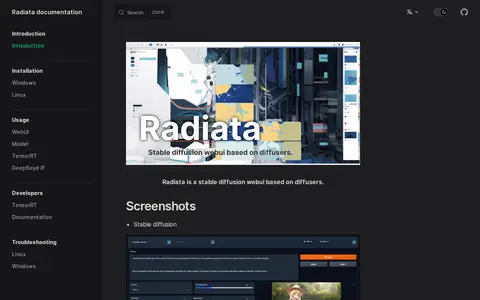
Radiata is a stable diffusion web UI built on the diffusers library that uses TensorRT high-speed inference technology. Its official documentation provides resources for introduction, installation, usage, developer guidance, and troubleshooting for Windows and Linux operating systems. It is categorized under AI & Machine Learning with a focus on AI image generation.