
DNS Jumper is a free, portable tool that lets users change DNS servers with a few clicks. It includes IPv6 support, backup and restore of DNS settings, a command-line interface, and a feature that tests DNS response times to find the fastest server. The tool can also flush the DNS cache and add custom DNS servers.
Directory
Search results
Published directory entries matching your search.
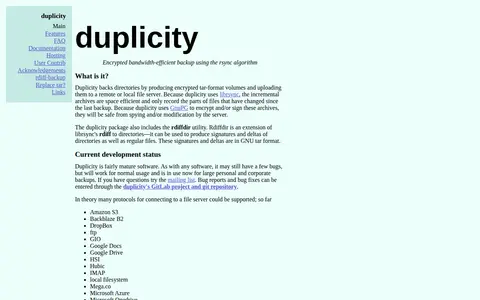
Duplicity is a command-line backup utility that produces encrypted tar-format volumes and uploads them to a remote or local file server. It uses librsync so incremental archives record only changed parts of files, and GnuPG to encrypt and sign archives. It supports many backends, including Amazon S3, Backblaze B2, Dropbox, ftp, Google Drive, rsync and ssh/scp.
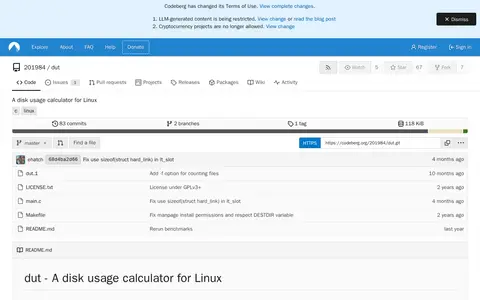
dut is a disk usage calculator for Linux. It produces an ASCII-art disk usage tree, counts hard links accurately, has a configurable output format, and allows setting the maximum depth of files shown via a command-line argument.
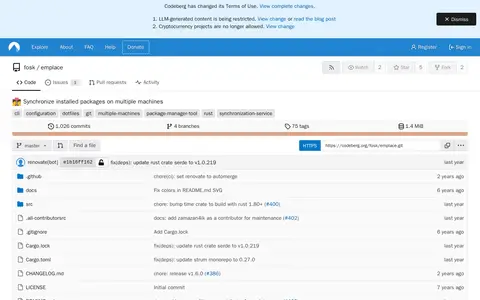
emplace is a command-line tool written in Rust that mirrors installed software across multiple machines, outputting a human-readable RON file to sync. It supports git-based push and pull of updates and works with package managers including Apt, Nix, Pacman, Snap, Homebrew, Cargo, Pip, and npm, on Bash, Zsh, Fish, and Nu shells.
Enact is an app development framework built atop React that provides a full framework for developers. It includes customizable widgets, a command-line tool for initializing projects, and solutions for internationalization, accessibility, focus management, linting, testing and building. Limestone is its TV-centric UI library with over 50 components for large-screen applications.

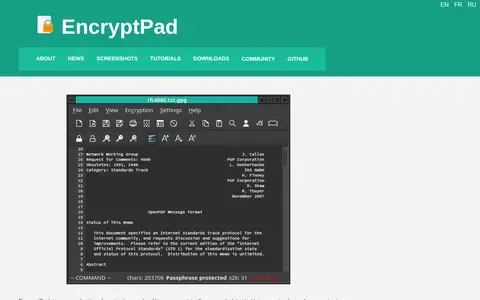
EncryptPad is an application for viewing and editing symmetrically encrypted text and for encrypting and decrypting binary files. It uses the OpenPGP format and focuses on symmetric encryption, offering both graphical and command line interfaces.
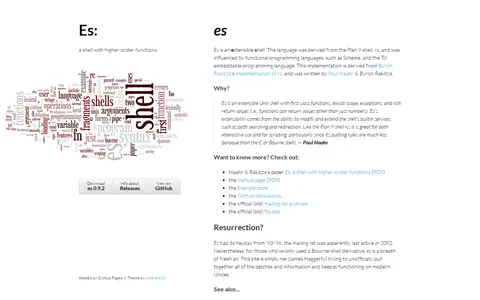
Es is an extensible Unix shell with first class functions, lexical scope, exceptions, and rich return values. Its language derives from the Plan 9 shell rc and was influenced by Scheme and Tcl. Extensibility comes from modifying builtin services such as path searching and redirection. The site gathers patches and information to keep es running on modern Unices.
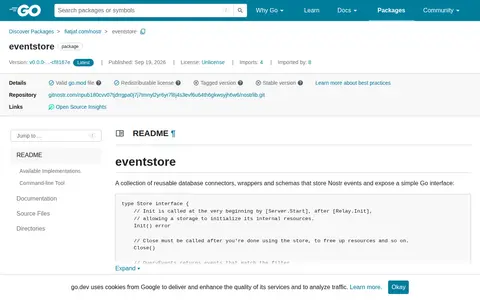
eventstore is a Go package providing reusable database connectors, wrappers and schemas that store Nostr events behind a simple Store interface. Available implementations include bleve, boltdb, lmdb, mmm, nullstore and slicestore, and an eventstore command-line tool can query these databases directly.
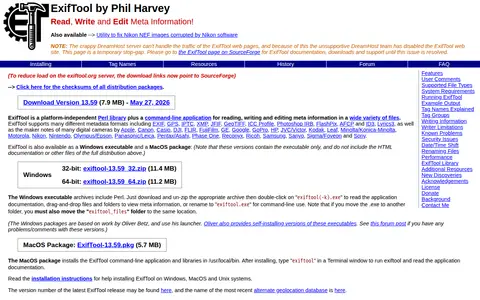
ExifTool is a platform-independent Perl library and command-line application for reading, writing and editing metadata in image, audio and video files. It supports formats including EXIF, GPS, IPTC and XMP, and maker notes from many camera brands. It is available for Windows, MacOS and Unix systems.
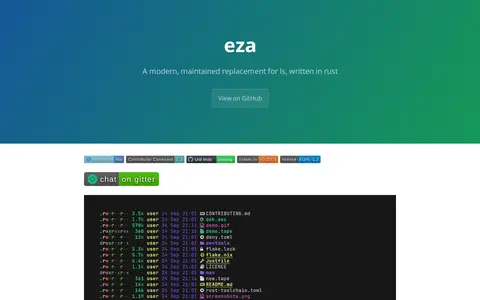
eza is a command-line file listing tool described as a more featureful, user-friendly version of ls. It lists files with colour, icons, Git status and a tree view in one small binary. It offers recursive tree output with depth limits, relative dates, clickable hyperlinks and colours distinguishing file types. It is written in Rust, licensed EUPL-1.2, and packaged for Windows, macOS, Linux and BSDs.
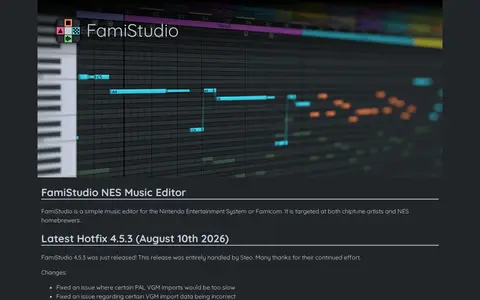
FamiStudio is a music editor for the Nintendo Entertainment System (NES) or Famicom, aimed at chiptune artists and NES homebrewers. It is available for desktop and mobile, with documentation covering installation, song editing, importing and exporting, and expansion audio. An NES sound engine and command-line processing are also documented.

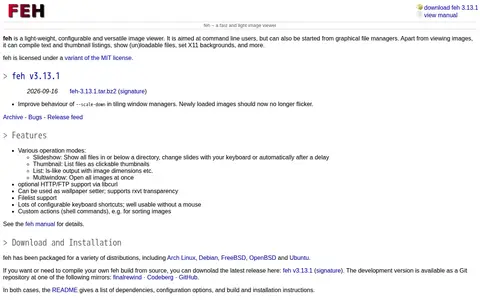
feh is a light-weight, configurable image viewer aimed at command line users that can also be started from graphical file managers. Besides viewing images, it compiles text and thumbnail listings, shows loadable files, and sets X11 backgrounds. It offers slideshow, thumbnail, list and multiwindow modes, optional HTTP and FTP support, and is packaged for several distributions.
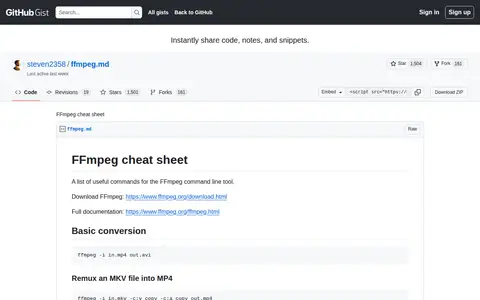
A GitHub Gist collecting useful commands for the FFmpeg command line tool. It covers basic conversion, remuxing an MKV file into MP4, high-quality encoding with the crf and preset parameters, trimming with and without re-encoding, muxing video and audio from another video, the concat demuxer, delaying audio or video, and burning subtitles.
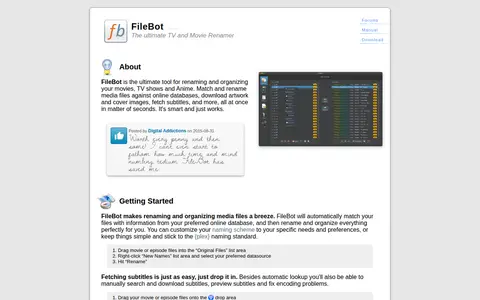
FileBot is a tool for renaming and organizing movies, TV shows and anime. It matches media files against online databases, downloads artwork and fetches subtitles, and offers a command-line interface for automated workflows.
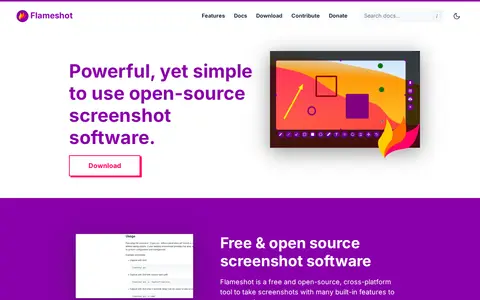
Flameshot is a free and open-source, cross-platform screenshot tool with built-in editing features. Users select an area to capture, then annotate it with arrows, text, blur, borders and counters before saving. It offers a configuration dialog, a command-line interface for scripting, and downloads for Windows, macOS and Linux.
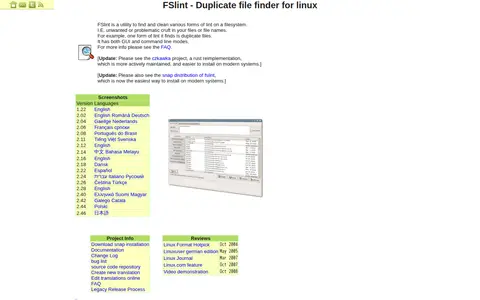
FSlint is a utility to find and clean various forms of lint on a filesystem, such as unwanted or problematic cruft in files or file names, including duplicate files. It has both GUI and command line modes. The page notes the czkawka project as a more actively maintained reimplementation.
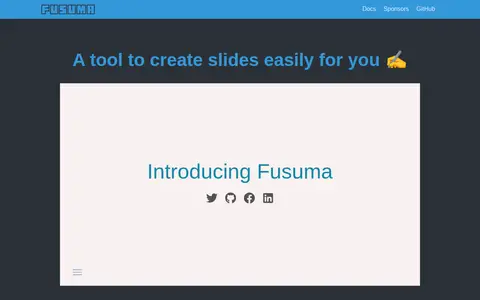
Fusuma is a tool for creating slides from Markdown or MDX. It offers a zero-config setup and a command-line interface for development, building, exporting as PDF, deploying to GitHub Pages, presenter mode, and live mode. It can record slide timelines and voice for practice and supports drawing fluorescent marker lines during a speech. Fusuma requires Node 12.x or later.
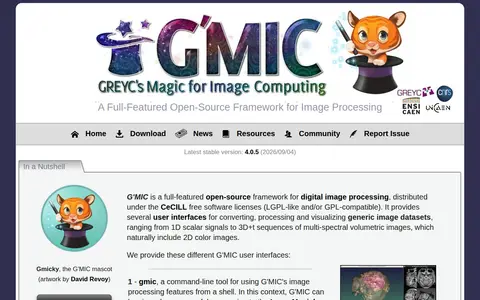
G'MIC is a full-featured open-source framework for digital image processing, distributed under free software licenses. It processes generic image datasets, from 1D signals to 3D+t volumetric sequences, and offers several interfaces: a command-line tool, the G'MIC-Qt plug-in for image editors, a C++ library, an online web service and the ZArt video tool.
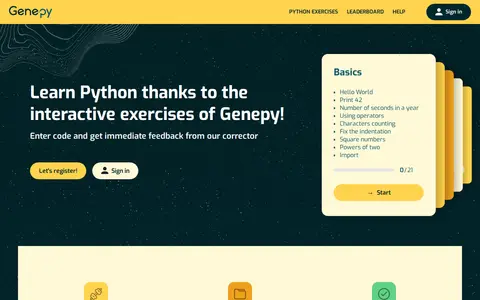
Genepy is a website offering interactive Python exercises, including basics, functions, comparisons and word counting. It provides immediate feedback from its corrector and supports individual and team leaderboards. A command line interface is available for users who prefer not to use the web editor.
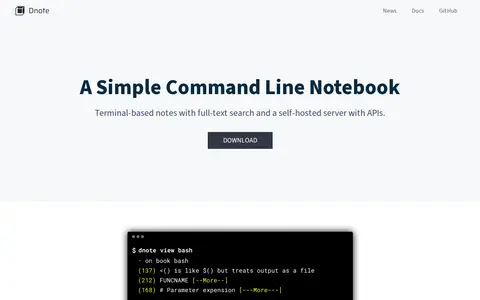
Dnote is a command-line notebook that stores notes in a SQLite file and provides full-text search. It ships as a single binary without dependencies, works with the user's own text editor, and is free and open source. An optional self-hosted server with a REST API enables syncing notes across devices.
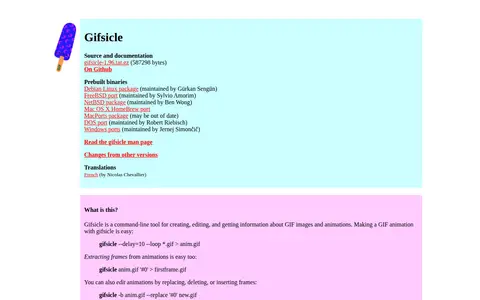
Gifsicle is a command-line tool for creating, editing, and getting information about GIF images and animations. It supports batch mode, frame replacement, deletion and insertion, and an optimizer that stores only changed portions of each frame. It can print GIF details, control interlacing, looping and transparency, and shrink colormaps. Two additional programs, gifview and gifdiff, are included.
GIN is a free data management system for neuroscientific data, built on open source projects including Git, git-annex, and Gogs. It syncs directories to a dedicated server and tracks changes to files and folders. Data can be shared with collaborators, made citable through a DOI service, and accessed from web and file browsers or a command line interface.
Git is a free and open source distributed version control system designed to handle projects of varying sizes with speed and efficiency. It has an ecosystem of GUIs, hosting services and command-line tools. The latest source release is 2.56.0.
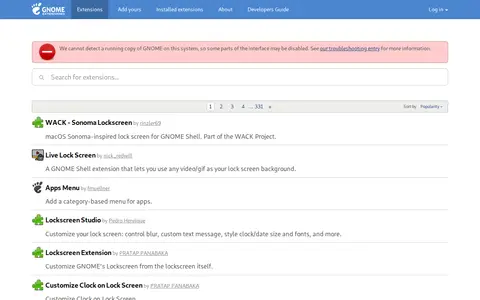
GNOME Shell Extensions is a website that provides a platform for discovering, installing, and managing extensions for the GNOME Shell desktop environment. It allows users to add their own extensions and view installed ones. The site is part of The GNOME Project, which develops the GNOME desktop. It is hosted by Red Hat and built using Django and SweetTooth. Content is available under a Creative Commons CC-BY license.