
github.com
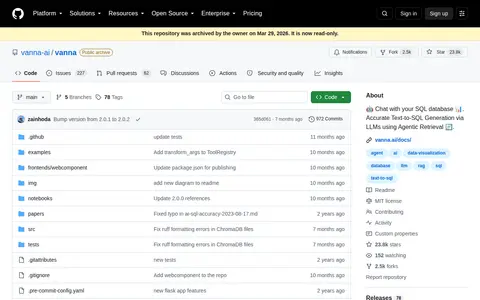
Vanna is an open source tool that enables users to interact with SQL databases via natural language. It uses large language models and agentic retrieval to generate accurate text-to-SQL queries.
Directory
Published directory entries matching your search.
Vanna is an open source tool that enables users to interact with SQL databases via natural language. It uses large language models and agentic retrieval to generate accurate text-to-SQL queries.
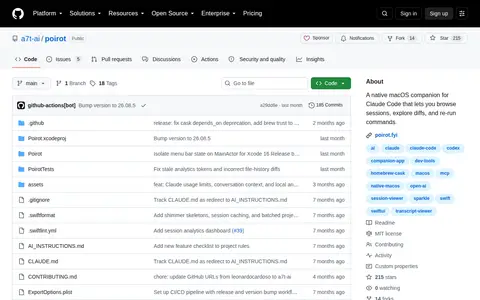
Poirot is a native macOS companion app for Claude Code. Built with SwiftUI, it lets users browse sessions, explore diffs, and re-run commands. It also provides session analytics, usage limit gauges, conversation views, and search across sessions. The app requires no login and no analytics and works offline.

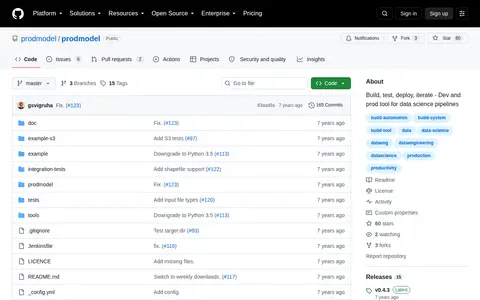
Build tool for data science pipelines.

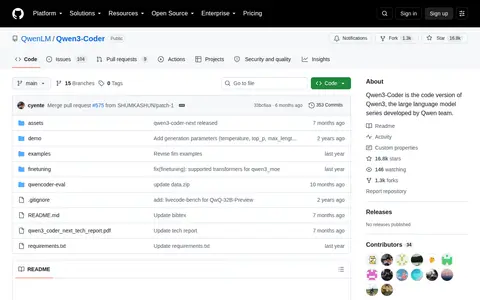
Qwen3-Coder is the code version of the Qwen3 large language model series from the Qwen team. It is offered in multiple sizes, including Qwen3-Coder-480B-A35B-Instruct, Qwen3-Coder-30B-A3B-Instruct and Qwen3-Coder-Next, and the repository supports platforms such as Qwen Code, CLINE and Claude Code.

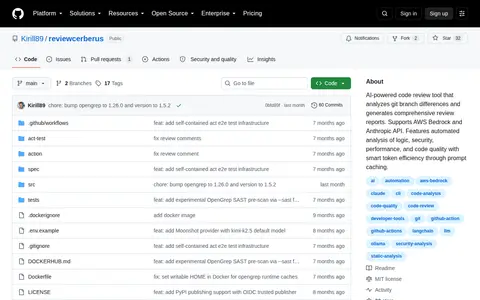
ReviewCerberus is an AI-powered code review tool that analyzes git branch differences and generates review reports. It examines logic, security, performance and code quality, and supports AWS Bedrock and Anthropic API, according to the repository. A GitHub Action posts review comments on pull requests.

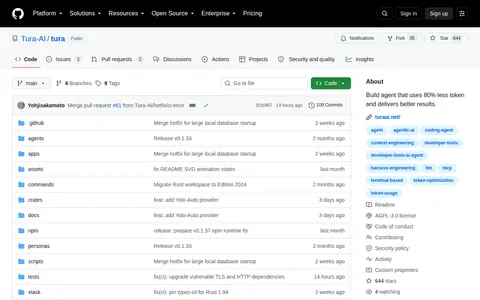
Tura is an open-source agent runtime harness that turns a task into a runtime-managed command graph, avoiding repeated model round trips in a ReAct session. The documentation describes it as a terminal-native developer tool that turns intent into verified code changes, emphasizing reading the repository first, keeping an audit trail, and proving results.

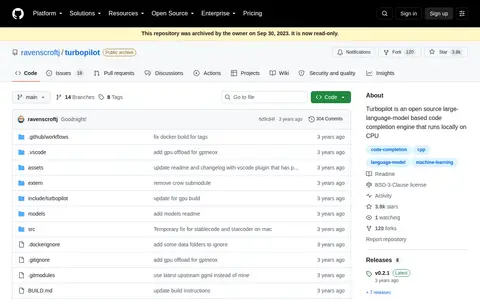
A self-hosted copilot clone that uses the library behind llama.cpp to run the 6 billion parameter Salesforce Codegen model in 4 GB of RAM.

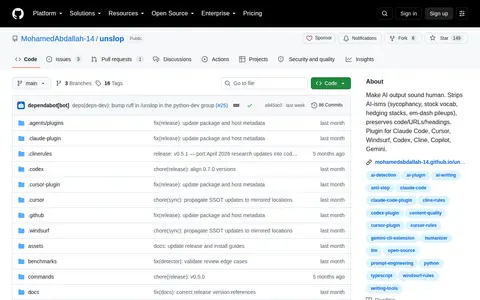
A plugin that rewrites AI-generated output to remove stock phrasing, sycophancy, hedging stacks and em-dash pileups while preserving code, URLs and headings. It is offered for Claude Code, Cursor, Windsurf, Codex, Cline, Copilot and Gemini.

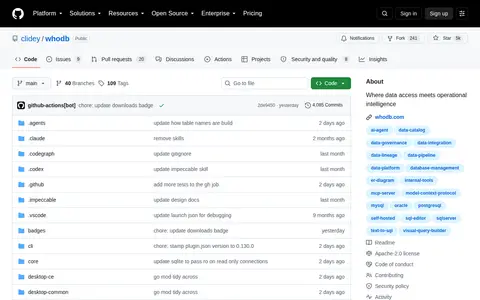
A lightweight, self-hosted workspace for databases that runs in the browser and is also available as a desktop app or terminal CLI. It offers spreadsheet-style data editing, a visual schema graph and a query scratchpad, with optional AI features through a chosen provider.

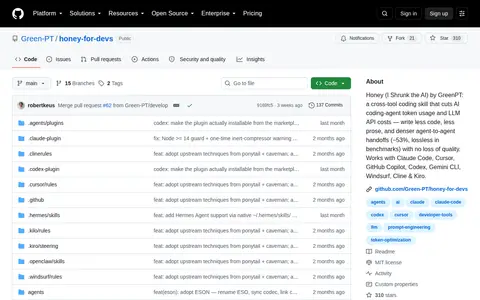
Honey (I Shrunk the AI) by GreenPT is a cross-tool coding skill that reduces AI coding-agent token usage and LLM API costs. It enables writing less code and prose and supports denser agent-to-agent handoffs, with reported 53% cost reduction and no quality loss in benchmarks. It is compatible with Claude Code, Cursor, GitHub Copilot, Codex, Gemini CLI, Windsurf, Cline, and Kiro.

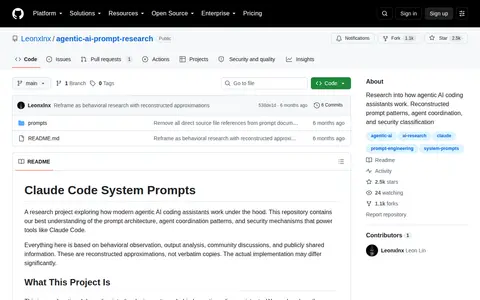
A research repository examining how agentic AI coding assistants work, covering reconstructed prompt patterns, agent coordination and security classification. It documents design patterns such as system prompts, sub-agent coordination and permission mechanisms, described as approximations based on observation rather than verbatim copies. It aims to help AI engineers and researchers learn from these architectural patterns.

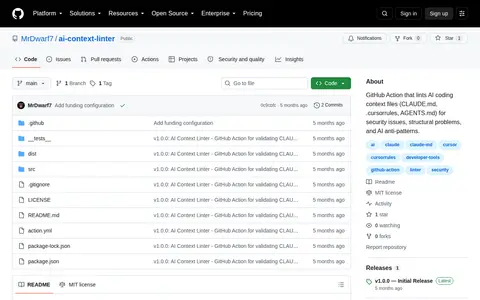
AI Context Linter is a GitHub Action that checks AI coding context files such as CLAUDE.md, .cursorrules and AGENTS.md for security issues, structural problems and AI anti-patterns. It auto-detects context files and runs 12 rules, including detection of hardcoded API keys and leaked home directory paths. Rules cover structure, vague or conflicting instructions and file-type specifics, with configurable token limits and disabled rules.

Open-source project that supports software development with code generation, analysis, debugging, or documentation.

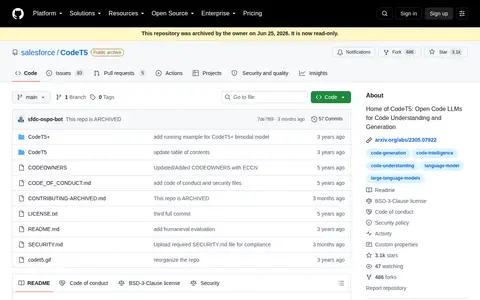
Open Code LLMs for Code Understanding and Generation.

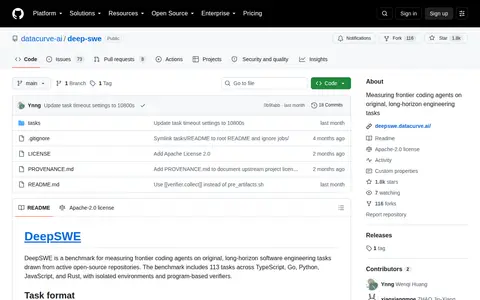
DeepSWE is a GitHub repository that provides a benchmark for measuring the performance of frontier coding AI agents on original, long-horizon engineering tasks. The repository includes documentation on task format, quickstart guides, and details about supported agents and models.

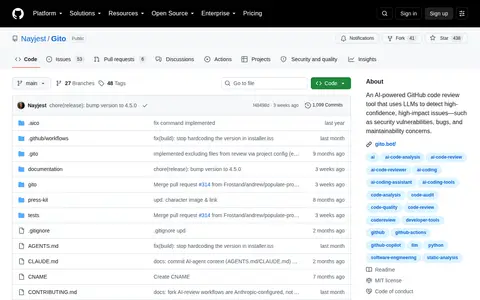
Gito is an open-source AI code reviewer that works with any language model provider. It detects issues in GitHub pull requests or local codebase changes, posts results as PR comments, and reacts to maintainer comments. GitLab support is in beta; Bitbucket support is planned.

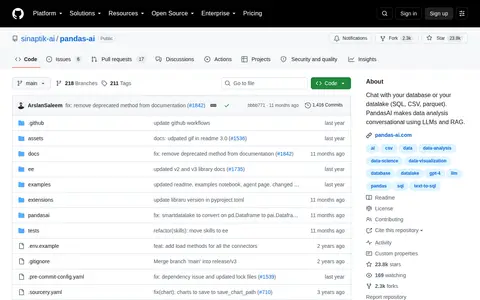
PandasAI is an open-source library that enables conversational data analysis using large language models and retrieval-augmented generation. It allows users to interact with databases or datalakes supporting SQL, CSV, and parquet file formats.

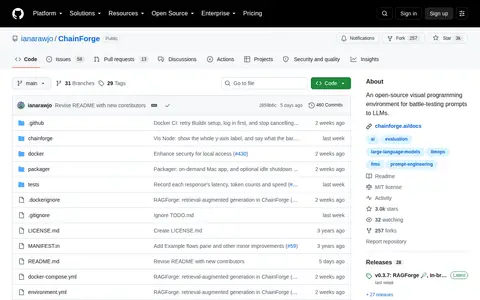
ChainForge is an open-source visual programming environment for battle-testing prompts to large language models. It supports querying multiple models at once, comparing response quality across prompts, models and model settings, and setting evaluation metrics to visualize results. Built on ReactFlow and Flask, it can be installed locally with pip or tried on the web, where features are limited.

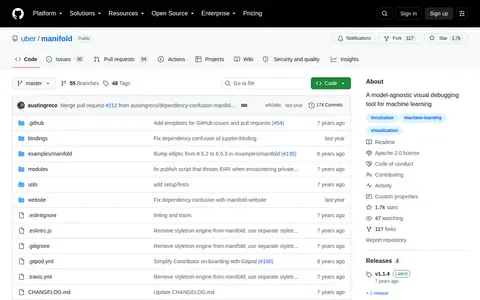
A model-agnostic visual debugging tool for machine learning.

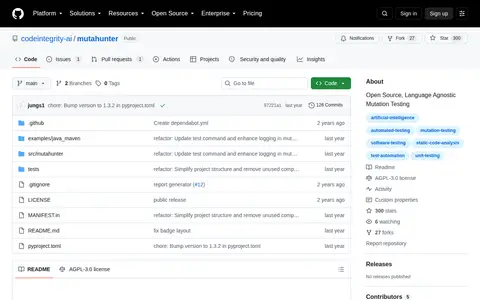
Mutahunter is an open-source, language-agnostic mutation testing tool that uses large language models. It is installed as a Python package requiring Python 3.11 or later and run against a repository with a test command, source path and test path, reporting mutation coverage and survived or killed mutants.
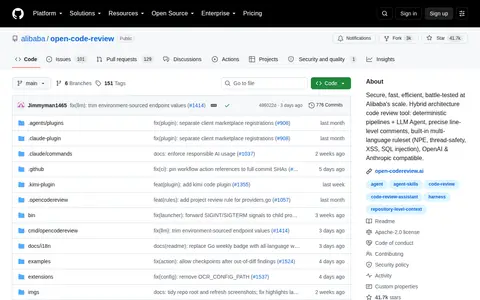
Open Code Review is an AI-powered code review CLI tool that reads Git diffs and sends changed files to a configurable LLM agent, producing structured line-level review comments. It also scans entire files and supports OpenAI and Anthropic compatible endpoints.

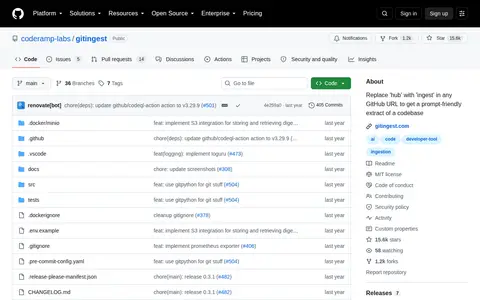
Gitingest converts any Git repository into a prompt-friendly text ingest for LLMs. Users can replace hub with ingest in any GitHub URL to access the corresponding digest. It provides a text digest from a repository URL or directory, with smart formatting for LLM prompts and statistics on file and directory structure, extract size and token count. It is available as a CLI tool and Python package.

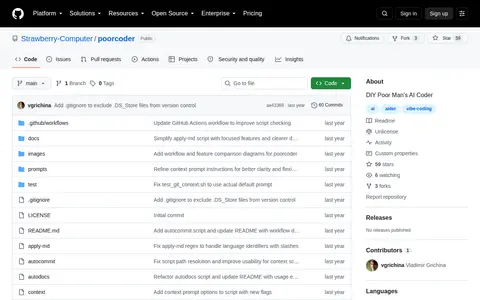
Lightweight Bash scripts that enhance your terminal coding workflow with web-based AI assistants like Claude or Grok.

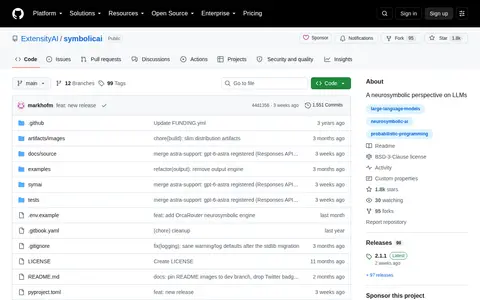
A neuro-symbolic framework for building applications with LLMs at the core.