
LittleSis is a free, open-source public accountability research platform operated by the nonprofit Public Accountability Initiative. It hosts a database mapping connections between influential figures in business and government, provides a power research toolkit for community organizers, runs trainings on strategic power research for researchers, activists and journalists, and publishes reports on corporate and elite influence, fossil fuel finance and related accountability issues.
Directory
Search results
Published directory entries matching your search.
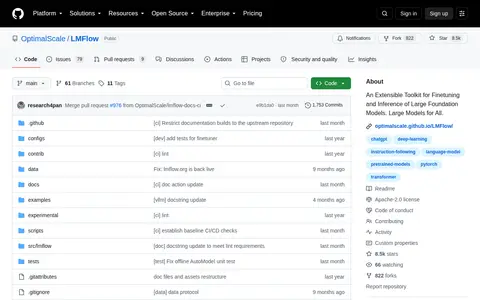
LMFlow is a toolkit for finetuning and inference of large foundation models, presented as extensible, convenient and efficient. It offers support for custom optimizer training, conversation templates, speculative decoding, long context inference with position interpolation for LLaMA models, and Flash Attention-2. The project is released under the Apache-2.0 license and was made available on PyPI.
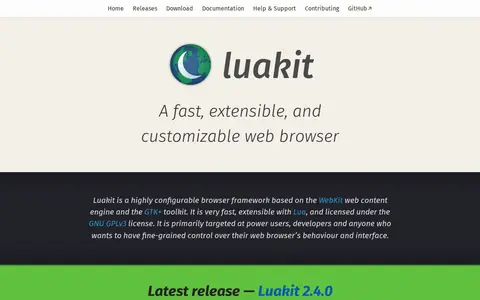
Luakit is a configurable web browser framework built on the WebKit engine and the GTK+ toolkit, extensible with Lua and licensed under GNU GPLv3. It targets power users and developers who want fine-grained control over browser behaviour and interface.
MEKA is an open source implementation of methods for multi-label learning and evaluation, based on the WEKA Machine Learning Toolkit. It includes dozens of multi-label methods from the scientific literature and a wrapper to the MULAN framework. The project is distributed via SourceForge, with code hosted on GitHub.
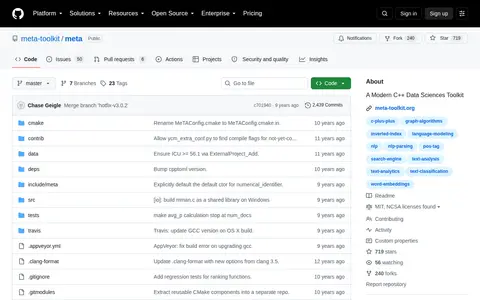
MeTA is a modern C++ data sciences toolkit. It provides text tokenization including deep semantic features like parse trees, inverted and forward indexes with compression and caching strategies, ranking functions for searching indexes, topic models, classification algorithms, graph algorithms, language models, a CRF implementation for POS-tagging and shallow parsing, and wrappers for liblinear and libsvm.
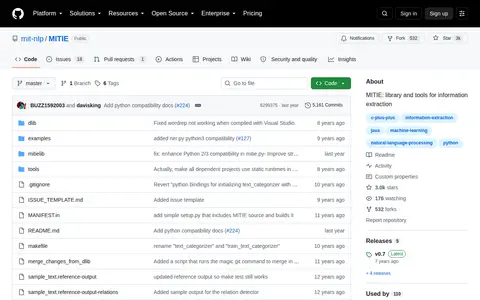
MITIE is a set of tools for information extraction built on dlib. It provides named entity extraction and binary relation detection, along with tools for training custom extractors and relation detectors. Pre-trained models support English, Spanish and German. The core is written in C++, with bindings for Python, R, Java, C and MATLAB.
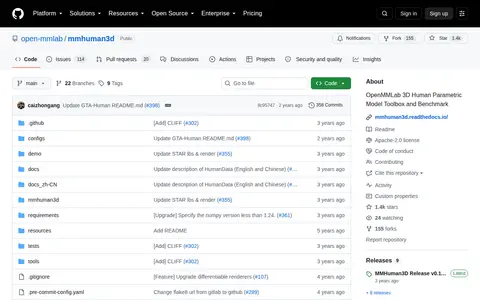
Open source 3D human modeling toolkit for pose estimation, mesh recovery, and research workflows.
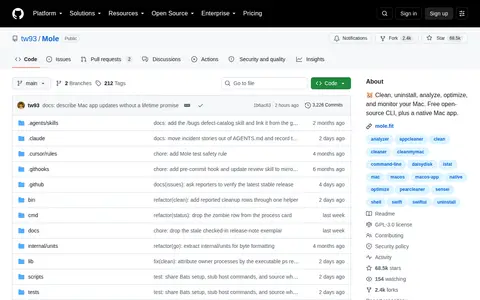
Mole is a free open-source CLI toolkit for macOS and Windows that cleans caches, logs, leftovers and orphaned app data, uninstalls apps with their leftovers, analyzes disk usage, performs system maintenance and shows live system monitoring. The repository is the CLI, called mo, installed via Homebrew or a script; Mole requires macOS 12 or newer and supports Intel and Apple Silicon Macs.
NKit is a Nintendo ToolKit that can recover and preserve Wii and GameCube disc images. It can rebuild scrubbed or hacked images to match Redump-verified images and convert them to the NKit format, a smaller reversible format. NKit images are playable with Dolphin, Swiss and Nintendont, but not with Wii USB loaders yet.
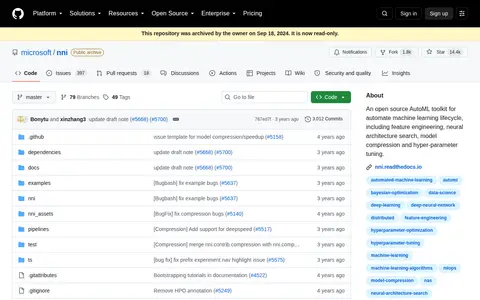
NNI is an open source AutoML toolkit developed by Microsoft. It automates tasks across the machine learning lifecycle, including feature engineering, neural architecture search, model compression and hyper-parameter tuning for machine learning workflows.

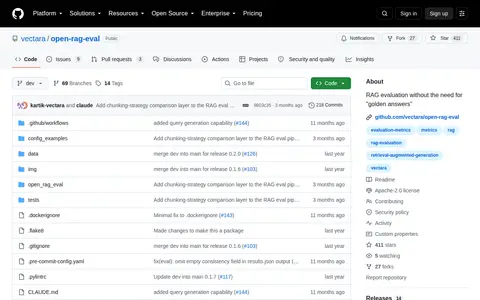
Open RAG Eval is an open-source Python evaluation toolkit for Retrieval-Augmented Generation pipelines. It provides TREC-RAG evaluation metrics and a modular design for custom metrics and connectors, with core metrics that do not require golden chunks or golden answers.
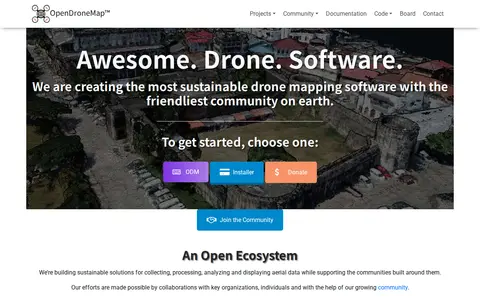
OpenDroneMap is drone mapping software that generates maps, point clouds, 3D models and DEMs from images taken by any camera in any orientation. Its ecosystem includes ODM, a command line toolkit for processing aerial images from drones, balloons or kites, plus NodeODM, CloudODM, PyODM, ClusterODM and other projects.
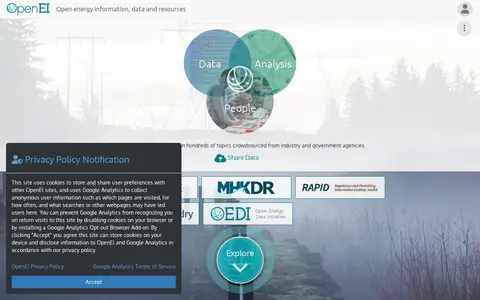
OpenEI is an open energy information platform that provides access to crowdsourced energy data, information, and applications from industry and government agencies. It covers hundreds of energy-related topics including geothermal, solar, wind, hydrogen, utilities, buildings, and smart grid. Its resources support education, data exploration, and industry decision-making, and include initiatives such as the Open Energy Data Initiative, Utility Rate Database, and specialized data repositories and toolkits.
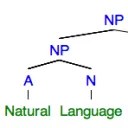
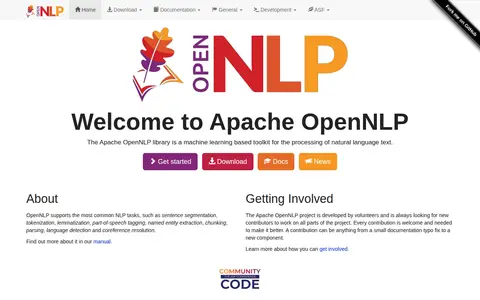
Apache OpenNLP is a machine learning based toolkit for the processing of natural language text. It supports tasks such as sentence segmentation, tokenization, lemmatization, part-of-speech tagging, named entity extraction, chunking, parsing, language detection and coreference resolution. The project is developed by volunteers and welcomes contributions, from small documentation fixes to new components.
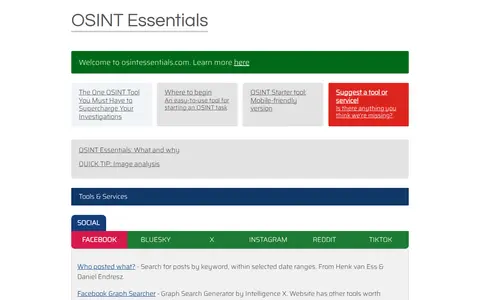
Curated OSINT toolkit with links for people search, social media, maps, domains, and research.
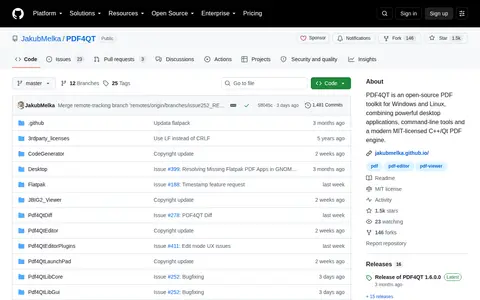
PDF4QT is an open-source PDF toolkit for Windows and Linux. It combines powerful desktop applications, command-line tools, and a modern C++/Qt PDF engine that is released under the MIT license.
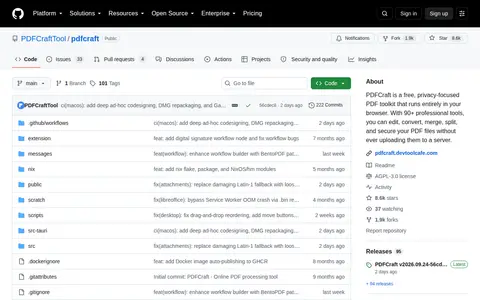
PDFCraft is a free, browser-based PDF toolkit. It provides over 90 tools to edit, convert, merge, split and secure PDF files. Files are processed client-side with WebAssembly and are not uploaded to a server. A visual workflow editor is offered in beta, subject to bugs or incomplete functionality.
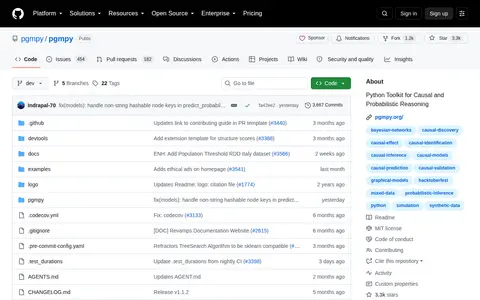
pgmpy is a Python toolkit for causal and probabilistic reasoning using graphical models. It implements data structures for models such as DAGs, PDAGs, MAGs, PAGs, Bayesian Networks, Dynamic Bayesian Networks and Structural Equation Models, with algorithms for tasks including causal discovery, causal identification, inference, model validation, parameter estimation and simulations. Algorithms follow a unified composable API and are scikit-learn compatible when possible. It is available on PyPI and conda.
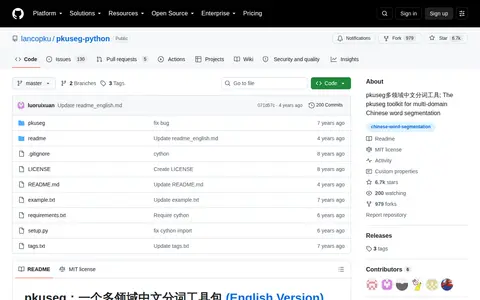
pkuseg is a Python toolkit for multi-domain Chinese word segmentation, based on a 2019 paper. It provides pretrained models for news, web, medicine, tourism, and mixed domains, and supports user-trained models and part-of-speech tagging. It is distributed under the MIT license.
The Plains to Peaks Collective is a collaborative initiative for libraries, archives, historical societies and museums in Colorado and Wyoming to share their digital cultural collections with a broader public audience. It provides resources for participants including a digitization toolkit, DPLA search widget, and guidance on digital stewardship, copyright, metadata management, and participation in shared digital projects.
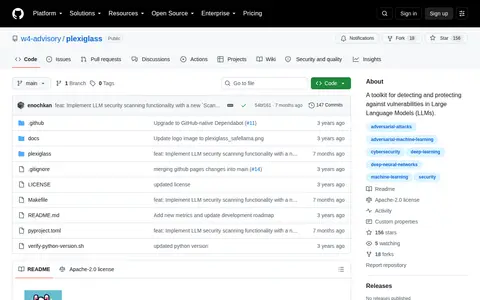
Plexiglass is a GitHub-hosted toolkit for detecting and protecting against vulnerabilities in large language models (LLMs). The repository includes quickstart guides, installation instructions, operation mode details, and feature request resources.
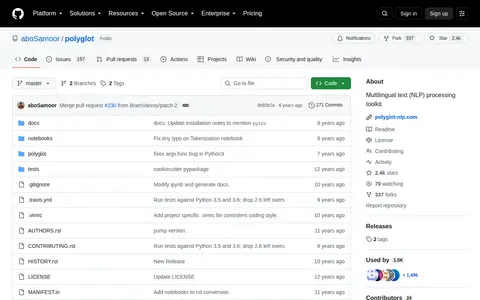
Multilingual text (NLP) processing toolkit.
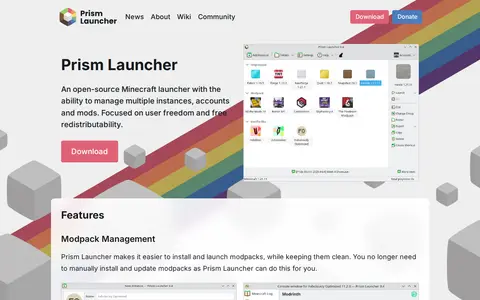
Prism Launcher is an open-source Minecraft launcher for managing multiple instances, accounts and mods. It installs and launches modpacks, interfaces with Modrinth and CurseForge for individual mods, and lets each instance keep its own settings and configurations. It is built with the Qt toolkit and runs on Windows, MacOS and Linux. It is licensed under GPL-3.
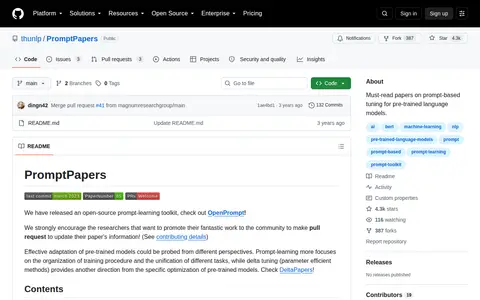
PromptPapers is a public GitHub repository that curates a list of must-read academic papers on prompt-based tuning for pre-trained language models. The list is primarily maintained by Ning Ding and Shengding Hu, and the repository also references the associated open-source prompt-learning toolkit OpenPrompt. It organizes papers into categorized sections and accepts community pull requests to update paper information.