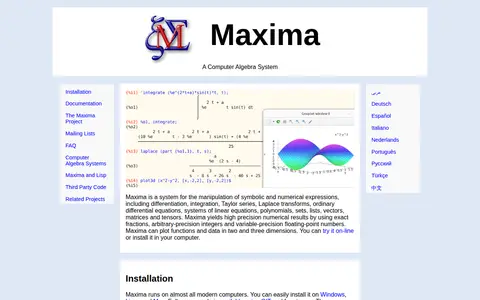
Maxima is a free, open-source computer algebra system written in Lisp with an emphasis on symbolic computation. It is based on the DOE-MACSYMA system and licensed under the GPL. Its capabilities include symbolic integration, 3D plotting, solving differential equations, manipulation of symbolic and numerical expressions, and high-precision numerical calculations. It runs on Windows, Linux, and Mac, with both terminal and notebook interface options, and has an active user community with frequent updates.
Directory
Search results
Published directory entries matching your search.
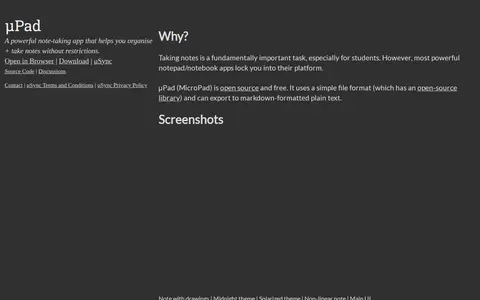
MicroPad is an open-source, free non-linear note-taking app with an infinite canvas for organising notes and notebooks. It runs in a web browser and on Windows, macOS and Linux, and supports μSync for synchronising notes across devices. It can import Evernote enex files and Markdown files, and export notes to markdown-formatted plain text.

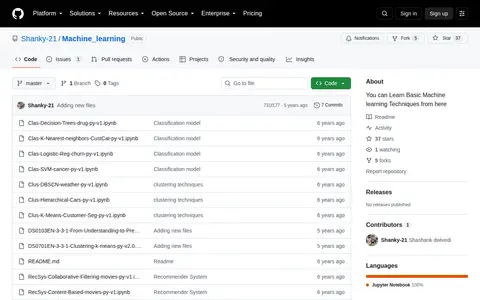
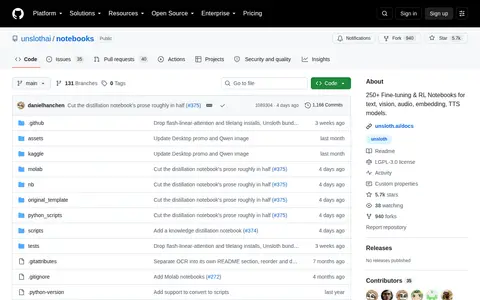
A Repository Containing Classification, Clustering, Regression, Recommender Notebooks with illustration to make them.
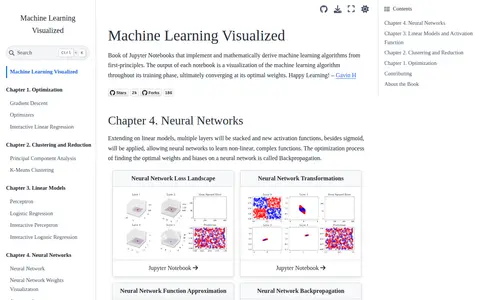
Machine Learning Visualized is a book of Jupyter Notebooks that implement and mathematically derive machine learning algorithms from first principles. Each notebook's output is a visualization of the algorithm during training, converging at its optimal weights. Chapters cover optimization, clustering and reduction, linear models and activation functions, and neural networks.
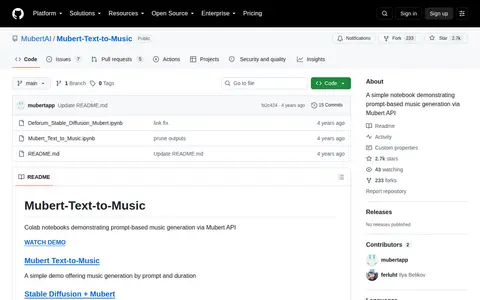
MubertAI/Mubert-Text-to-Music is a GitHub repository maintained by MubertAI. It hosts a simple notebook that demonstrates prompt-based music generation via the Mubert API, providing a reference implementation for users looking to generate music from text prompts using the service.
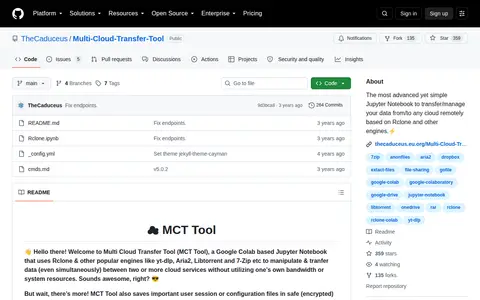
Multi-Cloud-Transfer-Tool is a GitHub-hosted Jupyter Notebook project created by TheCaduceus for transferring and managing data between local devices and any cloud service remotely. The tool is built on Rclone and other engines, and is described as advanced yet simple to use.
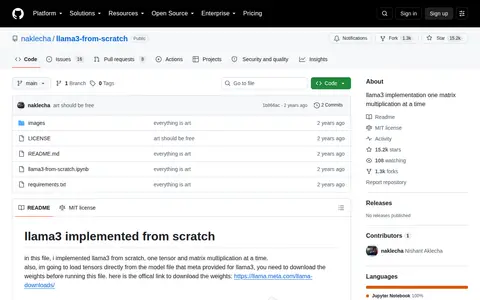
A notebook project that implements llama3 from scratch, one tensor and matrix multiplication at a time. It loads tensors directly from the model file Meta provided for llama3, and the weights must be downloaded before running the file. The author does not implement a BPE tokenizer and instead uses tiktoken.
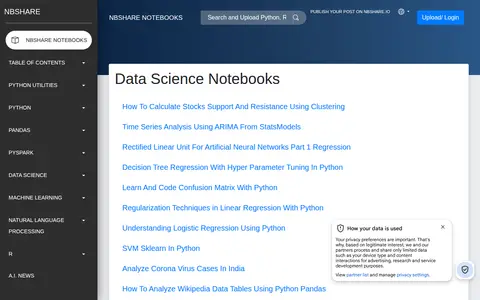
nbshare.io is a platform for learning data analytics using Python and R. It hosts a collection of notebooks covering topics including artificial intelligence, machine learning, basic Python coding, data analytics, web scraping and other related technical subjects.
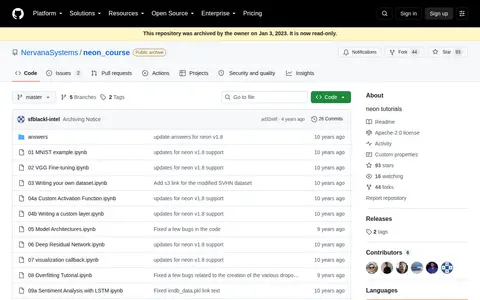
IPython notebooks for a complete course around understanding Nervana's Neon.
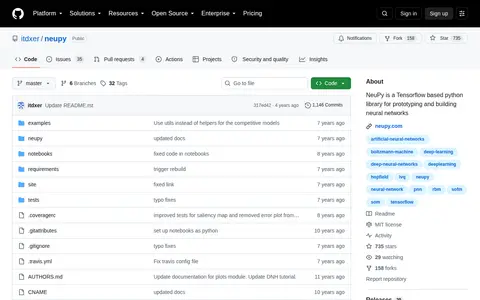
NeuPy is a Python library built on Tensorflow for prototyping and building neural networks. The repository notes that the library is no longer actively maintained. It includes examples and notebooks covering algorithms such as Boltzmann machines and self-organizing maps.
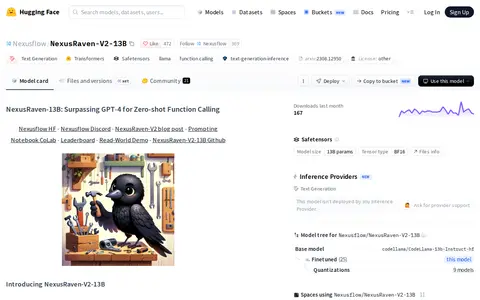
Nexusflow/NexusRaven-V2-13B is a 13-billion parameter language model available on Hugging Face. It is designed for zero-shot function calling and text generation, aiming to advance open-source artificial intelligence. The model can be used with libraries such as Transformers and provides instructions for deployment via inference providers, notebooks, and local applications.
Open-source project that provides machine-learning models, research, training resources, or evaluation tools.
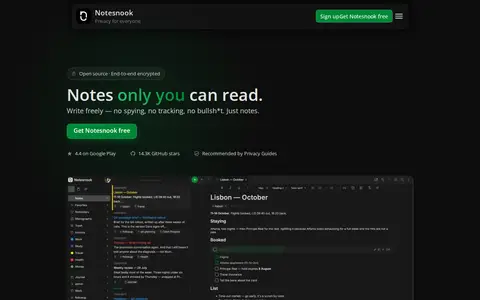
Notesnook is an open-source note-taking app with end-to-end encryption, available as desktop, web and mobile clients. It supports notebooks, tags, favorites, pins, linked notes, an app lock and publishing a single note as a web page behind an optional password. It offers sync across devices and imports from Evernote, Google Keep, Obsidian, Joplin and other apps and formats.
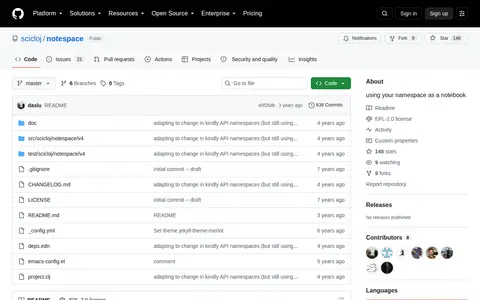
notespace is an open source project hosted as a public repository on GitHub under the scicloj/notespace project. It is designed to enable users to use their namespace as a notebook. The project invites contributions from developers.
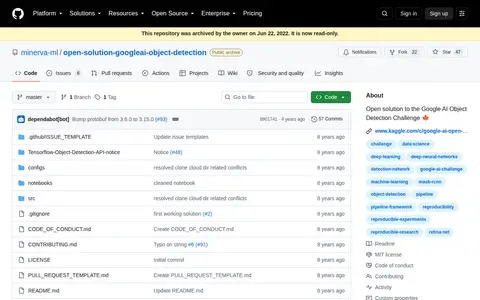
An archived, read-only GitHub repository holding an open solution to the Google AI Open Images Object Detection Track. It offers starter code, configs and notebooks, with RetinaNet training and references to the Neptune experiment platform; Neptune use is optional and the code can run as a plain Python script. The README notes the competition used Open Images Dataset V4.
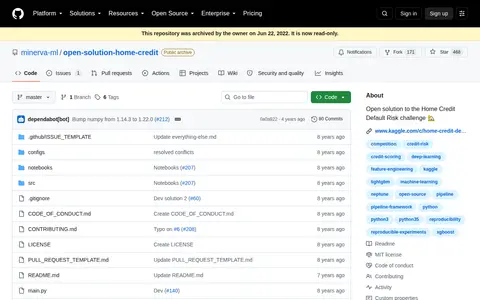
An archived, read-only GitHub repository holding an open solution to the Home Credit Default Risk challenge. It provides code, configs and notebooks plus documented solutions using LightGBM, sklearn and XGBoost with engineered features; the README lists cross-validation and leaderboard scores for each. References to Neptune are optional and the solution can run as a plain Python script.
Paperspace is a cloud GPU platform now owned by DigitalOcean. It provides access to NVIDIA H100 GPUs for AI and machine learning workloads, rendering, 3D graphics, simulations and cloud gaming. Users can develop, train and deploy AI applications on the platform, which is used by over 500,000 builders. Its product offerings include Gradient for AI model development, hosted notebooks, cloud desktops and deployment tools, with solutions tailored for machine learning, enterprise virtual desktops, gaming and rendering use cases.
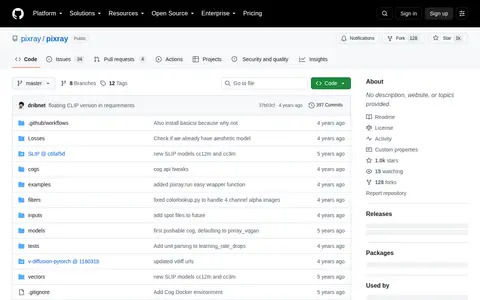
pixray is an image generation system combining perception engines, CLIP-guided GAN imagery and CLIPDraw. It is a Python library and command line utility that can also run in Google Colab notebooks or inside Docker using Cog. Installation requires a recursive git clone and a fresh Python 3.8 environment.
Creates or edits images with generative models and visual controls.
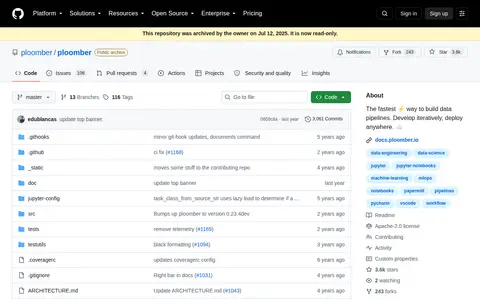
Ploomber is a tool for building data pipelines. It offers a YAML API and a Python API, and its features include caching previous pipeline results and running on Kubernetes, Airflow, AWS Batch or SLURM. It can convert monolithic notebooks into modular pipelines. The repository was archived on Jul 12, 2025 and is read-only.
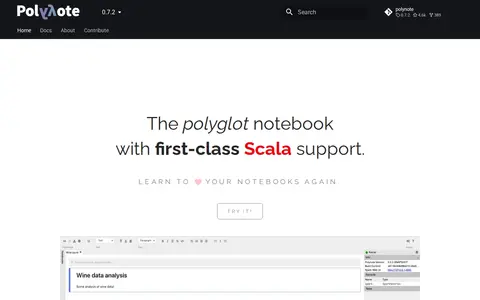
The polyglot notebook with first-class Scala support.
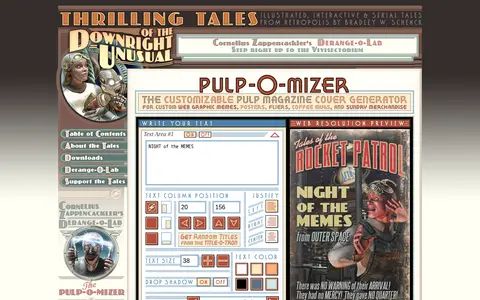
Pulp-O-Mizer is a web-based retro sci-fi pulp magazine cover generator. It enables users to design custom covers for web memes, blog illustrations, coffee mugs, posters, notebooks, and iPad covers. The tool provides multiple text areas, customizable colors, gradients, backgrounds, and characters. Users can save, load, export, and import cover settings. Preset dimensions include a rectangle (332x508) and a square (508x508) format.
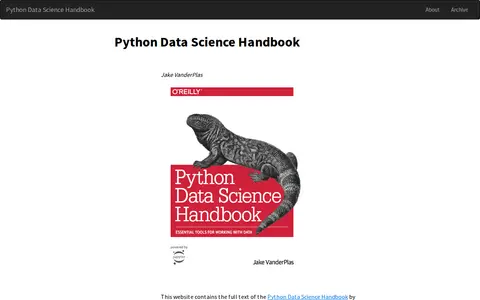
The Python Data Science Handbook by Jake VanderPlas is published as a website containing the full text, organized into chapters on IPython, NumPy, Pandas, Matplotlib and machine learning. The text is released under the CC-BY-NC-ND license and the code under the MIT license; the content is available on GitHub as Jupyter notebooks.
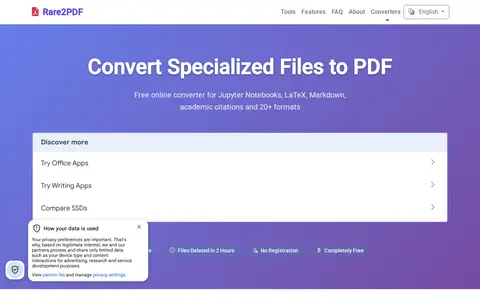
Rare2PDF is a free online converter that turns specialized files into PDF, including Jupyter Notebooks, LaTeX documents, Markdown files and academic citations such as RIS and EndNote files. It lists over 20 converters, requires no registration or installation, and states that uploads are deleted within two hours.