
Pyro is a deep probabilistic programming library built on PyTorch, described as universal, scalable, minimal and flexible. It can represent any computable probability distribution and was originally developed at Uber AI, now maintained by community contributors including a team at the Broad Institute. It became a project of the Linux Foundation in 2019. It installs via pip as pyro-ppl.
Directory
Search results
Published directory entries matching your search.
PyStanfordDependencies is a Python interface for converting Penn Treebank trees to Stanford Dependencies and Universal Dependencies. It offers a get_instance() function with subprocess or jpype backends, and convert_tree() or convert_trees() methods returning Token objects. Visualization options include asciitree, Graphviz dotgraphs, and interactive xdot windows. A Stanford CoreNLP or Parser jar file can be supplied, or downloaded automatically.
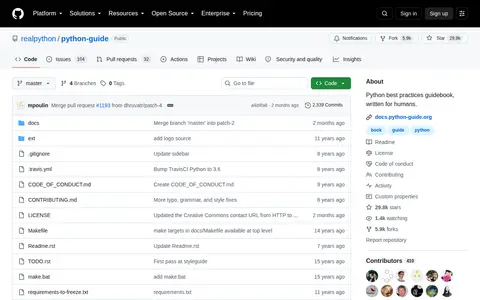
Python Guide is a GitHub repository or organization with source code, releases, documentation, or project resources.
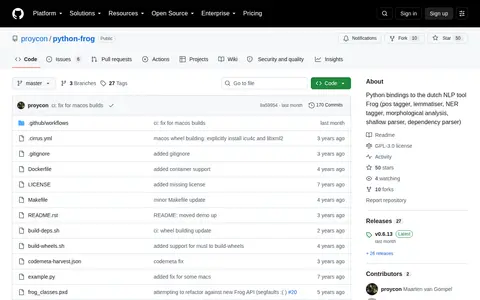
python-frog is an open-source Python library hosted on GitHub providing bindings to the Dutch NLP tool Frog, which supports part-of-speech tagging, lemmatisation, named entity recognition, morphological analysis, shallow parsing and dependency parsing.
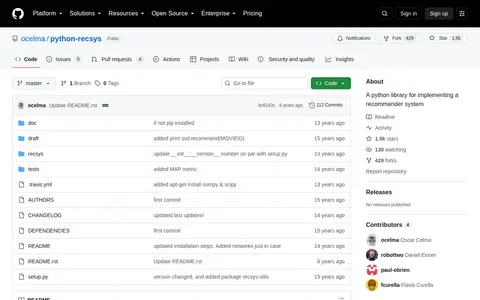
A Python library for implementing a Recommender System.
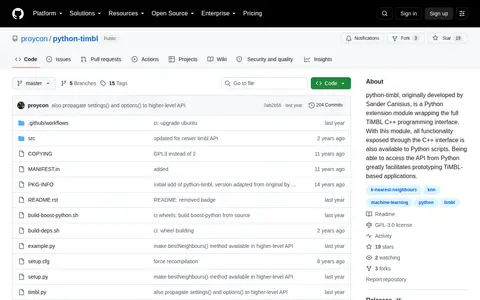
python-timbl is a Python extension module wrapping the full TiMBL C++ programming interface, exposing all functionality of the C++ interface to Python scripts for prototyping TiMBL-based applications. It was originally developed by Sander Canisius, with a 2013 release by Maarten van Gompel, and since 2020 supports only Python 3. It is distributed under the GNU General Public License.
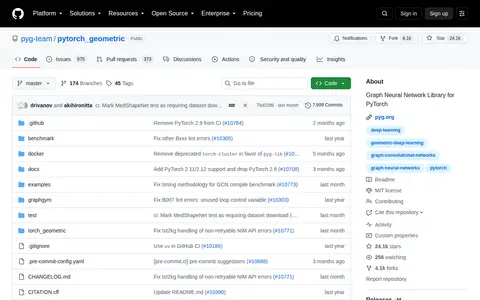
Graph Neural Network Library for PyTorch.
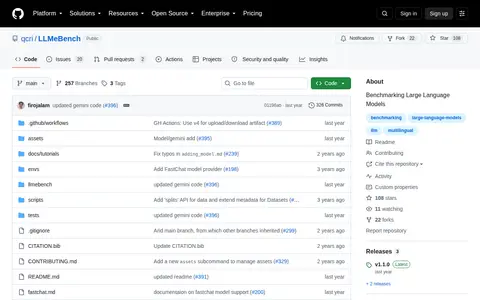
LLMeBench is a flexible framework for accelerating the benchmarking of large language models. It provides tools to run benchmarks and evaluate model performance. The project is hosted on GitHub under the qcri organization.
Open-source project that supports deploying, serving, monitoring, or operating AI and machine-learning systems.
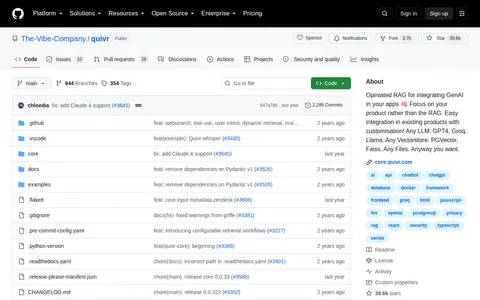
Dump all your files and chat with it using your generative AI second brain using LLMs & embeddings.
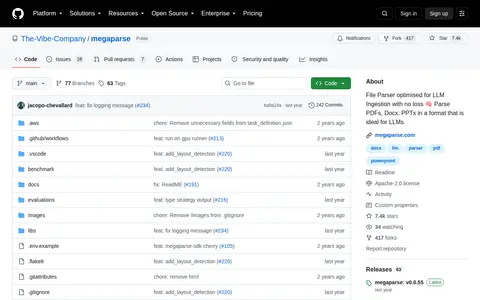
File Parser optimised for LLM Ingestion with no loss. Parse PDFs, Docx, PPTx in a format that is ideal for LLMs.
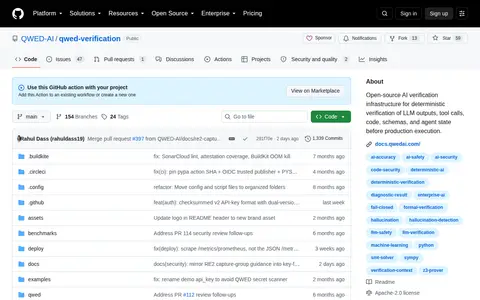
QWED is an open-source AI verification infrastructure hosted on GitHub. It provides deterministic verification for large language model outputs, tool calls, code, schemas, and agent state prior to production execution.
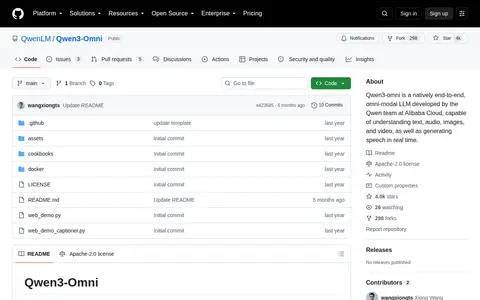
Qwen3-Omni is a natively end-to-end omni-modal large language model developed by the Qwen team at Alibaba Cloud. It can process text, audio, images, and video inputs, and generate speech in real time. The project's resources are hosted on a public GitHub repository.
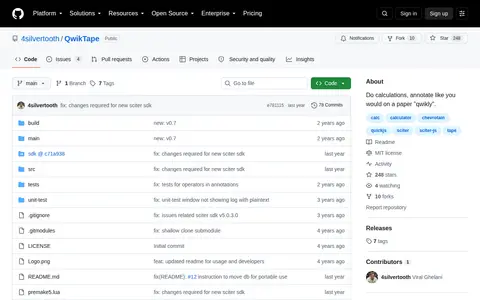
QwikTape is a tape-style calculator and annotation tool. It allows users to perform calculations, add text annotations alongside entries, save multiple auto-saved tapes, define variables for use in calculations, customize number display settings, and export tapes as PDFs. It is available for Windows, Linux, and macOS.

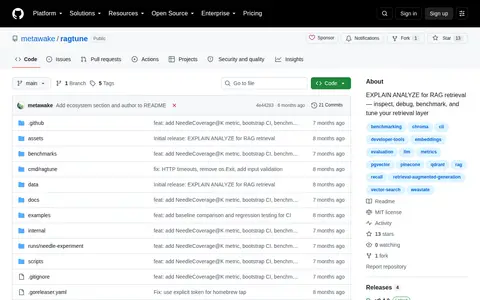
CLI tool for debugging and benchmarking RAG retrieval. EXPLAIN ANALYZE for your retrieval layer.
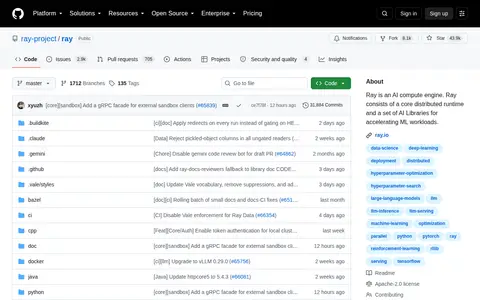
Ray is an AI compute engine consisting of a core distributed runtime and AI libraries for scaling AI and Python applications. It runs on any machine, cluster, cloud provider, and Kubernetes, and is installed with pip install ray.
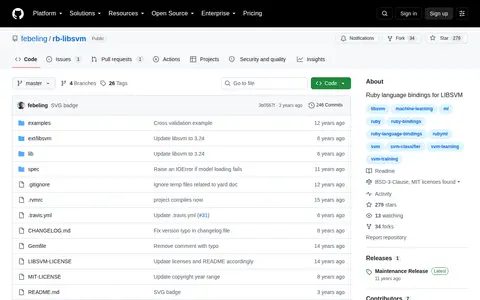
Ruby language bindings for LIBSVM which is a Library for Support Vector Machines.
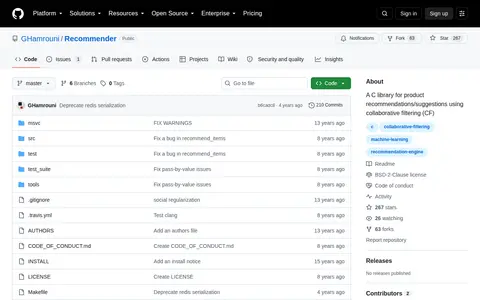
Recommender is a C library for product recommendations and suggestions using collaborative filtering. It analyzes implicit and explicit user feedback and item preferences, then predicts suitable products for a user. It offers user-based and item-based recommenders and has no external dependencies. It builds into libRecommender.a and is released under the BSD-2-Clause license.
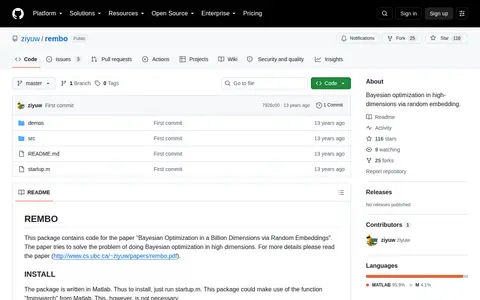
REMBO is a Matlab package implementing Bayesian optimization in high dimensions via random embedding, accompanying the paper "Bayesian Optimization in a Billion Dimensions via Random Embeddings". Configuration files specify parameter settings, and the package supports continuous, discrete, and categorical parameters as well as log scales.
REP is a GitHub-hosted machine learning toolbox developed by Yandex, branded as a Reproducible Experiment Platform. It includes documentation for its main features, usage examples, and installation guidance for both Docker and manual setup.
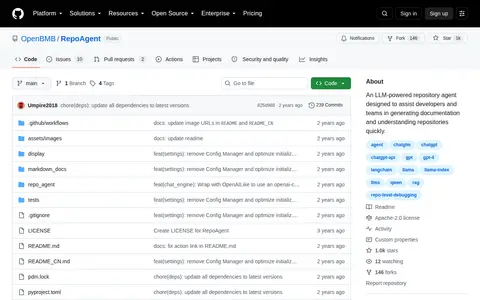
RepoAgent is an LLM-powered repository agent for generating documentation and understanding repositories. It detects changes in Git repositories, analyzes code structure through AST, and identifies bidirectional invocation relationships between objects. It supports GitHub Actions and can be installed via pip or PDM.
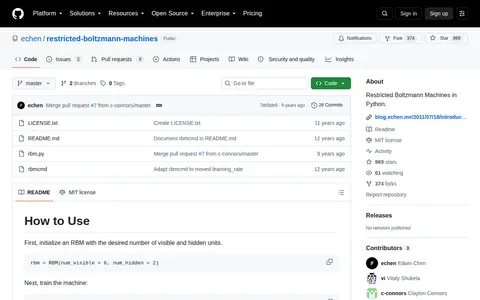
A Python implementation of Restricted Boltzmann Machines. It lets users initialize an RBM with a chosen number of visible and hidden units, train it on a matrix of training examples, run visible or hidden data, and let the network run freely. It is released under an MIT license.
Retext is an ecosystem of plugins that work with natural language as structured data, specifically concrete syntax trees. It is a tool that transforms natural language with plugins, which can inspect and change the natural language. The repository is a monorepo containing packages for parsing English, Dutch and Latin-script prose and serializing syntax trees.