
lavender.ai
Lavender helps thousands of sellers around the world write better emails faster and get more positive replies in less time.
Directory
Published directory entries matching your search.
Lavender helps thousands of sellers around the world write better emails faster and get more positive replies in less time.

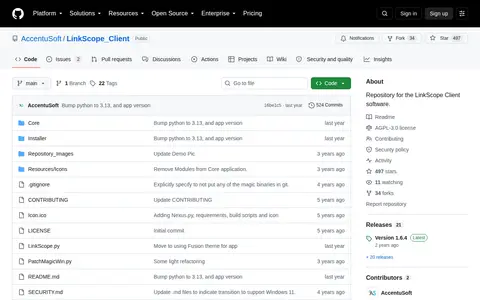
LinkScope is online investigation software that represents information as discrete entities, connects related data via resolution functions to build knowledge graphs, and helps users extract insights from online data. It offers graph visualisation, drag-and-drop data entry, event timelines, browser tab import, location mapping, and extensible functionality. A server version supports live project collaboration, text extraction from over 100 document types, content summarization, and context-aware Q&A about project data. Installers are available for Ubuntu 22.04 and Windows 11, though the SFDP graph layout is not functional on Windows.

Open-source project that supports AI-assisted research, knowledge retrieval, summarization, or source analysis.

A free downloadable guide from Kolena Inc. on testing large language models. It identifies principles for creating reliable testing protocols and details approaches for measuring model effectiveness in NLP tasks such as text summarization and prompt engineering, and discusses tracking performance differences over time.

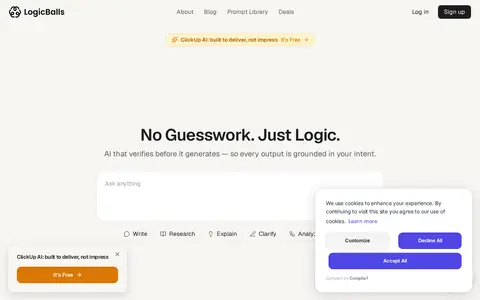
LogicBalls is an AI tool platform offering access to thousands of AI tools and a chat assistant across multiple AI models. It presents its approach as asking before answering and verifying before generating. Plans range from a free tier to Pro, Premium and Elite, with monthly word limits and model counts.

Luthor uses AI to draft, edit, summarize, or adapt written content.

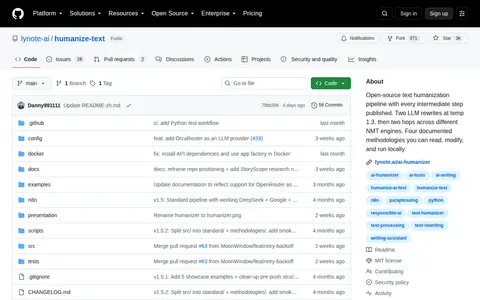
Open-source pipeline for rewriting AI-generated text into natural human prose. The repository documents a structure-first data pipeline that builds SFT and KTO training data for an AI-to-human rewrite model, with training data construction described in its docs.

Mining the Social Web is a technical manual focused on social web analysis, being overhauled for a third edition as of 2019 by Matthew Russell and co-author Mikhail Klassen. The project originated at PyCon 2016 in Portland, Oregon.

Open-source project that supports AI-assisted research, knowledge retrieval, summarization, or source analysis.

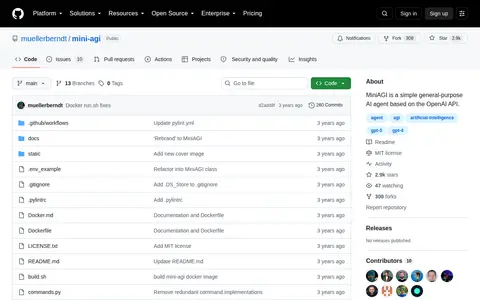
MiniAGI is a simple autonomous agent compatible with GPT-3.5-Turbo and GPT-4. It combines a prompt with a minimal set of tools, chain-of-thoughts and short-term memory with summarization, and is capable of inner monologue and self-criticism. A critic can be enabled for additional API requests.

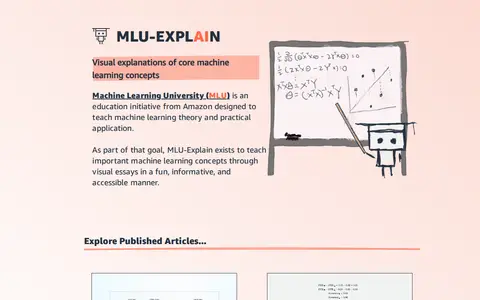
MLU-Explain is an education initiative from Amazon that teaches machine learning concepts through visual essays. It publishes interactive articles on topics such as neural networks, logistic regression, reinforcement learning, ROC and AUC, cross-validation, random forests, and decision trees.

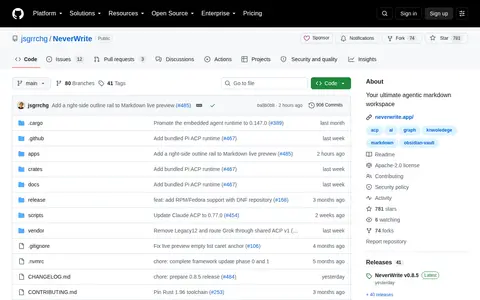
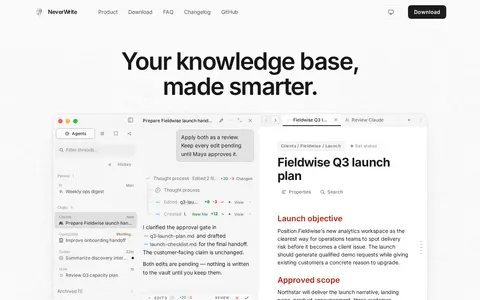
A local-first agentic markdown workspace combining a Markdown-first editor, knowledge navigation, AI agent sessions, and explicit change review in a multipane application. It runs agent sessions for providers such as Codex, Claude, Grok, Kilo, OpenCode, and Pi, and supports reviewing tracked AI edits before keeping or rejecting them.

NeverWrite is a local-first knowledge workspace for notes and documents with AI assistance. Notes stay in a folder on the computer, and every AI edit arrives as a reviewable change that can be accepted, rejected or refined before it is written to the vault. It is free, open source under Apache 2.0, requires no account, and connects to models the user already pays for.

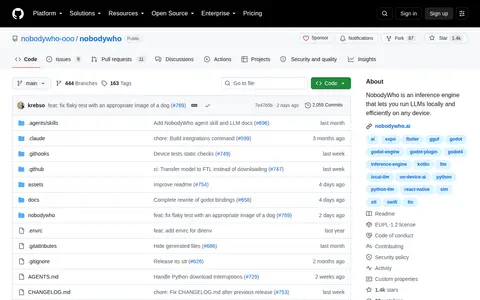
NobodyWho is an inference engine that runs LLMs locally and offline on any device, powered by llama.cpp. Bindings are available for Kotlin, Swift, React Native, Flutter, Python and Godot. It supports GGUF models, tool calling, multimodal input, text-to-speech and speech-to-text.

NotebookLM supports AI-assisted research, knowledge retrieval, summarization, or source analysis.

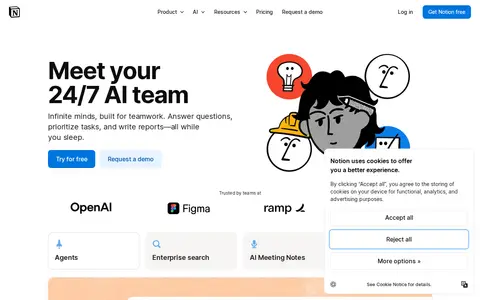
One tool that does it all. Search, generate, analyze, and chat—right inside Notion.

NSFWJS is a simple JavaScript library that identifies unseemly images directly in a user's web browser. The library is noted as reasonably accurate, with ongoing work to improve its performance.

Paper2Galgame is proprietary software that turns academic papers into interactive visual novels using AI. Users upload PDFs to generate story-driven explanations and can study with anime partners or custom characters. It also offers document parsing, chapter-by-chapter reading, voice, and blackboard notes. Its source code is not publicly available.

Postwise is an AI writing tool that turns ideas into posts for Twitter/X, LinkedIn, and Threads. It includes scheduling, viral post repurposing, and engagement tracking from one dashboard. Plans start at $37 per month, and a 7-day free trial is offered.

PulsePost is a tool for creating and managing SEO-optimized blogs for a business. The site states that switching to the new PulsePost system will be completed on October 20, 2026. Its documentation and support pages are titled Pulsepost with the tagline "Grow your traffic on autopilot."

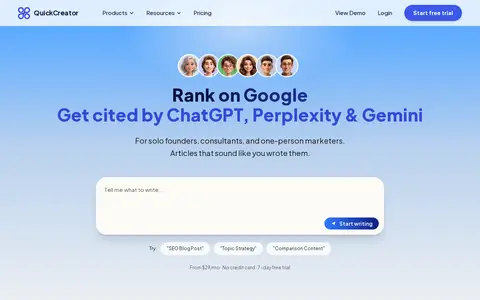
QuickCreator describes itself as an AI content team for solo founders that produces articles in the user's voice intended to rank on Google and be cited by ChatGPT, Perplexity, and Gemini. Plans range from $29 per month to custom enterprise pricing, with a 7-day free trial.

Recall is a personal AI knowledge base. It allows users to save, summarize, and chat with content including articles, videos, podcasts, PDFs, and notes using supported AI models such as ChatGPT, Claude, and Gemini.

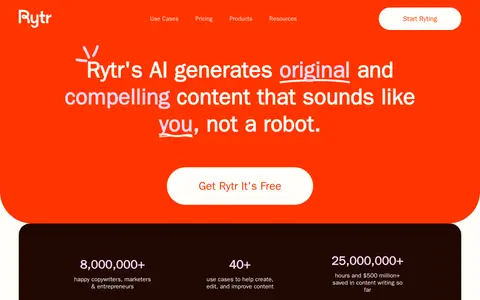
Rytr uses AI to draft, edit, summarize, or adapt written content.

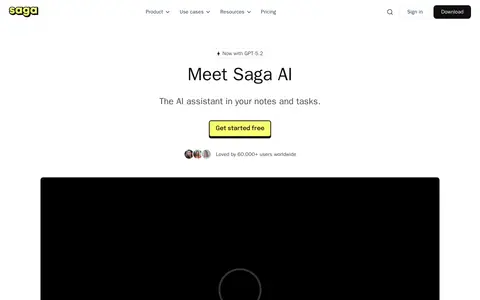
Saga AI is an AI assistant integrated into a workspace for notes, documents, and tasks. It supports drafting content, brainstorming ideas, correcting grammar, and translating text to more than 20 languages.