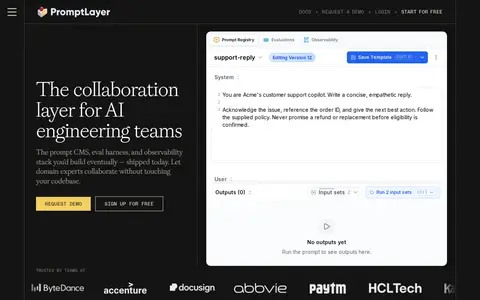

PromptLayer is a prompt management platform for AI engineering teams. It offers prompt versioning, large language model evaluation tools, and AI agent observability via tracing, logs, and regression sets, plus a visual editor for prompt iteration and collaboration.
Directory
Search results
Published directory entries matching your search.
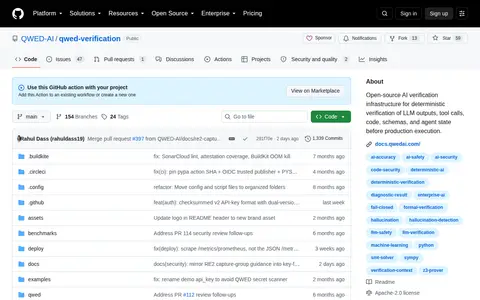
QWED is an open-source AI verification infrastructure hosted on GitHub. It provides deterministic verification for large language model outputs, tool calls, code, schemas, and agent state prior to production execution.
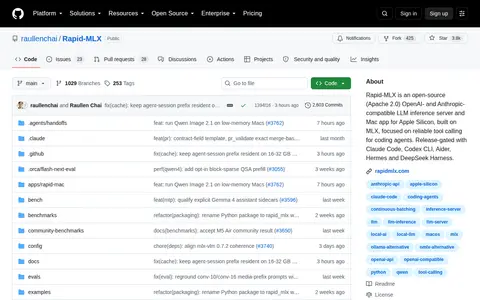
Rapid-MLX is an open-source, Apache 2.0 licensed large language model inference server and Mac application for Apple Silicon devices. It is compatible with OpenAI and Anthropic APIs, built on the MLX framework, and focused on reliable tool calling for coding agents.
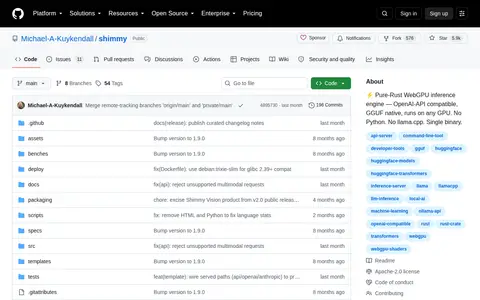
Python-free Rust inference server with OpenAI API compatibility and hot model swapping.
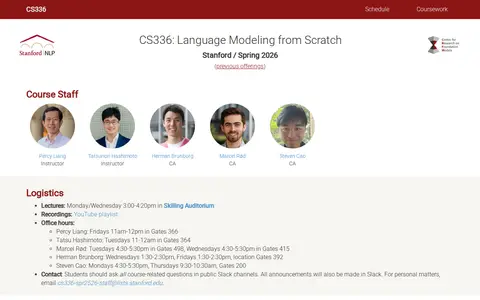
Stanford CS336: Language Modeling from Scratch is the official course website for a Stanford class offered in Spring 2026. The course walks students through the process of developing a language model, including data collection and cleaning for pre-training, transformer model construction, model training, and evaluation before deployment. The site provides logistics, schedule, assignments, and course materials.
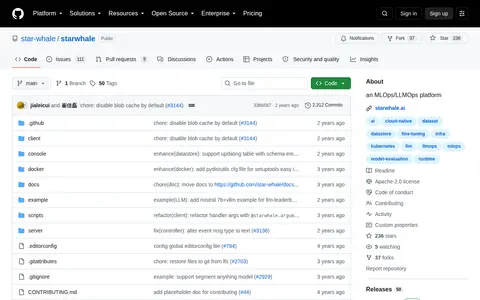
An MLOps/LLMOps platform for model building, evaluation, and fine-tuning.
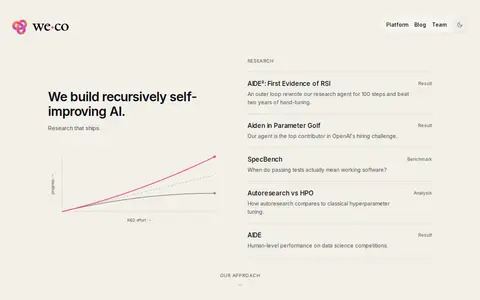
Weco is a research and product lab building recursively self-improving AI. Its platform points at an eval script and iteratively optimizes code against a metric the user defines, such as speed, accuracy or cost. Supported model providers include GPT, Claude, Gemini, Kimi, GLM and MiniMax, with bring your own key.
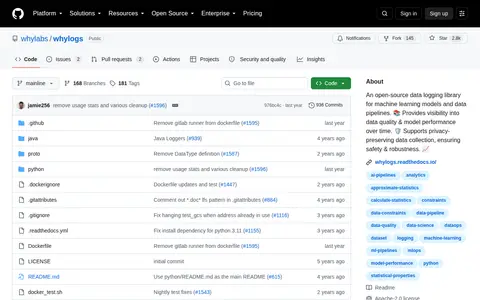
Whylogs is an open-source data logging library for machine learning models and data pipelines. It provides visibility into data quality and model performance over time, and supports privacy-preserving data collection to support system safety and robustness.
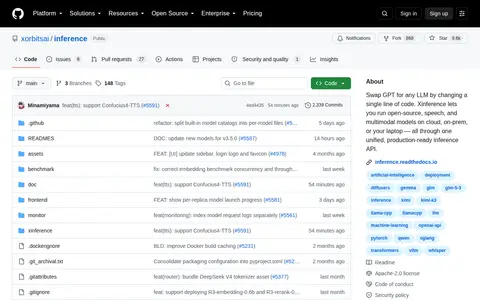
Xinference is a model serving tool that provides a unified production-ready inference API. It allows users to run open-source, speech and multimodal models on cloud infrastructure, on-premises systems or personal laptops by modifying a single line of code.
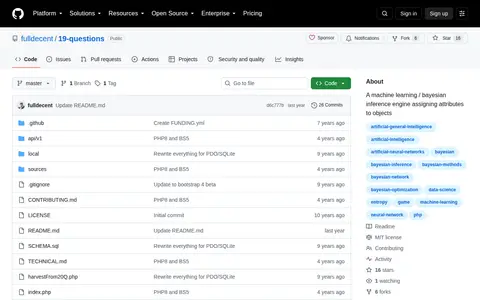
19 Questions is an open source machine learning and Bayesian inference engine designed to assign attributes to objects. Its source code is hosted in a public GitHub repository under the fulldecent organization, and contributions to the project are accepted from the public.
Agenta is an open-source workspace for AI agents. Agents are built through chat, improved with feedback, and shared with a team, either self-hosted or in the cloud. Integrations and messaging in Slack or Telegram are described on the site.
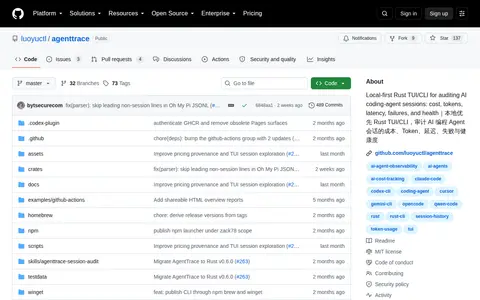
agenttrace is a local-first terminal TUI and report generator for AI coding-agent session history. It reads logs from several coding agents and produces reports on cost, tokens, time, and slow-run diagnosis. Prompts, code, and logs stay on the local machine.
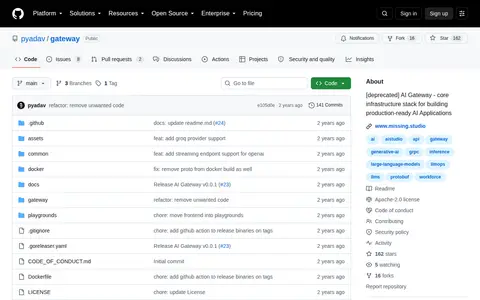
A deprecated GitHub repository described as an AI Gateway, a core infrastructure stack for building production-ready AI applications. It provides a universal API for inferencing over 100 LLMs and lists supported providers and endpoints such as OpenAI and Groq.
Open-source project that supports deploying, serving, monitoring, or operating AI and machine-learning systems.
Amadeus Code provides music AI infrastructure spanning rights-cleared training data, audio supply and royalty management. Its products include MusicTGA for MIDI songwriting ideas, FUJIYAMA AI SOUND for music and sound materials, and Evoke Music, a royalty-free library. CONNECT is a royalty management platform for copyrights and master rights in Japan.
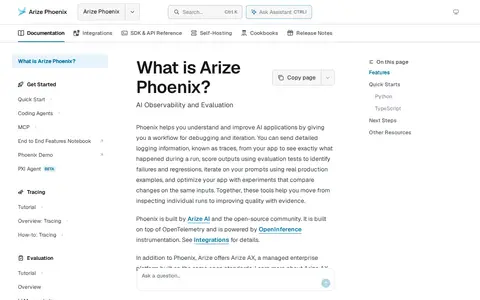
Arize Phoenix is an AI observability and evaluation tool built by Arize AI and the open-source community on OpenTelemetry and OpenInference. It provides tracing for debugging individual runs, evaluations to score output quality, a prompt playground, and datasets and experiments for comparing changes on the same inputs.
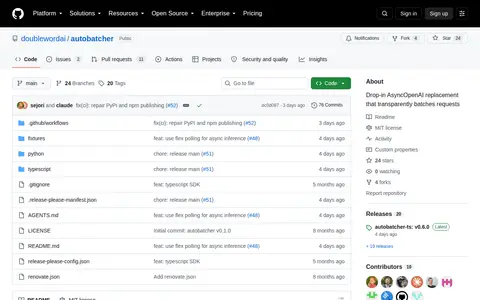
Drop-in AsyncOpenAI replacement that transparently batches requests via the Batch API for cheaper LLM inference.
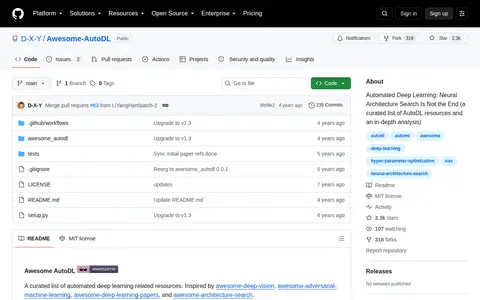
Awesome AutoDL is a curated list of automated deep learning resources and an in-depth analysis, subtitled that neural architecture search is not the end. It collects papers, libraries and benchmarks covering neural architecture search and hyper-parameter optimization.
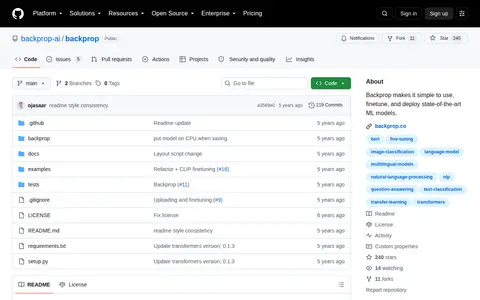
Backprop is a Python library, installable via PyPi, that enables use, finetuning and deployment of machine learning models. It provides task interfaces for conversational question answering, text classification in over 100 languages, image classification, summarisation, emotion detection and text generation, and models can be finetuned with a single line of code.
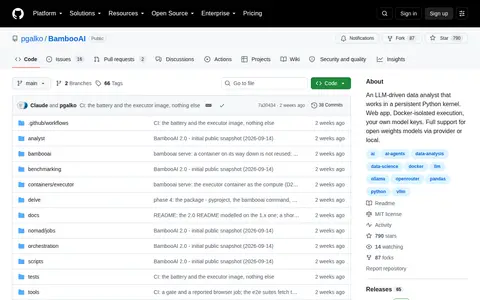
BambooAI is an LLM-driven data analyst tool that operates in a persistent Python kernel. It is available as a web app with Docker-isolated execution, supports user-provided model keys, and is compatible with open weights models via provider or local deployment.
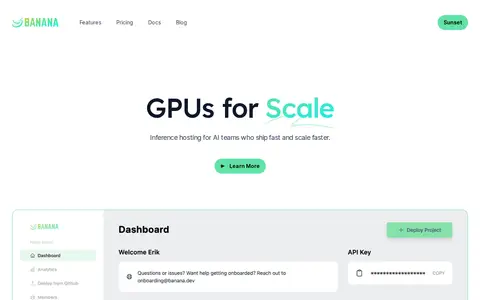
Banana provides GPU inference hosting for AI teams. The platform scales GPUs up and down automatically and includes monitoring, business analytics, a CLI, SDKs, and an open automation API. Backends can be written with Potassium, an open-source HTTP framework. Paid Team and Enterprise tiers are offered.
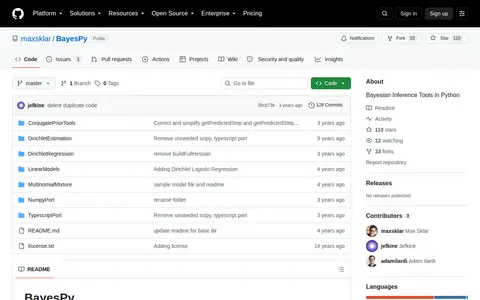
BayesPy is an open-source Python library that provides tools for performing Bayesian inference. It is hosted as a public repository on GitHub where users can access the code and contribute to its development.
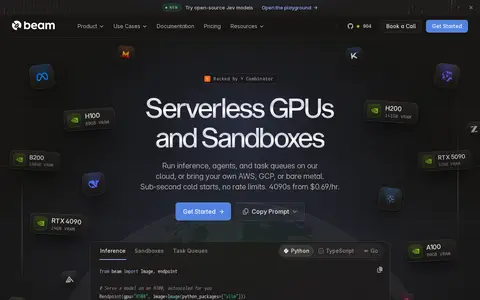
Beam provides a bare-metal cloud for agents, with persistent forkable microVMs that boot in seconds and can be paused, resumed, network-isolated and GPU-accelerated. Virtual machines are billed per second while running, with no compute charges while stopped. The platform also offers serverless GPU tasks, sandboxes and on-demand GPU machines.
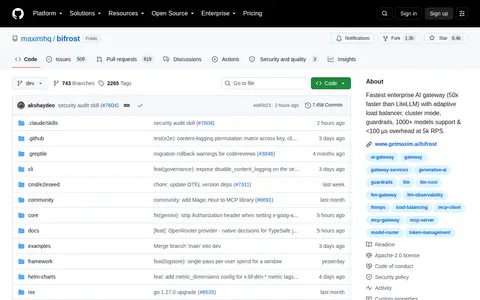
An open-source LLM gateway with routing, load balancing, guardrails, and observability for 1000+ models. opensource.