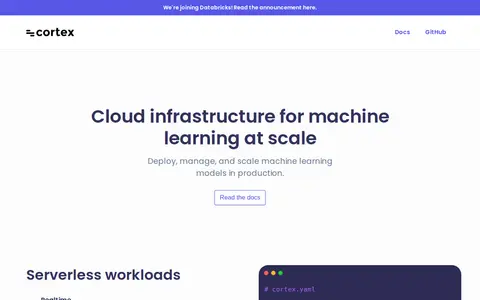

Cortex is cloud infrastructure for machine learning at scale, used to deploy, manage and scale machine learning models in production. It supports realtime, async and batch serverless workloads, along with automated cluster management including cluster autoscaling and spot instances with on-demand backups. Environments, provisioning and CI/CD and observability integrations are also listed. A notice states the project is joining Databricks.
Directory
Search results
Published directory entries matching your search.
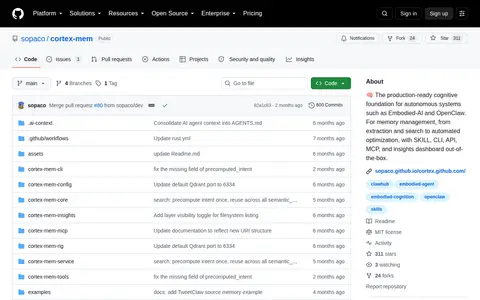
Cortex Memory is a production-ready cognitive foundation for autonomous systems such as Embodied-AI and OpenClaw. It provides memory management functionality including extraction, search, and automated optimization, and includes SKILL, CLI, API, MCP, and an insights dashboard out-of-the-box.
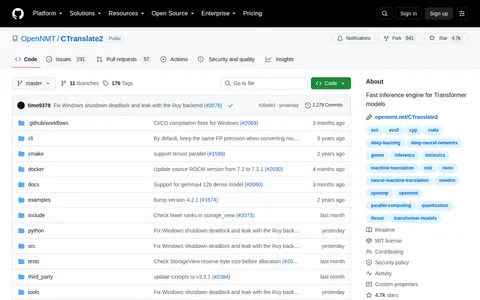
Fast inference engine for Transformer models in C++.
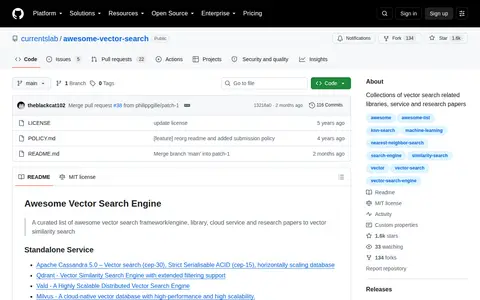
Curated list of awesome vector search framework/engine, library, cloud service and research papers to vector similarity search.
Enjoy unlimited API calls with Serverless AI Workers/LLMs for just $25 per month. No rate or concurrency limits.
Open-source project that supports deploying, serving, monitoring, or operating AI and machine-learning systems.
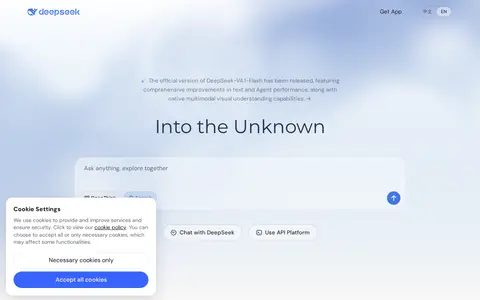
DeepSeek provides machine-learning models, research, training resources, or evaluation tools.
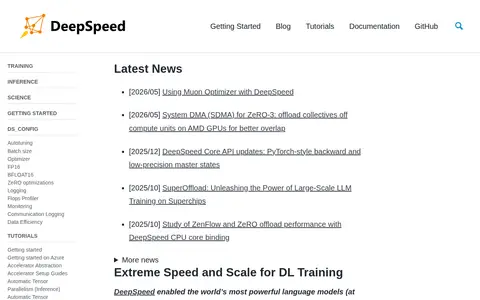
DeepSpeed is a deep learning optimization library intended to make distributed training easy, efficient and effective. It offers system innovations including ZeRO, 3D-Parallelism, DeepSpeed-MoE and ZeRO-Infinity, and has been integrated with several open-source deep learning frameworks.
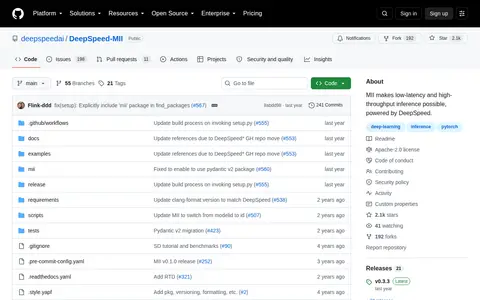
MII makes low-latency and high-throughput inference possible, powered by DeepSpeed.
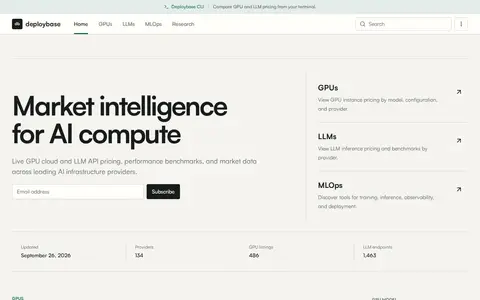
A market intelligence site for AI compute that tracks live GPU cloud and LLM API pricing, performance benchmarks and market data across AI infrastructure providers. It publishes comparisons of GPU cloud pricing by provider and of LLM performance versus cost, including articles on Azure, AWS, Google Cloud, CoreWeave and Lambda GPU offerings.

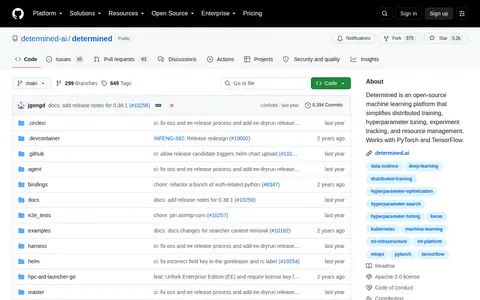
Determined is an open-source machine learning platform that simplifies distributed training, hyperparameter tuning, experiment tracking, and resource management. It works with PyTorch and TensorFlow, offering a Python library, command line interface, and web UI for managing machine learning workflows.
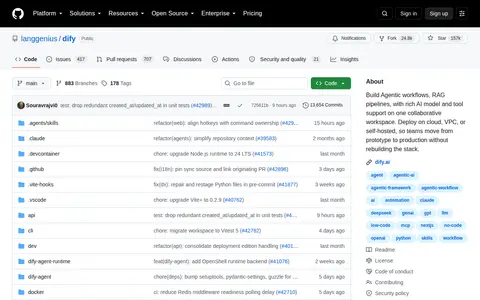
Dify is an open-source LLM app development platform with a visual canvas for AI workflows and RAG pipelines, plus model management and observability. It can be deployed on cloud, VPC, or self-hosted, and integrates with proprietary and open-source LLMs.
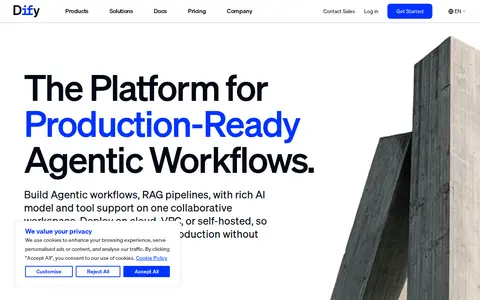
Dify is a platform for building agentic workflows on one canvas, covering agents, knowledge pipelines, models and tools. Deployments include Dify Cloud, a VPC or self-hosted setup, and a source-available Community Edition. The platform also supports RAG pipelines with AI model and tool support.
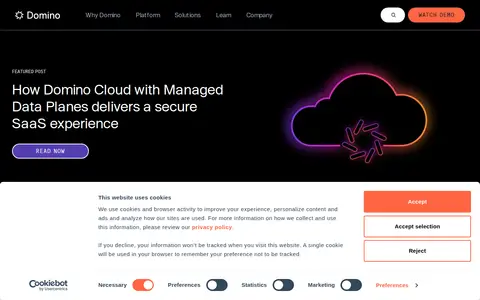
Dominodatalab supports deploying, serving, monitoring, or operating AI and machine-learning systems.
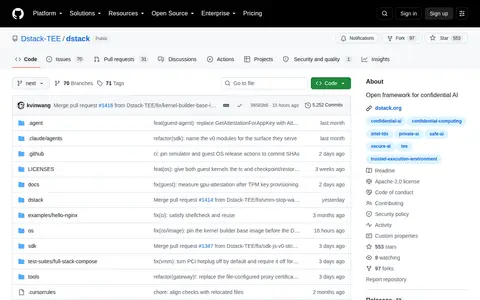
dstack is an open framework for confidential AI that runs containers inside confidential VMs with Intel TDX, using existing Docker Compose files. It supports attested workload identities and native NVIDIA Confidential Computing on H100 and Blackwell GPUs, with options for self-hosted TDX machines or Phala Cloud.
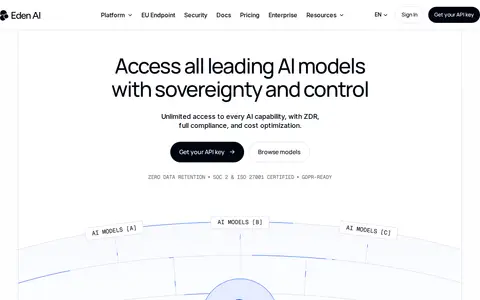
Eden AI offers a unified API for accessing large language models and specialist AI models, including OCR, speech, translation and vision. It standardizes requests, responses, authentication, billing and monitoring across providers, and supports routing requests by cost, performance and region.
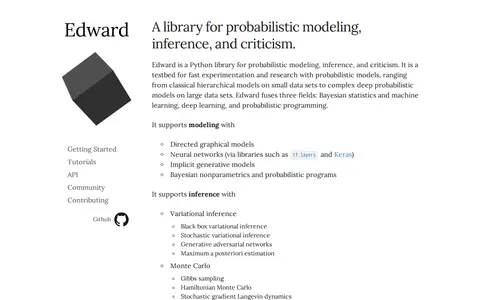
Edward is a Python library for probabilistic modeling, inference, and criticism. It is a testbed for experimentation and research with probabilistic models, from hierarchical models on small data sets to deep probabilistic models on large data sets. It fuses Bayesian statistics and machine learning, deep learning, and probabilistic programming, and is built on TensorFlow.
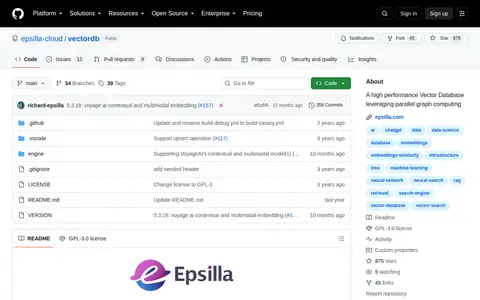
Epsilla is a high-performance vector database hosted on GitHub under the epsilla-cloud organization. It leverages parallel graph computing for its operations, and offers an experimental option to use it as a Python library without requiring a Docker image, alongside Epsilla Cloud as a deployment option.
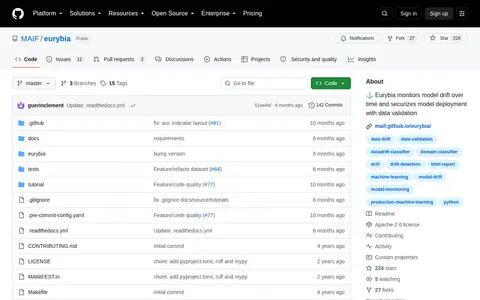
Eurybia is an open-source tool hosted on GitHub under the MAIF organization. It is designed to monitor model drift over time and secure model deployment processes through data validation functionality, with public documentation covering overview, quickstart, installation, features, and project background.
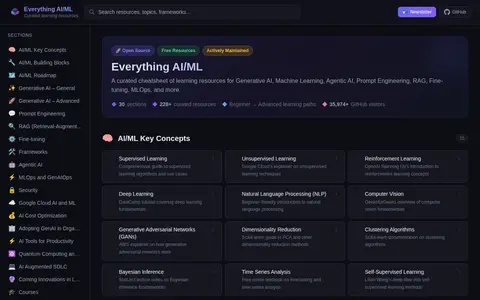
Everything AI/ML is a curated cheatsheet of learning resources covering topics such as generative AI, machine learning, agentic AI, prompt engineering, RAG, fine-tuning and MLOps. It organizes resources into sections, key concepts, interactive visualizations, building blocks and a roadmap from beginner to advanced, with links to external courses, tutorials and documentation.
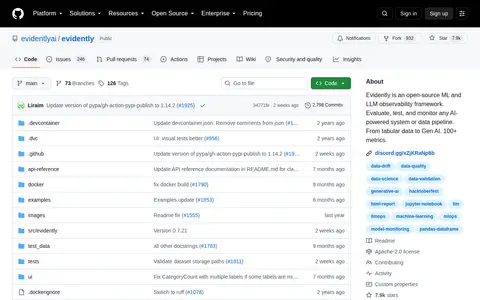
Evidently is an open-source observability framework for machine learning and large language models, hosted on GitHub under the evidentlyai organization. It enables users to evaluate, test, and monitor AI-powered systems and data pipelines, with support for use cases ranging from tabular data processing to generative AI, and includes more than 100 built-in metrics.
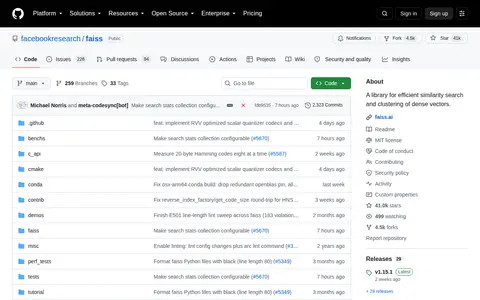
Faiss is a library for efficient similarity search and clustering of dense vectors, containing algorithms that search sets of vectors of any size. It is written in C++ with complete wrappers for Python/numpy, with some algorithms implemented on the GPU, and is developed primarily at Meta's Fundamental AI Research group.
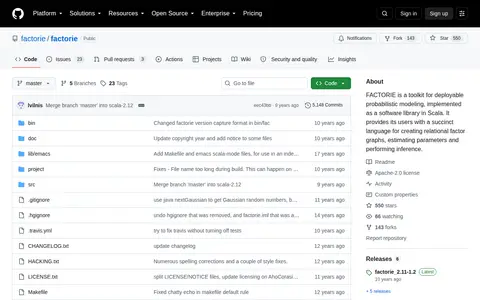
FACTORIE is an open-source toolkit for deployable probabilistic modeling, implemented as a software library in Scala and hosted on GitHub under the factorie organization. It provides users with a succinct language for creating relational factor graphs, estimating model parameters, and performing inference, with documentation for installation, example usage, and pre-built NLP models.
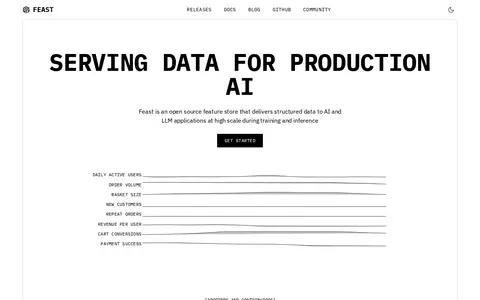
Feast is an end-to-end open source feature store for machine learning. It allows teams to define, manage, discover, and serve features, delivering structured data to AI and LLM applications during training and inference. Documented use cases include real-time recommendations, fraud detection, risk scoring, and customer segmentation.