GeoGebra is an interactive mathematics platform for teaching and learning. It provides free digital tools including calculators, graphing, geometry, 3D exploration, and collaborative whiteboard features. The platform offers ready-made educational resources for grades 4 to 12, tools for users to create custom materials, and classroom functionality for teachers to track student progress and provide feedback. It integrates with various learning management systems and is used by teachers and students at school and university levels.
Directory
Search results
Published directory entries matching your search.
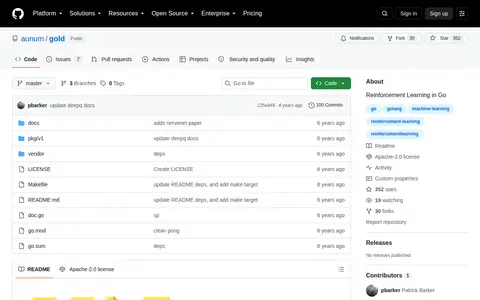
Gold is a reinforcement learning library for Go. It provides a set of agents for solving challenges in various environments, with composable tooling for creating agents and visualizing their performance. Agents include Q Learning, Deep Q learning with Double Q, REINFORCE, Natural Evolution Strategies, Hindsight Experience Replay and Proximal Policy Optimization, which is marked in progress.
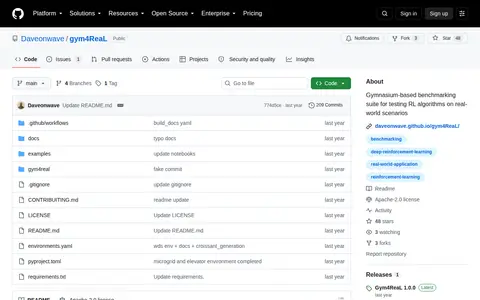
Gym4ReaL is an open-source GitHub repository maintained by Daveonwave. It is a Gymnasium-based benchmarking suite for testing reinforcement learning algorithms on real-world scenarios. The repository includes documentation on supported characteristics, reinforcement learning paradigms, folder structure, contribution guidelines, and licensing terms.
ICML is an international machine learning conference supported by the International Machine Learning Society. The 32nd International Conference on Machine Learning, ICML 2015, was held in Lille, France, on July 6 to July 11, 2015, with tutorials, a main conference and workshops.
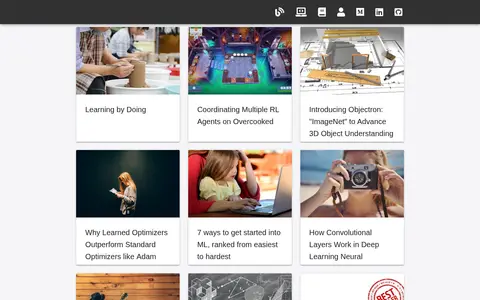
Hong Jing (Jingles) is a data scientist and Alibaba PhD student who writes about machine learning and neuroscience. The site collects blog articles on topics such as reinforcement learning agents, learned optimizers, convolutional layers, transformer models and decoding brain signals.
LanGeek is a language learning platform for learning English. It offers vocabulary, expressions and idioms, reading comprehension, pronunciation lessons and grammar lessons. A Daily Words feature is described as a digital version of the Leitner System for improving vocabulary knowledge. The site also lists a free online English picture dictionary and a mobile application.

Browser tool for learning languages with subtitles, translations, and video-based practice.
Learning Coach provides AI-assisted learning, courses, tutorials, or study support.
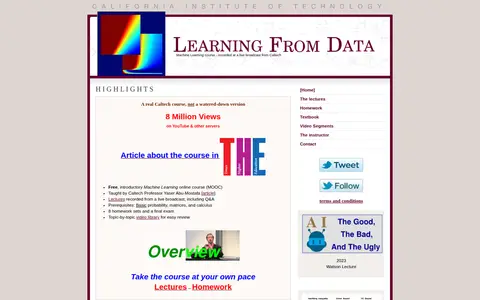
An introductory machine learning course taught by Caltech Professor Yaser Abu-Mostafa, recorded from a live broadcast and available as a free online MOOC. It covers basic theory, algorithms and applications across 18 lectures, with homework sets and a final exam. Prerequisites are basic probability, matrices and calculus.
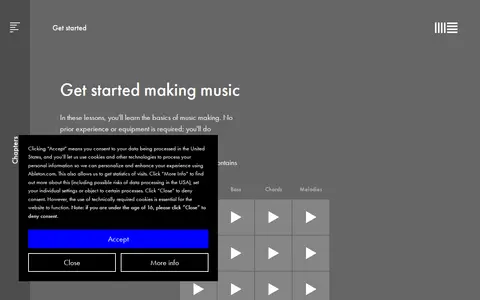
An interactive website from Ableton for exploring music fundamentals. Users experiment with beats, melody, harmony, basslines, and song structure in a web browser. The lessons cover music-making basics and require no prior experience or equipment.
Supports teaching, studying or skills practice with AI-guided learning tools.
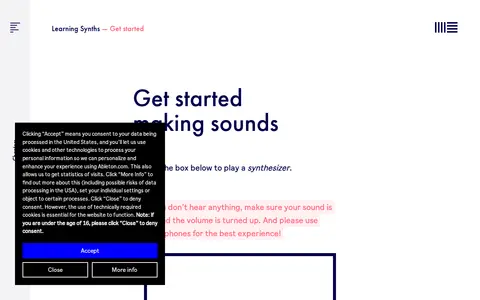
Learning Synths is an interactive website from Ableton for learning about synthesizers. It lets users play with a synth in a browser and learn the parts of a synth to make their own sounds.
Machine Learning – Software Engineering Daily provides machine-learning models, research, training resources, or evaluation tools.
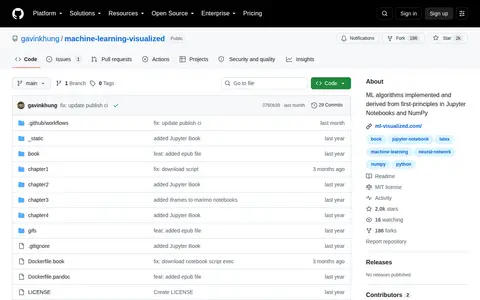
Machine Learning Visualized is a GitHub repository or organization with source code, releases, documentation, or project resources.
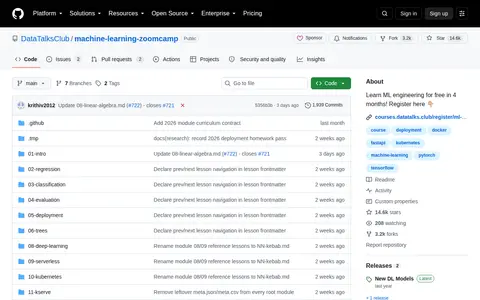
Machine Learning Zoomcamp is a free, hands-on course on building, evaluating, and deploying machine learning systems. It covers the path from framing a problem to preparing data, training and evaluating models, and deploying them, using Python, scikit-learn, TensorFlow, PyTorch, FastAPI, Docker, Kubernetes and AWS Lambda. No prior machine learning experience is required.
MEKA is an open source implementation of methods for multi-label learning and evaluation, based on the WEKA Machine Learning Toolkit. It includes dozens of multi-label methods from the scientific literature and a wrapper to the MULAN framework. The project is distributed via SourceForge, with code hosted on GitHub.
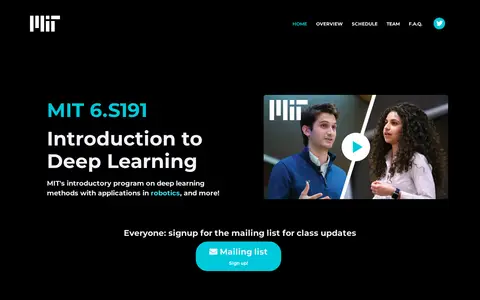
MIT 6.S191 is MIT's introductory program on deep learning methods, with applications in vision, robotics, medicine, language, game play, art and more. It is described as a high-intensity bootcamp teaching deep learning fundamentals, with lectures, software labs and a final project proposal competition. Prerequisites assume calculus and linear algebra.
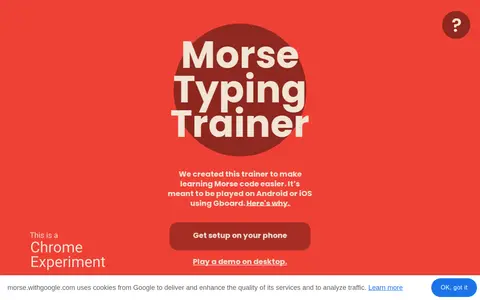
Morse Typing Trainer is a Google experiment for learning Morse code, created to make the learning process more fun. It is intended for people who have set up Morse code for Gboard and are ready to learn. The experiment is part of a larger project supporting Morse code for accessible communication and was built by Use All Five and Google Creative Lab.
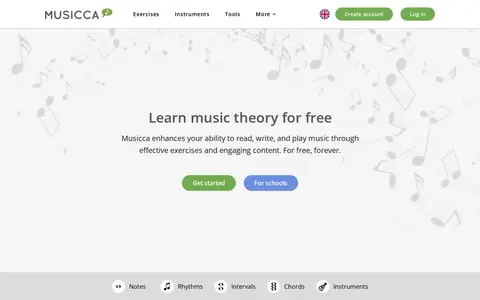
Musicca is a free music theory learning resource with exercises and content covering notes, rhythms, intervals, chords and instruments. It adds game elements to learning and offers accounts that give access to all content and remove ads. The site also provides material for schools and educators.
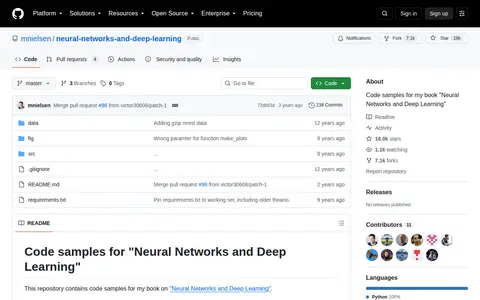
Code samples for my book "Neural Networks and Deep Learning" [DEEP LEARNING].
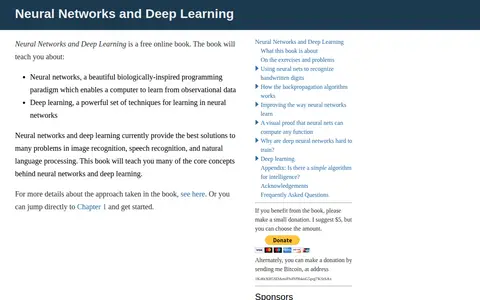
Neural Networks and Deep Learning is a free online book by Michael Nielsen. It teaches core concepts of neural networks and deep learning, covering handwriting recognition, backpropagation, and improving how neural networks learn. The work is licensed for copying and sharing but not for selling.
A site that introduces websites and online tools for studying Japanese, with sections for apps and categorized sites. It also includes articles on learning resources and links to a Japan Foundation e-learning platform.
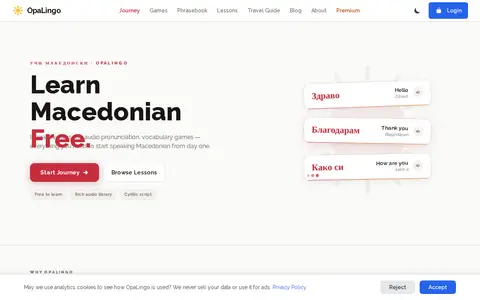
OpaLingo is a free online Macedonian language course with interactive lessons, audio pronunciation, vocabulary games and Cyrillic alphabet training. It offers a structured learning path from alphabet to conversation, with progress saved locally. Optional Premium adds extra games, learning analytics and cosmetics.
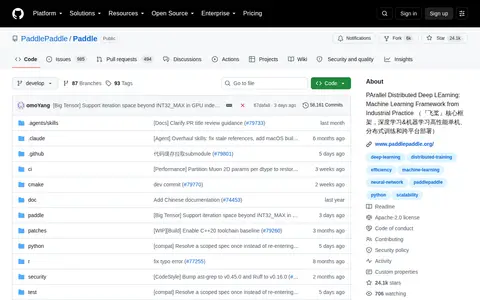
PaddlePaddle is an open-source parallel distributed deep learning framework developed from industrial practice, designed for high-performance single-machine and distributed training, as well as cross-platform deployment of deep learning and machine learning models.