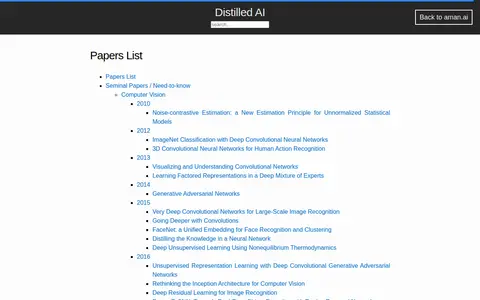

Aman's AI Journal papers list compiles seminal and need-to-know computer vision papers, organized by publication year from 2010 onward. Entries include titles such as ImageNet Classification with Deep Convolutional Neural Networks, Generative Adversarial Networks, and Deep Residual Learning for Image Recognition. The site also offers course notes and learning material for Artificial Intelligence and Deep Learning Stanford classes.
Directory
Search results
Published directory entries matching your search.
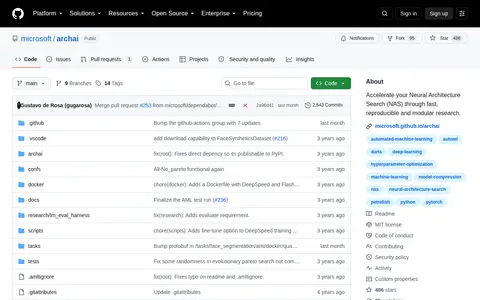
Archai is an open-source project developed by Microsoft and hosted on GitHub. It is designed to accelerate neural architecture search (NAS) research by providing fast, reproducible, and modular tooling for developing, testing, and refining new neural network architectures.
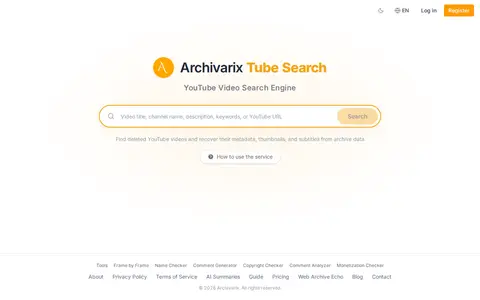
Archivarix Tube Search is a search engine for finding deleted, removed, and unavailable YouTube videos. It searches the Wayback Machine, Common Crawl, and other web archives to recover video metadata, thumbnails, subtitles, and links to archived video files. Users can search by channel, by video URL or ID, or full-text.

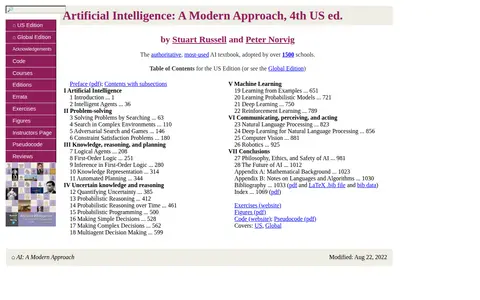
Artificial Intelligence: A Modern Approach is the official companion site for the 4th US edition of the AI textbook of the same name, authored by Stuart Russell and Peter Norvig. The textbook is the most widely used AI textbook, adopted by over 1500 schools. The site provides supporting resources including the book's table of contents, code, course materials, exercises, figures, and errata.
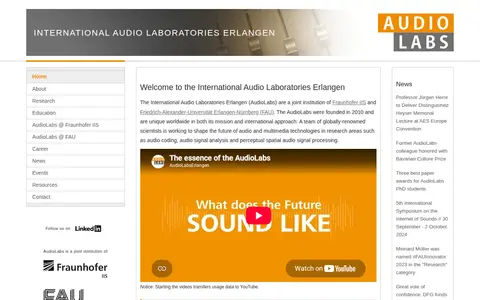
Audiolabs, formally the International Audio Laboratories Erlangen, is a joint research institution operated by Fraunhofer IIS and Friedrich-Alexander-Universität Erlangen-Nürnberg (FAU), founded in 2010. The organization conducts research in audio and multimedia technologies, with focus areas including audio coding, audio signal analysis, and perceptual spatial audio signal processing. It also hosts academic events including the International Symposium on the Internet of Sounds.
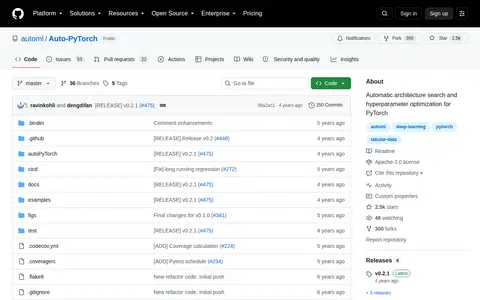
Automatic architecture search and hyperparameter optimization for PyTorch.
Awadb is an AI-native database built for working with embedding vectors. It is available as a public open-source repository on GitHub, where users can access the code, contribute to development, or deploy it locally on Mac OSX or Linux, or run it as a standalone service. The project is designed to support AI applications that rely on vector embedding functionality.
Awesome Decision Tree Papers is a GitHub-hosted open repository that collects research papers on decision trees, classification trees, and regression trees. The repository includes associated code implementations for the papers, and organizes content by publication year, with entries covering 2020, 2021, and 2022. It serves as a resource for machine learning researchers and practitioners.
An awesome list of open-source tools for systematic reviews, meta-analysis, and evidence synthesis derived from Evidence Synthesis Tools Directory. It organizes tools under categories such as literature search, text mining and NLP, screening, data extraction, risk of bias, meta-analysis statistics, and visualization and reporting.
A curated list of fraud detection papers from conferences including AAAI, CIKM, ICML, IJCAI, KDD, ICDM, and WWW. It also references similar collections about graph classification and other papers with implementations.
A curated list of Monte Carlo tree search papers with implementations, organized by conference and journal sources including NeurIPS, ICML, CVPR, ACL, AAAI, and others. The repository also links to similar collections covering graph classification, gradient boosting, and fraud detection papers.
BlockAGI conducts iterative, domain-specific research, and outputs detailed narrative reports to showcase its findings.
A site offering short, easy-to-read summaries of popular AI papers, with each explained in about five minutes. Covered papers include DALL-E 2, Latent Diffusion Models, GLIDE, Make-A-Scene, CLIP-GEN, and FILM.
A collaborative AI workspace, built on your company context. Build and orchestrate agents right alongside your team.
Chroma is open-source search infrastructure for AI under Apache 2.0. It supports vector, full-text, regex and metadata search, built on object storage. Chroma Cloud offers serverless, scalable deployment with usage-based pricing.
CiteMe is a citation generator that formats references in APA, MLA, Harvard, Chicago, and many other styles. Users paste a DOI, ISBN, URL, or title, and the tool reviews the metadata source before formatting. It searches scholarly databases such as OpenAlex, CrossRef, and PubMed. A free plan is offered, with a Pro tier adding batch PDF import and exports.
Introducing GetWhys: AI trained on firsthand experiences.
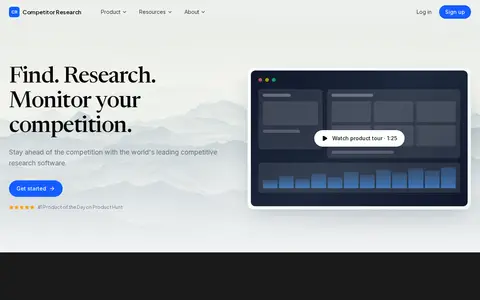
Competitor Research is a competitive research tool. It takes a website URL and produces a ranked list of competitors, which users can curate into watchlists. It provides profiles covering positioning, pricing, launches, and other data, and sends weekly signals about competitor changes. Some features, including real-time change alerts and SEO and keyword movement, are listed as coming soon.
Cosmos generates 30-second video essays from a typed idea, with sourced facts, archive pictures, a voiceover and original music. Films can be made free up to three a day, with a watermark, and a clean 1080p MP4 can be bought for $9. No credit card is required to start and there is no subscription.
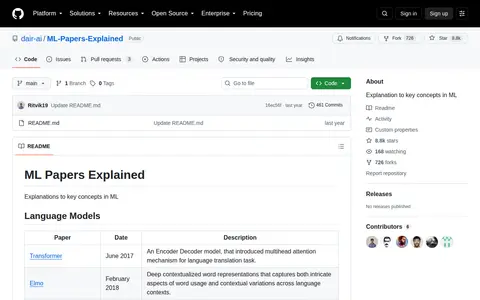
A GitHub repository from dair-ai containing explanations of key concepts in machine learning. The README lists papers with dates and descriptions, including the Transformer, Elmo, Marian MT, GPT, BERT and Transformer XL.
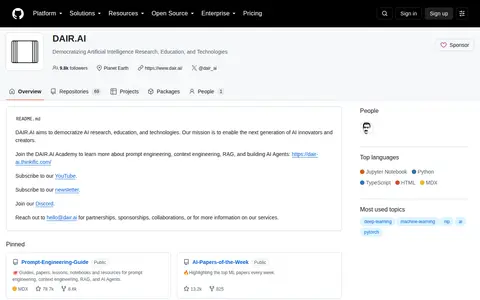
DAIR.AI is a GitHub organization that states it aims to democratize AI research, education, and technologies. Its repositories include a prompt engineering guide covering guides, papers, lessons, notebooks and resources for prompt engineering, context engineering, RAG, and AI Agents, and AI-Papers-of-the-Week, which highlights top machine learning papers each week.
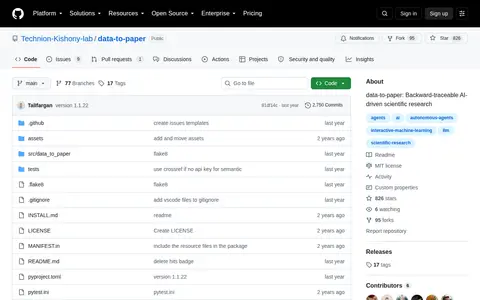
Data-to-paper: AI-driven research from data to human-verifiable research papers.
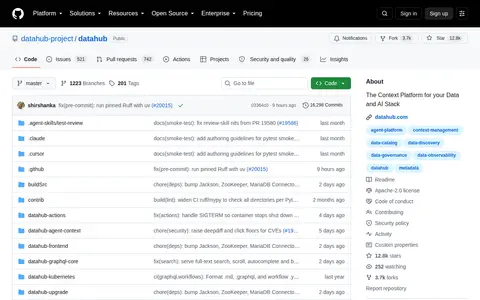
LinkedIn's generalized metadata search & discovery tool.
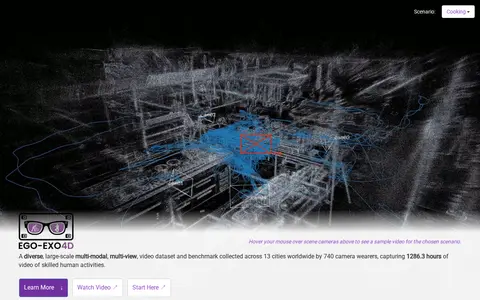
Ego-Exo4D is a large-scale multi-modal, multi-view video dataset and benchmark of simultaneously captured ego-centric and exo-centric video of skilled human activities such as sports, music, dance, and bike repair. It includes natural language datasets, multi-view capture with Aria glasses and GoPros, and benchmarks including Keystep Recognition and Proficiency Estimation.