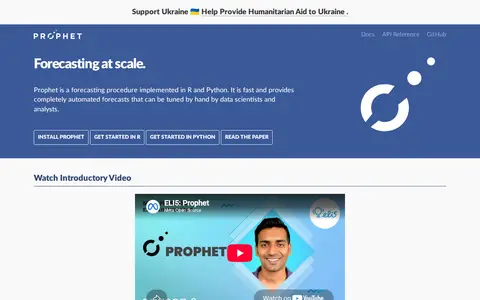

Prophet is a forecasting procedure implemented in R and Python. It provides automated forecasts that can be tuned by hand, and is based on an additive model with non-linear trends and yearly, weekly and daily seasonality plus holiday effects. Facebook released it as open source, available on CRAN and PyPI.
Directory
Search results
Published directory entries matching your search.
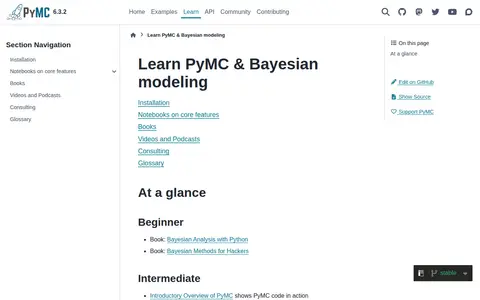
Python Library for Probabalistic Programming (Bayesian Inference and Machine Learning).
Helps find, analyze or synthesize information for research and knowledge discovery.
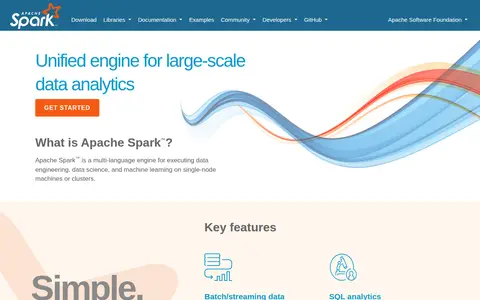
Apache Spark is a multi-language engine for executing data engineering, data science, and machine learning on single-node machines or clusters. It provides high-level APIs in Java, Scala, Python and R, and supports Spark SQL, pandas API on Spark, MLlib, GraphX and Structured Streaming. The documentation covers downloads, the shell and client applications.
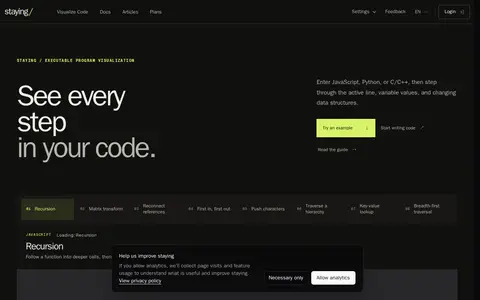
Staying is a code visualization platform for Python, JavaScript and C++. It animates execution flow, traces variables and monitors memory allocation, and offers code optimization suggestions. The documentation collects language support, data-structure examples and runnable code.
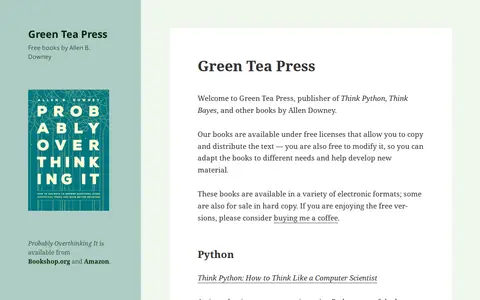
Green Tea Press is the publisher of free books by Allen B. Downey, including Think Python and Think Bayes. The books are available under free licenses that allow copying, distribution and modification, in several electronic formats, with some also sold in hard copy.
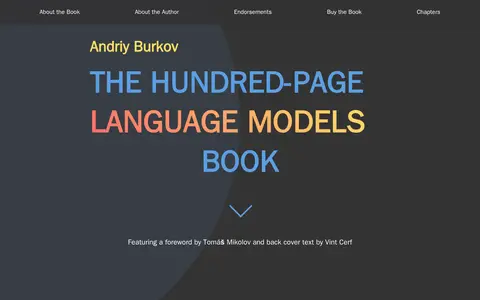
The Hundred-Page Language Models Book by Andriy Burkov is a concise hands-on guide covering machine learning basics through advanced transformer architectures and large language models. It explains AI fundamentals, text representation, count-based models, recurrent neural networks, and transformers, with mathematical foundations and Python code examples. The book targets ML practitioners and engineers building text-based applications.
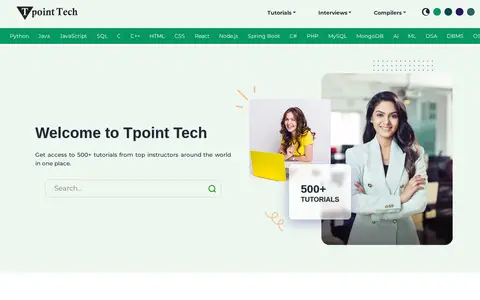
Tpoint Tech is a tutorial site offering free online tutorials and interview questions covering Java, Android, JavaScript, SQL, Python, PHP and other technology topics, aimed at beginners and professionals. It states that it provides access to more than 500 tutorials.
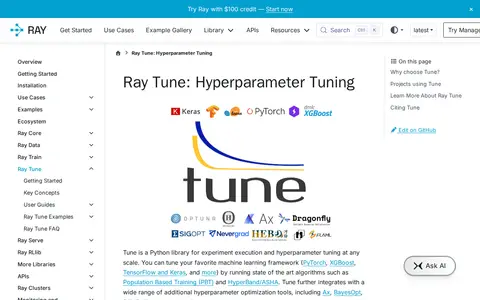
Tune is a Python library for experiment execution and hyperparameter tuning at any scale. It supports machine learning frameworks including PyTorch, XGBoost, and TensorFlow and Keras, and runs algorithms such as Population Based Training (PBT) and HyperBand/ASHA. It also integrates with hyperparameter optimization tools including Ax, BayesOpt, BOHB, Nevergrad, and Optuna.
tweetopic is a Python library for topic modelling of Tweets and other short texts. Its documentation site provides an API reference and a usage guide covering installation, the Dirichlet Multinomial Mixture Model, the Biterm Topic Model, pipelines, visualization and model persistence.
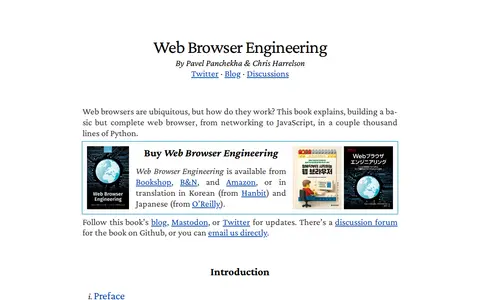
Web Browser Engineering is a book by Pavel Panchekha and Chris Harrelson that explains how web browsers work by building a basic but complete browser, from networking to JavaScript, in a couple thousand lines of Python. It is available from Bookshop, B&N and Amazon, and in Korean and Japanese translations.
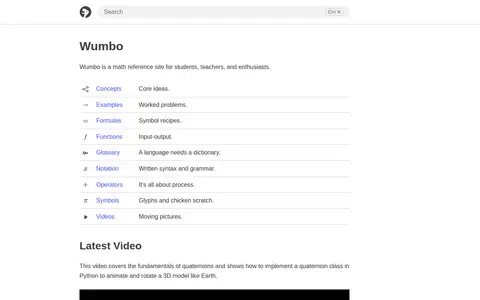
Wumbo is a math reference site for students, teachers, and enthusiasts. It organizes core concepts, worked examples, formulas, functions, a glossary, notation, operators, symbols, and videos, including a video on quaternions implemented in Python. It offers a contributing membership that funds future videos and resources.
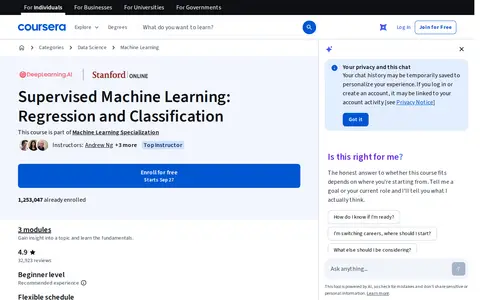
Andrew Ng’s Machine Learning at Stanford University is a Coursera course titled 'Supervised Machine Learning: Regression and Classification'. It is the first course of the Machine Learning Specialization. The course teaches how to build machine learning models in Python using NumPy and scikit-learn, covering regression and classification. It is aimed at beginners, requires flexible scheduling over three weeks at ten hours per week, and offers a shareable certificate.
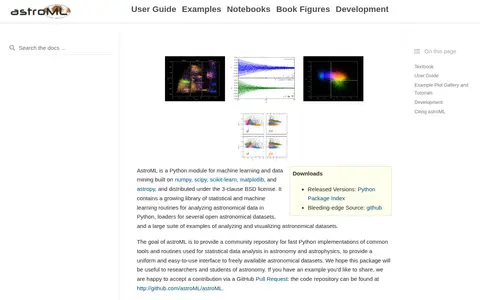
astroML is a Python module for machine learning and data mining built on numpy, scipy, scikit-learn, matplotlib and astropy, distributed under the 3-clause BSD license. It provides statistical and machine learning routines for analyzing astronomical data, loaders for open astronomical datasets, and examples of analyzing and visualizing datasets. The project was started in 2012 to accompany a textbook on statistics, data mining and machine learning in astronomy.
Python bindings for the BLLIP natural language parser.
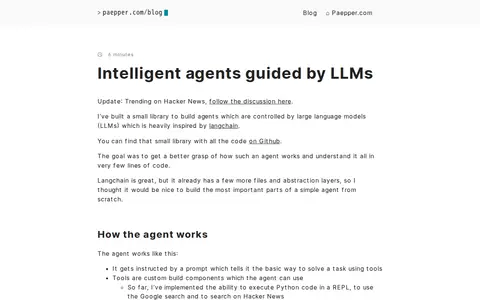
A blog post describing a small library for building agents controlled by large language models, inspired by langchain. The agent is instructed by a prompt and runs in a loop of Thought, Action and Observation. Implemented tools include executing Python code in a REPL, Google search and Hacker News search.
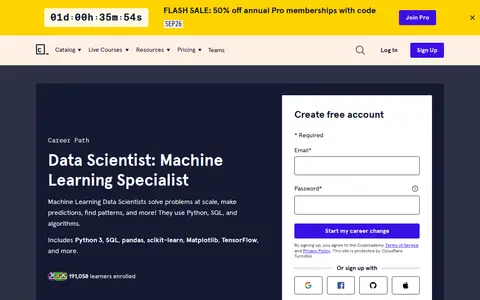
Codecademy's Data Scientist: Machine Learning Specialist Career Path is a beginner-level course covering Python 3, SQL, pandas, scikit-learn, Matplotlib, and TensorFlow. The path is listed as taking 95 hours on average and includes 59 projects with no prerequisites, and is described as teaching analysis of data, drawing predictions with machine learning, and building neural networks.
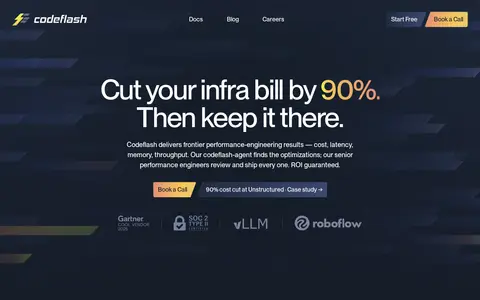
Codeflash uses AI to automatically find the most optimized version of your Python code through benchmarking — while verifying it's correct.
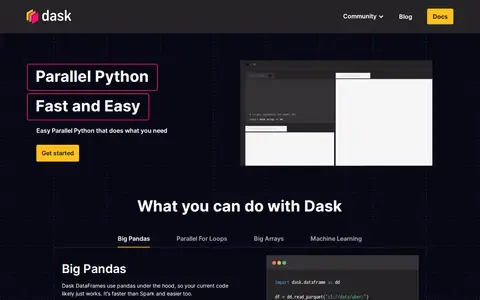
Dask is an open-source Python library for parallel computing maintained by contributors across dozens of companies. The site describes uses including Dask DataFrames for pandas, parallel for loops, large arrays with NumPy and Xarray, and machine learning. It can run on a laptop or be deployed on resource managers such as Kubernetes or cloud.
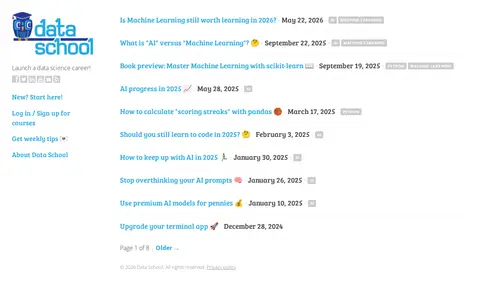
Data School is a blog about data science and machine learning. Its posts cover topics such as the difference between AI and machine learning, learning scikit-learn, AI progress, and using pandas for calculations. Posts are tagged by subject including Python, AI, and machine learning.
The Debian Wiki is a support and documentation resource for the Debian project. It is editable by everyone and offers pages including FindPage, WordIndex, TitleIndex and RecentChanges, with contact information available for the people running the wiki. The site is powered by MoinMoin and Python, with hosting provided by Metropolitan Area Network Darmstadt.
DeepLearning.ai is an educational platform led by Andrew Ng that offers online AI courses, specializations, and certifications for people learning to use and build artificial intelligence. The platform serves over 7 million learners and covers topics including AI Python, prompt engineering, generative AI, and machine learning.
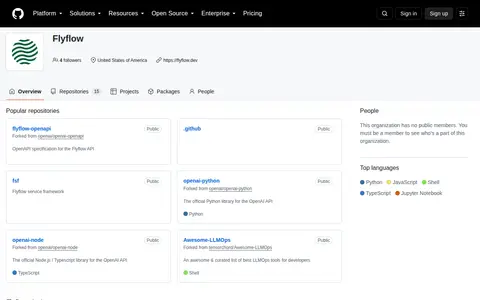
Flyflow is a GitHub organization with public repositories including an OpenAPI specification for the Flyflow API, a service framework, a Python library, and demo applications and notebooks. The organization page lists no public members.
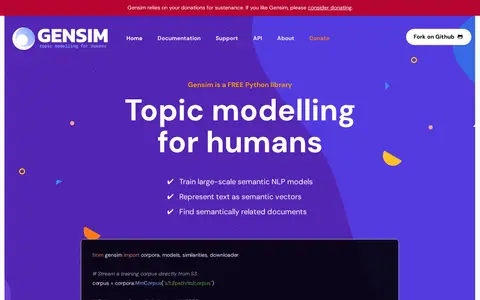
Gensim is a free open-source Python library for topic modelling and semantic NLP. It trains large-scale semantic models, represents text as semantic vectors and finds semantically related documents. The site describes streaming of arbitrarily large corpora, platform independence, and pretrained models and corpora published by the community.