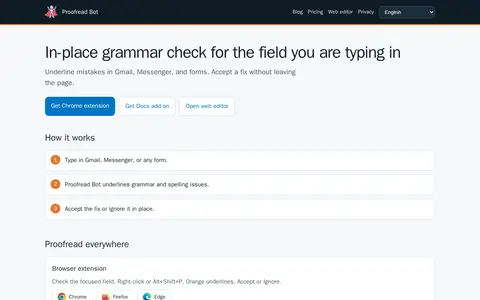
Proofread Bot is a grammar and spelling checker that works where the user types, including Gmail, Messenger, and forms. It underlines mistakes and lets users accept or ignore fixes in place, through Chrome, Firefox, Edge, Google Docs, a web editor, and mobile tools. A free tier provides a daily allowance of checks, and a Premium plan at $5/month offers unlimited checks.
Directory
Search results
Published directory entries matching your search.
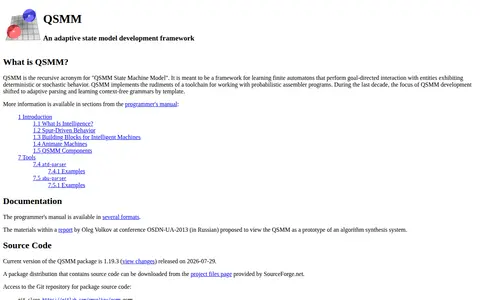
QSMM is a framework for learning finite automatons that perform goal-directed interaction with entities exhibiting deterministic or stochastic behavior. It implements the rudiments of a toolchain for working with probabilistic assembler programs, and development focus shifted to adaptive parsing and learning context-free grammars by template. It includes atd-parser and abu-parser tools.
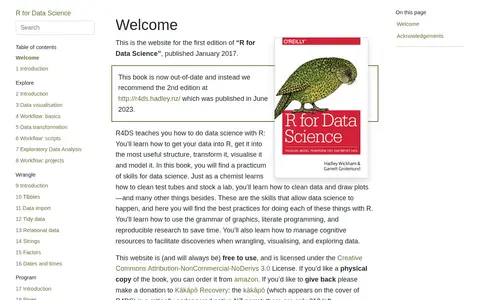
This site hosts the first edition of R for Data Science, published January 2017, a book teaching data science with R: importing data, structuring, transforming, visualising and modelling it, plus grammar of graphics, literate programming and reproducible research. The site notes the edition is out of date and points to a second edition.
Translation and language tool with context examples, grammar help, and dictionary results.
Saga AI is an AI assistant integrated into a workspace for notes, documents, and tasks. It supports drafting content, brainstorming ideas, correcting grammar, and translating text to more than 20 languages.

Sanskrit Studio is a blog offering video lessons and articles on Sanskrit grammar, including sentence construction, pronunciation and spelling in roman transliteration and Devanagari. It publishes downloadable exercise and answer sheets as PDFs next to some exercise videos, and articles on usage of individual Sanskrit words.
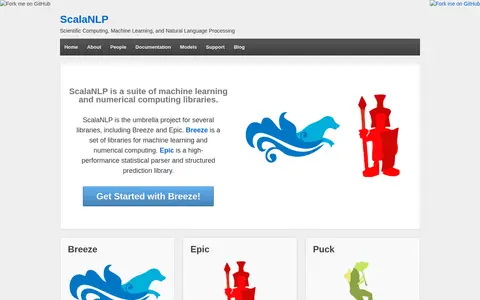
ScalaNLP is an umbrella project for machine learning and numerical computing libraries, including Breeze and Epic. Breeze covers linear algebra, numerical computing and optimization. Epic is a statistical parser and structured prediction library. The site also lists Puck, a GPU-powered parser built on grammars produced by the Berkeley Parser.
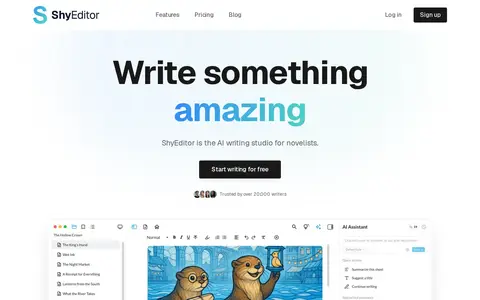
ShyEditor is an AI writing studio aimed at novelists, covering outlining, drafting and revision in one place. It offers a knowledge base for characters, places and events, story-aware AI suggestions, and chapter or full-manuscript critiques. It also provides grammar checking, bibliographies, version control, stats and export presets. A free plan is available.
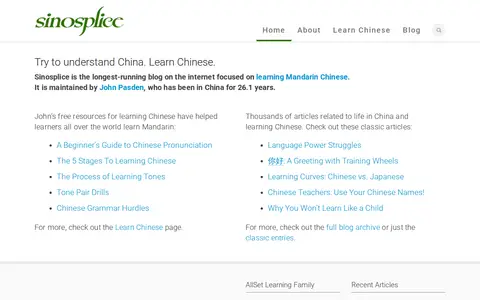
Sinosplice is a blog focused on learning Mandarin Chinese, maintained by John Pasden. It offers free resources including a beginner's guide to Chinese pronunciation, a guide to the five stages of learning Chinese, material on learning tones, tone pair drills and Chinese grammar hurdles, alongside articles about life in China.
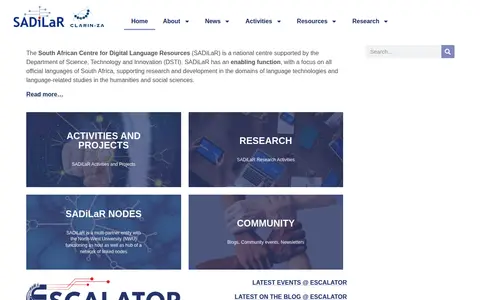
The South African Centre for Digital Language Resources (SADiLaR) is an organization focused on advancing digital language resources for African languages. It hosts a range of resources including the African Language Grammar Portal, Lwimilinks, Autshumato machine translation tools, NCHLT text services, and spelling checkers for South African languages. The centre runs initiatives including DH-IGNITE, ESCALATOR, SWiP and HESSP, offers workshops, and develops linguistic resources and terminology including the African Wordnet.
StudySpanish is a Spanish-learning resource offering beginner, intermediate and advanced Spanish courses, along with free tutorials on pronunciation, grammar, vocabulary and verbs. It also provides a daily word, podcasts, cultural notes, a travel helper and a directory of Spanish schools, with a free membership option.
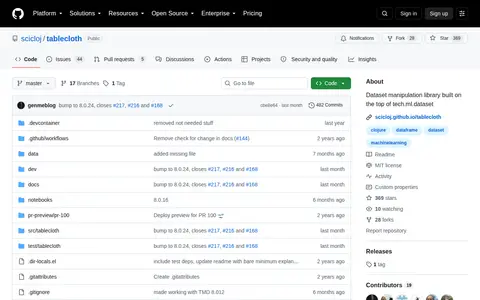
A dataframe grammar wrapping tech.ml.dataset, inspired by several R libraries.
The tidyverse is an opinionated collection of R packages intended for data science. The packages share an underlying design philosophy, grammar, and data structures, and the complete set can be installed with one R command.
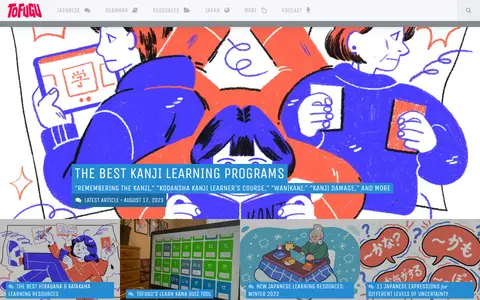
Tofugu is a Japanese culture and language blog. It publishes articles on Japanese learning topics, including kanji learning programs, kana resources, grammar differences and vocabulary, along with curated content and seasonal lists of new Japanese learning resources.
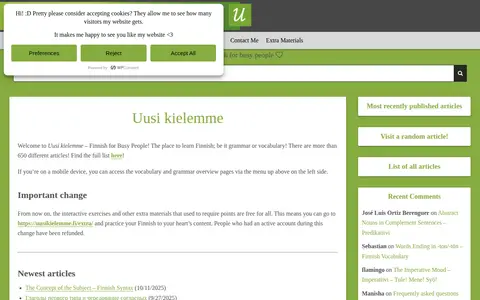
A website offering detailed descriptions and explanations of Finnish vocabulary and grammar, with more than 650 articles. It has been online since 2007 and is written by a non-native learner of Finnish. Interactive exercises and extra materials formerly requiring points are free.
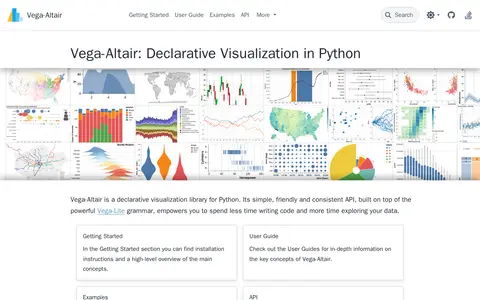
Vega-Altair is a declarative visualization library for Python with a simple, friendly and consistent API built on the Vega-Lite grammar. The project states it is not affiliated with Altair Engineering, Inc.
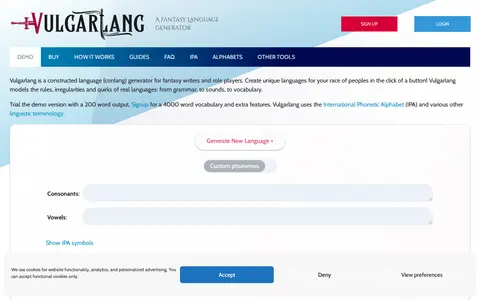
Vulgarlang is a constructed language (conlang) generator for fantasy writers and role players. It models the rules, irregularities and quirks of real languages, from grammar to sounds to vocabulary. A demo version offers a 200 word output, and a signup provides a 4000 word vocabulary and extra features.
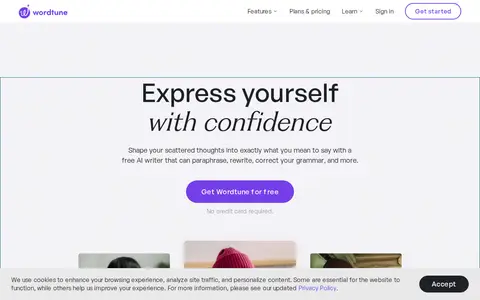
Wordtune is an AI writing assistant that helps users rewrite, paraphrase and refine text, adjust tone between casual and formal, correct spelling and grammar, and continue writing from existing text. It also offers translation intended to make writing sound like native English, plus a smart synonym generator. Free, Advanced and Unlimited plans are listed.
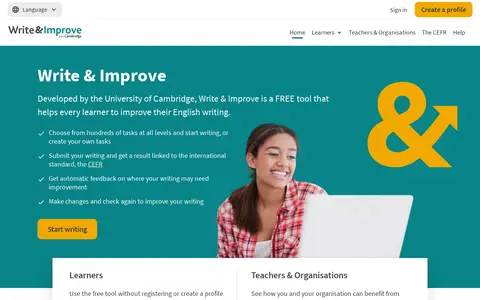
Write & Improve is a free service from the University of Cambridge for learners of English to practise written English. Users submit written work and receive feedback within seconds on spelling, vocabulary, grammar, and general style. It offers hundreds of tasks at all levels, and results are linked to the CEFR.
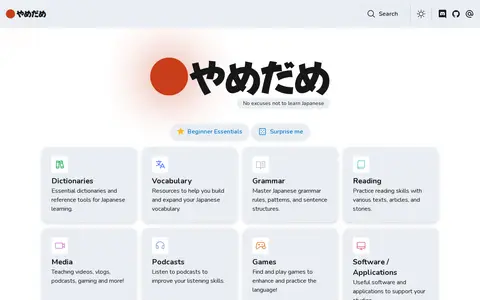
A list of Japanese learning resources for beginners and advanced learners, covering dictionaries, vocabulary, grammar, reading, media, podcasts, games, software and an encyclopedia. Some sections are marked as coming soon.
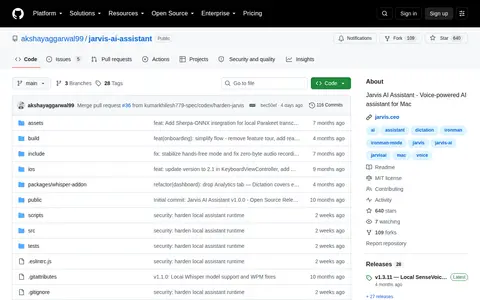
Jarvis AI Assistant is a voice dictation application for Mac that transcribes speech into text. It removes filler words, fixes grammar and supports local transcription with Whisper or Parakeet and local LLMs via Ollama, or cloud services. It is released under the MIT license and is described as open-source and local-capable.