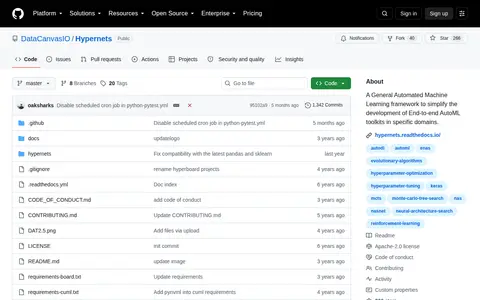

Hypernets is a general AutoML framework for building automatic optimization tools for machine learning frameworks and libraries, including tensorflow, keras, pytorch, sklearn, lightgbm and xgboost. It offers an abstract search space representation covering hyperparameter optimization and neural architecture search, with optimization algorithms such as evolution algorithm and Monte Carlo tree search.
Directory
Search results
Published directory entries matching your search.

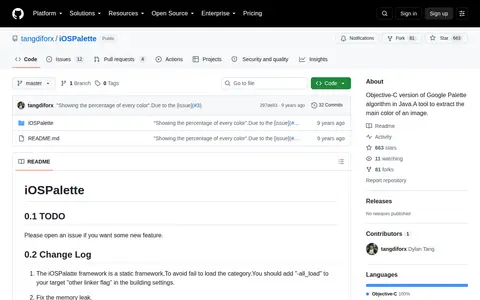
Objective-C version of Google Palette algorithm in Java.A tool to extract the main color of an image.
KerasTuner is a hyperparameter optimization framework for Keras. It provides a define-by-run syntax for configuring search spaces and includes Bayesian Optimization, Hyperband and Random Search algorithms. It requires Python 3.8+ and TensorFlow 2.0+.
JavaScript implementation of the k nearest neighbors algorithm for supervised learning.
Just a simple implementation of K-Nearest Neighbors algorithm using with a bunch of similarity measures.
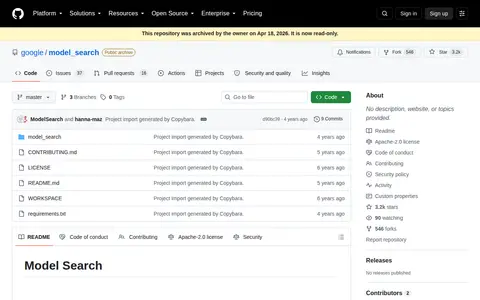
Open-source project that provides machine-learning models, research, training resources, or evaluation tools.
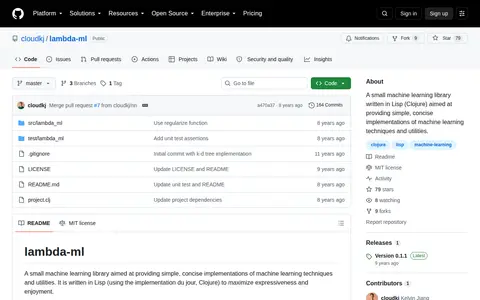
lambda-ml is a small machine learning library written in Lisp, specifically Clojure, aimed at simple, concise implementations of machine learning techniques and utilities. It covers supervised algorithms such as neural networks, decision trees, ensemble methods, k-nearest neighbors, linear and logistic regression, naive Bayes and random forest, plus unsupervised methods including DBSCAN, hierarchical clustering, k-means and non-negative matrix factorization.
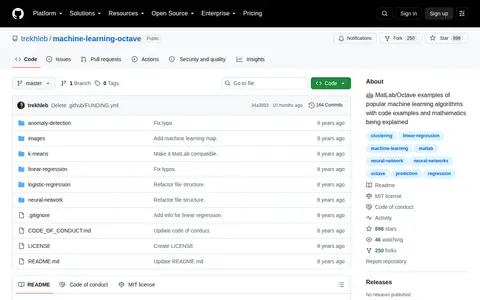
Machine Learning in MatLab/Octave is a collection of MatLab/Octave implementations of popular machine learning algorithms, including code examples and explanations of the associated mathematics. It covers supervised learning tasks such as regression and classification as well as unsupervised learning.
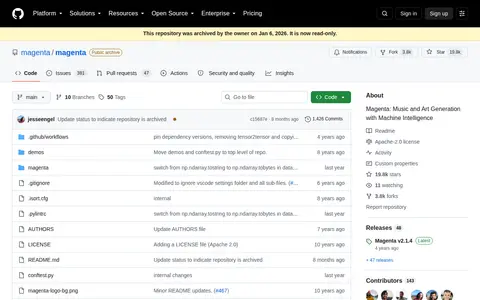
Magenta is a research project exploring machine learning in art and music creation, developing deep learning and reinforcement learning algorithms for generating songs, images, and drawings. It also explores tools letting artists and musicians extend their processes with these models. The repository is archived and read-only.
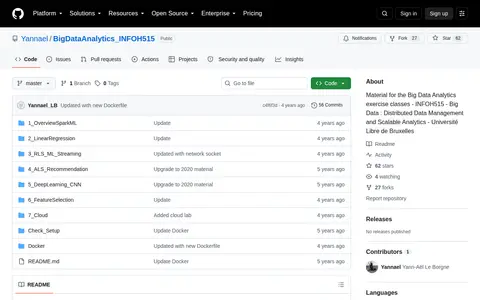
A repository of material for the exercise classes of a Big Data Analytics master course. Hands-on sessions cover Spark and its machine learning library, Map/Reduce implementations of linear regression and alternating least squares, streaming analytics with Recursive Least Squares, and image classification with convolutional neural networks. Material is provided as Jupyter notebooks.
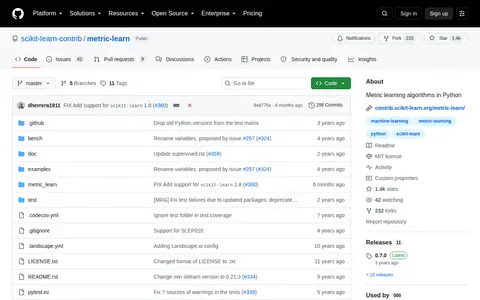
Metric Learning Algorithms in Python.
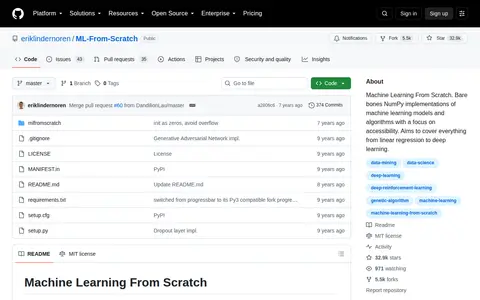
ML-From-Scratch is a GitHub repository that provides bare bones NumPy implementations of machine learning models and algorithms with a focus on accessibility, aiming to cover methods from linear regression to deep learning.
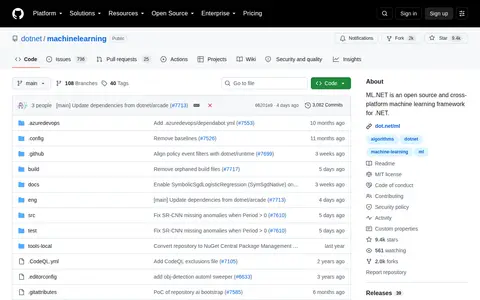
ML.NET is an open source, cross-platform machine learning framework for .NET. It lets developers build, train, deploy and consume custom models in .NET applications, with data loading from files and databases, data transformations and many ML algorithms. Models can be trained for scenarios such as classification, forecasting and anomaly detection, and TensorFlow and ONNX models can be consumed within the framework.
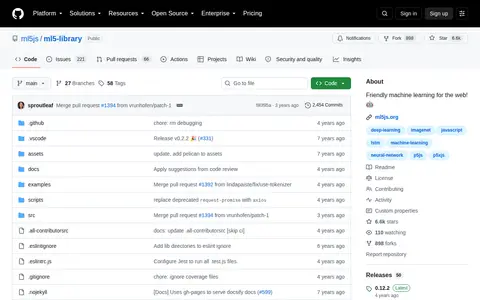
ml5.js is a JavaScript library providing access to machine learning algorithms and models in the browser, building on TensorFlow.js. It aims to make machine learning approachable for artists, creative coders and students, and is supported by code examples, tutorials and sample data sets. The project is described as currently in development.
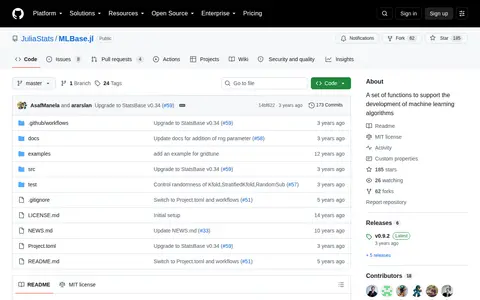
MLBase (MLBase.jl) is a Julia package hosted in the JuliaStats/MLBase.jl GitHub repository, providing a collection of functions to support the development of machine learning algorithms. It includes accompanying resources and documentation for package users.
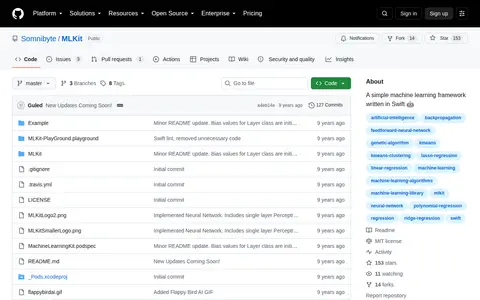
MLKit is a simple machine learning framework written in Swift. Currently it features algorithms dealing with regression, with planned expansion to classification, clustering, recommender systems and deep learning. The project is under active development and is not ready for use in commercial or personal projects, and can be installed via CocoaPods as MachineLearningKit.
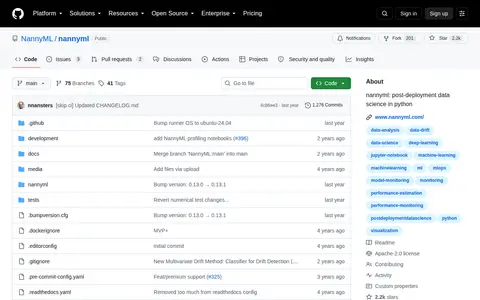
Framework that implements AutoML algorithms for model architecture search at scale.
Algorithm capable of fully capturing the impact of data drift on performance.
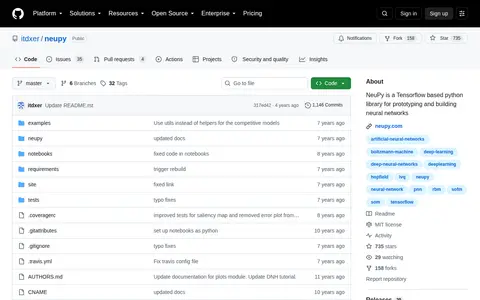
NeuPy is a Python library built on Tensorflow for prototyping and building neural networks. The repository notes that the library is no longer actively maintained. It includes examples and notebooks covering algorithms such as Boltzmann machines and self-organizing maps.
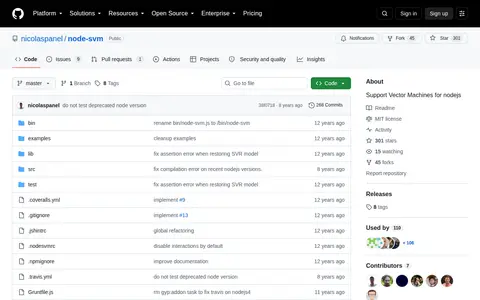
Node-SVM is a GitHub repository that provides support vector machine (SVM) implementations for Node.js. The project enables developers to use SVM algorithms within JavaScript applications. It includes installation instructions, a quick start guide, and an API reference. The repository is open source and contributed to by the community.
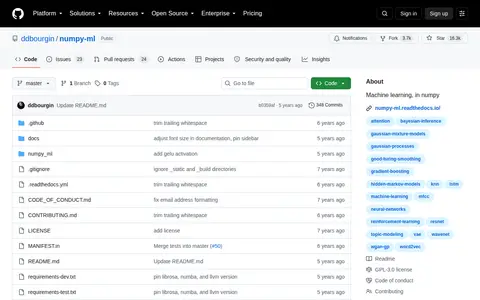
numpy-ML is a GitHub-hosted library that implements various machine learning algorithms using only NumPy. The project emphasizes rapid experimentation and can be used as a package. It covers a range of ML methods and includes documentation for users. The repository is open source and welcomes contributions.
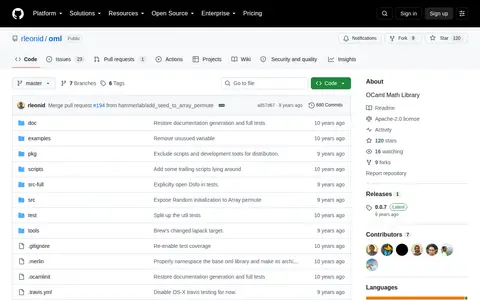
Oml is an OCaml math library that collects OCaml math and statistics functions. It aims for a descriptive, simple and typed approach to algorithms. A superset, Oml_full, includes C and Fortran dependencies such as Lacaml and LBFGS.
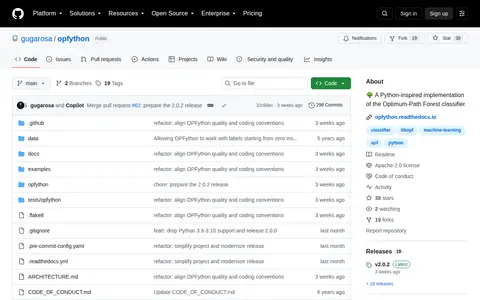
OPFython is a GitHub repository offering a Python-inspired implementation of the Optimum-Path Forest classifier. The library enables classification tasks using the optimum-path forest algorithm. It includes installation instructions, quick start guides, and classifier documentation. The project is open source and welcomes contributions from the community.
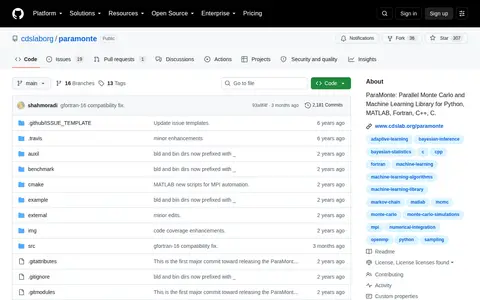
ParaMonte is a serial and parallel library of Monte Carlo routines for sampling mathematical density functions of arbitrary dimensions and machine learning algorithms for scientific inference. It is designed for interoperability with C, C++, Fortran, MATLAB and Python, and supports shared-memory OpenMP threads and MPI distributed communications.