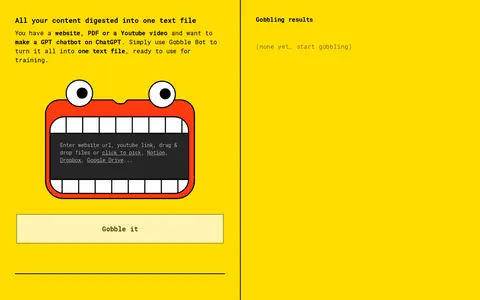
A scraper that converts varied content into a single text file for training custom ChatGPT chatbots. It handles YouTube transcriptions, public websites and many file formats, processing data on the device. It is a free weekend project with some known limitations.
Directory
Search results
Published directory entries matching your search.
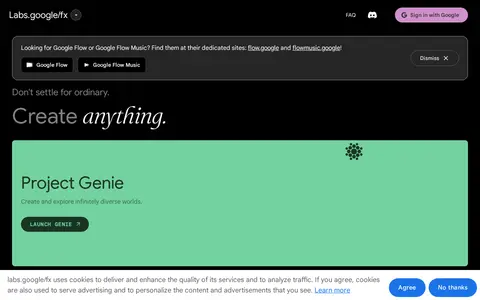
Google Labs FX is the official hub for AI experiments from Google. As of the listing snapshot, its primary featured project is Project Genie, a tool for creating and exploring infinitely diverse worlds. It also notes that related Google Flow and Google Flow Music products are hosted at separate dedicated sites.
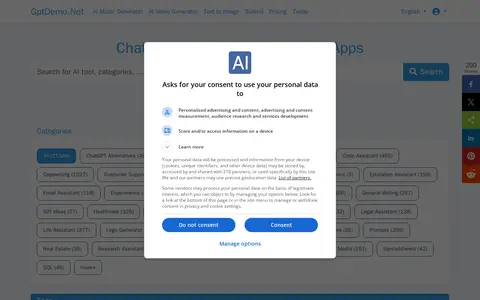
GptDemo.Net is a website that collects AI tools and displays them by category, with a catalog spanning thousands of entries. The listing shows a search or filter results page for free tools sorted by popularity, covering categories such as writing, image, video and code assistants.
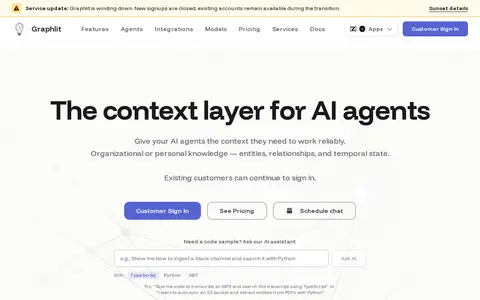
Graphlit is a context layer for AI agents. It provides real-time synchronization across services including Slack, GitHub, and Jira, operates via a single API with no operations overhead, and includes built-in semantic search.
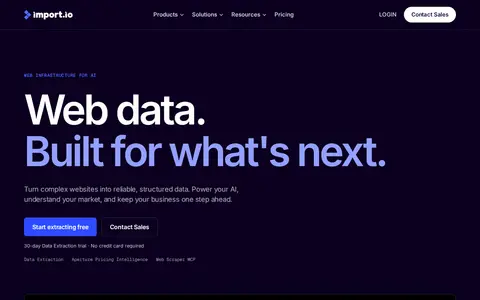
Import.io is a web data extraction and AI infrastructure platform. It converts website content into structured data, and provides web scraping tools, managed data services, pricing intelligence, and MCP tools for AI agents. It supports use cases across multiple industries including retail, ecommerce and AI development.
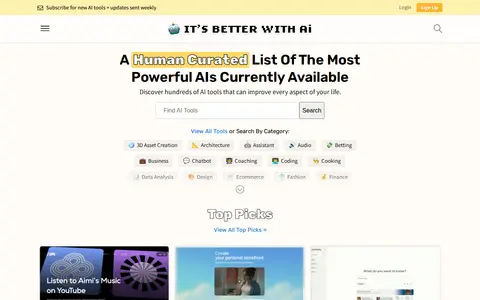
It's Better With AI is a human-curated directory of AI tools organized by categories such as coding, image generation, writing and summarization. The site lists tools with brief descriptions and starting prices, and offers a weekly newsletter for new AI tools and updates. It includes a submission page and a contact page for a human.
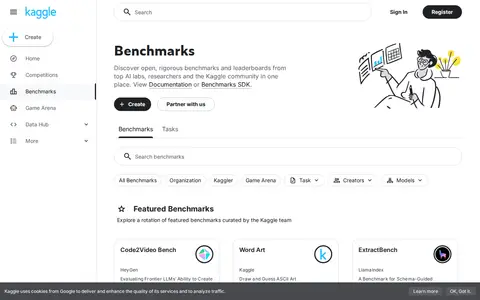
Kaggle Benchmarks is a Kaggle feature that allows the AI research community to build, run, and share benchmarks for evaluating artificial intelligence models and agents. All benchmarks are crowdsourced by the global AI research community.
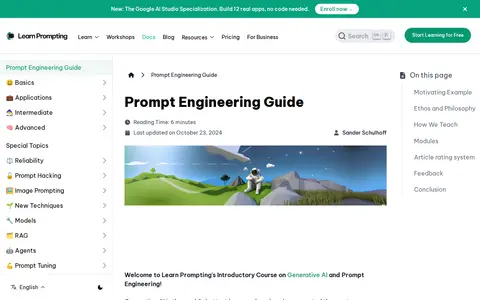
LearnPrompting is a free educational resource focused on generative AI and prompt engineering. It provides a comprehensive guide suitable for both beginners and advanced users, with structured courses, modular learning content, specialized topics including prompt hacking and image prompting, and supplementary resources such as a vocabulary guide and community support.
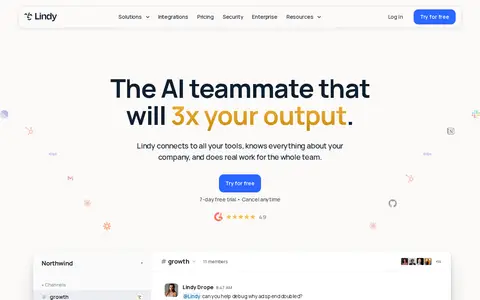
Lindy is described as an AI employee that connects to tools and performs work for a team. The page lists integrations with services such as Gmail, Slack and Notion and mentions skills for research, data analysis, decks and dashboards. According to the pricing page, the Team plan starts at $29.99 per month and includes 3,000 credits every month.
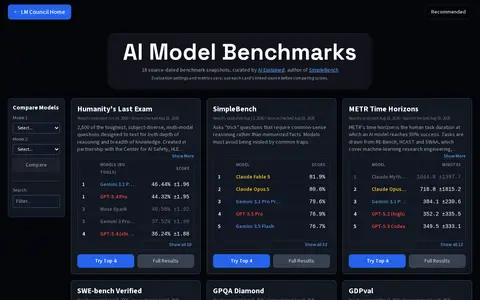
LM Council presents source-dated benchmark snapshots for AI models. It covers GPT, Claude, Gemini and other frontier models across benchmarks including Humanity's Last Exam, FrontierMath, GPQA and SWE-bench, with a comparison tool selecting two models. Each snapshot links its source and checked date, and evaluation settings and metrics vary.
Lutra AI is a productivity agent platform that connects to work applications and services to build custom automations. It supports integration standards including MCP, REST, and OpenAPI, with use cases such as contact enrichment, data extraction, and email campaign assistance.

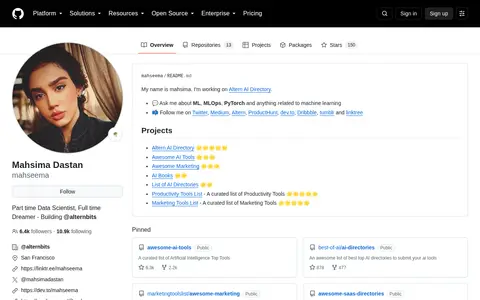
GitHub profile of Mahsima Dastan, a part-time data scientist who states work on the Altern AI Directory. The profile lists pinned repositories with curated lists of AI tools, AI directories, marketing tools, SaaS directories and AI books.
Marblism offers AI employee services to support and scale business operations. Its AI tools are built to handle a range of common business tasks including inbox management, social media management, search engine optimization, lead generation, phone calls, and customer support. The service provides a free starting option for new users to test its features.
Microsoft Azure for Students offers access to cloud services, developer tools and $100 in Azure credits for students to build apps and explore AI and data science. Signup uses a school email, renews yearly while the user is a student, and does not require a credit card.

Neon is a serverless backend platform built on Lakebase Postgres, offering Postgres databases with branching and autoscaling alongside authentication, object storage, functions and an AI gateway. Environments can be created and branched via MCP, CLI and SDK, and services are described as instant, branchable and agent-ready.
ngrok is developer infrastructure that routes and secures traffic to apps, APIs and AI models wherever they run, from localhost to production. It offers an AI Gateway, a gateway to services running anywhere, and localhost sharing. It provides a REST-style API at https://api.ngrok.com, plus client libraries, a CLI and a Terraform provider. A guide covers exposing a local MCP server with a stable public HTTPS URL secured by Traffic Policy.
Nohat is a site described by its operator as intended to create something useful for content creators. Its AI Editor page lists tools including background removal, upscaling, relighting and Photosoft. The operator states that most tools are free and paid services are very cheap.
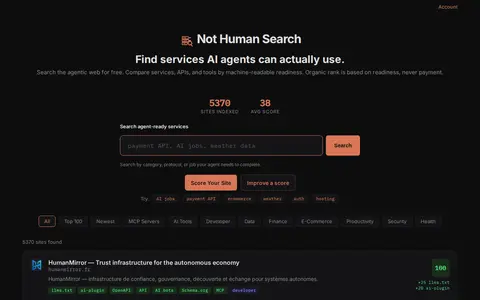
Not Human Search scores websites from 0 to 100 on seven agentic signals, including llms.txt, OpenAPI, MCP and Schema.org. It also indexes agent-ready sites and lets users search for services, APIs and tools by machine-readable readiness. Organic rank is said to be based on readiness rather than payment.
OpenRouterTeam is the GitHub organization behind OpenRouter, described as a unified interface for LLMs. The organization publishes open source SDKs for TypeScript, Python and Go, plus agent tooling, and maintains the Mintlify-hosted documentation repository for openrouter.ai/docs.
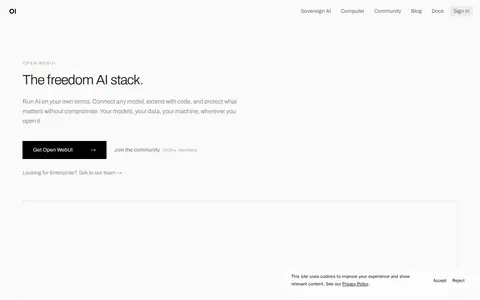
Open WebUI is a self-hosted AI interface for running AI on the user's own hardware. It connects to local or cloud models including Ollama, OpenAI, Anthropic, or compatible services, and can be extended with Python. The project offers community-shared prompts, models, tools, and functions, and lists deployment options including on-premises or air-gapped setups. Installation can be done with a pip command.
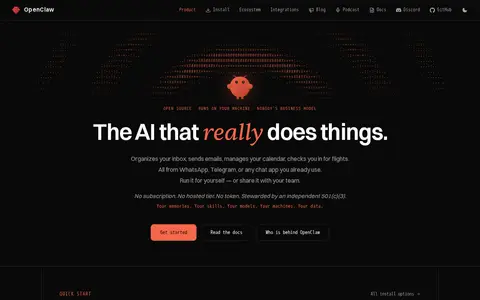
OpenClaw is an open-source AI assistant that runs on the user's machine and works from WhatsApp, Telegram or other chat apps. According to the site, it organizes inboxes, sends emails, manages calendars and checks users in for flights. Desktop apps are listed for macOS, Windows and Linux, and an enterprise platform is in development ahead of a 1.0 release.
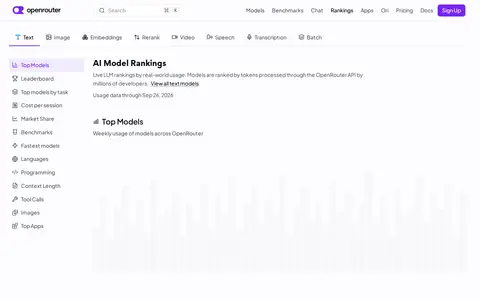
OpenRouter hosts an LLM ranking and AI leaderboard that ranks large language models by real-world usage metrics, specifically the volume of tokens processed through the OpenRouter API. It is intended to show which AI models are most widely used by developers.
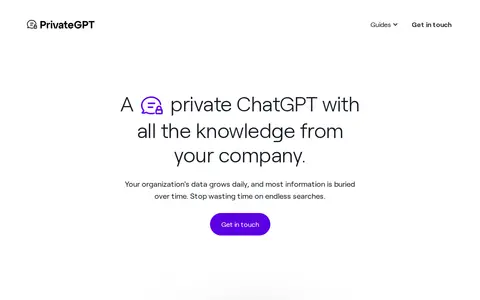
PrivateGPT is a private AI tool that connects an organization's own data sources and answers questions in natural language. It links services such as Notion, JIRA, Slack and Github to retrieve company knowledge, and people receive answers only about information they are permitted to access. A live demo is offered.
Privatiser anonymizes IPs, API keys, passwords, PII and cloud identifiers before text is pasted into AI tools. It runs in the browser with local processing, preserves structure, and offers a reversible mapping to restore values in replies. It is free and open source.