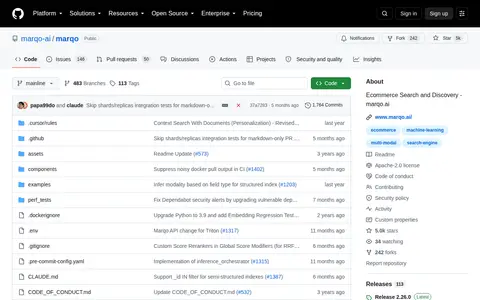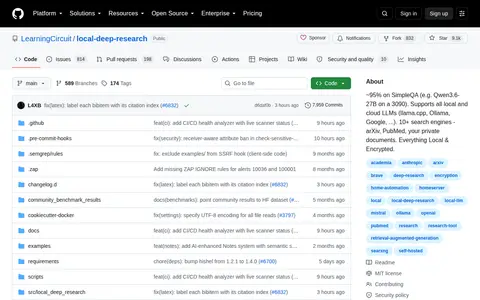

Local Deep Research is a tool that achieves approximately 95% accuracy on the SimpleQA benchmark, with an example run using Qwen3.6-27B on an RTX 3090. It supports all local and cloud LLMs including llama.cpp, Ollama, and Google models, integrates over 10 search engines such as arXiv, PubMed, and private document sources, and operates with local and encrypted processing.
Directory
Search results
Published directory entries matching your search.
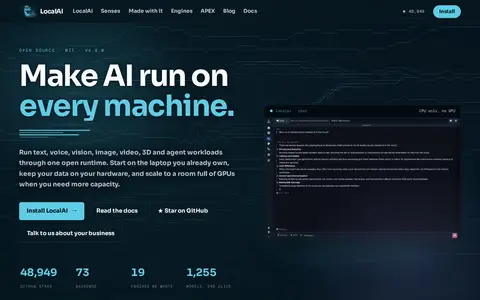
LocalAI is described as an open source AI engine that runs models, including LLMs, vision, voice, image and video, on any hardware without a GPU. It presents itself as a drop-in replacement for most upstream APIs and includes a built-in agent platform powered by LocalAGI, whose agents can reason, use tools and maintain memory. Image generation with Stable diffusion on CPU is also supported.
LoLLMs, described as the Lord of Large Language and Multimodal Systems, is a local AI tool for running models. It states full local execution and hardware support for NVIDIA, AMD, Apple Silicon or CPU. It is offered for Windows, Linux and macOS.
LongCat provides conversational AI for questions, tasks, and general assistance.
Collection of infrastructure and tools for research in neural network interpretability.
Lumiverse provides conversational AI for questions, tasks, and general assistance.
Luthor uses AI to draft, edit, summarize, or adapt written content.
Open-source pipeline for rewriting AI-generated text into natural human prose. The repository documents a structure-first data pipeline that builds SFT and KTO training data for an AI-to-human rewrite model, with training data construction described in its docs.
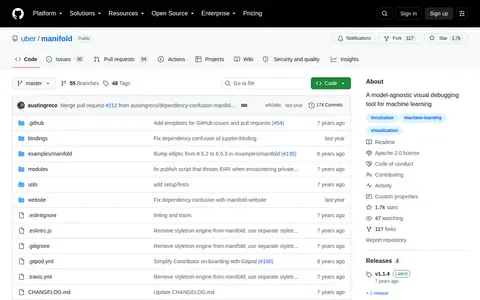
A model-agnostic visual debugging tool for machine learning.
Manuskript is an open-source writing tool for writers. It offers an outliner for organizing thoughts hierarchically, a distraction-free mode with word-count or time goals, and a novel assistant that uses the snowflake method. It includes tools for characters, plots and world-building. The page states the software is still in development and in need of extensive testing.

Creates, rewrites or summarizes written content with language models.

Open-source project that provides conversational AI for questions, tasks, and general assistance.
Helps find, analyze or synthesize information for research and knowledge discovery.
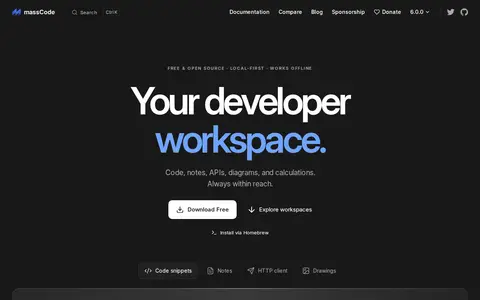
massCode is a free and open-source developer workspace for code snippets, Markdown notes, HTTP requests, calculations, and quick developer utilities. It is a local-first desktop app organized into Spaces, with a built-in AI assistant that connects to a user's own AI provider or a local model.
Matt Harrison is a personal blog authored by Matt Harrison. The blog covers topics including Amazon book piracy, the Effective Pandas book, Python and data science courses, and general software development content.
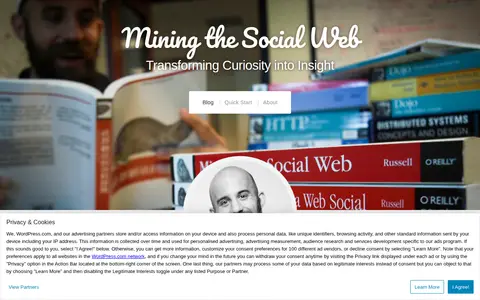
Mining the Social Web is a technical manual focused on social web analysis, being overhauled for a third edition as of 2019 by Matthew Russell and co-author Mikhail Klassen. The project originated at PyCon 2016 in Portland, Oregon.
MaxVideoAI is a pay-as-you-go AI video generator that lets users compare models such as Seedance, Kling, Veo, LTX, Wan and Pika before generating, with pricing shown upfront. An MCP integration connects compatible assistants and automation tools to the models, credits and private media library of a MaxVideoAI account for quotes, approvals and results.
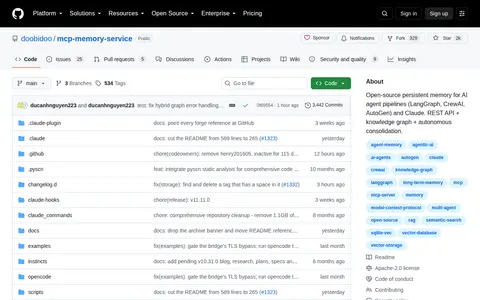
MCP Memory Service is an open-source tool that provides persistent memory for AI agent pipelines including LangGraph, CrewAI, AutoGen and Claude, with a REST API, knowledge graph and autonomous consolidation functionality.
Massachusetts College of Pharmacy and Health Sciences (MCPHS) is a life sciences and healthcare university offering in-person and online undergraduate and graduate programs. Its academic offerings include nursing, occupational therapy, optometry, physician assistant studies, pharmacy and premedical health sciences.
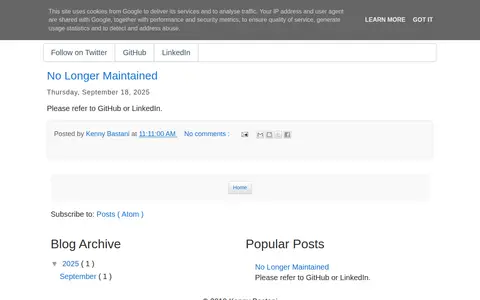
Meaning of is the personal blog of Kenny Bastani, covering open source software, graph databases, cloud native architectures, information theory, artificial intelligence, and machine learning. As of September 18, 2025, the blog is no longer maintained, with readers directed to the author's GitHub or LinkedIn profiles.
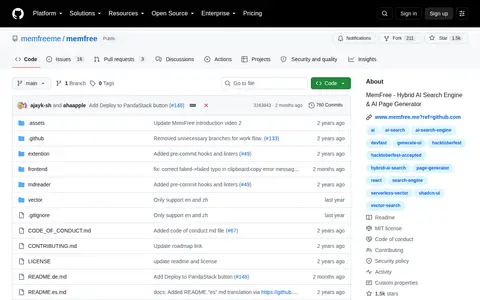
MemFree is a hybrid AI search engine and AI page generator. It provides accurate answers sourced from the internet and a user's personal knowledge base. It supports multiple AI models, search engines, and input formats including text, images, and local files. It can generate production-ready user interface pages from text or image inputs in seconds.
A blog and article site by Meta S. Brown about predictive analytics. It addresses executives, business analysts, IT staff and data analysts, describing how each group can understand analytics, work with analysts, and communicate technical topics to decision makers.
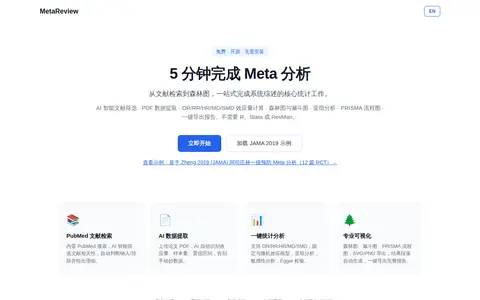
MetaReview is a free, open-source online meta-analysis tool that combines PubMed literature search, AI screening and data extraction, effect-size calculation for OR/RR/HR/MD/SMD, forest and funnel plots, subgroup and sensitivity analysis, PRISMA flow diagrams and report export. It runs in the browser without R, Stata or RevMan. A comparison page states the tool is free.
Metorial is an agentic infrastructure platform for AI-native companies. It provides a single unified platform for employees, AI agents, and AI clients to connect tools and skills, with built-in governance, access control, and tracing capabilities. The platform supports development of customer-facing agents, internal assistants, and scalable AI workforces.