
an0ncer.github.io
Tunime is a non-English technical, learning, or open source resource for regional audiences.
Directory
Published directory entries matching your search.
Tunime is a non-English technical, learning, or open source resource for regional audiences.

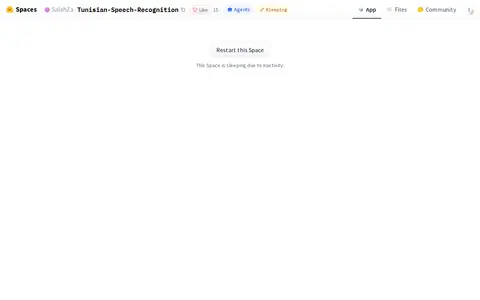
Tunisian Speech Recognition is a Hugging Face Space created by SalahZa. The application transcribes spoken Tunisian Arabic into text using Arabic characters. Users can provide input audio either by recording through a microphone or uploading an audio file, and the tool returns the corresponding text transcription.
Tunity is a mobile application that lets users hear live audio from muted televisions. It uses computer vision technology to identify a live video stream and its timing, then syncs the channel's audio to the user's mobile device. The site lists bars, restaurants, gyms, universities, waiting rooms, doctor's offices and airports among its uses.

TunnlTo is a privacy tool for blocking ads, trackers, popups, proxies, or unwanted web behavior.

A simple guide to fine-tuning Llama 2 Brev docs provides machine-learning models, research, training resources, or evaluation tools.
Al-Fajr publishes newspaper reporting, headlines and current-affairs coverage in Tunisia.

Assabah publishes newspaper reporting, headlines and current-affairs coverage in Tunisia.

Attariq Al-Jadid publishes newspaper reporting, headlines and current-affairs coverage in Tunisia.

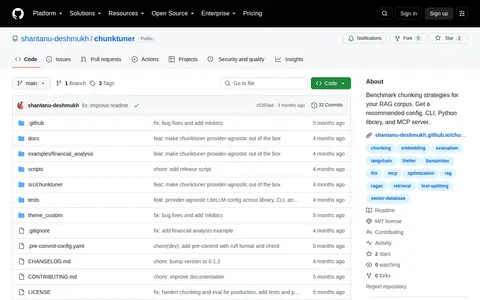
Chunk Tuner is a tool that benchmarks chunking strategies for a RAG corpus and recommends a configuration. It benchmarks strategies such as fixed-token windows, recursive character splitting, semantic splitting and PDF structural chunking, scoring each against retrieval metrics. It is available as a Python library, a CLI and an MCP server.

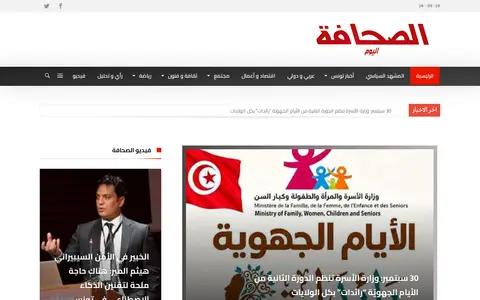
Essahafa publishes newspaper reporting, headlines and current-affairs coverage in Tunisia.

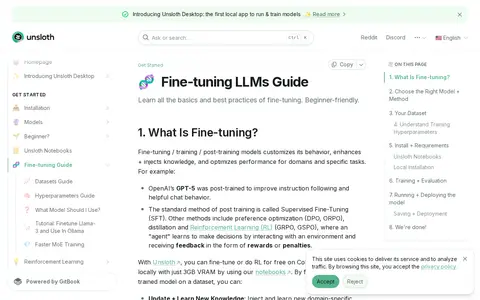
Documentation for Fine Tuning Guide, covering setup, features, and practical usage.

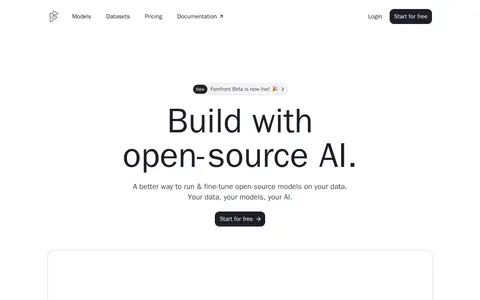
Forefront is described as a platform to fine-tune and inference open-source language models. The site mentions building with open-source AI, fine-tuning models on data, and running inference through serverless API endpoints. It also describes storing training, validation and evaluation data in ready-to-fine-tune datasets. Pricing lists a free tier and a team plan at $99 per month, each including $20 in free credits.

HappyHardcore.com is a forum-based site for happy hardcore music, news, tunes and information. Its boards cover hardcore discussion, track ID requests, music production and gear, buying and selling tunes, rumors, and hardcore events in the UK, Ireland, North America, Australia and New Zealand. Music boards ask users not to post links to, request MP3 files or discuss file swapping programs.

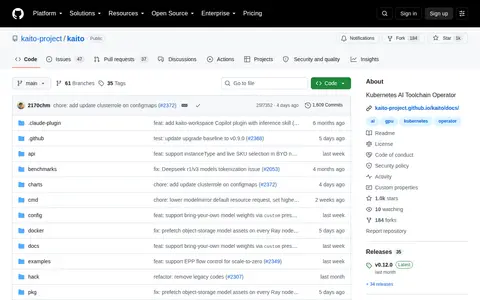
Kaito is the Kubernetes AI Toolchain Operator, an operator suite that automates LLM inference, fine-tuning and RAG engine deployment in a Kubernetes cluster. It simplifies the CRD API and provides optimized preset configurations for inference engine scheduling parameters. Workspaces are the basic CRD for managing inference and tuning workloads, and all vLLM-supported models can be run.

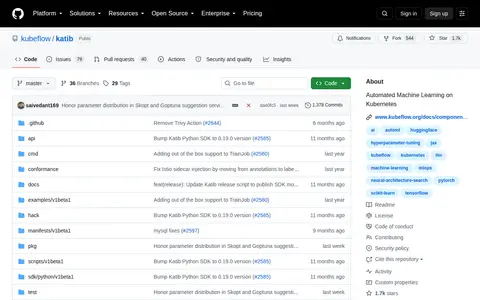
Kubeflow Katib is a Kubernetes-native project for automated machine learning (AutoML). It supports hyperparameter tuning, early stopping and neural architecture search, and is agnostic to machine learning frameworks, natively supporting frameworks such as TensorFlow, PyTorch and XGBoost. Training jobs can use any Kubernetes Custom Resources, with out-of-box support for Kubeflow Training Operator, Argo Workflows and Tekton Pipelines. A Python SDK simplifies creating tuning jobs.

La Presse de Tunisie publishes newspaper reporting, headlines and current-affairs coverage in Tunisia.

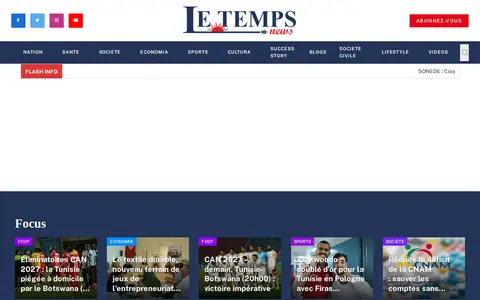
Le Temps publishes newspaper reporting, headlines and current-affairs coverage in Tunisia.

National Yang Ming Chiao Tung University up in Hsinchu, Taiwan is kind of a big deal for Computer Science, Medicine and Engineering.

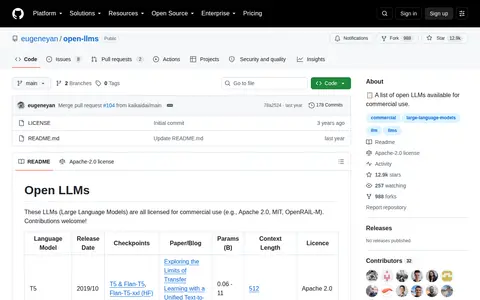
Open LLMs is a public repository that curates a list of open large language models (LLMs) available for commercial use. It also includes related datasets for LLM pre-training, instruction-tuning, and alignment-tuning, and is hosted under the eugeneyan GitHub organization.

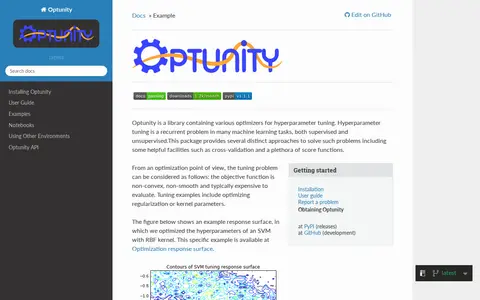
Optunity is a Python library containing various optimizers for hyperparameter tuning. It provides several approaches to solving tuning problems, including cross-validation facilities and score functions. The documentation states it is supported in R, MATLAB, GNU Octave and Java through Jython, and is free software under a BSD-style license.

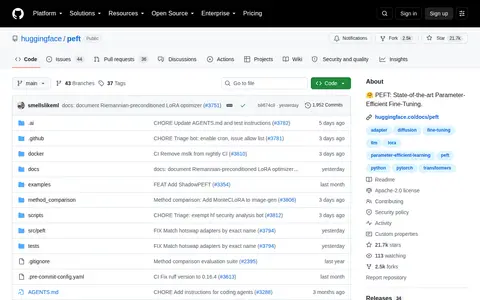
PEFT is a library of parameter-efficient fine-tuning methods from Hugging Face. It adapts large pretrained models by fine-tuning only a small number of extra parameters instead of all model parameters, which decreases computational and storage costs. It is integrated with Transformers, Diffusers and Accelerate.

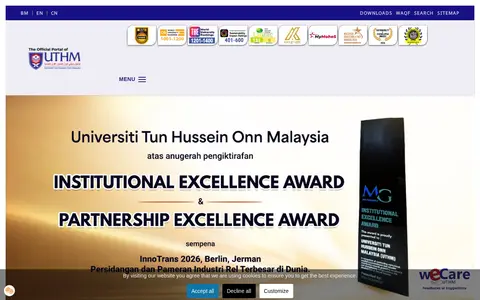
Tun Hussein Onn University of Malaysia over in Batu Pahat, Malaysia is the move for Mathematics, Computer Science and Environmental Science.

Tune is a Python library for experiment execution and hyperparameter tuning at any scale. It supports machine learning frameworks including PyTorch, XGBoost, and TensorFlow and Keras, and runs algorithms such as Population Based Training (PBT) and HyperBand/ASHA. It also integrates with hyperparameter optimization tools including Ax, BayesOpt, BOHB, Nevergrad, and Optuna.
Tunghai University, Taichung, Taiwan, is the move for Pharmacology, Toxicology and Pharmaceutics, Mathematics and Environmental Science.