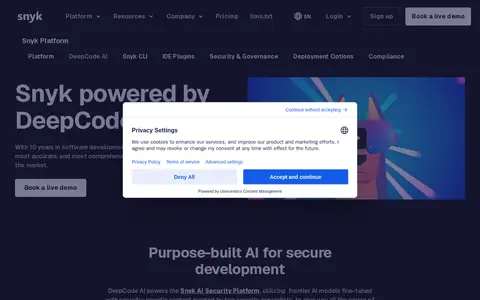
DeepCode AI is an AI-powered code review and application security tool for static application security testing (SAST), part of the Snyk platform. It offers AI code autofix capabilities, hybrid AI scanning for high accuracy, risk-based prioritization of security issues, and simplified creation of security rules for developers.
Directory
Search results
Published directory entries matching your search.
Open-source project that supports software development with code generation, analysis, debugging, or documentation.
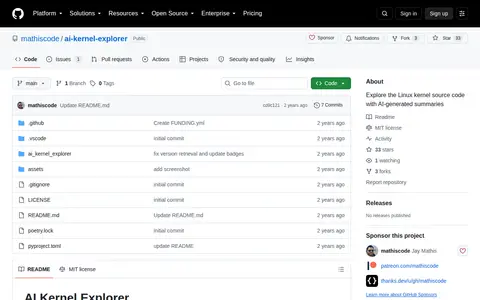
AI Kernel Explorer is a lightweight tool that uses GPT-4o to generate summaries of Linux kernel source code while the codebase is explored. It addresses the difficulty of understanding a codebase of over 30 million lines. It is installed via pip or pipx and requires an OpenAI API key; options include a cache path and a model selection.
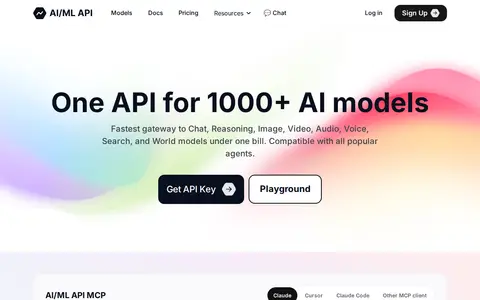
AI/ML API provides access to over 1000 AI models through a single API for text, image, video, audio, code and embeddings, with pricing, latency and capability comparison in one place. It also offers an MCP server for connecting clients such as Claude, Cursor and Claude Code.
Open-source project that supports software development with code generation, analysis, debugging, or documentation.
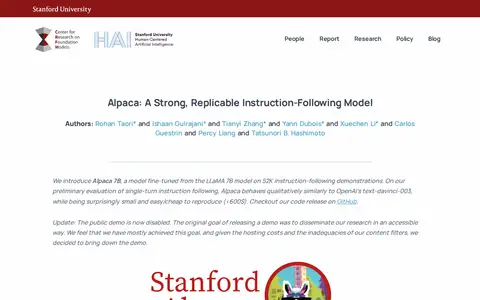
Alpaca 7B is a model fine-tuned from the LLaMA 7B model on 52K instruction-following demonstrations. In a preliminary evaluation of single-turn instruction following, it behaved qualitatively similarly to OpenAI's text-davinci-003 while being small and cheap to reproduce.
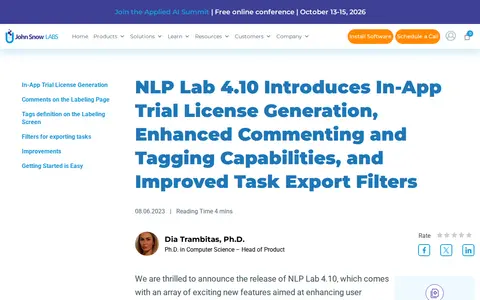
Annotation Lab, referenced in its 4.10 release notes as NLP Lab 4.10, is a platform from John Snow Labs for annotation tasks. The 4.10 release added features including in-app trial license generation, enhanced commenting and tagging for labeling pages, improved task export filters, a video template for project content types, and fixes for visual NER task export JSON formatting.
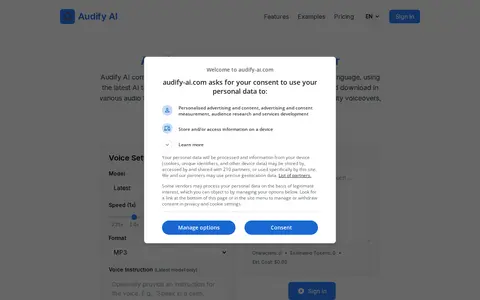
Audify AI is a text-to-speech converter that turns written text into speech using AI models from OpenAI. Users can select voices, adjust speaking speed, and download audio in formats such as MP3, WAV, FLAC and OPUS. The site lists voiceovers, podcasts, audiobooks, accessibility and education among use cases.
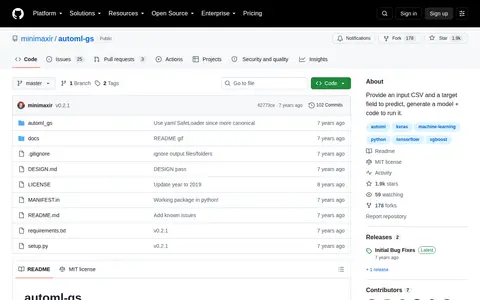
automl-gs is a Python 3 AutoML module that takes an input CSV and a target field and generates a trained machine learning or deep learning model plus native Python code pipelines. It provides a zero code/model definition interface and performs random hyperparameter searches, reporting metrics for each trial in a CSV.
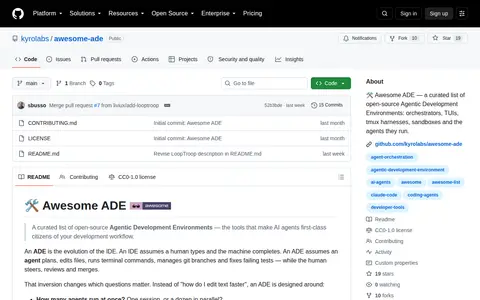
Awesome ADE is a curated GitHub list of open-source Agentic Development Environments, covering orchestrators, TUIs, tmux harnesses, sandboxes and the agents they run. It is maintained by KyroLabs and organized by packaging and stack layer.
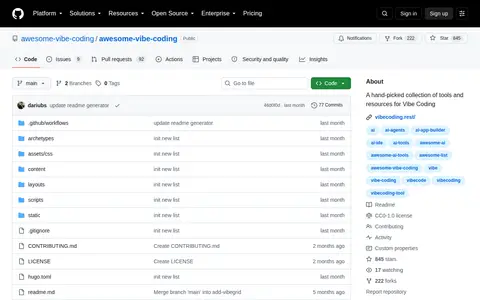
A hand-picked collection of tools and resources for Vibe Coding.
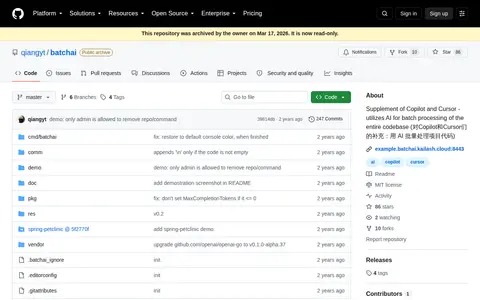
A supplement to Copilot and Cursor - utilizes AI for batch processing of project codes.
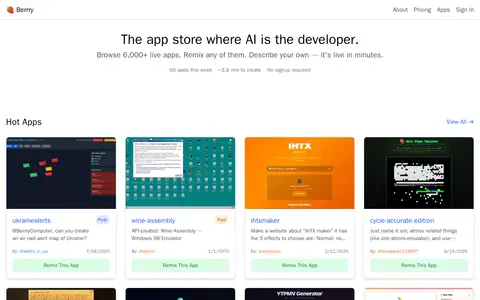
Berrry is a platform that enables users to create tiny, self-contained web applications using artificial intelligence. It operates as an app store where AI acts as the developer. Users can post requests to the r/BerrryComputer subreddit to initiate builds, and the service includes advanced editing, version control, and professional export features. It hosts over 6,000 live apps available for remix, and users can describe their own app idea to generate a working version in approximately 3.9 minutes on average, with no signup required.
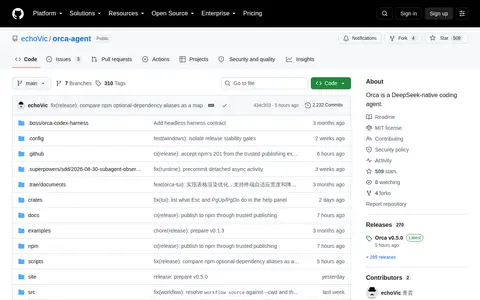
A DeepSeek-native terminal coding agent in Rust with OS-level sandboxing, persistent goal mode, background tasks, and verification gates.
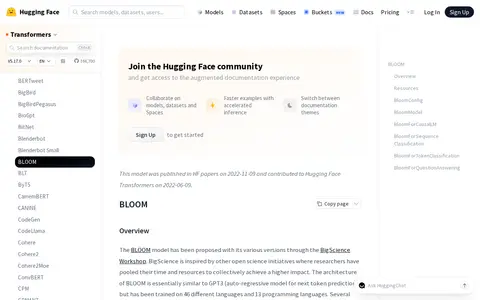
Bloom is a large language model documented within the Hugging Face Transformers library. The official documentation provides implementation resources, configuration classes, model classes, and guidance for integrating BLOOM into artificial intelligence and machine learning workflows, as part of Hugging Face's open-source and open science initiative to advance and democratize AI.
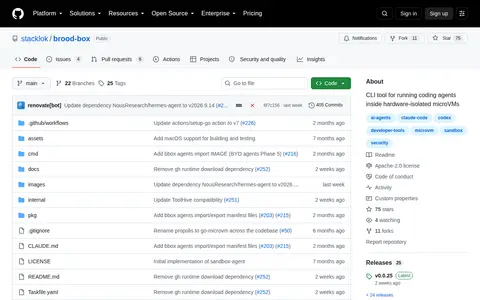
Brood Box is a command-line tool for running coding agents inside hardware-isolated microVMs. It boots a microVM via libkrun and KVM, mounts a copy-on-write snapshot of the workspace, and allows review of each file change before it is accepted. The project is described as experimental, with APIs and behavior subject to change between releases.
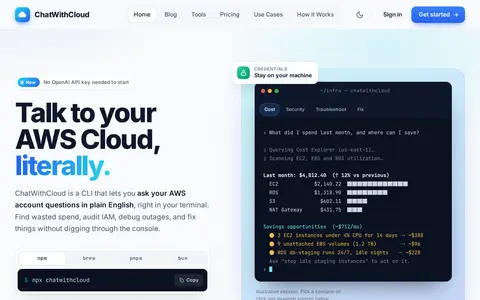
ChatWithCloud is an AWS natural language CLI that lets users ask questions about their AWS account in plain English from the terminal. It turns questions into AWS API calls against the account, covering cost analysis, IAM audits and troubleshooting, and it can make infrastructure changes. The first 15 runs are free.
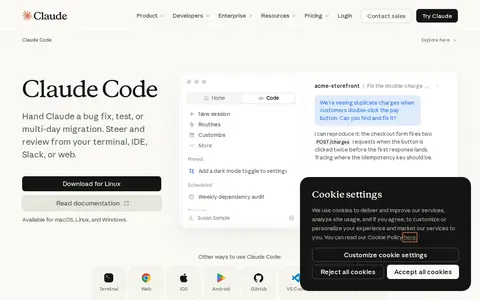
Claude Code is Anthropic's agentic coding tool for developers. It understands a codebase, edits files and runs commands. It is available as a terminal, IDE, Slack or web tool for macOS, Linux and Windows. Projects group related coding sessions so multiple Claude agents can run at once, and auto mode runs by default on Pro, Max and Team plans.


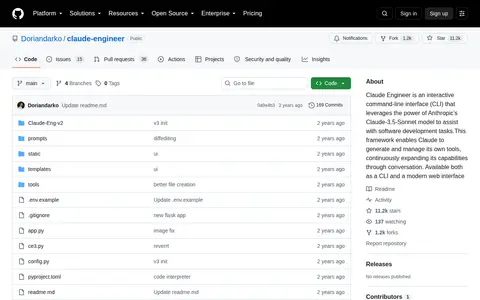
Claude Engineer is an interactive command-line interface that uses Anthropic's Claude-3.5-Sonnet model to assist with software development tasks. The framework lets Claude generate and manage its own tools, expanding its capabilities through conversation. It is available both as a CLI and a modern web interface.
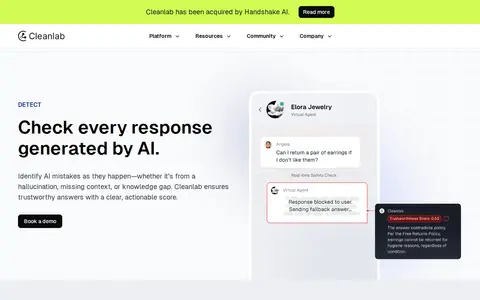
Cleanlab supports software development with code generation, analysis, debugging, or documentation.
A Hugging Face Space by livecodebench that presents a collection of coding questions and shows how different AI models perform on each. Selecting a problem displays each model's generated code, its pass/fail rate and a color-coded correctness score.
Code generation with 🤗 is a Hugging Face Space developed by codeparrot. It allows users to generate code snippets by providing a prompt, with options to select from multiple code generation models and adjust settings such as temperature and token length.
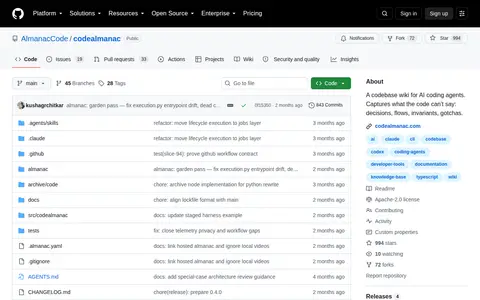
CodeAlmanac is a GitHub repository maintained by AlmanacCode. It is a codebase wiki for AI coding agents, designed to capture information including decisions, flows, invariants, and gotchas that are not explicitly stated in code.
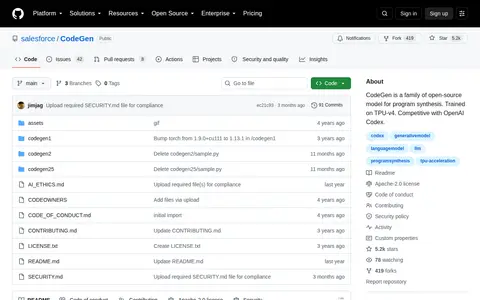
CodeGen is an open-source model for program synthesis. Trained on TPU-v4. Competitive with OpenAI Codex.